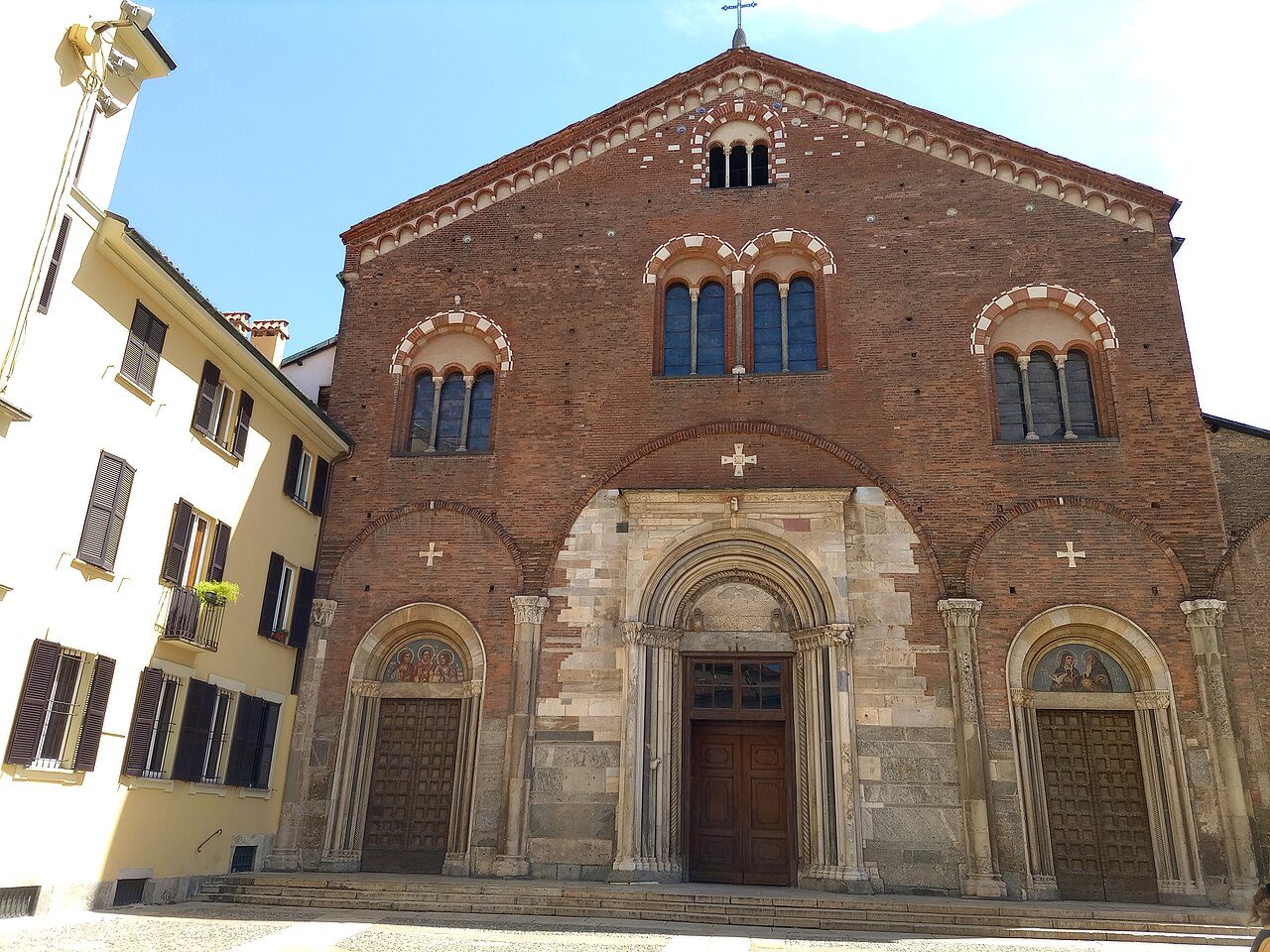
Church · Brera · IV–XII secolo
Basilica di San Simpliciano
Roman walls as tall as a palace, mistaken for a medieval church for centuries
In brief
One of the basilicas founded in Milan in the days of Saint Ambrose, at the end of the 4th century. Its original walls still stand almost to the roof. Inside you'll find Bergognone's great fresco and the legend of the three doves of Legnano.
Stories of this place
- Record · The 4th-century wallsReadSixteen centuries undercoverFor generations San Simpliciano passed for a Romanesque church. The medieval vaults and bell tower, then the heavy restorations of the 1800s, had hidden its true age. In the mid-1900s the scholar Edoardo Arslan studied the walls and realized they were those of the late 4th-century basilica, still standing about 22 meters high. Excavations then found the ancient floor almost two meters below the present one, and the foundations of the first facade beneath today's. For archaeologists it is an exceptional case of preservation.
- Anecdote · The bell tower cut shortReadTwenty-five meters shorterThe bell tower of San Simpliciano, built in the 12th century, used to be much taller than it is today. In the mid-1500s Ferrante Gonzaga, governor of Milan under Spanish rule, ordered it lowered by about 25 meters. The reason was military: from the top you could look inside the nearby Castello Sforzesco, the city's castle. Other bell towers in the area met the same fate. The result is the squat tower you see, with a Renaissance belfry on top of a medieval shaft.
- Anecdote · The bell tower cut shortReadLightning on the bell tower, then witchesIn 1517 the monks of San Simpliciano move the altar of the basilica and rediscover the relics of Simpliciano, the 4th-century bishop it is named after, of the three martyrs buried here and of other saintly bishops. According to the 19th-century writer Ignazio Cantù, while a large crowd is gathered a lightning bolt strikes the bell tower. The people read it as the anger of the saints. The crowd storms the monastery, and riots and arrests follow. Then, again according to Cantù, talk of witchcraft begins, and some women are burned at the stake in Ornago and Lampugnano. The relics, meanwhile, are sealed in lead caskets.
- In culture · The naveReadA German organ for BachAbove the entrance of the basilica of San Simpliciano is an instrument that has become a benchmark in Milan. It is the organ built in the early 1990s by the German Jürgen Ahrend, modeled on the Baroque organs of his country, on the initiative of a committee of enthusiasts backed by the city government. It is designed for the music of Johann Sebastian Bach. The concert series Bach in Basilica, directed by the organist Lorenzo Ghielmi and by Gianluca Capuano, reached its third edition in 2025. The basilica has also hosted concerts of the MITO SettembreMusica festival.
- Legend · The Carroccio windowsReadThe three doves of LegnanoOn May 29, 1176, the Lombard city-states face Emperor Frederick Barbarossa at Legnano. That day is also the feast of the three martyrs buried at San Simpliciano. According to legend, a priest named Leone sees three doves leave their tombs and fly away. They reach the battlefield and land on the Carroccio, the wagon carrying the banners of Milan. The Lombards win. The story comes from Galvano Fiamma, a chronicler of the 1300s, writing a century and a half later. Historians consider it an implausible tale, but Milan believed it for centuries.
- Anecdote · The Carroccio windowsReadThe parish priest inside the windowOn the entrance wall of San Simpliciano, the Carroccio windows recall the battle of Legnano of 1176, won by the Lombard city-states against Emperor Frederick Barbarossa. The painter Aldo Carpi designed them in the late 1920s and filled them with real people. Among the civilians listening to Alberto da Giussano, the battle's legendary commander, are the glassmaker Angelo Tevarotto, who made the work, and Carpi himself. Among the soldiers are one of the painter's sons and an architect he knew. In another window, the priest praying among women and children is said to have the face of Adolfo Rivolta, parish priest of the basilica in those years.
- In culture · The Carroccio windowsReadLegnano, from Verdi to the national anthemAt San Simpliciano the windows above the entrance recall the battle of Legnano of 1176, when the Lombard city-states defeated Emperor Frederick Barbarossa: according to legend, three doves flew there from this basilica. That battle became a myth of united Italy. Giuseppe Verdi wrote the opera La battaglia di Legnano, of 1849. The poet Giosuè Carducci celebrated it in the Canzone di Legnano. Legnano and Rome are the only two cities named in the national anthem. Today May 29, the day of the battle, is the day of the Lombardy Region. In 2026, for the 850th anniversary, the Vigil of the Cross of Legnano's Palio was brought right here.
- Anecdote · Under the dome: choir lofts and altarReadSaint Peter Martyr's first stopOn April 6, 1252, Pietro da Verona, a Dominican friar and inquisitor, is killed in a wood while traveling from Como to Milan. His body is brought to San Simpliciano and laid in a coffin. Less than a year later the pope proclaims him a saint. His tomb is in the Basilica di Sant'Eustorgio, inside a great marble monument of the 1300s. But one link with San Simpliciano remains. The marble chest in which the body was placed at Sant'Eustorgio after the canonization was a gift from the abbot of this monastery.
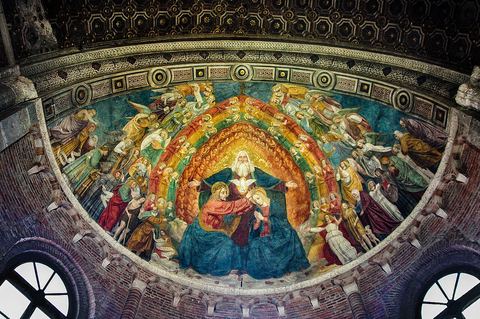
- Anecdote · Bergognone's Coronation of the VirginReadThe altar that hid the masterpieceBetween 1838 and 1841 the architect Giulio Aluisetti modernized the basilica of San Simpliciano. Among other things he built a new, bigger high altar. It blocked the view of the Coronation of the Virgin, the great fresco painted in the apse in the early 1500s by the Lombard painter Bergognone: the most important work in the church. The fresco was also suffering from damp. Only at the end of the 1800s was the apse roof rebuilt to protect it, and in 1892 the painting was cleaned in full. The restorations of the 1900s then removed Aluisetti's decorations from walls and vaults.
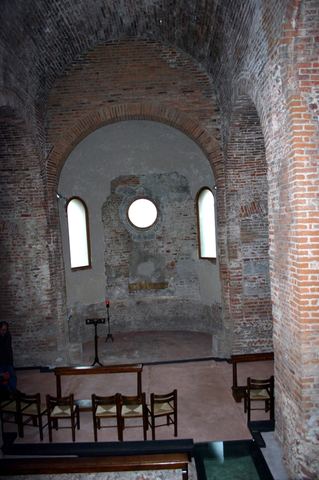
- Anecdote · The sacello of the martyrsReadThe amphorae in the vaultIn the vault of the sacello of the martyrs, a small chapel beside the apse of San Simpliciano, archaeologists found a surprise: whole amphorae, embedded in the mortar. The builders had put them there to support the structure of the roof. It is not an isolated case. The same technique has been identified in Milan in two other ancient chapels, Sant'Ippolito and Sant'Aquilino, both in the Basilica di San Lorenzo Maggiore. The sacello, dated to the 5th century on the basis of its masonry, is only slightly younger than the basilica.
Ready-made questions
Because Simpliciano, bishop of Milan after Ambrose, is buried here. He was an elderly, respected priest: he had completed Ambrose's religious education and encouraged Saint Augustine, who dedicated some writings to him. He was chosen as successor in 397, when he was nearly eighty, and died a few years later. Originally the church was called the basilica virginum, the basilica of the virgins. The new name took hold over time, along with the veneration of the bishop buried here.
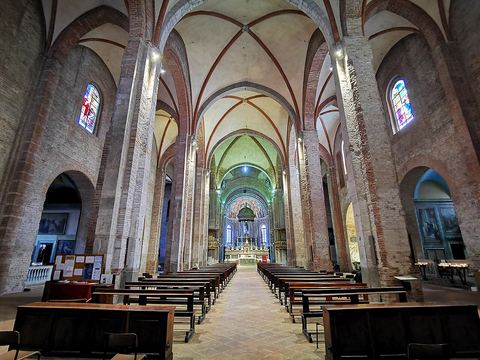
Yes, in the part that matters most: the walls. The late 4th-century masonry still stands about 22 meters high, almost to the roof, and the cross-shaped plan is the original one. The newer parts are the , rebuilt between the 11th and 12th centuries, the vaults and pillars, the bell tower and the facade, restored in 1870. In practice the Middle Ages furnished a Roman building without knocking it down.
Go to stop: The 4th-century wallsThree clerics who came from Cappadocia: Sisinnio, a deacon, Martirio, a lector, and Alessandro, a doorkeeper, the keeper of the church. Ambrose sent them to Anaunia, today's Val di Non in Trentino, at the request of Vigilius, bishop of Trento. On May 29, 397, they were killed during a pagan festival. Vigilius sent part of the relics to Simpliciano, who laid them in this basilica. At the site of the martyrdom, in Sanzeno, a basilica dedicated to them stands today.
Go to stop: The sacello of the martyrsBecause of the legend of the three doves that in 1176 supposedly flew from here to the , the war wagon of the Milanese, during the battle of Legnano. The legend is late, but the link is old and documented. In 1393 a decree of the Milanese authorities prescribed a solemn procession to San Simpliciano on the anniversary, and May 29 became a holiday throughout the surrounding countryside. It is the oldest documented commemoration of the battle.
Go to stop: The Carroccio windowsNot according to historians: he is a legendary figure. The commander who rallies the soldiers in the windows comes from the chronicles of Galvano Fiamma, written in the 1300s, about a century and a half after the battle. Fiamma says he led the Company of Death, nine hundred knights who had sworn to fight to their last breath. He would be a hero invented as a counterpart to Barbarossa. One tradition even makes him a parishioner of San Simpliciano.
Go to stop: The Carroccio windowsAmbrogio da Fossano, known as Bergognone, was a Lombard painter documented between 1481 and 1522. He trained on the painting of Vincenzo Foppa and worked for years at the Certosa di Pavia, the charterhouse near Pavia. He painted quiet, devout figures, and Leonardo's innovations touched him only on the surface. The Coronation at San Simpliciano is considered his finest fresco. Other works of his can be seen in Milan at the Pinacoteca di Brera, the city's main picture gallery, and in the Basilica di Sant'Ambrogio.
Go to stop: Bergognone's Coronation of the VirginBecause the restorations of the 1900s chose to take away rather than add. In the 1800s the architect Giulio Aluisetti had covered walls and vaults with decoration and removed old capitals and plaster: work that, according to scholars, falsified the church. After World War II those additions were eliminated, to bring the brick and the oldest forms back into view. The result is an austere interior, where space and light are what count. And where the fresco in the stands out even more.
Go to stop: The naveThe stops
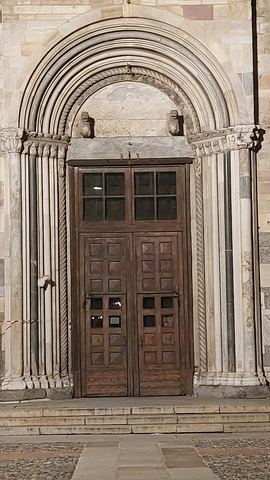
1 The piazza and the facade
The facade looks medieval through and through, but much of what you see is an 1870 rebuild. The old part is the central portal, from the 12th century. And the church's real secret can't be seen from here.
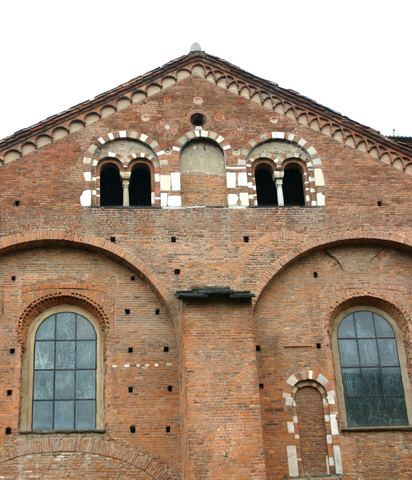
2 The 4th-century walls
These walls are not medieval: they date from the end of the 4th century and stand about 22 meters high. This is one of the best-preserved buildings of ancient Milan, and for centuries nobody noticed.
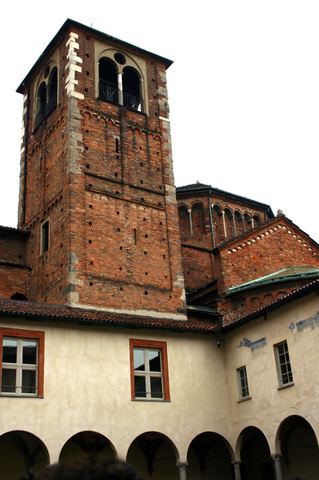
3 The bell tower cut short
The bell tower is from the 12th century, but it is no longer what it was: in the mid-1500s a governor had about 25 meters taken off it. From up there you could see too well into the Castello.
4 The nave
A nave and two aisles of equal height, round brick pillars, little decoration. The space is still that of the 4th-century hall: the supports and the vaults were added in the Middle Ages.
5 The Carroccio windows
The windows on the entrance wall tell the basilica's most famous legend: the three doves that flew from here to Legnano in 1176. They date from the 1920s, and they hide a few portraits.
6 Under the dome: choir lofts and altar
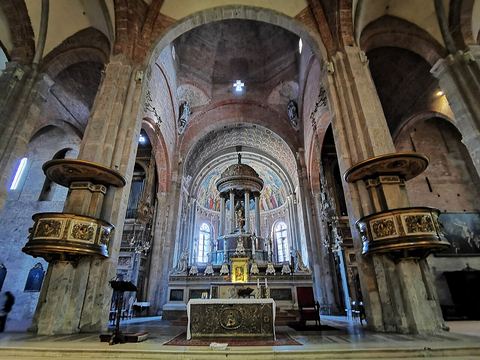
Here the church widens into the transept and rises into the dome. On either side are two choir lofts frescoed by Aurelio Luini. Beneath the altar lie Simpliciano and the three martyrs of Anaunia.
7 Bergognone's Coronation of the Virgin
The basilica's masterpiece: the Coronation of the Virgin, painted by Bergognone in the early 1500s. It fills the entire half-dome of the apse, with Christ, Mary and God the Father inside a ring of angels.
8 The sacello of the martyrs
A miniature church beside the apse, built between the late 4th and the 5th century. Tradition ties it to the three martyrs of Anaunia: the missionaries behind the legend of the doves of Legnano.
Timeline
- Late 4th centuryThe basilica virginum is built on the road to Como. Tradition credits it to Bishop Ambrose.
- 397Simpliciano succeeds Ambrose and lays in the basilica the relics of the three martyrs killed in Val di Non.
- 11th–13th centuryThe church takes on its Romanesque look: vaults, tiburio, a new apse, the bell tower and the facade.
- 1176Battle of Legnano. According to legend, three doves fly from the basilica to the Carroccio of the Milanese.
- Around 1508Bergognone frescoes the half-dome of the apse with the Coronation of the Virgin.
- Mid-1500sGovernor Ferrante Gonzaga has the bell tower lowered by about 25 meters.
- 1870Carlo Maciachini rebuilds the facade in Romanesque style, keeping the 12th-century portal.
- 1957Excavations led by Edoardo Arslan find the ancient floor, almost two meters below the present one.
Who's who
Simpliciano
bishop of Milan from 397
An elderly priest and Ambrose's teacher, he succeeded him at nearly eighty. He laid the relics of the martyrs of Anaunia here and was buried here: the basilica bears his name.
Sisinnio, Martirio and Alessandro
missionaries, martyrs of Anaunia
Three clerics from Cappadocia, sent by Ambrose to Val di Non and killed on May 29, 397. Their relics rest in the basilica.
Ambrogio da Fossano, known as Bergognone
Lombard painter
Documented between 1481 and 1522, he worked for years at the Certosa di Pavia. The Coronation of the Virgin in the apse is considered his finest fresco.
Galvano Fiamma
friar and chronicler of the 1300s
He wrote about 150 years after Legnano. From him come the legend of the three doves and the figure of Alberto da Giussano, whom historians consider legendary.
Ferrante Gonzaga
governor of Milan in the mid-1500s
He had the bell tower lowered by about 25 meters, like others near the Castello Sforzesco, so that nobody could look into the fortress from above.
Aldo Carpi
painter
Born in 1886, died in 1973. In the late 1920s he designed the windows with the stories of the Carroccio. He portrayed himself in them, the glassmaker and, it seems, the parish priest.
Words to know
Where it is
The neighborhood
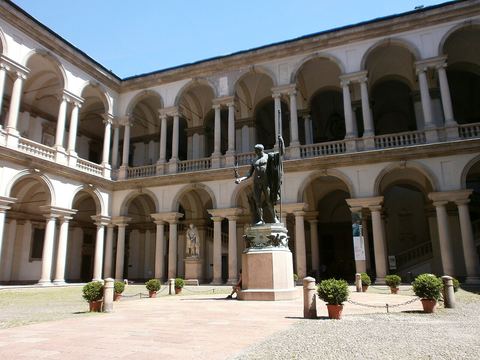
Brera
Related places
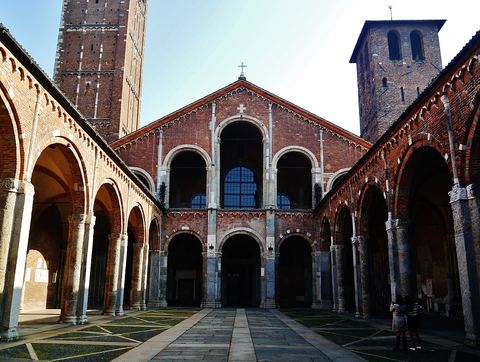
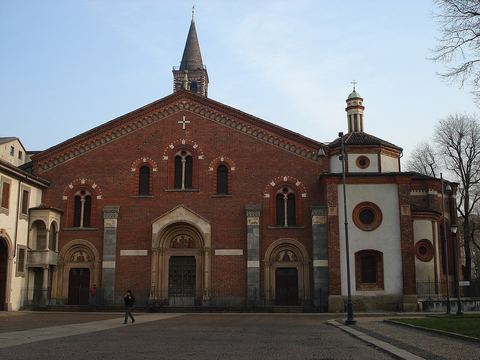
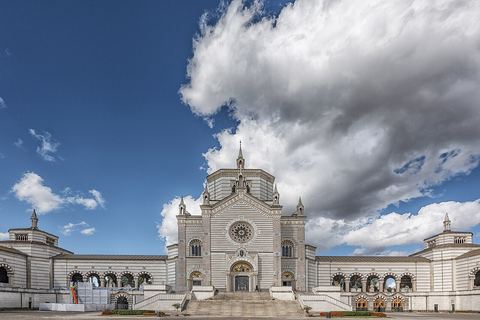
The story of the place
From outside it looks like one of the many brick churches of medieval Lombardy. It isn't. Beneath that Romanesque look is a building from the end of the 4th century, when Milan was the capital of the Western Roman Empire. Its walls still stand about 22 meters high, roughly 72 feet.
The basilica of the virgins
Tradition counts it among the basilicas that Ambrose, bishop of Milan, wanted on the main roads leading out of the city. This one stood on the road to Como and was called the basilica virginum, the basilica of the virgins. Ambrose's writings never mention it, though, and several scholars think it was built, or at least finished, by his successor.
That successor was Simpliciano, an old priest who had been Ambrose's teacher. He became bishop in 397, at nearly eighty. He had the relics of three missionaries killed that year in Val di Non, an Alpine valley, laid to rest here: the martyrs of Anaunia. He was buried here too, and in time the church took his name.
A thousand years of alterations
Then everyone had a go. The Lombards divided the great hall into a nave and two aisles. In the 9th century the Benedictine monks arrived, and they stayed until 1798. Between the 11th and 13th centuries the church gained vaults, a bell tower and a facade, and took on the Romanesque look you see.
In the middle of all this comes May 29, 1176. That day the Lombard city-states defeated Emperor Frederick Barbarossa at Legnano. According to legend, three doves set out from here and landed on the , the war wagon of the Milanese. Ever since, this has been the church of the Carroccio.
In the early 1500s Bergognone, a Lombard painter, frescoed the with a great Coronation of the Virgin. It is the most important work of art in the basilica.
The 20th-century discovery
The 1800s did damage, with decorations and rebuilding that muddled everyone's ideas. For generations people believed the church had been born in the Middle Ages. Only the studies and excavations of the mid-1900s recognized the ancient basilica in its walls.
The Basilica di Sant'Ambrogio, the church of Milan's patron saint, has more treasures. But if you want to grasp how big a church of imperial Milan was, you have to come here. The visit starts outside, walking around the walls. It ends in front of the fresco and in the small chapel of the martyrs.
Sources
- Basilica paleocristiana di San Simpliciano, Catalogo generale dei beni culturali (opens in a new tab)Catalog
- Vetrata «Il popolo che ringrazia Dio mentre appaiono i tre Santi», Catalogo generale dei beni culturali (opens in a new tab)Catalog
- Vetrata «Alberto da Giussano che chiama il popolo a raccolta», Catalogo generale dei beni culturali (opens in a new tab)Catalog
- Cantorie affrescate della basilica di San Simpliciano, Catalogo generale dei beni culturali (opens in a new tab)Catalog
- Ambrogio da Fossano detto il Bergognone, Dizionario Biografico degli Italiani Treccani (opens in a new tab)Encyclopedia
- Simpliciano, santo, Enciclopedia Italiana Treccani (opens in a new tab)Encyclopedia
- Pietro da Verona, santo, Dizionario Biografico degli Italiani Treccani (opens in a new tab)Encyclopedia
- Basilica di San Simpliciano, in-Lombardia, portale turistico della Regione Lombardia (opens in a new tab)Institution
- Basilica di San Simpliciano, MITO SettembreMusica (opens in a new tab)Institution
- Bach in Basilica, terza edizione: appuntamenti con l'organo Ahrend di San Simpliciano, Arcidiocesi di Milano (opens in a new tab)Institution
- San Simpliciano ospita la Veglia della Croce, Il Giornale (opens in a new tab)Other source
- La Basilica che segnò il passaggio alla Milano cristiana, La Nuova Bussola Quotidiana (opens in a new tab)Other source
- The Paleo-Christian Basilica of St Simplician in Milan, New Liturgical Movement (opens in a new tab)Other source
- Basilica di San Simpliciano, MilanoFree (opens in a new tab)Other source
- Milan: San Simpliciano, Corvinus (opens in a new tab)Other source
- Basilica di San Simpliciano, Wikipedia in italiano (opens in a new tab)Wikipedia
- Basilica of San Simpliciano, Wikipedia in inglese (opens in a new tab)Wikipedia
- Simpliciano, vescovo di Milano, Wikipedia in italiano (opens in a new tab)Wikipedia
- Martiri anauniesi, Wikipedia in italiano (opens in a new tab)Wikipedia
- Battaglia di Legnano, Wikipedia in italiano (opens in a new tab)Wikipedia