Church · Ticinese and Navigli · IV–XV secolo
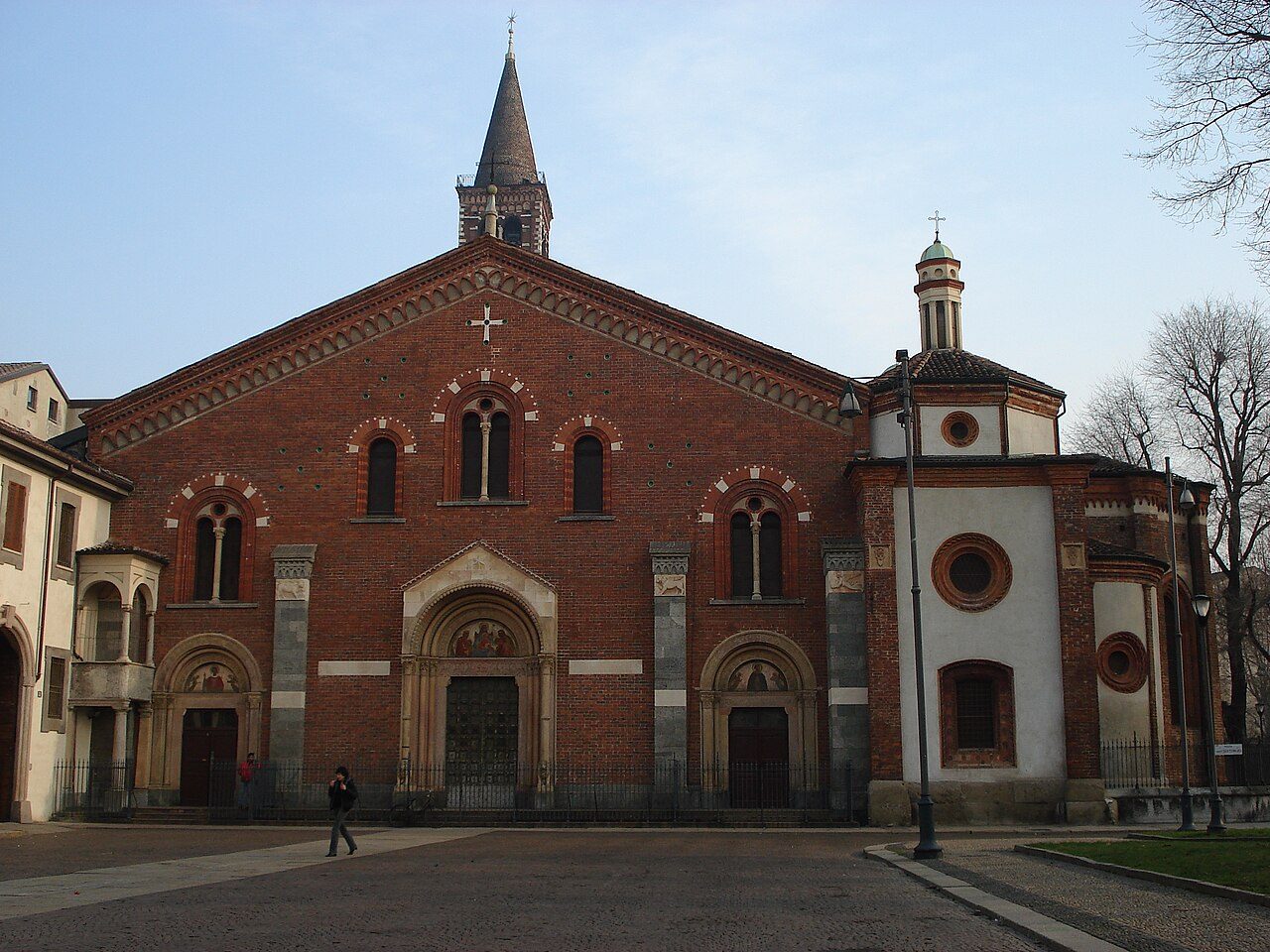
Basilica di Sant'Eustorgio
The church of the Three Kings, with a Florentine jewel hidden at the back
In brief
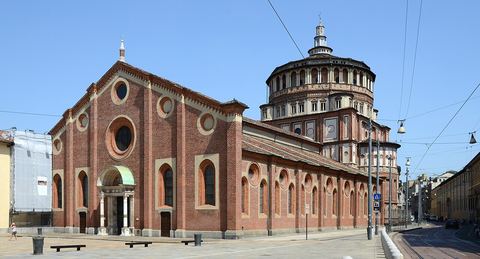
One of Milan's oldest basilicas, founded, tradition says, to hold the bodies of the Magi, the Three Kings. From outside it looks like any other brick church. At the back it hides the Cappella Portinari, the most Florentine piece of Renaissance in the city.
Stories of this place
- Legend · The square and the facadeReadThe Magi's cart that would not moveAccording to tradition, the basilica of Sant'Eustorgio stands where a cart came to a halt. In the 4th century Eustorgio, bishop of Milan, received the bodies of the three Magi, then in Constantinople, as a gift from the emperor. He loaded them, inside a stone sarcophagus, onto a cart pulled by oxen and set off for Milan. At the gates of the city the cart stopped. Some say the oxen collapsed from exhaustion, others that the load became too heavy. Eustorgio saw in it the will of the Magi and built the church on that spot, outside the walls. The story appears in writing only in the 12th century.
- Legend · The square and the facadeReadThe apostle's spring under a courtyardBeside the basilica of Sant'Eustorgio, under the courtyard of a house on the square, is a stone basin about two meters wide: the Fonte di San Barnaba, Saint Barnabas's font. A medieval legend says Milan's first Christians were baptized in it. Galvano Fiamma, a 14th-century chronicler and friar of Sant'Eustorgio, writes that the apostle Barnabas settled here, outside the walls, to avoid living in a pagan city, and celebrated the first Mass. No document confirms it: the spring is first mentioned in the late 10th century. Later it became a washhouse. In the 1600s Federico Borromeo, archbishop of Milan, built a church over it, later demolished. The basin remains.
- Record · The bell tower and the starReadMilan's first clockThe bell tower of the basilica of Sant'Eustorgio, finished in 1309, got a mechanical clock straight away: so says the chronicler Galvano Fiamma, a friar of the convent. It is remembered as the first in Milan, and some consider it the first public clock in Italy. It was not alone for long. In 1336 another clock, able to strike the hours, was placed on the tower of the church of San Gottardo in Corte. The street beside it took the name Via delle Ore, the street of the hours.
- In culture · The chapel of the MagiReadIn Cologne, a cathedral for the MagiThe basilica of Sant'Eustorgio keeps an empty Roman sarcophagus: tradition says it held the bodies of the three Magi. In 1164 Rainald of Dassel, archbishop of Cologne, carried them off, and those relics changed the face of another city. They arrived in Cologne on July 23. To hold them, the goldsmith Nicholas of Verdun built a reliquary of gold, silver and precious stones shaped like a small church, more than two meters long. It was in all likelihood the Magi that pushed Cologne, in 1248, to begin its great Gothic cathedral. The bones are still there, apart from a few fragments returned to Milan in the early 20th century.
- Legend · The chapel of the MagiReadThe Magi's Epiphany processionEvery January 6 the three Magi return to the basilica of Sant'Eustorgio, which according to tradition held their bodies until 1164. A procession of costumed players sets out from Piazza del Duomo, crosses the center and stops at the basilica of San Lorenzo, where Herod waits with his escort. Then it reaches the forecourt of Sant'Eustorgio, to offer gold, frankincense and myrrh. The tradition is traced back to 1336. It was suspended at the time of the plague by Carlo Borromeo, archbishop of Milan, and revived in the 20th century by Archbishop Giovanni Battista Montini, the future Pope Paul VI.
- In culture · The chapel of the MagiReadThe Magi in Umberto Eco's novelThe basilica of Sant'Eustorgio keeps the sarcophagus that tradition says held the bodies of the three Magi, taken to Cologne in 1164. The writer Umberto Eco made it an episode of Baudolino, his 2000 novel. The hero is a country boy adopted by the emperor Frederick Barbarossa, and a gifted liar. In the novel, in a Milan defeated by the emperor, the bodies of the Magi are “found” in Sant'Eustorgio, and it is Baudolino who sends them to Cologne. So begins his career as a maker of fake relics. It is fiction. But one fact is true: before the 12th century no known text speaks of Magi buried in Milan.
- Anecdote · The Cappella PortinariReadThe frescoes hidden for two centuriesIn the Cappella Portinari, the chapel at the far end of the basilica of Sant'Eustorgio, Vincenzo Foppa, a 15th-century Lombard painter, frescoed the stories of Saint Peter Martyr. After the plague of 1630 his frescoes disappeared under several layers of plaster, and new painting went on top. For more than two centuries nobody saw them. In 1868 a piece of the Miracle of the Cloud resurfaced, and a few years later the plaster was removed: in a hurry, unfortunately, damaging part of the color. It took the 20th-century restorations, up to the chapel's reopening in 2000, to get close again to what Foppa had painted.
- Anecdote · The arca of Saint Peter MartyrReadThe saint's killer who was beatifiedIn the Cappella Portinari, the chapel at the far end of the basilica of Sant'Eustorgio, lies Saint Peter Martyr, the Dominican friar and inquisitor killed in an ambush in 1252. His killer was called Carino da Balsamo. He was a hired killer: a nobleman, Stefano Confalonieri of Agliate, was named as the man behind the plot. Carino was caught by a peasant, but his story did not end there. He joined the Dominican order, the same as his victim, and lived as a friar in Forlì. In the end the Church declared him blessed. The saint and his killer, in the end, are on the same side.
- Legend · The arca of Saint Peter MartyrReadBanging your head at Sant'EustorgioIn the Cappella Portinari, the chapel at the far end of the basilica of Sant'Eustorgio, is the tomb of Saint Peter Martyr, the Dominican friar killed in 1252 by a blow to the head. His skull is kept apart. In the 14th century Giovanni Visconti, archbishop of Milan, took it to his palace chapel. Fierce migraines, the story goes, seized him and ended only when he returned the relic. Since then, perhaps, the saint has been invoked against headaches. The Milanese said andà a pestà el cô in Sant'Ustorg: go bang your head at Sant'Eustorgio. The custom lives on: in late April the faithful touch his tomb with their heads.
- Record · The arca of Saint Peter MartyrReadSaint Peter Martyr, a saint in eleven monthsIn the Cappella Portinari, the chapel at the far end of the basilica of Sant'Eustorgio, lies Saint Peter Martyr, a Dominican friar and inquisitor, a judge charged by the Church with fighting heretics. He was killed in an ambush on April 6, 1252. In March 1253 Pope Innocent IV proclaimed him a saint: less than a year had passed, about eleven months. The haste had its reasons. Lombardy was full of heretics, the Church needed a martyr to set against them, and the Dominicans very likely pressed the pope. The result is a record: for those who have studied his cult, no pope has ever proclaimed a saint so fast.
Ready-made questions
Nobody can prove it. That their bodies came to Milan with the bishop Eustorgio is a tradition put in writing only in the 12th century, and there are no older sources. What is history is the effect. The Milanese believed it, so did the Germans, and in 1164 those bones were carried off to Cologne as the most precious of spoils. There they stayed, and there they are venerated to this day.
Go to stop: The chapel of the MagiA few fragments. For centuries Milan asked for its Magi back and got nothing. In 1903 Cardinal Andrea Ferrari, the city's archbishop, obtained a small share of the bones from the archbishop of Cologne, including a tibia and a vertebra. They returned to the basilica the following year. They are not in the great sarcophagus, which is empty, but in a 20th-century reliquary, in the niche above the altar of the chapel of the Magi.
Go to stop: The chapel of the MagiBecause Sant'Eustorgio is the church of the Magi, and the Magi are known by the star that, according to the Gospel, guided them to Bethlehem. The one on the bell tower has eight points and stands in place of the cross, on top of a tower about 75 meters tall. The same star is carved on the lid of the sarcophagus, inside the church. The have been in Cologne since 1164, but the sign has stayed.
Go to stop: The bell tower and the starA Dominican friar, Pietro da Verona, who lived in the first half of the 13th century. He belonged to the convent of Sant'Eustorgio and was famous for his sermons, which he also gave in the open air, in front of the basilica. He was an , charged with fighting heretics, the in particular. In 1252 he was killed in an ambush on the road from Como to Milan, and a year later he was already a saint. In images you spot him at once: he has a blade stuck in his head.
Go to stop: The arca of Saint Peter MartyrNobody knows, and it is a small mystery of Milanese art. Giorgio Vasari, the biographer of artists, attributed it to the Florentine Michelozzo. That idea has been dropped on grounds of style and dates. Scholars then thought of Filarete, and later of Guiniforte Solari, a Lombard architect, perhaps advised by someone close to Florentine culture. It is the theory that best explains what you see: a Tuscan scheme, built and decorated the Lombard way.
Go to stop: The Cappella PortinariA Florentine banker, born in 1421 and raised in the household of Cosimo de' Medici after his father's death. In 1452 he was sent to Milan to open the branch of the Medici Bank, which financed the court of Duke Francesco Sforza. He became the duke's friend and adviser. He died in 1468, the year the chapel was finished. Tradition makes him its patron and has him buried here. It has to be said that documents from the time are lacking, and some scholars today doubt it.
Go to stop: The Cappella PortinariOlder than it looks. Tradition places its founding around 344, in the time of the bishop Eustorgio. The physical evidence points the same way: under the nave is a necropolis with tombs from the 3rd and 4th centuries, and behind the high altar you can see the remains of a first, early Christian church. What you see above ground is much later. The layout is Romanesque, the chapels run from the 13th to the 15th century, the facade dates from 1865.
The stops
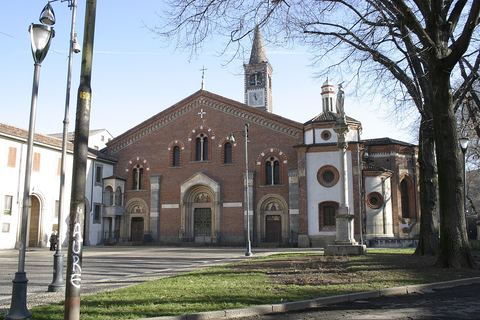
1 The square and the facade
The facade looks medieval but is barely more than a hundred and fifty years old. The real stories are at the edges: an open-air pulpit and, legend says, the spot where the cart of the Magi stopped.
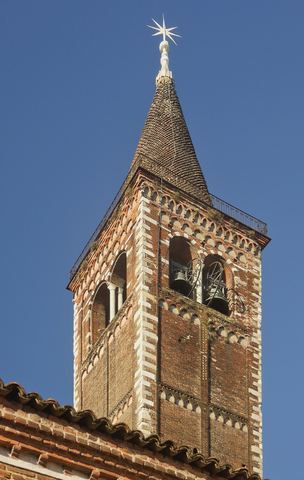
2 The bell tower and the star
A brick tower about seventy-five meters tall, finished in 1309. At the top it carries not a cross but the star of the Magi, and in the 14th century it had a clock people still talk about.
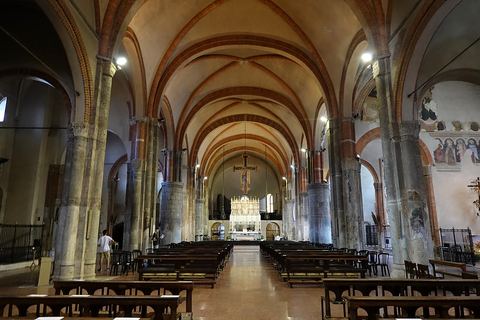
3 The nave and the family chapels
A church seventy meters long, adapted by the Dominicans for preaching to crowds. Along the right side the great Milanese families built their chapels, one next to the other: two centuries of luxury tombs.
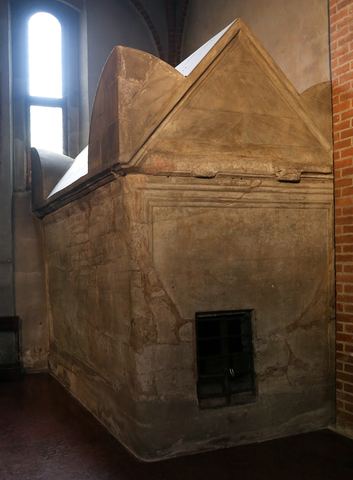
4 The chapel of the Magi
A huge Roman sarcophagus, empty, with a star on its lid. According to tradition it held the bodies of the Magi, the Three Kings, until they left for Cologne in 1164. A few fragments came back in 1904.
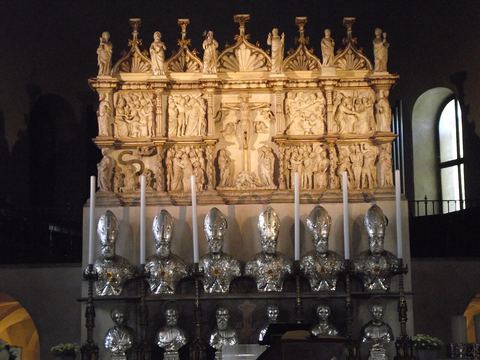
5 The high altar and the ancona of the Passion
The altar is dominated by a great marble relief commissioned by Gian Galeazzo Visconti, duke of Milan. Under the altar table rests the bishop Eustorgio, and behind the altar the remains of the oldest church come to the surface.
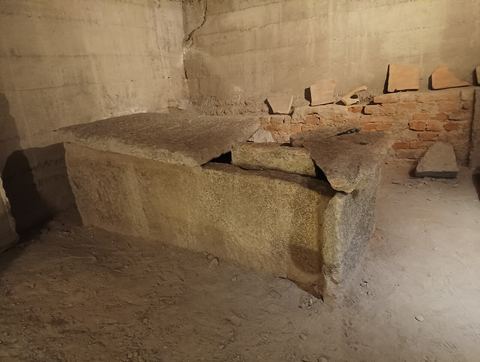
6 The early Christian cemetery
Under the church floor lies the cemetery where it all began: tombs from the 3rd century onward, excavated between 1959 and 1962. The gravestones show that Christians were being buried here as early as the 4th century.
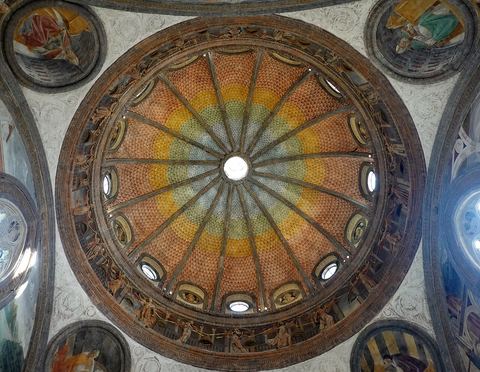
7 The Cappella Portinari
A cube with a dome on top, as in Florence, but decorated the Lombard way: sixteen rainbow-colored segments, a ring of angels and the frescoes of Vincenzo Foppa. If you only have time for one thing, make it this.
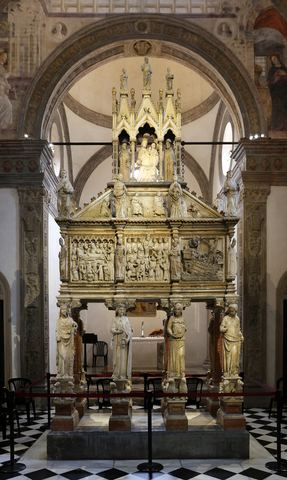
8 The arca of Saint Peter Martyr
The tomb of the inquisitor friar killed in 1252, carved by Giovanni di Balduccio of Pisa and finished in 1339. It is more than a century older than the chapel: it was brought here only in the 18th century.
Timeline
- 4th centuryAccording to tradition the bishop Eustorgio founds the basilica to hold the bodies of the Magi, in a burial area outside the walls.
- 1164Two years after the destruction of Milan the relics of the Magi are taken to Cologne. The sarcophagus stays behind, empty.
- 1220The basilica passes to the Dominican friars, who adapt it into a large church for preaching.
- 1252Pietro da Verona, friar of Sant'Eustorgio and inquisitor, is killed in an ambush. The following year he is proclaimed a saint.
- 1309The bell tower, about 75 meters tall, is finished. According to the chronicler Galvano Fiamma it gets a clock right away.
- 1339Giovanni di Balduccio completes the marble arca for the body of Saint Peter Martyr.
- 1462–1468The Cappella Portinari is built, with frescoes by Vincenzo Foppa.
- 1904A few fragments of the relics of the Magi return from Cologne to Sant'Eustorgio.
Who's who
Eustorgio
bishop of Milan in the 4th century
According to tradition he brought the bodies of the Magi from Constantinople to Milan and founded the basilica to hold them. He is buried under the high altar.
Rainald of Dassel
archbishop of Cologne
Right-hand man of the emperor Frederick Barbarossa. In 1164 he took the relics of the Magi from Milan to Cologne, where they still are.
Pietro da Verona
Dominican friar, inquisitor and saint
Preacher of the convent of Sant'Eustorgio, killed in 1252 and canonized a year later as Saint Peter Martyr. The arca and the Cappella Portinari are for him.
Giovanni di Balduccio
sculptor from Pisa
He came to Milan in the 1330s and worked for the Visconti. In 1339 he signed the arca of Saint Peter Martyr, his most important work in Lombardy.
Pigello Portinari
Florentine banker of the Medici Bank
From 1452 he ran the Medici branch in Milan and was an adviser to Duke Francesco Sforza. Tradition credits him with the chapel that bears his name.
Vincenzo Foppa
Lombard painter of the 15th century
Between 1464 and 1468 he frescoed the Cappella Portinari with the stories of Saint Peter Martyr: it was his first major public commission.
Words to know
Where it is
The neighborhood
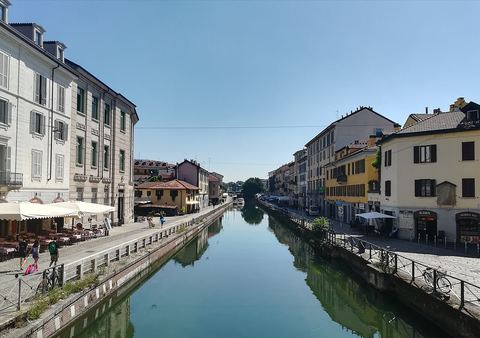
Ticinese and Navigli
Related places
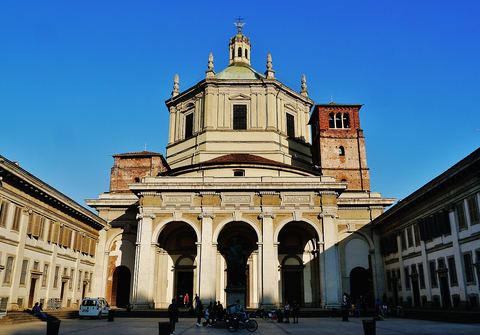
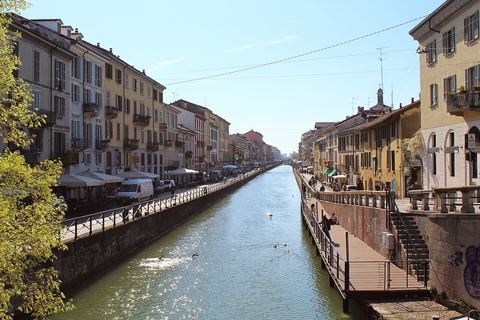
The story of the place
At the top of the bell tower, where you expect a cross, there is an eight-pointed star. It is this church's signature: for the Milanese, Sant'Eustorgio has always been the basilica of the Magi, the Three Kings.
A church born from a cart
According to tradition, in the 4th century the bishop Eustorgio brought the bodies of the three Magi from Constantinople to Milan, sealed in a huge stone sarcophagus. When it got here, outside the city walls, the cart stopped and would not move again. Eustorgio took it as a sign and had the church built on that spot.
What is certain is that the site is very old indeed. Under the nave, excavations uncovered a necropolis already in use between the 3rd and 4th centuries, with Christian gravestones from the 4th century.
In 1164 the Magi left. Frederick Barbarossa, the German emperor, had destroyed Milan two years earlier, and the ended up in Cologne, where they still are. Sant'Eustorgio was left with the empty sarcophagus.
The age of the Dominicans
In 1220 the basilica passed to the Dominican friars, an order founded to preach. They turned it into a great hall for crowds, and the most powerful families in the city, the Visconti first among them, wanted their chapels here. For more than three centuries the convent next door housed the Inquisition of Lombardy.
The most famous Dominican of the house was Pietro da Verona, preacher and , killed in 1252 and made a saint the following year. The most beautiful things you will see grew up around his tomb: first a marble , a monumental tomb carved in the 14th century, then an entire chapel.
The jewel at the back
That chapel is the Cappella Portinari, the Portinari Chapel, built between 1462 and 1468 and tied to the name of Pigello Portinari, the Florentine who ran the Medici bank in Milan. Inside are a dome of colored segments and the frescoes of Vincenzo Foppa.
The facade you see from the square, on the other hand, is the youngest part: a remake in medieval style finished in 1865.
The visit starts outside, between the square and the bell tower. Then it crosses the nave to the sarcophagus of the Magi and the altar, and ends in the basilica's museum, with the ancient cemetery and the chapel. If you only have time for one thing, make it the Cappella Portinari.
Sources
- Museo di Sant'Eustorgio, sito ufficiale: il museo (opens in a new tab)Official site
- Museo di Sant'Eustorgio: Cappella Portinari (opens in a new tab)Official site
- Museo di Sant'Eustorgio: Cappella dei Magi (opens in a new tab)Official site
- Museo di Sant'Eustorgio: cimitero paleocristiano (opens in a new tab)Official site
- Museo di Sant'Eustorgio: ancona della Passione (opens in a new tab)Official site
- Museo di Sant'Eustorgio: Cappella Visconti (opens in a new tab)Official site
- Museo di Sant'Eustorgio: Cappella Brivio (opens in a new tab)Official site
- Museo di Sant'Eustorgio: l'arca di San Pietro Martire (opens in a new tab)Official site
- Museo di Sant'Eustorgio: San Pietro Martire (opens in a new tab)Official site
- Museo di Sant'Eustorgio: le reliquie dei Magi, il trafugamento a Colonia e il ritorno parziale a Milano (opens in a new tab)Official site
- Museo di Sant'Eustorgio: il corteo storico dei Magi (opens in a new tab)Official site
- Museo di Sant'Eustorgio: piazza Sant'Eustorgio (opens in a new tab)Official site
- Museo di Sant'Eustorgio: dettagli e curiosità sulla facciata (opens in a new tab)Official site
- Museo di Sant'Eustorgio: l'ordine domenicano a Sant'Eustorgio (opens in a new tab)Official site
- Museo di Sant'Eustorgio: il fonte di San Barnaba tra storia e leggenda (opens in a new tab)Official site
- Pietro da Verona, santo, Dizionario Biografico degli Italiani Treccani (opens in a new tab)Encyclopedia
- Giovanni di Balduccio, Enciclopedia dell'Arte Medievale Treccani (opens in a new tab)Encyclopedia
- Portinari, Pigello, Dizionario Biografico degli Italiani Treccani (opens in a new tab)Encyclopedia
- Fiamma, Galvano, Dizionario Biografico degli Italiani Treccani (opens in a new tab)Encyclopedia
- Giovanni di Balduccio, Dizionario Biografico degli Italiani Treccani (opens in a new tab)Encyclopedia
- Le colonne votive a Milano, Milanofree (opens in a new tab)Other source
- La Cappella Portinari. Una delle meraviglie segrete di Milano, Artribune (opens in a new tab)Other source
- Sant'Eustorgio, dove l'Epifania si fa incontro, Avvenire (opens in a new tab)Other source
- Orologi storici, i rintocchi dal 1309, Il Giornale (opens in a new tab)Other source
- Quando i Re Magi passarono da Milano, Linkiesta (opens in a new tab)Other source
- «Battere il capo» sulla tomba del martire in Sant'Eustorgio, Milano Sette del 30 aprile 2017, Chiesa di Milano (opens in a new tab)Institution
- Album Baudolino: Bernardino Corio, L'Historia di Milano, Cultura Bologna, Comune di Bologna (opens in a new tab)Institution
- Andà a pestà el côo in Sant'Ustorg: il santo del mal di testa, Milanofree (opens in a new tab)Other source
- The Feast of St Peter Martyr, di Donald Prudlo, New Liturgical Movement (opens in a new tab)Other source
- Re Magi, il viaggio delle reliquie, Avvenire (opens in a new tab)Other source
- Chiesa di S. Barnaba al Fonte (ex Ospedale di S. Fede), piazza Sant'Eustorgio 8, Lombardia Beni Culturali, scheda LMD80-00345 (opens in a new tab)Catalog
- Who holds the record for fastest track to canonization?, Aleteia (opens in a new tab)Other source
- Basilica di Sant'Eustorgio, Wikidata Q672082 (opens in a new tab)Other source
- Basilica di Sant'Eustorgio, OpenStreetMap way 165882138 (opens in a new tab)Other source
- Basilica di Sant'Eustorgio, Wikipedia in italiano (opens in a new tab)Wikipedia
- Cappella Portinari, Wikipedia in italiano (opens in a new tab)Wikipedia
- Basilica of Sant'Eustorgio, Wikipedia in inglese (opens in a new tab)Wikipedia
- Portinari Chapel, Wikipedia in inglese (opens in a new tab)Wikipedia
- Dreikönigenschrein, Wikipedia in tedesco (opens in a new tab)Wikipedia
- Pietro da Verona, Wikipedia in italiano (opens in a new tab)Wikipedia
- Peter of Verona, Wikipedia in inglese (opens in a new tab)Wikipedia
- Baudolino, Wikipedia in italiano (opens in a new tab)Wikipedia
- Baudolino, Wikipedia in inglese (opens in a new tab)Wikipedia