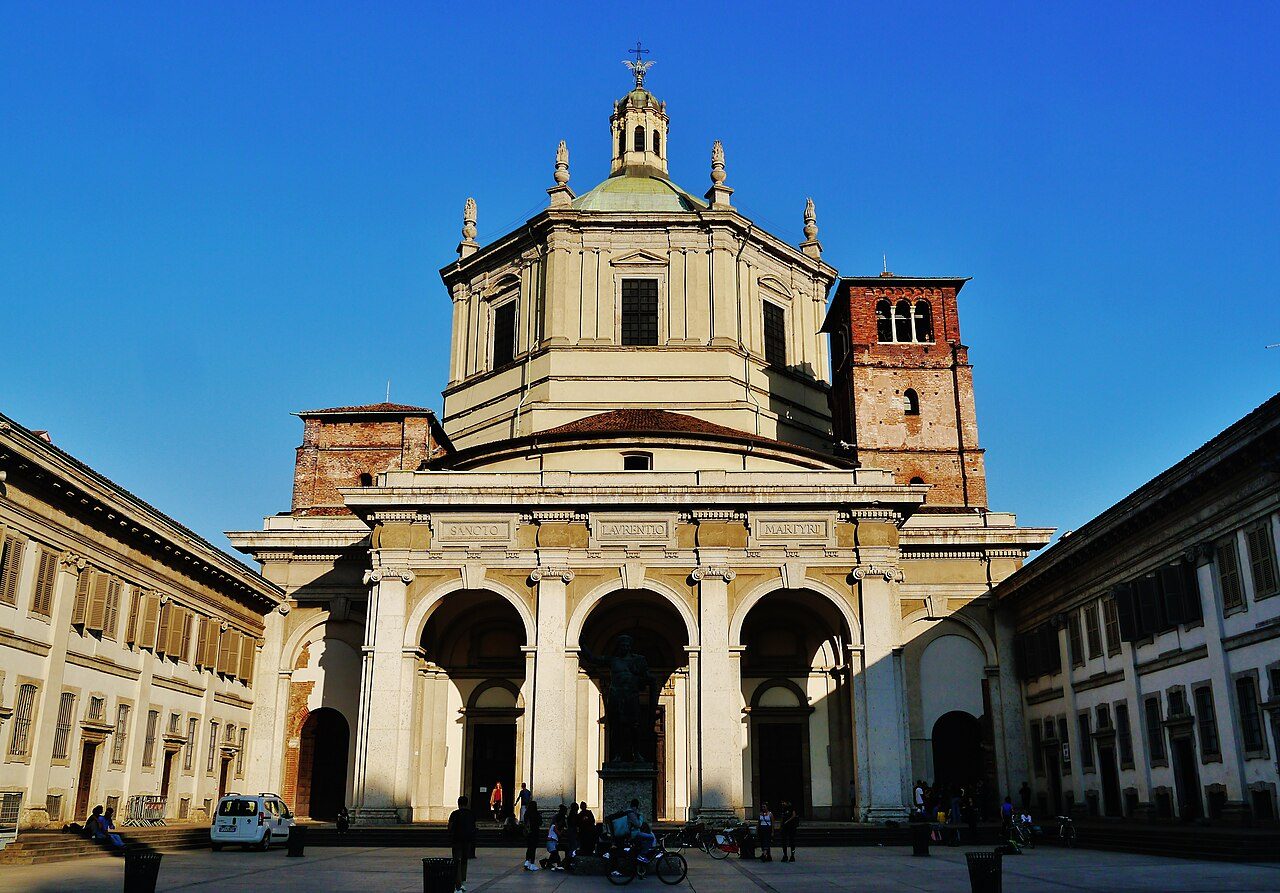
Church · Ticinese and Navigli · 390–410
Basilica di San Lorenzo Maggiore
A church fit for emperors, behind sixteen Roman columns
In brief
Built around 400, when Milan was capital of the Roman Empire, it is one of the city's oldest churches, and nobody knows for sure who ordered it. Outside stand sixteen Roman columns; inside, a plan with four apses and, in one chapel, mosaics sixteen centuries old.
Stories of this place
- Anecdote · The Colonne di San LorenzoReadThe columns saved by a governorIn front of the basilica of San Lorenzo, along Corso di Porta Ticinese, stands a row of sixteen Roman columns, and it is almost by chance that they are still up. In 1548 Milan was preparing for the ceremonial entry of Prince Philip, the future Philip II of Spain, and to widen the route of the procession someone proposed knocking them down. Ferrante Gonzaga, the governor of the city, refused. Four centuries later the opposite happened: until the 1930s a block of old houses stood between the columns and the basilica, and it was the houses that were demolished, to make room for the columns.
- Anecdote · The forecourt, Constantine, and the facadeReadThe provost and the love storyIn the basilica of San Lorenzo Maggiore the list of provosts includes a name you would not expect: Enea Silvio Piccolomini, humanist and poet, who sought and obtained the post around 1437. A few years later he wrote the Historia de duobus amantibus, the tale of two lovers: a daring novella that became famous. In 1458 he was elected pope, taking the name Pius II, and that success turned into an embarrassment. In a letter he repented of having written it and asked people to forget the man he had been: “Reject Aeneas, accept Pius.”
- In culture · The hall with four apsesReadIn Leonardo's notesThe basilica of San Lorenzo, in Milan, has a rare plan: not a long nave, but a space gathered around a center. It was the perfect church the architects of the Renaissance dreamed of. Few ancient examples were left, and this was the largest one close at hand. So its plan ended up in the notes of Leonardo da Vinci, who was working in Milan, and in a drawing by the architect Giuliano da Sangallo. Bramante remembered it in Rome, in his designs for the new basilica of Saint Peter's. A church whose author nobody knew became a teacher to the greatest of them.
- Record · The hall with four apsesReadThe first great centrally planned churchThe basilica of San Lorenzo, in Milan, is considered the first great centrally planned Christian building in the West, meaning one built around a point rather than along a nave. When it was finished, at the start of the fifth century, it was also the largest of its kind in this part of the empire. Its size explains the foundations: holding it up on marshy ground took a base of large stone blocks, taken from the city's amphitheater.
- Anecdote · The Cappella di Sant'AquilinoReadThe Christmas ray in Sant'AquilinoThe Sant'Aquilino chapel, in the basilica of San Lorenzo, is an octagon that was most likely built as an imperial mausoleum. According to the most recent studies, which the basilica has adopted, it was oriented on purpose. On Christmas Day the light comes in through the southeast window and falls on the mosaic of the chariot of Christ, shown as the sun. Then it moves down toward the floor, perhaps toward the spot where the sarcophagus stood. The same play of light is found in an ancient mausoleum in Rome. Christmas falls around the winter solstice, and the worship of Christ had absorbed the older cult of the Unconquered Sun.
- Legend · The Cappella di Sant'AquilinoReadSant'Aquilino, the porters' saintIn the Sant'Aquilino chapel, on the right side of the basilica of San Lorenzo, an urn of crystal and silver holds the saint the chapel is named after. According to tradition, Aquilinus was a German priest, born in Würzburg, who came to Milan. Around 1015 a group of heretics killed him with a knife to the throat. The body is said to have been found by porters, who carried it to San Lorenzo. He has been their patron saint ever since. For centuries, every January 29, the porters of Milan came to the basilica in procession, bringing oil for the lamp that burned in front of the urn.
- Anecdote · Under the chapel, the amphitheaterReadFrom the top of the arena to the foundationsAmong the blocks the basilica of San Lorenzo rests on, scholars have recognized pieces that give away where they came from: cornices, capitals, and pierced brackets. The holes held the poles of the velarium, the great awning that covered the tiers of seats in a building for spectacles, in all likelihood Milan's amphitheater, and shielded the crowd from the sun. So they once sat at the top of an arena more than thirty meters high. Here they ended up at the lowest point, serving as a base for a church built on marshy ground. From the top ring of the arena to the dark of the foundations.
- In culture · The back, from the parkReadThe column of infamyPiazza Vetra, behind the basilica of San Lorenzo, was for centuries the place where Milan carried out its executions. In 1630, the year of the great plague, it was the turn of Guglielmo Piazza, a health commissioner, and Gian Giacomo Mora, a barber, accused of being untori, people who spread the contagion on purpose. They were tortured and put to death, and Mora's ashes ended up in the square's canal. His house was demolished and replaced by a column, called the colonna infame, the column of infamy, which stood until 1778. Alessandro Manzoni, the author of I promessi sposi, wrote about that trial in the Storia della colonna infame.
- In culture · The back, from the parkReadPoor RosettaIn the early 1900s Piazza Vetra, behind the basilica of San Lorenzo, was the realm of the ligera, Milan's small-time underworld. Rosetta worked here: born Elvira Andrezzi, she was a prostitute and, lately, a singer too. She died in August 1913, not yet eighteen, after an arrest. For the police it was suicide; for the square it was the beating she took from the officers: two were tried and acquitted. Out of it came a ballad, La povera Rosetta, later recorded by singers such as Milly and Nanni Svampa. Seventy years later the writer Leonardo Sciascia reconstructed the case and sided with the song.
- LegendReadThe temple of Hercules that never wasFor centuries people in Milan believed that the basilica of San Lorenzo had not started out as a church. In the 1300s chroniclers such as Galvano Fiamma and Benzo d'Alessandria described it as a temple of Hercules, built by the emperor Maximian. Others spoke of baths. Modern studies have settled the matter: the basilica was Christian from the start, built around 400, a century after Maximian. One curious detail remains. That tradition remembered Maximian well and ignored Constantine altogether, the emperor who granted Christians their freedom in Milan. Today the one standing in bronze in the forecourt is him.
Ready-made questions
Nobody knows for sure, and that is the beauty of this church. No ancient document names the founder. Scholars agree only that the imperial court paid for it, at a time, between the end of the fourth century and the start of the fifth, when it was based in Milan. The name mentioned most often is Stilicho, the general who ruled for the young emperor Honorius. Others think of Theodosius, the father of Honorius. In 402 the court moved to Ravenna, and the memory of the building site was lost.
Because they were part of the church. They were carved in the second century for another building, then taken down and put up again here when the basilica was built. They formed the entrance to a , the colonnaded courtyard that stood in front of the church, like the one that still exists at the basilica of Sant'Ambrogio. The rest of the courtyard has vanished, and later the space filled up with houses. Only in the 1930s were the houses demolished, and columns and basilica faced each other again.
Go to stop: The Colonne di San LorenzoBecause it did not start out as an ordinary church. The plan with four apses around a square was a luxury choice, made by the imperial court. Perhaps it served palace ceremonies, perhaps it was tied to the mausoleum of the ruling family. The churches that Bishop Ambrose had built in those years had elongated shapes instead, with naves or in the form of a cross. After the collapse of 1573 the architect Martino Bassi tried to give it a direction toward the altar, but the ancient layout has remained.
Go to stop: The hall with four apsesWith the church, not much. With Milan, a lot. In 313 the emperor Constantine issued here the edict that granted Christians freedom of worship. The basilica was built about eighty years later, and he never saw it. The bronze statue in the forecourt is a copy of an ancient original kept in Rome, at San Giovanni in Laterano. It was set up in the 1930s, when the square was cleared of houses and Italy was celebrating two thousand years since the birth of Augustus.
Go to stop: The forecourt, Constantine, and the facadeMore than it seems, but not where you expect. The columns on the street, the plan of the hall, the foundations, and almost all of the Sant'Aquilino chapel, dome and mosaics included, are ancient. The big dome, on the other hand, was rebuilt in the late 1500s and early 1600s, after a collapse. The facade with the portico is from 1894, in cement made to look like stone. The statue of Constantine and the open square date from the 1930s. For the Roman Empire you need to look down and to the side, not straight ahead.
Galla Placidia, one of the most powerful women of the late empire. She was the daughter of the emperor Theodosius, the sister of the emperor Honorius, and the mother of a third emperor, Valentinian III. In the Middle Ages the Milanese credited her with the chapel, which they called the chapel of the Queen, and an ancient sarcophagus kept there is also known by her name. There is no proof she was really involved. But the dates fit, and today scholars take seriously the idea of a mausoleum commissioned by the imperial family.
Go to stop: The Cappella di Sant'AquilinoThe stops
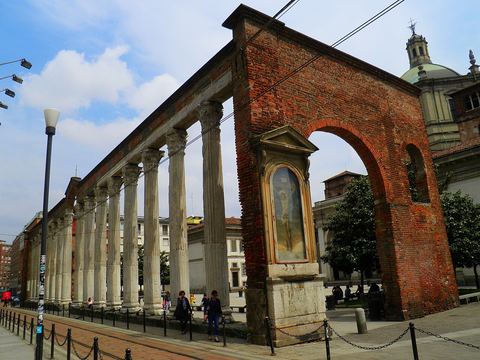
1 The Colonne di San Lorenzo
Sixteen marble columns carved in the second century for another building and put back up here, around 400, as the grand entrance to the basilica. They are the most striking Roman remains in Milan, and in the 1500s they came close to being torn down.
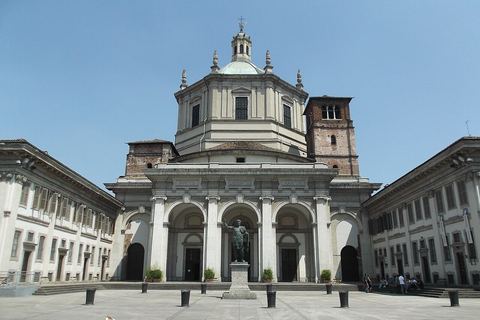
2 The forecourt, Constantine, and the facade
A bronze emperor who never saw this church, a square opened up in the 1930s, and a facade from 1894. This is the youngest point of the visit, and it shows how much of what looks ancient has been reworked.
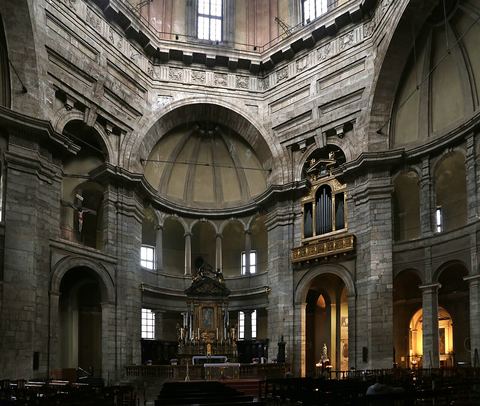
3 The hall with four apses
Not a nave but a square with four great curved recesses and a corridor running all the way around. This is the plan the imperial court wanted around 400, and it has come down to us almost intact. Leonardo and Bramante studied it.
4 The dome that fell and rose again
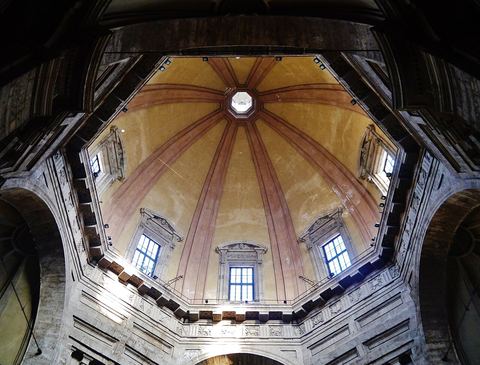
On the morning of June 5, 1573, the dome collapsed, without killing anyone. Carlo Borromeo had Martino Bassi rebuild it, and it took almost fifty years. The one above you is his: eight sides on a square from the time of the emperors.
5 The Cappella di Sant'Aquilino
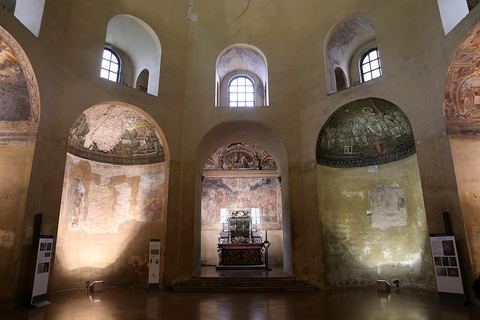
An octagon that in all likelihood began as an imperial mausoleum, with mosaics sixteen centuries old: a boyish Christ among the apostles, on a background of solid gold. If you only have time for one thing, make it this.
6 Under the chapel, the amphitheater
The chapel rests on a platform of blocks taken from a demolished Roman building, in all likelihood Milan's amphitheater. It is one of the most tangible clues that imperial power stood behind San Lorenzo.
7 The back, from the park
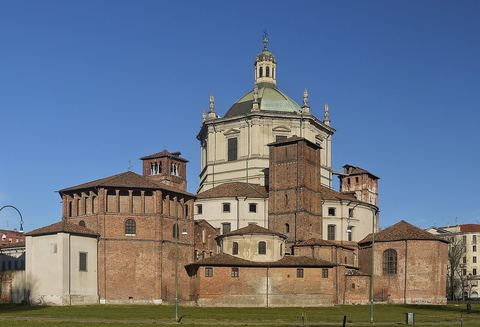
From here San Lorenzo shows its age: brick towers, eight-sided chapels, the dome in the middle. The ground you are standing on was Piazza Vetra, for centuries Milan's place of execution. Manzoni told the darkest chapter of that justice.
Timeline
- 2nd centuryThe sixteen columns are carved, for a building in Roman Milan whose name is unknown.
- About 390–410The imperial court builds the basilica. Blocks from the amphitheater end up in the foundations.
- Around 500Bishop Lorenzo adds the chapel of San Sisto, intended for the tombs of the bishops of Milan.
- 11th–12th centuryFires and collapses damage the church, which is repaired in Romanesque forms without changing the plan.
- 1573On the morning of June 5 the dome collapses, with no victims. Carlo Borromeo entrusts the rebuilding to Martino Bassi.
- 1619Work on the new eight-sided dome comes to an end. Bassi is already dead.
- 1894The engineer Cesare Nava builds the entrance portico, in cement made to look like stone.
- 1934–1943The houses between the columns and the church are demolished, the statue of Constantine arrives, and the mosaics in Sant'Aquilino resurface.
Who's who
Stilicho
general and regent of the Western Empire
He ruled on behalf of the young emperor Honorius. His is the name most often put forward as the possible patron of the basilica. He was killed in 408.
Galla Placidia
daughter of the emperor Theodosius
Sister of Honorius and mother of Valentinian III. Milanese tradition credited her with the Sant'Aquilino chapel, hence its name, chapel of the Queen.
Saint Aquilinus
priest, patron saint of porters
A German from Würzburg, by tradition killed in Milan around 1015. He lies in an urn of crystal and silver on the altar of the chapel that bears his name.
Carlo Borromeo
archbishop of Milan from 1564
After the collapse of 1573 he ordered the dome rebuilt. He proclaimed Saint Aquilinus co-patron of Milan. He was canonized in 1610.
Martino Bassi
architect of the new dome
He rebuilt the dome after 1573 and wrapped it in the eight-sided tiburio. He died before the work was finished, in 1619.
Enea Silvio Piccolomini
provost of San Lorenzo, later Pope Pius II
A humanist, he was provost of the basilica from 1436 to 1440 and was elected pope in 1458. His name appears in the list of provosts carved in marble inside the church.
Words to know
Where it is
The neighborhood
Ticinese and Navigli
Related places
The story of the place
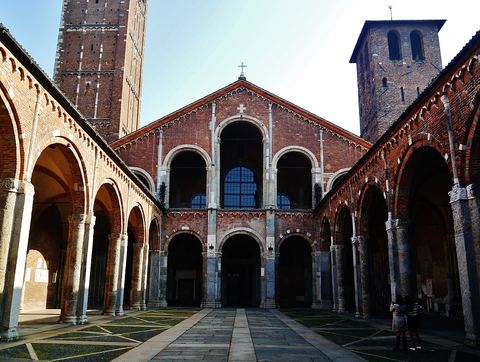
Not much of Roman Milan is still standing, and the most eye-catching piece is right here. Sixteen columns along the street, and behind them a church like no other in the city: not long but gathered around a center, with four towers at the corners and a dome on top.
A project of the imperial court
San Lorenzo was born between the end of the fourth century and the start of the fifth. Milan was then the residence of the emperors of the West, and only the court could afford a building site like this one: blocks from the city's amphitheater ended up in the foundations.
Who commissioned it, though, no document says. Perhaps Stilicho, the general who ruled on behalf of the young emperor Honorius. Perhaps it was the church of the imperial palace, which stood not far away. Perhaps it was tied to a family mausoleum.
In 402 the court moved to Ravenna and the founder's name was lost. Later the Milanese, faced with such a strange building, convinced themselves it had been a pagan temple, or else a bathhouse.
Collapses and rebuildings
Then came the troubles. Between the eleventh and twelfth centuries, fires and collapses forced a rebuilding, and in 1573 the dome came down again. It was rebuilt by the architect Martino Bassi, on the orders of Carlo Borromeo, archbishop of Milan.
Each time, though, they rebuilt on top of the ancient plan. That is why the space you walk into is still, in its essential lines, the one the Romans designed. In the Renaissance, Leonardo and Bramante came to study it.
What to see today
The most precious part is the Cappella di Sant'Aquilino, the chapel of Saint Aquilinus, an octagon that in all likelihood began as an imperial mausoleum. It preserves mosaics from the time of the founding and, beneath the floor, the stones of the amphitheater.
The way it looks today, with the basilica standing free between a square and a park, is recent. Until the 1930s the houses came right up to the columns and hemmed the church in on every side.
The visit starts outside, at the columns, crosses the forecourt, enters the main hall, and ends around the back, in the park. If you only have time for one thing, make it Sant'Aquilino.
Sources
- Basilica di San Lorenzo Maggiore, sito ufficiale: storia della basilica (opens in a new tab)Official site
- Basilica di San Lorenzo Maggiore, sito ufficiale: la basilica nei secoli IV-IX (opens in a new tab)Official site
- Basilica di San Lorenzo Maggiore, sito ufficiale: la basilica nei secoli X-XV (opens in a new tab)Official site
- Basilica di San Lorenzo Maggiore, sito ufficiale: la basilica nei secoli XVI-XVIII (opens in a new tab)Official site
- Basilica di San Lorenzo Maggiore, sito ufficiale: la basilica nei secoli XIX-XXI (opens in a new tab)Official site
- Basilica di San Lorenzo Maggiore, sito ufficiale: cappella di Sant'Aquilino (opens in a new tab)Official site
- Basilica di S. Lorenzo Maggiore, Lombardia Beni Culturali (opens in a new tab)Catalog
- Colonne di S. Lorenzo, Lombardia Beni Culturali (opens in a new tab)Catalog
- Milano, Enciclopedia dell'Arte Medievale Treccani (opens in a new tab)Encyclopedia
- Pio II, Enciclopedia dei Papi Treccani (opens in a new tab)Encyclopedia
- Marco Sannazaro, Lo sviluppo urbanistico di Milano in età paleocristiana, rivista LANX, Università degli Studi di Milano (opens in a new tab)Institution
- Anfiteatro romano di Milano, comunicato della Soprintendenza Archeologia Belle Arti e Paesaggio di Milano, 2020 (opens in a new tab)Institution
- Pio II, Commentarii, libro I, traduzione inglese di Florence A. Gragg, Elfinspell (opens in a new tab)Other source
- Ultime notizie della Rosetta, Associazione culturale Il Cantastorie on line (opens in a new tab)Other source
- Basilica di San Lorenzo (Milano), Wikipedia in italiano (opens in a new tab)Wikipedia
- Colonne di San Lorenzo, Wikipedia in italiano (opens in a new tab)Wikipedia
- Piazza della Vetra, Wikipedia in italiano (opens in a new tab)Wikipedia
- Basilica of San Lorenzo, Milan, Wikipedia in inglese (opens in a new tab)Wikipedia
- Colonne di San Lorenzo, Wikipedia in inglese (opens in a new tab)Wikipedia
- Cappella di Sant'Aquilino, Wikipedia in italiano (opens in a new tab)Wikipedia
- Colonna infame (Milano), Wikipedia in italiano (opens in a new tab)Wikipedia
- Gian Giacomo Mora, Wikipedia in italiano (opens in a new tab)Wikipedia
- Anfiteatro romano di Milano, Wikipedia in italiano (opens in a new tab)Wikipedia
- La povera Rosetta, Wikipedia in italiano (opens in a new tab)Wikipedia
- Rosetta Andrezzi, mistero e malavita nella Milano del 1913, Milanofree (opens in a new tab)Other source
- Basilica di San Lorenzo Maggiore, OpenStreetMap (opens in a new tab)Other source