Stop 7 of 7
The back, from the park
Where to stand
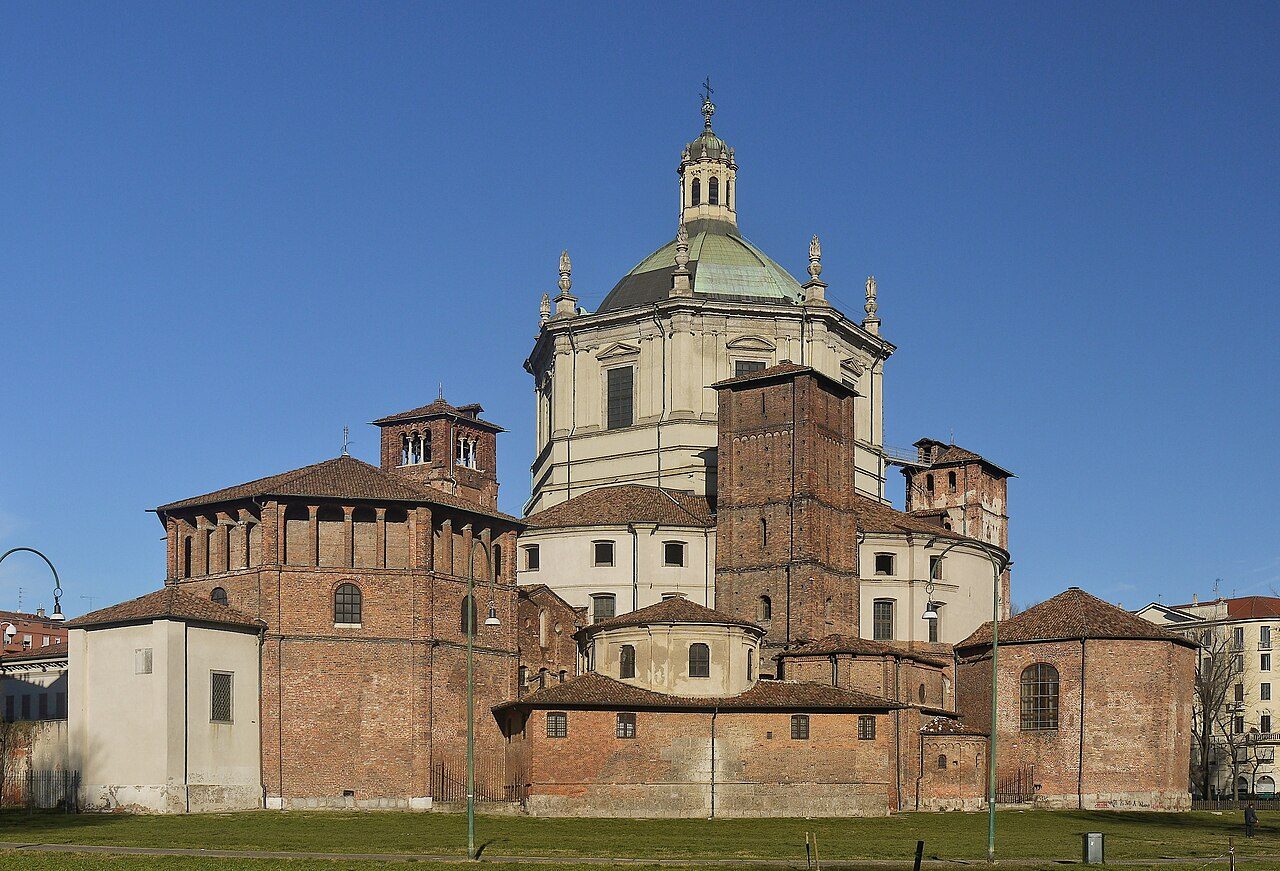
In the park behind the basilica, a few dozen meters from the apses, looking toward the dome
From here San Lorenzo shows its age: brick towers, eight-sided chapels, the dome in the middle. The ground you are standing on was Piazza Vetra, for centuries Milan's place of execution. Manzoni told the darkest chapter of that justice.
Spot the detail
Look for eight-sided shapes in the outline of the basilica. Where do you find them?
The full story
If the facade struck you as a little cold, this is the payback. From behind, San Lorenzo wears no nineteenth-century clothes: just brick, and a heap of volumes clambering over one another up to the dome.
Towers, tiburio, and chapels
Try reading them. At the corners are the towers, four in all, which brace the central block and help it stay up. In the middle rises the eight-sided of Martino Bassi, the architect who rebuilt the dome after the collapse of the 1500s.
Down low the chapels jut out, small buildings in their own right attached to the big one: Sant'Ippolito behind the high altar, Sant'Aquilino to the south, San Sisto to the north. That last one was added around 500 by Bishop Lorenzo, as the burial place of the bishops of Milan.
How the park was born
This view too, like the one from the forecourt, is a gift of the twentieth century. For centuries the basilica was squeezed in among houses. The demolitions of the 1930s and then the bombs of World War II cleared the ground, and after the war it was decided not to rebuild. That is how the Parco delle Basiliche was born, the park that links San Lorenzo to Sant'Eustorgio, the neighborhood's other great ancient church.
Piazza Vetra and the gallows
The place, though, has a less peaceful memory. This was Piazza Vetra. An open canal ran through it, used by the leather tanners. And for centuries, until the 1800s, it was where Milan put its condemned to death.
The most famous date from 1630, the year of the great plague: Guglielmo Piazza, a public health commissioner, and Gian Giacomo Mora, a barber. They were accused of being untori, plague-spreaders who smeared the contagion around on purpose. They were tortured and put to death, and Mora's ashes ended up in the Vetra canal. His house, not far from here on Corso di Porta Ticinese, was razed to the ground, and in its place rose a column meant to recall his infamy forever.
They called it the colonna infame, the column of infamy. It was removed in 1778, in the years when Pietro Verri, the Enlightenment writer, was writing against torture. Alessandro Manzoni, the author of the novel I promessi sposi, known in English as The Betrothed, devoted a whole book to that trial, the Storia della colonna infame.
Look at the basilica one more time before you go. It has seen the court of the emperors, the fires, the gallows in the square, and the bombings. It is still here, with the same plan as sixteen centuries ago.
About this stop
In culture
The column of infamy
Piazza Vetra, behind the basilica of San Lorenzo, was for centuries the place where Milan carried out its executions. In 1630, the year of the great plague, it was the turn of Guglielmo Piazza, a health commissioner, and Gian Giacomo Mora, a barber, accused of being untori, people who spread the contagion on purpose. They were tortured and put to death, and Mora's ashes ended up in the square's canal. His house was demolished and replaced by a column, called the colonna infame, the column of infamy, which stood until 1778. Alessandro Manzoni, the author of I promessi sposi, wrote about that trial in the Storia della colonna infame.
In culture
Poor Rosetta
In the early 1900s Piazza Vetra, behind the basilica of San Lorenzo, was the realm of the ligera, Milan's small-time underworld. Rosetta worked here: born Elvira Andrezzi, she was a prostitute and, lately, a singer too. She died in August 1913, not yet eighteen, after an arrest. For the police it was suicide; for the square it was the beating she took from the officers: two were tried and acquitted. Out of it came a ballad, La povera Rosetta, later recorded by singers such as Milly and Nanni Svampa. Seventy years later the writer Leonardo Sciascia reconstructed the case and sided with the song.