Milan
Capital of emperors, dukes, and Napoleon, and it has never stopped remaking itself
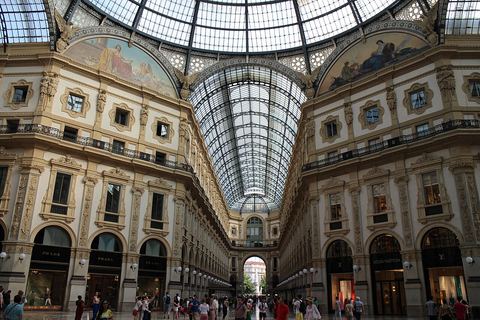
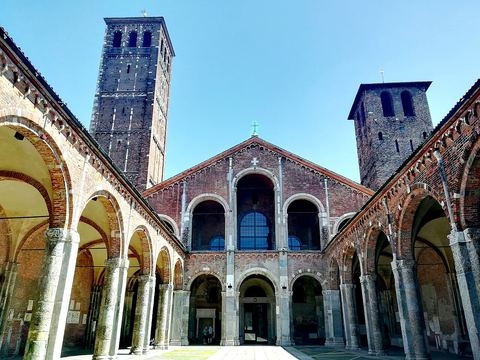
Milan has no postcard view. It has two thousand years of layers. It has been a capital of the Roman Empire, the court of the Visconti and the Sforza, a Spanish stronghold, the Austrian city of La Scala, and Napoleon's capital. Every ruler left something behind, and the Milanese still use it.
Stories to flip through
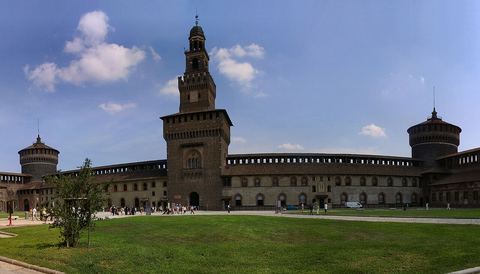
- LegendReadThe biscione, Milan's serpent emblemIn Milan a serpent follows you everywhere. It is the biscione, emblem of the Visconti, the city's medieval lords: a snake swallowing a child or, in other versions, a Saracen. You find it on the Castello Sforzesco, the city's castle, at the Stazione Centrale train station, on the Alfa Romeo badge, among the symbols of the Inter soccer club. One legend says a Visconti tore it from a Saracen killed on the First Crusade. Another says an ancestor adopted it after slaying a dragon. Historians believe neither: the earliest reliable evidence is thirteenth-century. The poet Dante already knew it: his Purgatorio calls it the viper of the Milanese.
- LegendReadThe sow with half a coat of woolAccording to legend, Milan was founded in the sixth century BC by Bellovesus, chief of a Celtic tribe, on the spot where he found a scrofa semilanuta, a sow covered in wool on only half its body. Bellovesus is mentioned by the Roman historian Livy. The sow turns up in later Latin authors, such as the poet Claudian. Scholars are more sober: the first village is thought to date from around 400 BC, and Mediolanum would simply mean in the middle of the plain. The sow, you have to admit, is easier to remember.
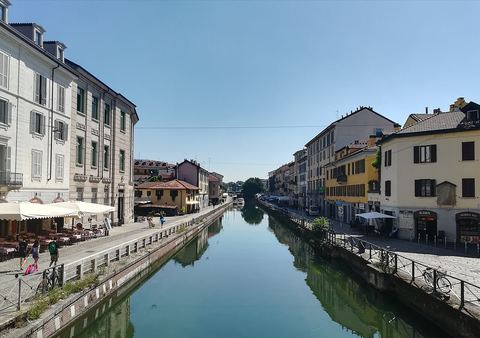
- RecordReadA port with no seaMilan is far from the sea, and yet it had a real port. It was the Darsena, the basin where the Naviglio Grande, the great canal, ends. In 1953 it ranked thirteenth among Italian ports by goods received. The cargo was almost always the same: sand for the city's building sites. The last barge entered the Darsena at the end of March 1979, carrying one hundred twenty tons of sand. With that trip, some seven centuries of transport by water came to an end.
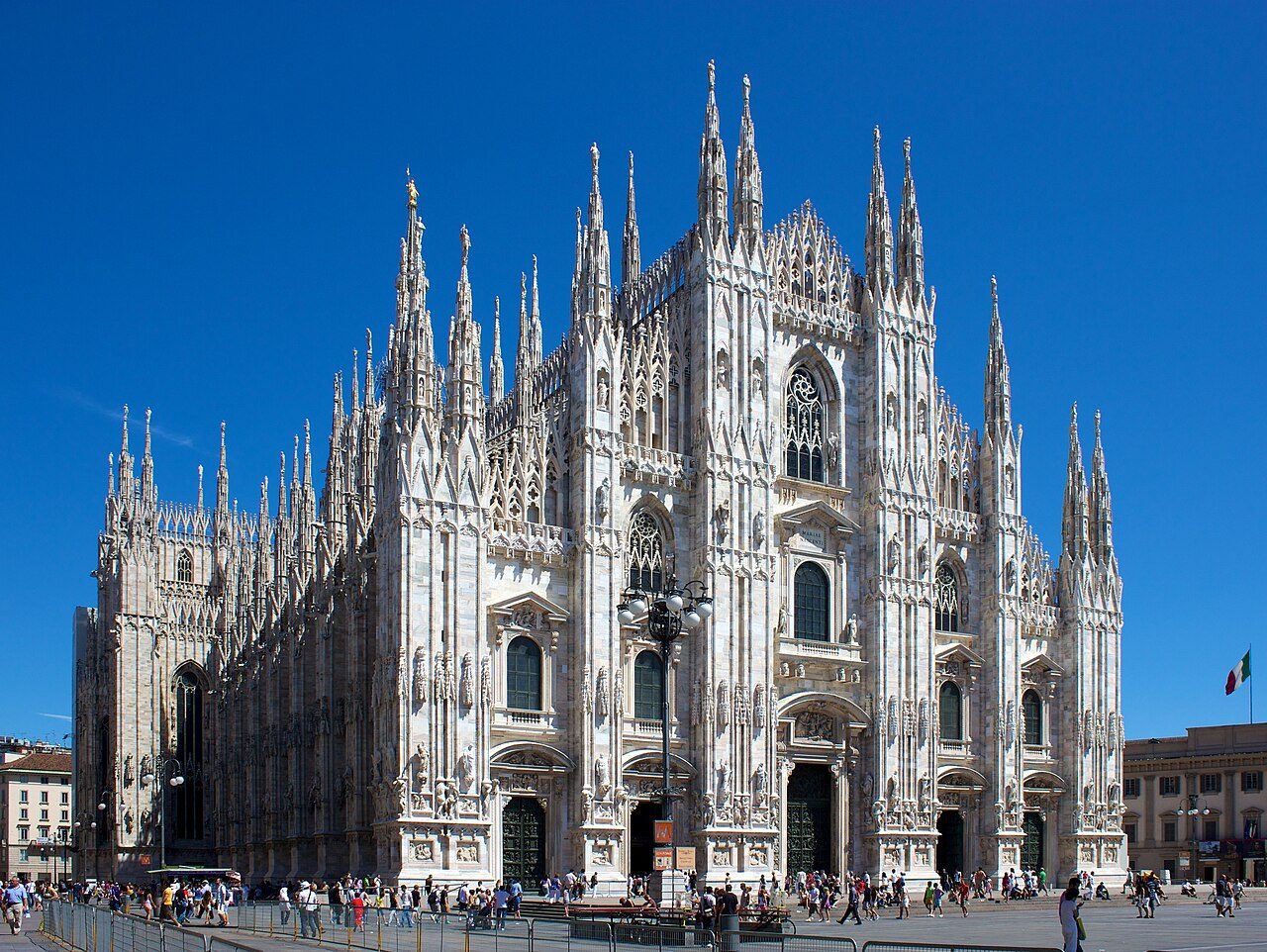
- RecordReadElectric light, steps from the DuomoIn Milan, steps from the Duomo, a brick smokestack over fifty meters tall was smoking in 1883. It belonged to the Via Santa Radegonda power station, continental Europe's first thermal power station: it burned coal to make light. Behind it was Giuseppe Colombo, a professor at the Politecnico, the technical university, who went to New York to study the inventor Thomas Edison's plant. The current first lit a few shops on Piazza del Duomo. Then, on December 26, 1883, over two thousand bulbs lit up the Teatro alla Scala, the opera house. The station shut down in 1900 and was demolished in the 1920s. Today only a plaque recalls it.
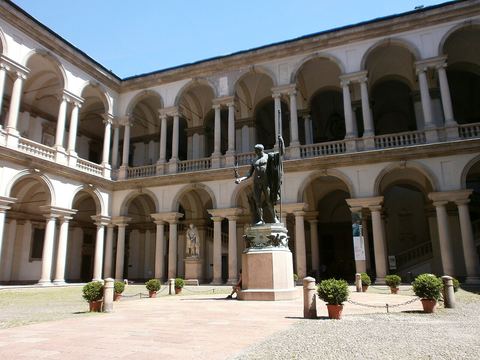
- AnecdoteReadNapoleon makes himself at homeNapoleon entered Milan in May 1796 and behaved as if he owned the place. In 1800 he ordered the Castello Sforzesco, the city's castle, demolished, and part of it really was torn down. Around what was left, the architect Giovanni Antonio Antolini designed the Foro Bonaparte, a grandiose complex that stayed on paper. In 1805 Napoleon crowned himself king of Italy in the Duomo. And the day chosen to open the Pinacoteca di Brera, the painting gallery, was August 15, 1809: his birthday. His bronze statue, in the guise of Mars the Peacemaker, still stands in the center of the courtyard of the Brera palace.
- AnecdoteReadThe Five Days of Milan, balloons and orphansIn March 1848, in the Cinque giornate, the Five Days, Milan rose up against its Austrian rulers and made do with what it had. Over fifteen hundred barricades went up across the city. Astronomers and opticians were sent up the bell towers to watch the enemy's moves. To call for help from the countryside, beyond the walls held by the soldiers, the insurgents launched balloons carrying their messages. From one barricade to the next ran the Martinitt, the boys of the city orphanage, serving as couriers. After five days Field Marshal Radetzky, the Austrian commander, left the city with his army. Balloons and young boys had helped drive him out.
- AnecdoteReadThe bombs of August 1943In August 1943 the bombs changed the face of Milan. On the night of the 15th they hit Santa Maria delle Grazie: the refectory collapsed, but the wall with Leonardo's Last Supper stayed standing. Between the 15th and the 16th an incendiary bomb exploded on the roof of La Scala, the opera house, and brought down the ceiling of the auditorium. In the Brera palace, home of the Pinacoteca art gallery, the vaults gave way in twenty-six rooms out of thirty-four. Less than three years later La Scala was standing again: it reopened on May 11, 1946, with a concert conducted by Arturo Toscanini.
- In cultureReadThe Jamaica bar, Brera and La vita agraIn the 1950s and 1960s artists, writers, and intellectuals had a regular address in Milan: the Jamaica bar, on Via Brera, the same street as the palace of the Accademia di Belle Arti, the fine arts academy. The photographer Ugo Mulas photographed it between 1953 and 1954. The writer Luciano Bianciardi told the story of that neighborhood life in the first chapters of his novel La vita agra. If you are looking for a book to carry with you as you wander around Brera, start with that one.