Stop 2 of 7
The forecourt, Constantine, and the facade
Where to stand
At the center of the forecourt, between the columns and the church, facing the bronze statue
A bronze emperor who never saw this church, a square opened up in the 1930s, and a facade from 1894. This is the youngest point of the visit, and it shows how much of what looks ancient has been reworked.
Spot the detail
The three-arched portico in front of the entrance: it looks like stone. Take a close look
The full story
You have just passed the columns and you are standing in a space that seems to have always been planned this way: colonnade, forecourt, statue, church. In fact almost nothing you can see from here is more than a hundred and thirty years old.
The statue of Constantine
Start with the emperor. He is Constantine, and he is here for a specific reason: in 313, in Milan, he issued the edict that granted Christians freedom of worship.
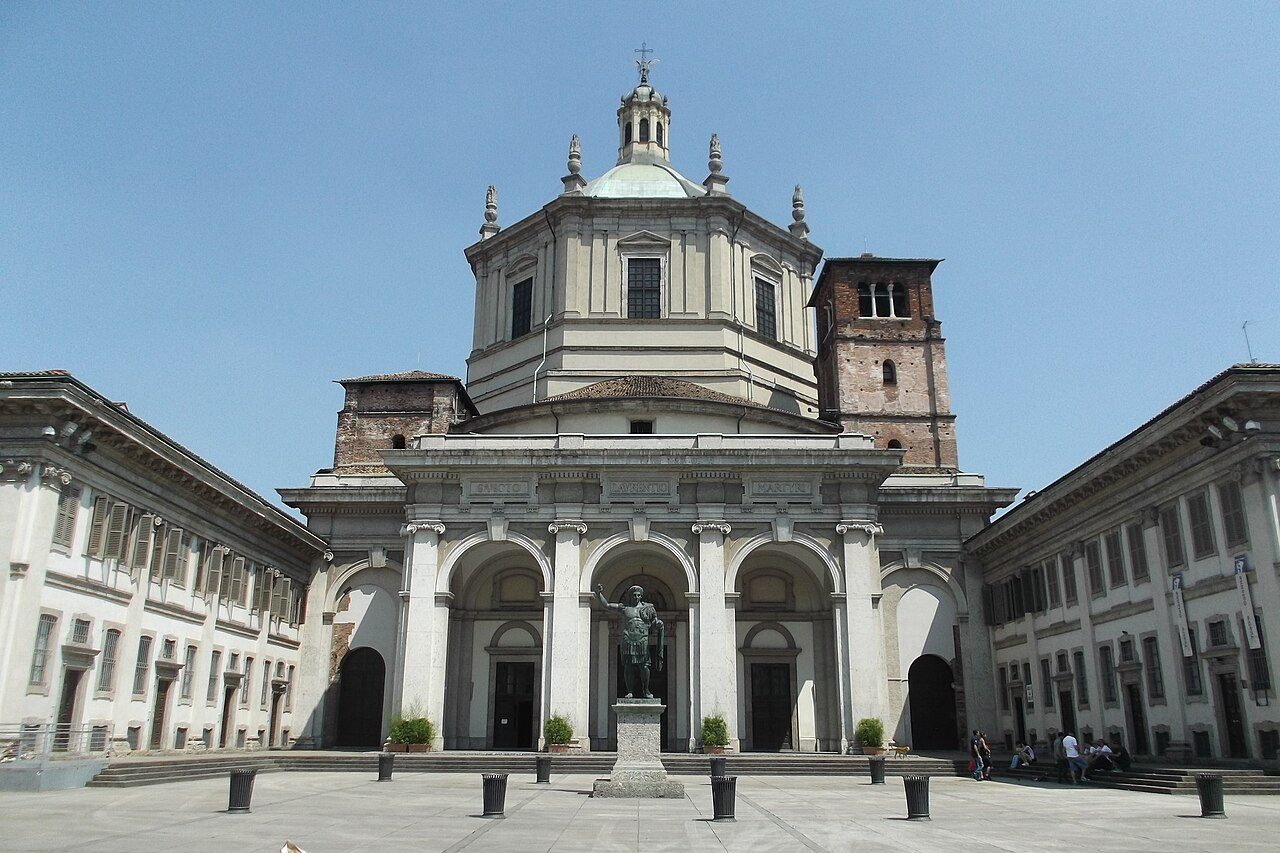
The statue, though, is a bronze copy. The original is ancient and stands in Rome, at the basilica of San Giovanni in Laterano. This one arrived in the 1930s, when Italy was celebrating two thousand years since the birth of Augustus and Milan was putting its Roman past back on show. In those same years the houses that filled the forecourt were demolished, and the columns faced the church again.
There is a small paradox. Constantine never saw this basilica: it was built about eighty years after his edict. The statue commemorates the imperial city, not the founder. The founder remains nameless.
The facade of 1894
Now look at the facade behind the statue. Three arches, pilasters with the scrolls of the Ionic order, a serious, classical air. It is a , an entrance portico, and it dates from 1894.
It was designed by the engineer Cesare Nava, drawing on the ideas of Martino Bassi, the architect who had rebuilt the dome three centuries earlier. It was the last act of a building project begun in the 1500s. The parish itself now admits that the portico has a flaw: it blocks the view of the ancient mass that stands behind it.
To find that again, raise your eyes above the . The octagon that protects the dome pokes out, with the brick towers on either side. That is the real church, and the comparison says it all: in front, a nineteenth-century outfit; behind, a body sixteen hundred years old.
A provost who became pope
Before you go in, one illustrious name. It belongs to Enea Silvio Piccolomini, the humanist who was provost of San Lorenzo around 1437 and some twenty years later became pope under the name Pius II. Even a church without a founder has had its important tenants.
About this stop
Anecdote
The provost and the love story
In the basilica of San Lorenzo Maggiore the list of provosts includes a name you would not expect: Enea Silvio Piccolomini, humanist and poet, who sought and obtained the post around 1437. A few years later he wrote the Historia de duobus amantibus, the tale of two lovers: a daring novella that became famous. In 1458 he was elected pope, taking the name Pius II, and that success turned into an embarrassment. In a letter he repented of having written it and asked people to forget the man he had been: “Reject Aeneas, accept Pius.”
With the church, not much. With Milan, a lot. In 313 the emperor Constantine issued here the edict that granted Christians freedom of worship. The basilica was built about eighty years later, and he never saw it. The bronze statue in the forecourt is a copy of an ancient original kept in Rome, at San Giovanni in Laterano. It was set up in the 1930s, when the square was cleared of houses and Italy was celebrating two thousand years since the birth of Augustus.
This stop on the map
Next stop
Go in through the doorway and stop just inside, before walking toward the center