Stop 7 of 8Must-see
The Cappella Portinari
Where to stand
Inside the chapel, just past the entrance, looking first at the dome and then at the upper walls
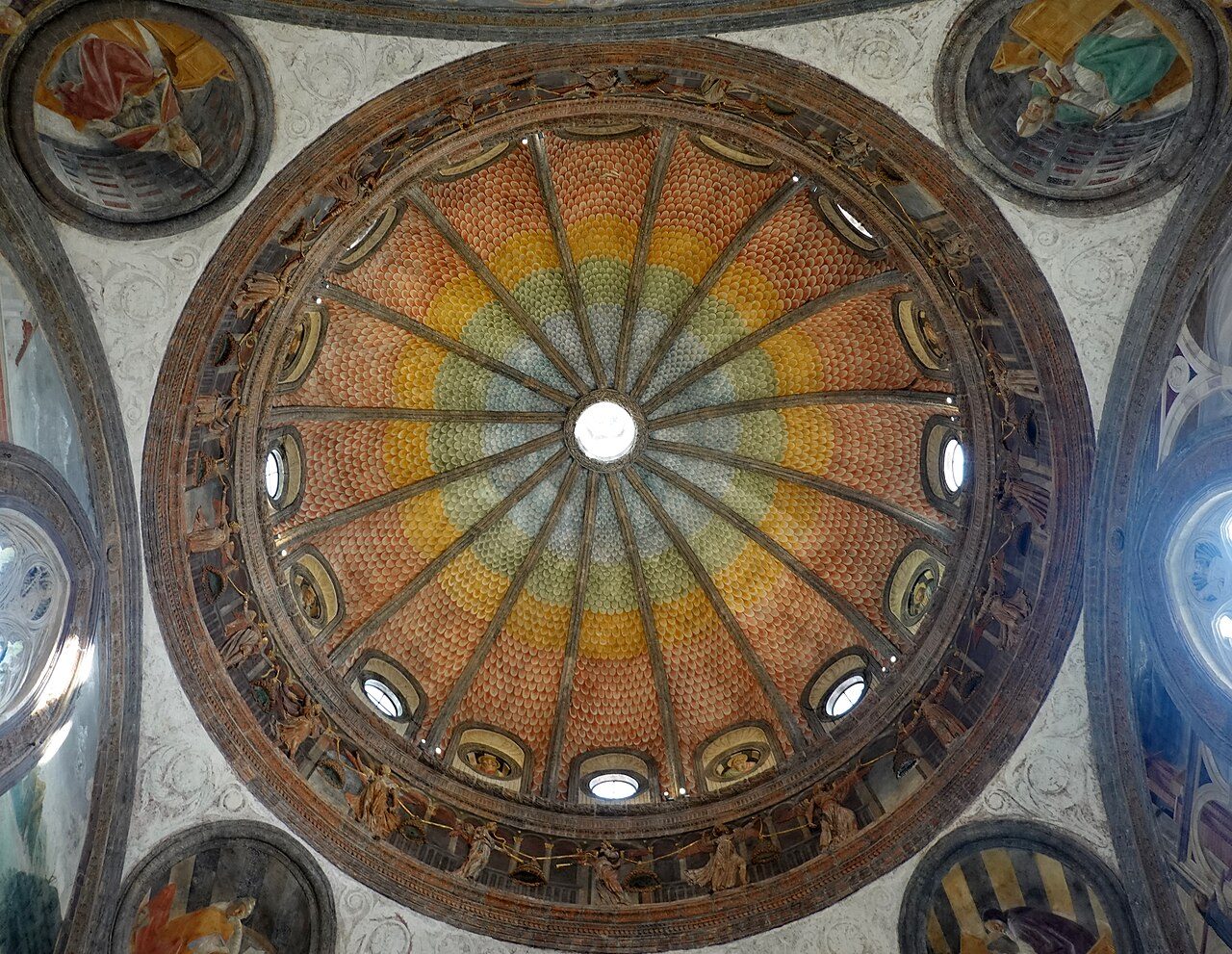
A cube with a dome on top, as in Florence, but decorated the Lombard way: sixteen rainbow-colored segments, a ring of angels and the frescoes of Vincenzo Foppa. If you only have time for one thing, make it this.
Spot the detail
On the right wall, in the scene where the saint holds up the host, look closely at the Madonna and Child. What do they have on their heads?
The full story
Look up right away. The dome is divided into sixteen segments decorated like bird feathers, and the colors shift in bands as in a rainbow. All around the base runs a row of angels in relief, painted, dancing and playing music.
It is an idea of Paradise, and it still works.
A Florentine in Milan
The man behind all this, according to tradition, was Pigello Portinari, a Florentine sent to Milan in 1452 to open the branch of the Medici bank. He was a friend and adviser of Duke Francesco Sforza. The chapel was built between 1462 and 1468, as a tomb for him and as a home for the of Saint Peter Martyr.
The architecture speaks Tuscan. A square room, a dome, a small square apse: it is the scheme Brunelleschi had used in Florence for the Sagrestia Vecchia, the Old Sacristy of San Lorenzo. A way, perhaps, of reminding everyone where the master of the house came from.
The decoration, though, is Lombard, starting with the terracotta around the arches and windows. Who the architect was, nobody knows. Vasari, the biographer of artists, named the Florentine Michelozzo. Today scholars lean toward a Lombard, perhaps Guiniforte Solari.
The frescoes by Foppa
The paintings are by Vincenzo Foppa, a Lombard painter on his first major public commission. In the four , the curved triangles that carry the dome, he painted four roundels with the Doctors of the Church, seen from below.
High on the side walls are four stories of Saint Peter Martyr. On the left the saint reattaches the foot of a young man who had cut it off in remorse, after striking his mother. Next to it is his murder in the woods.
On the right he summons a cloud to shade the crowd listening to him from the sun. Then he unmasks a false Madonna. Above the apse is an Annunciation, above the entrance an Assumption.
Two centuries under plaster
For a long time none of this could be seen. After the plague of 1630 the frescoes were covered with plaster, and they came back to light only in the second half of the 19th century.
That is why you find them worn here and there. But Foppa's soft grays are still there. And so is his perspective, more attentive to air and light than to geometry. Give yourself a few minutes with your head tilted back.
About this stop
Anecdote
The frescoes hidden for two centuries
In the Cappella Portinari, the chapel at the far end of the basilica of Sant'Eustorgio, Vincenzo Foppa, a 15th-century Lombard painter, frescoed the stories of Saint Peter Martyr. After the plague of 1630 his frescoes disappeared under several layers of plaster, and new painting went on top. For more than two centuries nobody saw them. In 1868 a piece of the Miracle of the Cloud resurfaced, and a few years later the plaster was removed: in a hurry, unfortunately, damaging part of the color. It took the 20th-century restorations, up to the chapel's reopening in 2000, to get close again to what Foppa had painted.
Nobody knows, and it is a small mystery of Milanese art. Giorgio Vasari, the biographer of artists, attributed it to the Florentine Michelozzo. That idea has been dropped on grounds of style and dates. Scholars then thought of Filarete, and later of Guiniforte Solari, a Lombard architect, perhaps advised by someone close to Florentine culture. It is the theory that best explains what you see: a Tuscan scheme, built and decorated the Lombard way.
A Florentine banker, born in 1421 and raised in the household of Cosimo de' Medici after his father's death. In 1452 he was sent to Milan to open the branch of the Medici Bank, which financed the court of Duke Francesco Sforza. He became the duke's friend and adviser. He died in 1468, the year the chapel was finished. Tradition makes him its patron and has him buried here. It has to be said that documents from the time are lacking, and some scholars today doubt it.
This stop on the map
Next stop
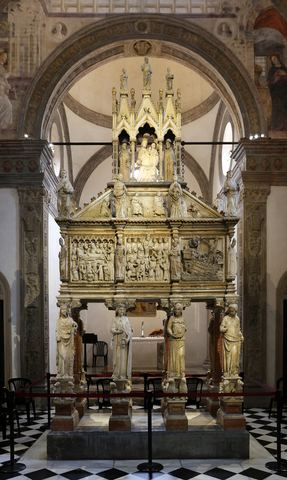
Stay in the chapel and move closer to the great marble tomb in the center