Stop 8 of 8Must-see
The arca of Saint Peter Martyr
Where to stand
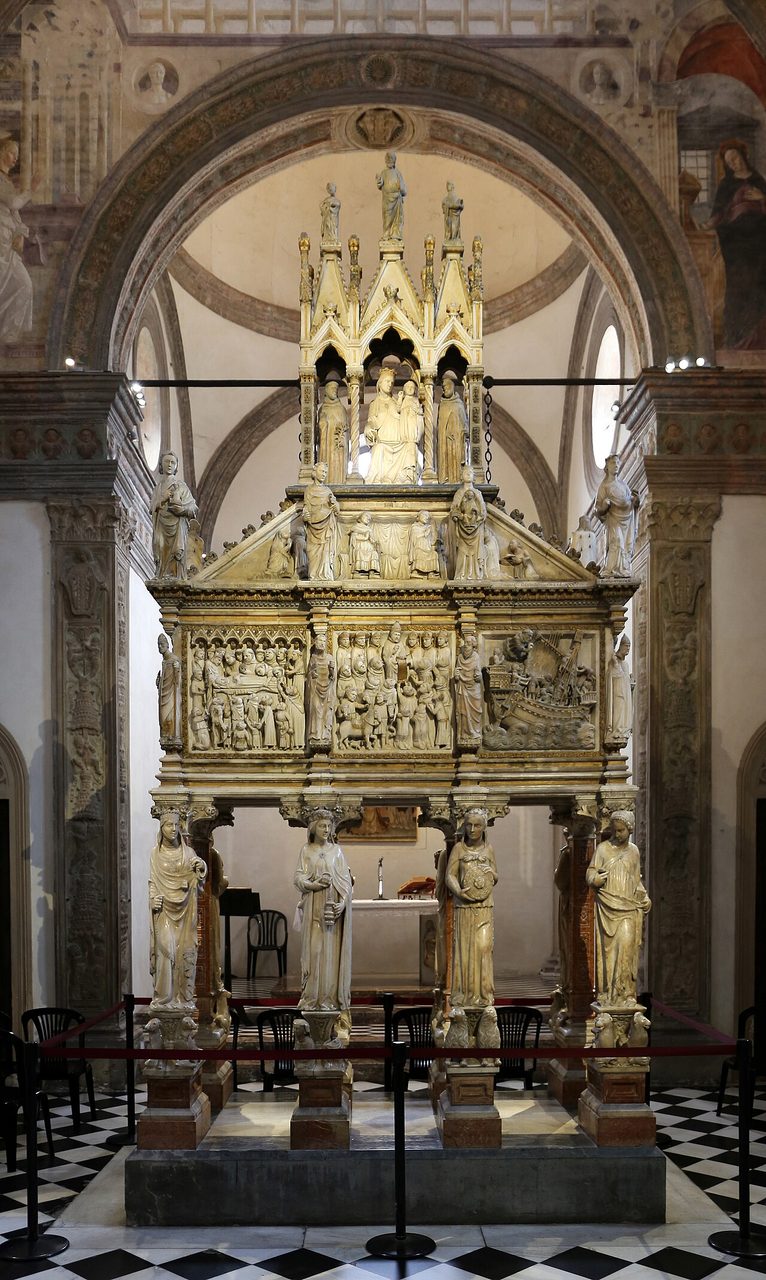
In the center of the Cappella Portinari, walking around the great white marble tomb on its small red pillars
The tomb of the friar killed in 1252, carved by Giovanni di Balduccio of Pisa and finished in 1339. It is more than a century older than the chapel: it was brought here only in the 18th century.
Spot the detail
The sculptor signed the work. Look on the sarcophagus for a Latin inscription with his name and a date in Roman numerals
The full story
Walk around the before you read its story. Arca is the name for the monumental tombs of saints: a sarcophagus raised off the ground, made to be seen from every side. This one is of white Carrara marble and rests on eight small pillars of red Verona marble.
A statue leans against each pillar. They are the Virtues, each with a symbolic animal at her feet, and they quite literally hold up the saint's tomb. Above, on the sarcophagus, eight reliefs tell of his miracles, his killing, his funeral.
At the top, under a small pointed tabernacle, sits the Madonna between Saint Dominic and Saint Peter Martyr.
Who Pietro was
Pietro da Verona was a Dominican friar of Sant'Eustorgio, a famous preacher and an . He fought the , heretics then widespread in Lombardy. In April 1252, as he was walking back from Como, he was attacked in a wood north of Milan and struck on the head with a falcastro, a kind of billhook.
According to tradition, before dying he dipped a finger in his blood and wrote Credo on the ground. Less than a year later the pope proclaimed him a saint. The haste is easy to explain: in the Lombardy of those years, the Church and the Dominicans needed a martyr.
A tomb that has traveled
The Dominicans ordered the around 1336, with the help of Azzone Visconti, lord of Milan. They entrusted it to Giovanni di Balduccio, a sculptor from Pisa who had only recently arrived in the city. In three years it was finished, and it set a trend: a few decades later, in Pavia, the tomb of Saint Augustine was carved on this model.
For four centuries the stayed in the basilica. It entered the chapel built for the saint only in 1736, and reached the center, where you see it, only in the second half of the 19th century.
And the head? It was separated from the body back at the time of the canonization and kept apart, in a reliquary. It is still here, in a small room next to the chapel.
An , a tomb fit for a prince, a chapel fit for a banker. Few saints in Milan have been treated this well.
About this stop
Anecdote
The saint's killer who was beatified
In the Cappella Portinari, the chapel at the far end of the basilica of Sant'Eustorgio, lies Saint Peter Martyr, the Dominican friar and killed in an ambush in 1252. His killer was called Carino da Balsamo. He was a hired killer: a nobleman, Stefano Confalonieri of Agliate, was named as the man behind the plot. Carino was caught by a peasant, but his story did not end there. He joined the Dominican order, the same as his victim, and lived as a friar in Forlì. In the end the Church declared him blessed. The saint and his killer, in the end, are on the same side.
Legend
Banging your head at Sant'Eustorgio
In the Cappella Portinari, the chapel at the far end of the basilica of Sant'Eustorgio, is the tomb of Saint Peter Martyr, the Dominican friar killed in 1252 by a blow to the head. His skull is kept apart. In the 14th century Giovanni Visconti, archbishop of Milan, took it to his palace chapel. Fierce migraines, the story goes, seized him and ended only when he returned the . Since then, perhaps, the saint has been invoked against headaches. The Milanese said andà a pestà el cô in Sant'Ustorg: go bang your head at Sant'Eustorgio. The custom lives on: in late April the faithful touch his tomb with their heads.
Record
Saint Peter Martyr, a saint in eleven months
In the Cappella Portinari, the chapel at the far end of the basilica of Sant'Eustorgio, lies Saint Peter Martyr, a Dominican friar and , a judge charged by the Church with fighting heretics. He was killed in an ambush on April 6, 1252. In March 1253 Pope Innocent IV proclaimed him a saint: less than a year had passed, about eleven months. The haste had its reasons. Lombardy was full of heretics, the Church needed a martyr to set against them, and the Dominicans very likely pressed the pope. The result is a record: for those who have studied his cult, no pope has ever proclaimed a saint so fast.
A Dominican friar, Pietro da Verona, who lived in the first half of the 13th century. He belonged to the convent of Sant'Eustorgio and was famous for his sermons, which he also gave in the open air, in front of the basilica. He was an , charged with fighting heretics, the in particular. In 1252 he was killed in an ambush on the road from Como to Milan, and a year later he was already a saint. In images you spot him at once: he has a blade stuck in his head.