Stop 1 of 8
The square and the facade
Where to stand
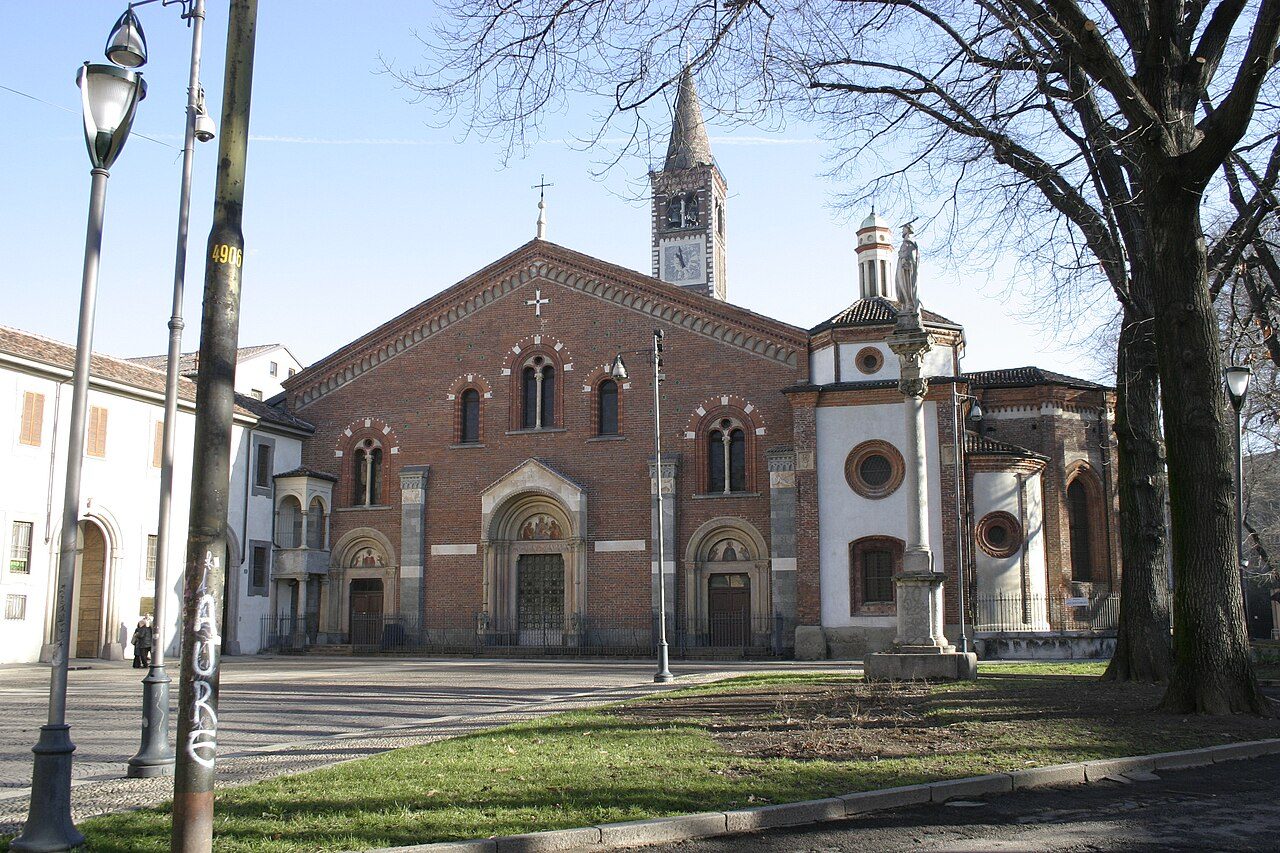
In Piazza Sant'Eustorgio, a few dozen meters back from the facade, far enough to take it all in
The facade looks medieval but is barely more than a hundred and fifty years old. The real stories are at the edges: an open-air pulpit and, legend says, the spot where the cart of the Magi stopped.
Spot the detail
In the square there is a column with the statue of a friar on top. Look closely: what does he have on his head?
The full story
Look at the facade: brick, a simple gabled roof, a row of little arches under the eaves. Everything says Middle Ages. In fact it is a 19th-century remake, designed by the engineer Giovanni Brocca and finished in 1865.
Before then the church had never had a proper facade. Brocca gave it one by imitating the medieval churches of Lombardy, in a style known as Neo-Romanesque. The result is correct, perhaps a little too tidy. The old things are elsewhere.
The open-air pulpit
Look at the left corner of the facade. That stone balcony is a pulpit, and it is outside for a good reason. In the 13th century Pietro da Verona, a Dominican friar, preached here, and the church could not hold everyone who came to hear him. So he spoke to the square.
His pulpit was made of wood. The one you see copies it in stone and dates from 1597. The last man to climb it to preach was Federico Borromeo, cardinal and archbishop of Milan.
Pietro was no ordinary preacher. He was an , a judge charged by the Church with fighting heretics. The court of the Inquisition sat right next door, in the rooms of the friars' convent.
Where the cart stopped
Now the legend, which explains why the church is here. In the 4th century, the story goes, the bishop Eustorgio was on his way back from Constantinople with a gift from the emperor: a stone sarcophagus holding the bodies of the three Magi. The cart, pulled by oxen, reached this spot outside the city walls and went no farther.
Eustorgio understood that the Magi had chosen. He gave up on taking them into the city and had the church built where the cart had stopped.
This square has another tradition too, and an even more ambitious one. There was a spring nearby, and in the Middle Ages people said the apostle Barnabas had baptized Milan's first Christians in it. No document proves it.
But the two stories say the same thing. For the Milanese, this corner outside the gates has always been the place where it all began.
About this stop
Legend
The Magi's cart that would not move
According to tradition, the basilica of Sant'Eustorgio stands where a cart came to a halt. In the 4th century Eustorgio, bishop of Milan, received the bodies of the three Magi, then in Constantinople, as a gift from the emperor. He loaded them, inside a stone sarcophagus, onto a cart pulled by oxen and set off for Milan. At the gates of the city the cart stopped. Some say the oxen collapsed from exhaustion, others that the load became too heavy. Eustorgio saw in it the will of the Magi and built the church on that spot, outside the walls. The story appears in writing only in the 12th century.
Legend
The apostle's spring under a courtyard
Beside the basilica of Sant'Eustorgio, under the courtyard of a house on the square, is a stone basin about two meters wide: the Fonte di San Barnaba, Saint Barnabas's font. A medieval legend says Milan's first Christians were baptized in it. Galvano Fiamma, a 14th-century chronicler and friar of Sant'Eustorgio, writes that the apostle Barnabas settled here, outside the walls, to avoid living in a pagan city, and celebrated the first Mass. No document confirms it: the spring is first mentioned in the late 10th century. Later it became a washhouse. In the 1600s Federico Borromeo, archbishop of Milan, built a church over it, later demolished. The basin remains.
This stop on the map
Next stop
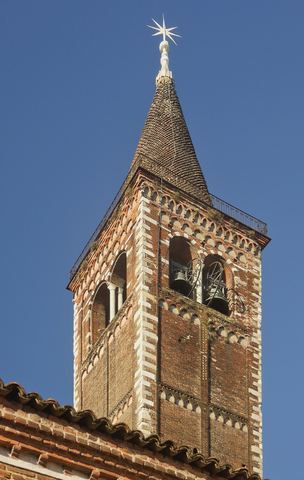
Stay outside and look for the tower rising behind the church: that is the bell tower