Stop 7 of 8Must-see
Bergognone's Coronation of the Virgin
Where to stand
In front of the high altar, looking up at the painted half-dome at the back of the apse
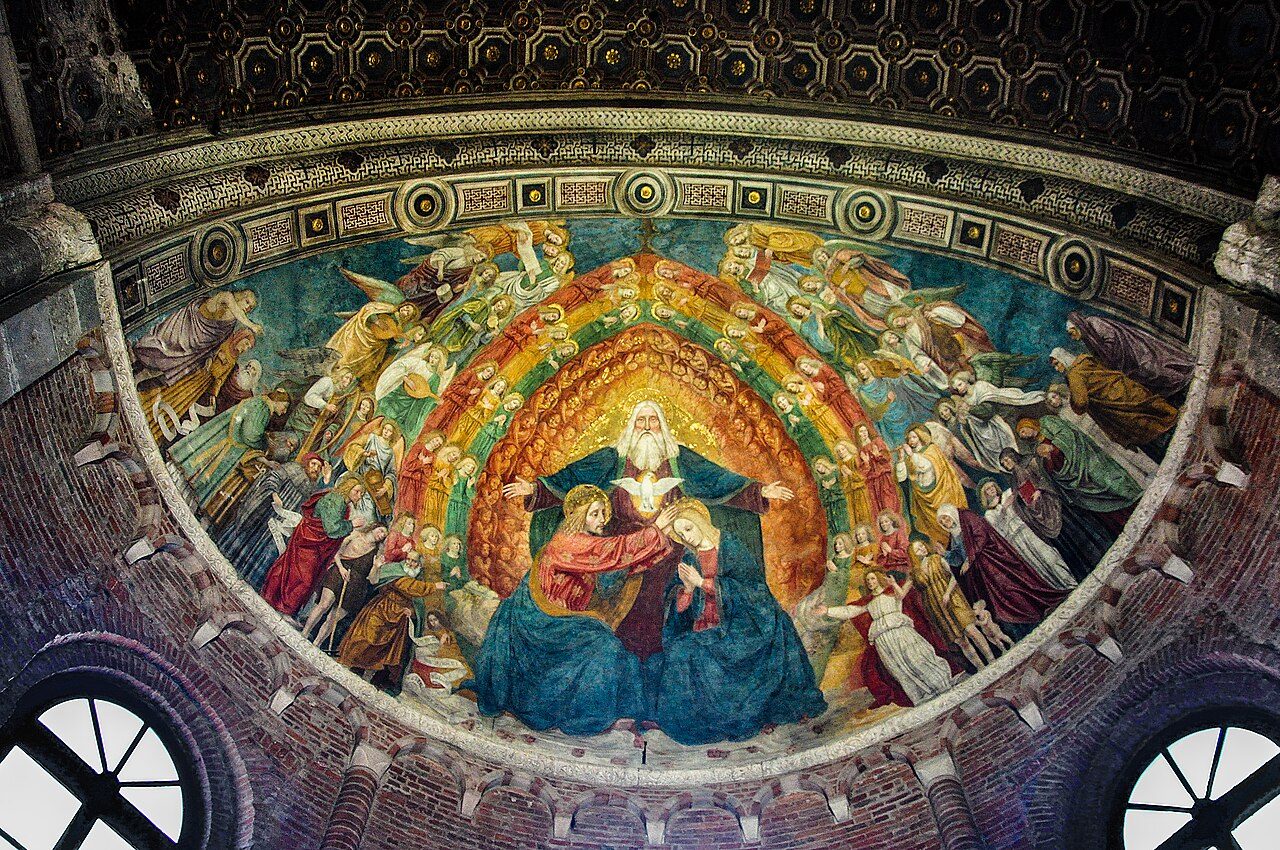
The basilica's masterpiece: the Coronation of the Virgin, painted by Bergognone in the early 1500s. It fills the entire half-dome of the , with Christ, Mary and God the Father inside a ring of angels.
Spot the detail
Compare the figures with one another: the saints below, the angels, God the Father at the top. Are they the same size?
The full story
If you have time for only one thing, this is it. The entire half-dome of the , the , is a single fresco: the Coronation of the Virgin. It was painted by Ambrogio da Fossano, known as Bergognone, in the first decade of the 1500s.
How to read the fresco
Start from the center. Christ places the crown on the head of Mary, his mother. Above them is God the Father. The three figures form a triangle, and its apex is the Father's face.
Around them wheels a host of brightly colored angels, arranged in concentric bands. Below, in the foreground, stands a crowd of saints and worshippers, large and solemn.
Now look at the sizes. The figures do not follow distance, they follow importance: whoever matters more is bigger. God the Father is over four meters tall, about 13 feet.
A painter against the tide
Bergognone worked in Milan in the same years as Leonardo da Vinci. Yet he seems to come from another world. Leonardo's lesson barely brushed him. His figures stay still, devout, full of an old-fashioned sweetness.
He had trained on the Lombard painting of Vincenzo Foppa and had worked for years among the monks at the Certosa di Pavia, the great charterhouse near Pavia. That is why he works so well here. A monks' church, ancient and austere, needed an orderly, luminous Paradise. Scholars consider this his finest fresco.
A masterpiece put in the shade
In the 1800s it became hard to see. In 1839 a new high altar was built in front of the , bigger than the old one, and it blocked the view of the fresco. Damp did the rest.
At the end of the century the roof of the was rebuilt to protect it, and the fresco was cleaned from top to bottom. Today it is back to doing what it was made for. It is the first thing you look at when you raise your eyes from the altar, and the last thing that stays with you as you leave.
About this stop
Anecdote
The altar that hid the masterpiece
Between 1838 and 1841 the architect Giulio Aluisetti modernized the basilica of San Simpliciano. Among other things he built a new, bigger high altar. It blocked the view of the Coronation of the Virgin, the great fresco painted in the in the early 1500s by the Lombard painter Bergognone: the most important work in the church. The fresco was also suffering from damp. Only at the end of the 1800s was the apse roof rebuilt to protect it, and in 1892 the painting was cleaned in full. The restorations of the 1900s then removed Aluisetti's decorations from walls and vaults.
Ambrogio da Fossano, known as Bergognone, was a Lombard painter documented between 1481 and 1522. He trained on the painting of Vincenzo Foppa and worked for years at the Certosa di Pavia, the charterhouse near Pavia. He painted quiet, devout figures, and Leonardo's innovations touched him only on the surface. The Coronation at San Simpliciano is considered his finest fresco. Other works of his can be seen in Milan at the Pinacoteca di Brera, the city's main picture gallery, and in the Basilica di Sant'Ambrogio.
Next stop
To the left of the apse, look for the door under the choir loft: it leads into the sacello of the martyrs