Stop 1 of 8
The piazza and the facade
Where to stand
In Piazza San Simpliciano, a few steps back from the church forecourt, so you can see the whole facade
The facade looks medieval through and through, but much of what you see is an 1870 rebuild. The old part is the central portal, from the 12th century. And the church's real secret can't be seen from here.
Spot the detail
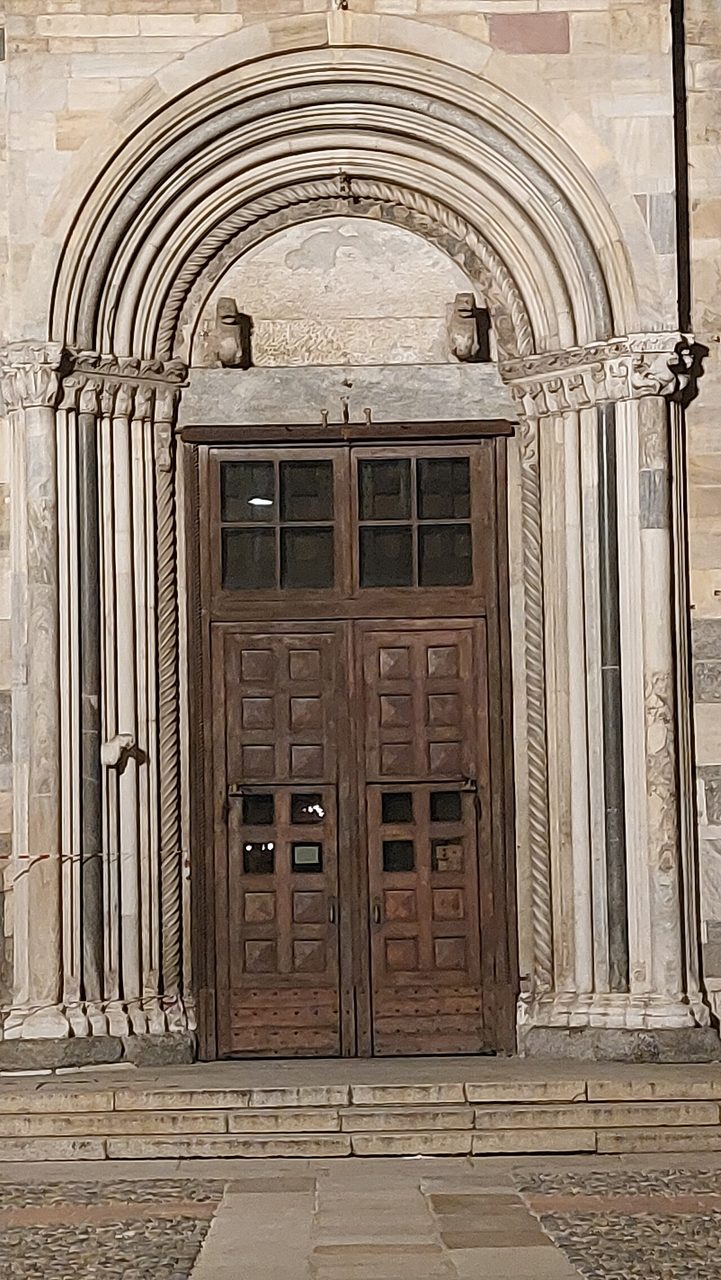
On the central portal, find the stone animals standing guard. What are they, and how many?
The full story
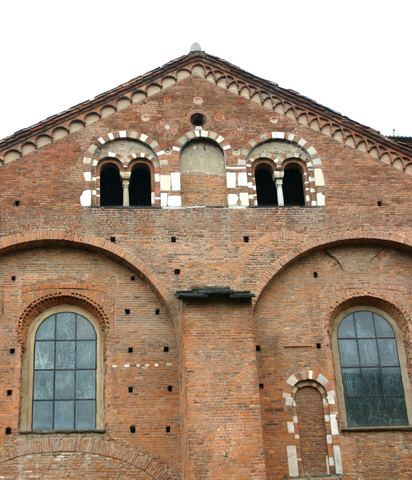
Look at the facade: brick, a simple gabled roof, three arches below and windows with little columns above. It seems to have come out of the Middle Ages in one piece. In fact, much of what you see dates from 1870.
It was rebuilt by Carlo Maciachini, the architect of Milan's Cimitero Monumentale, the city's monumental cemetery. This was the age when old churches were restored in style: whatever was missing was rebuilt the way people imagined it had been. Maciachini added the two side doors and redesigned the upper part, with the , the three-light window and the row of small arches under the roof.
The 12th-century portal
One thing he left where it was, though, and it is the thing to look at: the central portal. It dates from the 12th century, when the church was given its Romanesque dress. It has kept its arches and its stone lions.
On either side of the arch are small carved figures, worn and partly broken. Nobody agrees on who they are. Some see Milanese saints, others a procession of women holding lamps, like the virgins in a Gospel parable.
The second reading has one argument in its favor. Originally this was not the church of San Simpliciano: it was the basilica of the virgins.
The saints above the doors
Above the side doors, look at the two mosaics. One shows three saints: Sisinnio, Martirio and Alessandro. They are the martyrs buried inside, and you will keep meeting them all through the visit.
The other shows Saint Benedict and Saint Scholastica, the saints of the Benedictine monks. They recall the monastery that lived beside the church for about nine centuries.
What the facade hides
So far you have seen a medieval church restored with a great deal of goodwill. But the facade is the youngest part of the building, and the least honest.
Behind it stands a basilica sixteen centuries old, built when Milan was a capital of the Roman Empire. To see it you have to leave the piazza and walk around the church.
This stop on the map
Next stop
Go around the corner of the facade and walk along the side of the church, looking up at the brick walls