Stop 6 of 8
Under the dome: choir lofts and altar
Where to stand
At the far end of the nave, under the dome, in front of the high altar
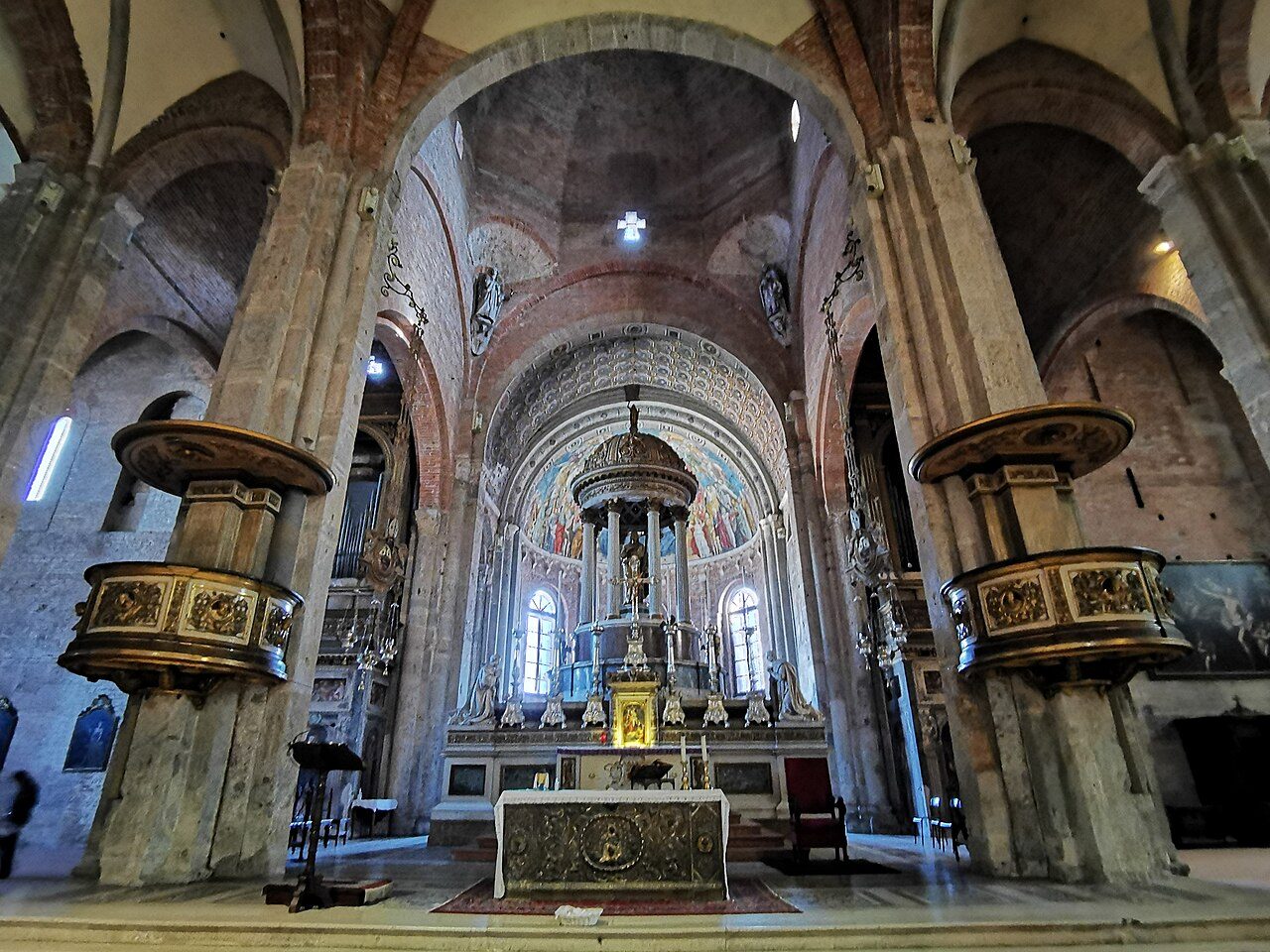
Here the church widens into the and rises into the dome. On either side are two frescoed by Aurelio Luini. Beneath the altar lie Simpliciano and the three martyrs of Anaunia.
Spot the detail
On the two choir lofts, the masonry balconies at the sides, find the painted angels. What are they holding?
The full story
You are at the point where the basilica changes shape. The nave crosses the , the transverse arm, and the dome opens above your head. From outside it is enclosed in a , an eight-sided masonry tower, added in the Middle Ages and reworked at the end of the 1500s.
The is older than it looks. Its two arms follow those of the 4th-century basilica, which already had a cross-shaped plan.
The orchestra of angels
High up on either side are two masonry . They were frescoed in the 1500s by Aurelio Luini, son of Bernardino Luini, one of the best-loved painters in the Milan of his day. He filled them with pairs of saints and, in the frieze at the top, little angels playing instruments of every sort.
Look also at the two organ cases, one on each side. They are identical, but only one holds an instrument, built at the end of the 1800s. The other is empty: it is there for symmetry.
Then look for the paintings. In the left arm of the is the Marriage of the Virgin by Camillo Procaccini, one of the most important paintings in the church.
Who rests beneath the altar
The high altar, in colored marbles, is from the 1800s. But what matters lies underneath. Here rest Simpliciano, the bishop who gives the church its name, and the three martyrs of Anaunia, along with other saintly bishops.
The relics were rediscovered in the early 1500s, when the monks moved the altar to enlarge the choir. In 1582 Carlo Borromeo, archbishop of Milan, had them carried to the new altar in a great procession. The monks' choir still has its inlaid wooden stalls from the end of the 1500s.
The saint passing through
This church also hosted a famous dead man. In April 1252 the body of Pietro da Verona was brought here: a Dominican friar and inquisitor, killed in a wood on the road between Como and Milan. At San Simpliciano he was laid in a coffin.
Less than a year later he was already a saint, under the name of Saint Peter Martyr. His tomb is in the Basilica di Sant'Eustorgio, on the other side of the city. But the first marble chest in which he rested there was a gift from the abbot of this monastery.
About this stop
Anecdote
Saint Peter Martyr's first stop
On April 6, 1252, Pietro da Verona, a Dominican friar and inquisitor, is killed in a wood while traveling from Como to Milan. His body is brought to San Simpliciano and laid in a coffin. Less than a year later the pope proclaims him a saint. His tomb is in the Basilica di Sant'Eustorgio, inside a great marble monument of the 1300s. But one link with San Simpliciano remains. The marble chest in which the body was placed at Sant'Eustorgio after the canonization was a gift from the abbot of this monastery.
Next stop
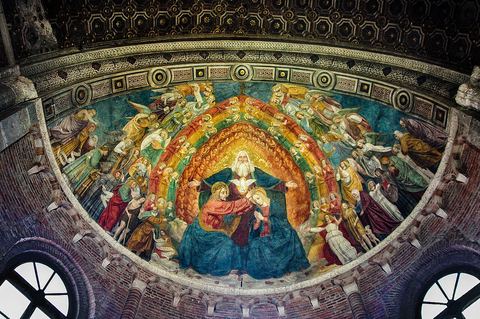
Stay in front of the altar and look beyond it, up to the great painted half-dome at the end of the church