Monument · Monumentale and Porta Nuova · 1863–1866
Cimitero Monumentale
A city of marble and bronze where Milan carved its own memory
In brief
The cemetery that opened in 1866 and became the open-air museum of Milanese sculpture. You'll find Manzoni and Gaber here, a Last Supper in bronze, and Italy's first cremation temple.
Stories of this place
- Anecdote · The entrance and Maciachini's facadeReadThe attack on Anna Kuliscioff's funeralAt the end of December 1925 a great crowd followed Anna Kuliscioff to the Cimitero Monumentale, Milan's monumental cemetery. She was a doctor, a Russian revolutionary and the soul of Italian socialism. Fascism was now master of the country. A group of Fascists threw themselves on the procession and tore away drapes and wreaths. The socialist Pietro Nenni recalled being attacked on the steps of the cemetery, as he shouted Viva il socialismo!, long live socialism. Some have called that funeral the last free demonstration of that Italy. Anna's partner, Filippo Turati, died in exile in Paris in 1932. His remains came back to Milan, to this cemetery, in 1948.
- Anecdote · The entrance and Maciachini's facadeReadThe cemetery's first guest, a musicianOn November 2, 1866, while a monsignor blessed Milan's new Cimitero Monumentale, the monumental cemetery, in front of the mayor, its first guest was being buried. His name was Gustavo Adolfo Noseda, a composer and a collector of music manuscripts and prints. He had died of consumption at twenty-seven, just as he was about to make his debut at La Scala, and had been buried in another of the city's cemeteries. He was moved here for the inauguration. Sixteen more burials followed over the next two months, and then the cemetery opened for real.
- In culture · The Famedio, temple of Milan's great and goodReadVerdi, a guest for one monthGiuseppe Verdi died in Milan on January 27, 1901, and was buried at the Cimitero Monumentale, the city's monumental cemetery. He stayed about a month. Then he and his wife, Giuseppina Strepponi, were moved to the crypt of the rest home for musicians that the composer had founded. For the occasion a young Arturo Toscanini conducted a choir of more than eight hundred voices in Va' pensiero, the chorus from Nabucco. What the Monumentale has kept of Verdi is his name, carved in the Famedio, the hall of illustrious Milanese. Toscanini, on the other hand, came back to stay.
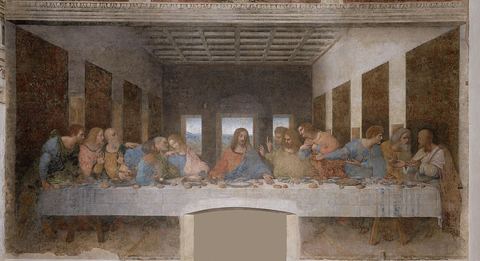
- Anecdote · The Edicola Campari, a Last Supper in bronzeReadThe Campari tomb, the last aperitivoAt the Cimitero Monumentale, Milan's monumental cemetery, stands the tomb of Davide Campari, owner of the liqueur house that bears his name. On it the sculptor Giannino Castiglioni set a life-size bronze Last Supper in 1935, resting on a boulder of porphyry. The subject could not be more serious, but the Milanese couldn't resist: ever since, everyone has called the monument the last aperitivo, after the drink before dinner. The nickname has made its way into the city's newspapers, and it captures Milan, a city happy to joke even about solemn things, as long as it is done with affection.
- Record · The Tempio Crematorio, the first in ItalyReadItaly's first crematoriumThe Tempio Crematorio at the Cimitero Monumentale, Milan's monumental cemetery, opened on January 22, 1876, is the first cremation temple in Italy, and according to some sources the first in the Western world. The textile industrialist Alberto Keller had campaigned for it, and the first cremation was his own. It used an altar with flames fed by illuminating gas. Twenty years later came four wood-fired furnaces, which are still in place. The temple stayed in operation until 1992.
- In culture · The Riparto Israelitico, the Jewish sectionReadChagall, by way of a windowAt the Cimitero Monumentale, Milan's monumental cemetery, the stained-glass windows of the pavilion in the Riparto Israelitico, the Jewish section, are an open tribute to the painter Marc Chagall. Diego Pennacchio Ardemagni designed them with an eye on the twelve windows the painter made for the synagogue of the Hadassah hospital in Jerusalem, dedicated to the twelve tribes of Israel. They were made in a workshop in Frankfurt using Chagall's own technique: glass that is blown, flashed, etched and kiln-fired with paint. In them you will find flowers, fish, birds, stars and a menorah.
- AnecdoteReadA Mozart keeping the books in MilanOn the central avenue of the Cimitero Monumentale, Milan's monumental cemetery, between the Famedio and the Tempio Crematorio, stands the Ossario, the domed ossuary. Low on its right side, facing east, look for a plaque with an unexpected surname: Mozart. It is Carlo, son of Wolfgang Amadeus. He came to Milan young, studied music for a few years, then gave it up and became an accounting clerk for the Austrian government. He died here in 1858, unmarried, and the family ended with him. He was buried in the same cemetery as the poet Parini, later closed. The plaque, from 1958, calls him the last son of the supreme musician.
- AnecdoteReadThe Ascaris and the number 26Antonio and Alberto Ascari, father and son, both racing drivers, lie in the same monument at the Cimitero Monumentale, Milan's monumental cemetery, not far from the Tempio Crematorio, the cremation temple. Antonio died racing in France on July 26, 1925, when Alberto was seven. The son became Formula 1 world champion and was superstitious: he always raced in his own blue helmet and avoided getting behind the wheel on the 26th. On May 26, 1955, at Monza, he took a friend's car out for a few test laps, wearing a borrowed helmet. The car overturned. He was thirty-six years and ten months old, like his father.
- AnecdoteReadEinstein's fatherAmong the names you don't expect at the Cimitero Monumentale, Milan's monumental cemetery, is that of Hermann Einstein, father of the physicist Albert Einstein. He was a businessman in the electrical industry. With his brother he had moved the family firm from Munich to Pavia, without success, and then opened another one in Milan. He died here in 1902, at fifty-five. His tomb is in the Civico Mausoleo Palanti, a mausoleum that the city has set aside for distinguished citizens.
- RecordReadErba and Bocconi, a contest won by a meterAt the Cimitero Monumentale, Milan's monumental cemetery, the family chapels, called edicole, competed in height too. The one of the Erba family, of the pharmaceutical industry, is a truncated pyramid about nineteen meters tall, and it took twelve years to finish. It was commissioned by Luigi Erba, grandfather of the film director Luchino Visconti. Not far away stands that of the Bocconi family, of the department stores and the university: its granite canopy reaches twenty meters. In Milan the story goes that the two families were competing, and that the Bocconis won by one meter. Find them both and judge by eye.
Ready-made questions
Because at a certain point the Monumentale became the cemetery for burials in perpetuity. It was built for everyone, but it soon proved too small, and in 1895 Milan opened the cemetery of Musocco. What stayed here were the family tombs meant to last. The dynasties of industry, from the Falcks to the Bocconis, from the Camparis to the Brancas, competed to have the most remarkable , or family chapel, built for themselves, and called in leading architects and sculptors. It is a contest of prestige that went on for decades, and it is the reason you are here today.
Yes. The Monumentale is a real cemetery, not a museum in disguise. Families come to visit their dead, and the goes on welcoming new names every November 2. Among the best-known recent burials is that of the ballerina Carla Fracci, who died in 2021, the first woman buried in the hall of the Famedio. So one simple rule applies: look at everything you like, but with the pace and the voice you would use in a church.
A committee, which chooses people who have brought honor to Milan, Milanese by birth or by adoption. Be careful, though: getting into the almost always means having your name carved on the walls, not having your tomb there. Only eight people are buried in the hall, among them Manzoni, Cattaneo, Quasimodo and Carla Fracci. Others rest in the crypt. Everyone else is buried somewhere else, in the cemetery or far from Milan. New names are added every year on November 2, at a ceremony presided over by the mayor.
Go to stop: The Famedio, temple of Milan's great and goodThe list is long and mixes everything. For literature, Alessandro Manzoni, Salvatore Quasimodo, Alda Merini and Dario Fo. For music, Arturo Toscanini, the pianist Vladimir Horowitz, Giorgio Gaber and Enzo Jannacci. For art, the painter Francesco Hayez, remembered by a monument in the crypt of the , and the sculptor Medardo Rosso. For sports, the soccer player Giuseppe Meazza and the racing drivers Antonio and Alberto Ascari, father and son. And then there is Carlo Maciachini, the architect who designed the cemetery itself.
Many, and that is why the Monumentale is called an open-air museum. Medardo Rosso, Leonardo Bistolfi, Enrico Butti and Adolfo Wildt all worked on the tombs, and after them Lucio Fontana, Giacomo Manzù, Francesco Messina, Fausto Melotti and Giò Pomodoro. There are architects too, such as Gio Ponti and the BBPR studio. Within a few avenues you go from the realism of the late nineteenth century to the sculpture of the later twentieth. No museum in Milan lets you make the same journey while walking outdoors.
Go to stop: The Edicola Toscanini and the language of symbolsBecause that is how Maciachini designed it. The Monumentale was created as a civic cemetery, open to more than one faith, but with separate spaces: the Catholic part in the center, and on either side two symmetrical sections, one for non-Catholics and one for Jews. The Israelitico, opened in 1872, replaced the Jewish sections of the old cemeteries that had been closed, and it had its own entrance, the three-arched pavilion you can still see. For the nineteenth century it was a modern solution: a city of the dead with its own districts, like the city of the living.
Go to stop: The Riparto Israelitico, the Jewish sectionThe stops
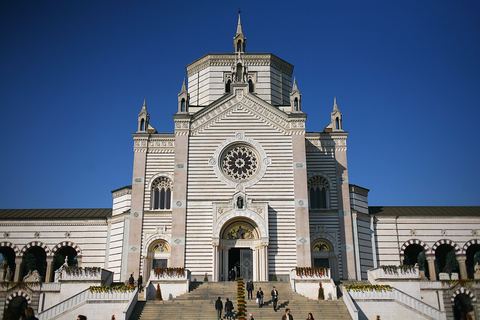
1 The entrance and Maciachini's facade
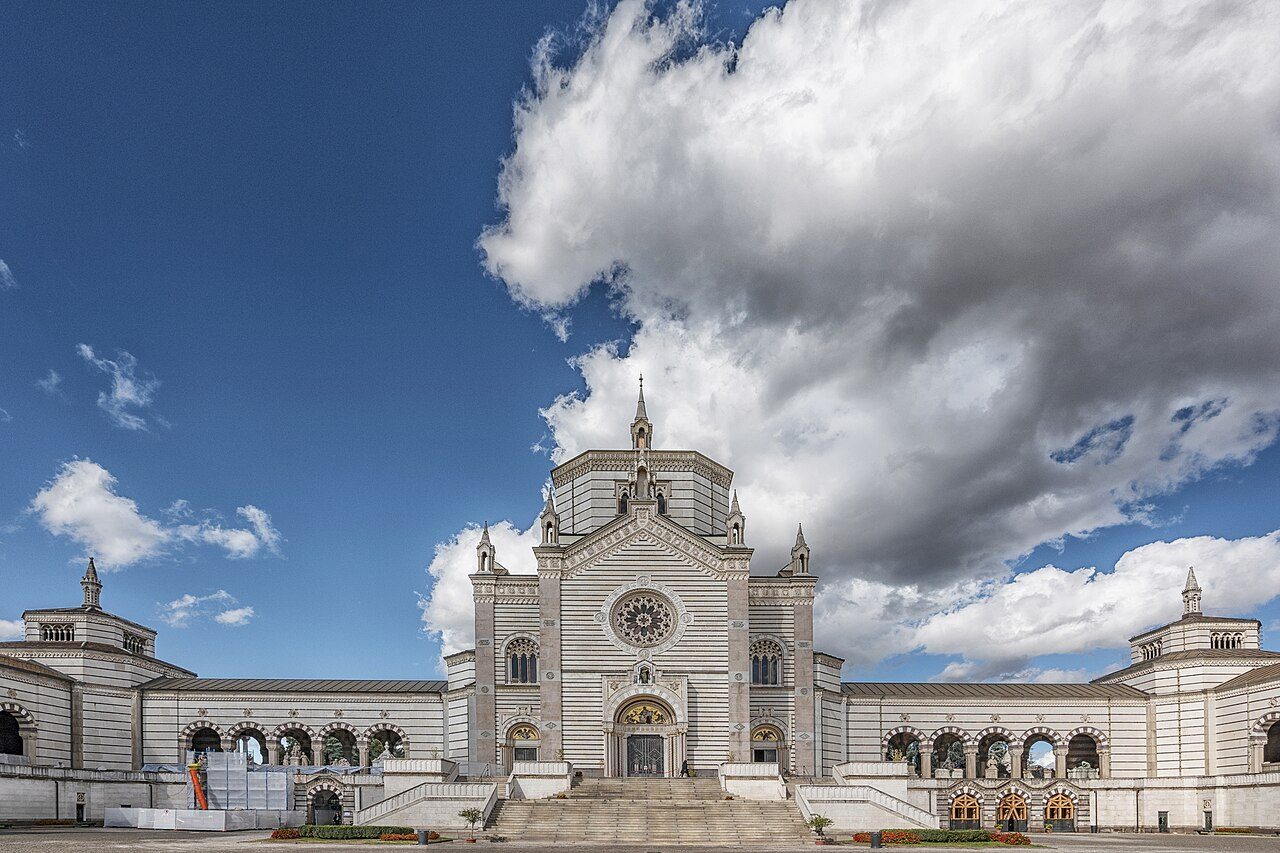
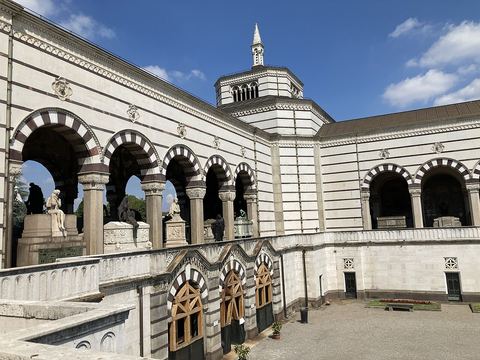
A facade in red and white stripes that belongs to no particular style. It was designed by Carlo Maciachini, a former carpenter turned architect, after almost thirty years of failed plans.
2 The Famedio, temple of Milan's great and good
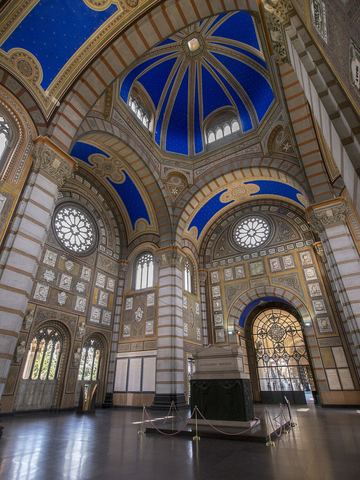
It was meant to be a church and became Milan's pantheon. Manzoni lies at the center, the names of the city's great and good run along the walls, and Gaber, Jannacci and Alda Merini rest in the crypt.
3 The Edicola Campari, a Last Supper in bronze
On the tomb of Davide Campari there is a life-size Last Supper in bronze, modeled by Giannino Castiglioni in 1935. The Milanese call it, with no malice at all, the last aperitivo.
4 The memorial to those who died in the Nazi camps
A memorial made of almost nothing: white tubes, stone slabs and, at the center, a mess tin holding soil from a Nazi camp. It was designed after the war by the BBPR studio, which had lost one of its founders in a camp.
5 The Edicola Toscanini and the language of symbols
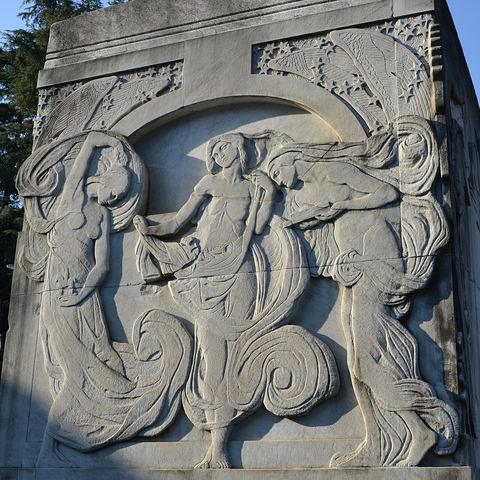
The conductor Arturo Toscanini had this tomb built for his son Giorgio, who died as a child in Buenos Aires in 1906. The reliefs by Leonardo Bistolfi speak of childhood and of a voyage by sea.
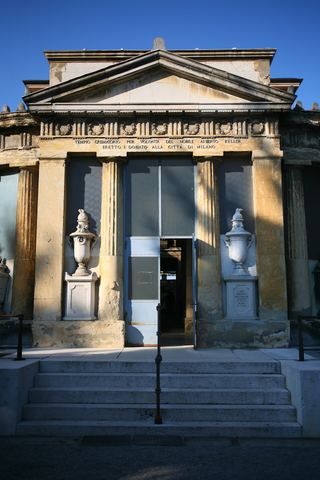
6 The Tempio Crematorio, the first in Italy
Opened in January 1876, this is the first cremation temple in Italy. The industrialist Alberto Keller campaigned for it, and the first cremation was his own. The late nineteenth-century furnaces are still in place.
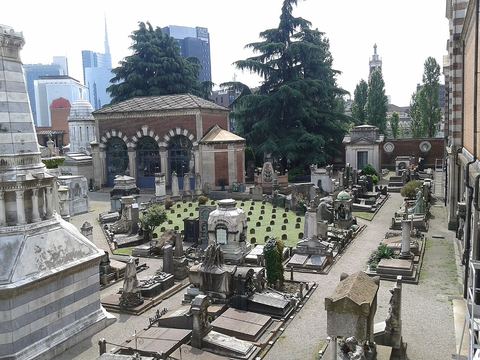
7 The Riparto Israelitico, the Jewish section
A cemetery within the cemetery, opened in 1872 for the Jewish community. It has a pavilion with stained glass inspired by Chagall, the chapels of great families and the memorial to the Jewish martyrs of Nazism.
Timeline
- 1837Under Austrian rule, the idea is born of a single cemetery to replace the six scattered around the city.
- 1863After a new competition the city council chooses the design by the architect Carlo Maciachini.
- 1866On November 2 the cemetery is blessed. The first person buried is the composer Gustavo Adolfo Noseda.
- 1872The Riparto Israelitico, the Jewish section, opens east of the Famedio with an entrance of its own.
- 1876On January 22 the Tempio Crematorio, the first in Italy, opens with the cremation of Alberto Keller.
- 1883Alessandro Manzoni is moved to the Famedio. Carlo Cattaneo follows him a year later.
- 1895The cemetery of Musocco opens: the Monumentale keeps the burials in perpetuity and the great family tombs.
- 1946The memorial to the Milanese who died in the Nazi camps is built, designed a year earlier by the BBPR studio.
Who's who
Carlo Maciachini
architect of the cemetery
Born near Varese in 1818, a carpenter and carver, he studied in the evenings at the Accademia di Brera. He won the competition in 1863 and followed the works for over twenty years. He is buried here.
Alessandro Manzoni
writer, author of I promessi sposi
He died in 1873 and was brought to the Famedio ten years later. His sarcophagus stands at the center of the hall, on a base with bronze reliefs added in 1958.
Giannino Castiglioni
sculptor
Milanese, 1884 to 1971. He made the Last Supper on the Campari tomb, the Way of the Cross on the Bernocchi tomb and Manzoni's base. Father of the designers Livio, Pier Giacomo and Achille.
Alberto Keller
textile industrialist
He campaigned for the Tempio Crematorio, the first in Italy. When it opened, on January 22, 1876, the first cremation was his own.
Arturo Toscanini
conductor
He had the family edicola built for his son Giorgio, who died as a child in 1906. He died in 1957 and is buried there, as is his son-in-law, the pianist Vladimir Horowitz.
Gian Luigi Banfi
architect of the BBPR studio
He took part in the Resistance and died in the Gusen camp in 1945. A few months later his partners designed the memorial to those who died in the Nazi camps.
Words to know
Where it is
The neighborhood
Monumentale and Porta Nuova
Related places
The story of the place
It took Milan almost thirty years to make up its mind. In 1837, under Austrian rule, the city began to think about a single cemetery to replace the six scattered around its edges. What followed was a competition, designs approved and then blocked, a building site abandoned. Only after the unification of Italy did the city council start again from scratch, and in July 1863 it chose the design by Carlo Maciachini, a former carpenter from the province of Varese who had become an architect by taking evening classes at the Accademia di Brera, Milan's fine arts academy.
Laid out like a city
The cemetery was blessed on November 2, 1866, All Souls' Day, and opened officially at the start of the following year. It covers twenty-five hectares and is laid out like a city: a central avenue, an axis that cuts it in half, a grid of districts called .
The style mixes Byzantine, Gothic and Romanesque without a hint of embarrassment, in bands of white marble and red stone. This is nineteenth-century : you take from the past whatever you need.
An open-air museum
But the Monumentale is not famous for its architecture. It is famous for its tombs.
It soon turned out to be too small for a city that was growing fast. In 1895 the cemetery of Musocco opened, and from then on only burials in perpetuity stayed here. Milan's industrial families had ever more ambitious , or family chapels, built for themselves and handed them to the best sculptors of the day: Medardo Rosso, Adolfo Wildt, later Lucio Fontana and Giacomo Manzù. The result is an open-air museum of sculpture, from the realism of the late nineteenth century right up to the present.
What you find along the route
At the center of the entrance stands the , the temple of Milan's great and good, with the tomb of Alessandro Manzoni. Farther in you'll find the bronze Last Supper on the Campari tomb, the memorial to the Milanese who died in the Nazi camps, the Tempio Crematorio, the first cremation temple in Italy, and the Israelitico, the Jewish section, a world apart behind a wall.
One word of warning. This is not a museum like the others: burials still take place, and people still come to visit their dead. Walk slowly and keep your voice down.
The route takes in seven spots chosen because each has a clear story to tell, but the cemetery is far bigger than that. If you feel like it, get lost.
Sources
- Maciachini, Carlo, Dizionario Biografico degli Italiani, Enciclopedia Treccani (opens in a new tab)Encyclopedia
- La struttura architettonica del Riparto Israelitico, Cimitero Monumentale di Milano (opens in a new tab)Institution
- Cimitero Monumentale di Milano, Wikipedia in italiano (opens in a new tab)Wikipedia
- Cimitero Monumentale di Milano, Wikipedia in inglese (opens in a new tab)Wikipedia
- Giannino Castiglioni, Wikipedia in italiano (opens in a new tab)Wikipedia
- BBPR, Wikipedia in italiano (opens in a new tab)Wikipedia
- Vladimir Horowitz, Wikipedia in inglese (opens in a new tab)Wikipedia
- Hermann Einstein, Wikipedia in inglese (opens in a new tab)Wikipedia
- Va, pensiero, Wikipedia in inglese (opens in a new tab)Wikipedia
- Monumentale, i tesori delle tombe, il Giornale, 31 ottobre 2006 (opens in a new tab)Other source
- Il Cimitero Monumentale: una passeggiata fra arte e milanesi illustri, Il Giorno, 23 giugno 2016 (opens in a new tab)Other source
- Cimitero Monumentale di Milano, storia e opere, MilanoFree (opens in a new tab)Other source
- Edicola Campari, L'Ultima Cena di Giannino Castiglioni, didascalia fotografica Photo12 (opens in a new tab)Other source
- Cimitero monumentale di Milano, Wikidata (Q608405) (opens in a new tab)Other source
- Famedio, Vocabolario Treccani (opens in a new tab)Encyclopedia
- Progettare la memoria. Lo studio BBPR: i monumenti, le deportazioni, Gaia Carboni, Novecento.org (opens in a new tab)Institution
- A Non-Figurative Memorial: the Monument to the Victims of the Concentration Camps in Milan by BBPR, Socks Studio (opens in a new tab)Other source
- The Crematorium Temple of Milan, Himetop, Università Campus Bio-Medico di Roma (opens in a new tab)Institution
- Herbert Kilpin nella cripta del Famedio, AC Milan, 13 dicembre 2024 (opens in a new tab)Other source
- Carla Fracci prima donna tumulata al Famedio, Il Fatto Quotidiano, 2 novembre 2021 (opens in a new tab)Other source
- Mozzoni e Mantegazza, due varesini nel Famedio di Milano, VareseNews, 3 novembre 2016 (opens in a new tab)Other source
- Cimitero Monumentale di Milano, sito ufficiale del Comune di Milano (opens in a new tab)Official site
- Ossario centrale, Cimitero Monumentale di Milano, Comune di Milano (opens in a new tab)Official site
- Edicola Bocconi, Cimitero Monumentale di Milano, Comune di Milano (opens in a new tab)Official site
- Edicola Erba, Cimitero Monumentale di Milano, Comune di Milano (opens in a new tab)Official site
- Cimitero Monumentale di Milano: a spasso tra storie, personaggi e curiosità, Mentelocale, 28 novembre 2025 (opens in a new tab)Other source
- Carl Thomas Mozart, Wikipedia in italiano (opens in a new tab)Wikipedia
- Karl Thomas Mozart, Wikipedia in inglese (opens in a new tab)Wikipedia
- Sepolture illustri del Cimitero Monumentale di Milano, Wikipedia in italiano (opens in a new tab)Wikipedia
- Alberto Ascari, Wikipedia in inglese (opens in a new tab)Wikipedia
- Ascari and a destiny foretold, Pirelli, 13 luglio 2020 (opens in a new tab)Other source
- Anna Kuliscioff a cento anni dalla morte, Domani, 29 dicembre 2025 (opens in a new tab)Other source
- Anna Kuliscioff, il coraggio di non appartenere, RSI Cultura (opens in a new tab)Other source
- Anna Kuliscioff, Wikipedia in italiano (opens in a new tab)Wikipedia
- Filippo Turati, Wikipedia in italiano (opens in a new tab)Wikipedia
- Cimitero della Mojazza, Wikipedia in italiano (opens in a new tab)Wikipedia
- Parini, Giuseppe, Dizionario Biografico degli Italiani, Enciclopedia Treccani (opens in a new tab)Encyclopedia
- Karl Thomas Carlo Mozart, iscrizione della lapide all'Ossario, Find a Grave (opens in a new tab)Other source
- Monumento Ascari, Cimitero Monumentale di Milano, Comune di Milano (opens in a new tab)Official site
- Alberto Ascari, A Legendary Driver, Fondazione Pirelli, 22 maggio 2020 (opens in a new tab)Institution
- Turati, Filippo, Dizionario Biografico degli Italiani, Enciclopedia Treccani (opens in a new tab)Encyclopedia
- Anna Kuliscioff, ristampa di «In memoria» (1926), Fondazione Anna Kuliscioff (opens in a new tab)Institution
- Io, Anna Kuliscioff, la dottora dei poveri, Il Giorno, 9 gennaio 2025 (opens in a new tab)Other source