Stop 7 of 7
The Riparto Israelitico, the Jewish section
Where to stand
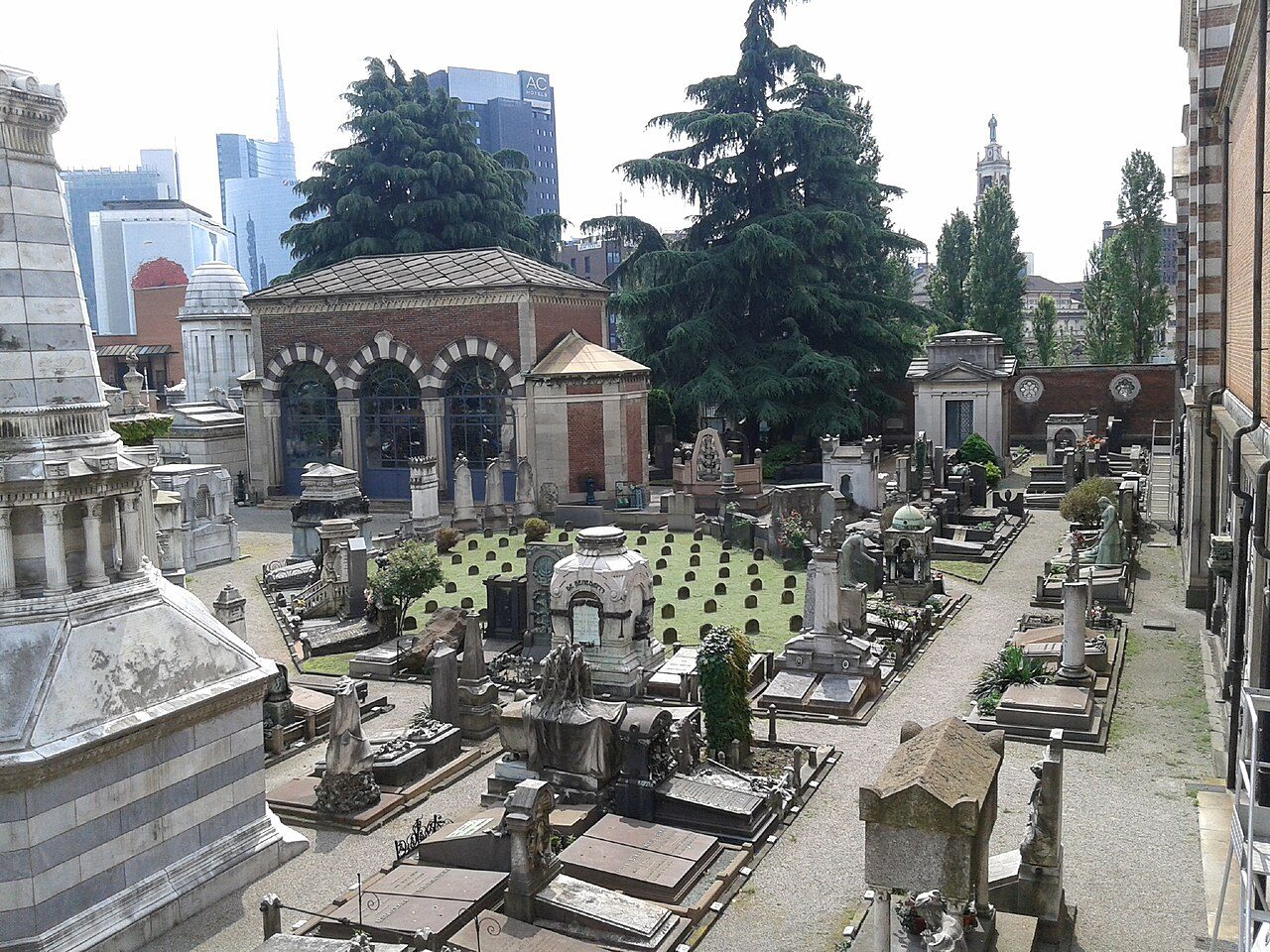
East of the Famedio, beyond the dividing wall, in front of the pavilion with three arches
A cemetery within the cemetery, opened in 1872 for the Jewish community. It has a pavilion with stained glass inspired by Chagall, the chapels of great families and the memorial to the Jewish martyrs of Nazism.
Spot the detail
At the top of the facade of the three-arched pavilion: what is carved there?
The full story
The Israelitico, the Jewish section, is a cemetery within the cemetery. Maciachini, the architect of the Monumentale, designed it along with everything else and placed it east of the , behind a wall, with an entrance of its own. On the other side, in a mirror position, is the riparto for non-Catholics. This one opened in 1872 and replaced the Jewish sections of the old city cemeteries, which had by then been closed down.
The pavilion and its windows
Stop in front of the central pavilion. Three round arches, two polygonal apses at the sides, small decorated columns at the corners of the piers. It is as sober and as Lombard as the rest of the Monumentale. Then you look up, and at the top you find the Tablets of the Law.
Look at the pavilion's stained-glass windows. They are recent: they came with the restoration of 2014. Diego Pennacchio Ardemagni designed them with a thought for the twelve windows that Marc Chagall made for the synagogue of the Hadassah hospital in Jerusalem.
They are dedicated to the twelve tribes of Israel and were made in a workshop in Frankfurt, with the same technique Chagall used. Flowers, fish, birds, stars: a window of color in the middle of the gray.
The family chapels
Then wander among the chapels. Here the Jewish middle class of Milan told its own story just as the Catholic one did on the other side of the wall.
The Treves, the Treves family chapel, from the early twentieth century, is by the sculptor Ettore Ximenes: Carrara marble and a bronze band where the publisher Emilio Treves and his brother Giuseppe appear among writers and typographers. The edicola of Ugo Pisa, a banker and senator who had fought with Garibaldi, is by Maciachini, with a large rose window and an air of the East. On the door of the Goldfinger chapel the sculptor Giannino Castiglioni placed a pomegranate, which in Jewish tradition is a symbol of abundance and fertility.
The old heart of the section is its three common fields, with their small headstones. The one in the middle was for children. Burials here stop at the end of the nineteenth century, when the community began to use the cemetery of Musocco.
The memorial to the Jewish martyrs
Finish in front of the memorial to the Jewish martyrs of Nazism, put up by the community in 1947. It is a great in gray marble, the seven-branched candelabrum, and it holds the remains of twelve victims. Around it, across the section, other names remember people killed by the Nazis.
The visit ends here and the cemetery goes on. It is a good place to stand in silence for a moment before you leave.
About this stop
In culture
Chagall, by way of a window
At the Cimitero Monumentale, Milan's monumental cemetery, the stained-glass windows of the pavilion in the Israelitico, the Jewish section, are an open tribute to the painter Marc Chagall. Diego Pennacchio Ardemagni designed them with an eye on the twelve windows the painter made for the synagogue of the Hadassah hospital in Jerusalem, dedicated to the twelve tribes of Israel. They were made in a workshop in Frankfurt using Chagall's own technique: glass that is blown, flashed, etched and kiln-fired with paint. In them you will find flowers, fish, birds, stars and a .
Because that is how Maciachini designed it. The Monumentale was created as a civic cemetery, open to more than one faith, but with separate spaces: the Catholic part in the center, and on either side two symmetrical sections, one for non-Catholics and one for Jews. The Israelitico, opened in 1872, replaced the Jewish sections of the old cemeteries that had been closed, and it had its own entrance, the three-arched pavilion you can still see. For the nineteenth century it was a modern solution: a city of the dead with its own districts, like the city of the living.