Stop 1 of 7
The entrance and Maciachini's facade
Where to stand
On the forecourt in front of the cemetery, far enough back to see the whole facade and its two wings of arcades
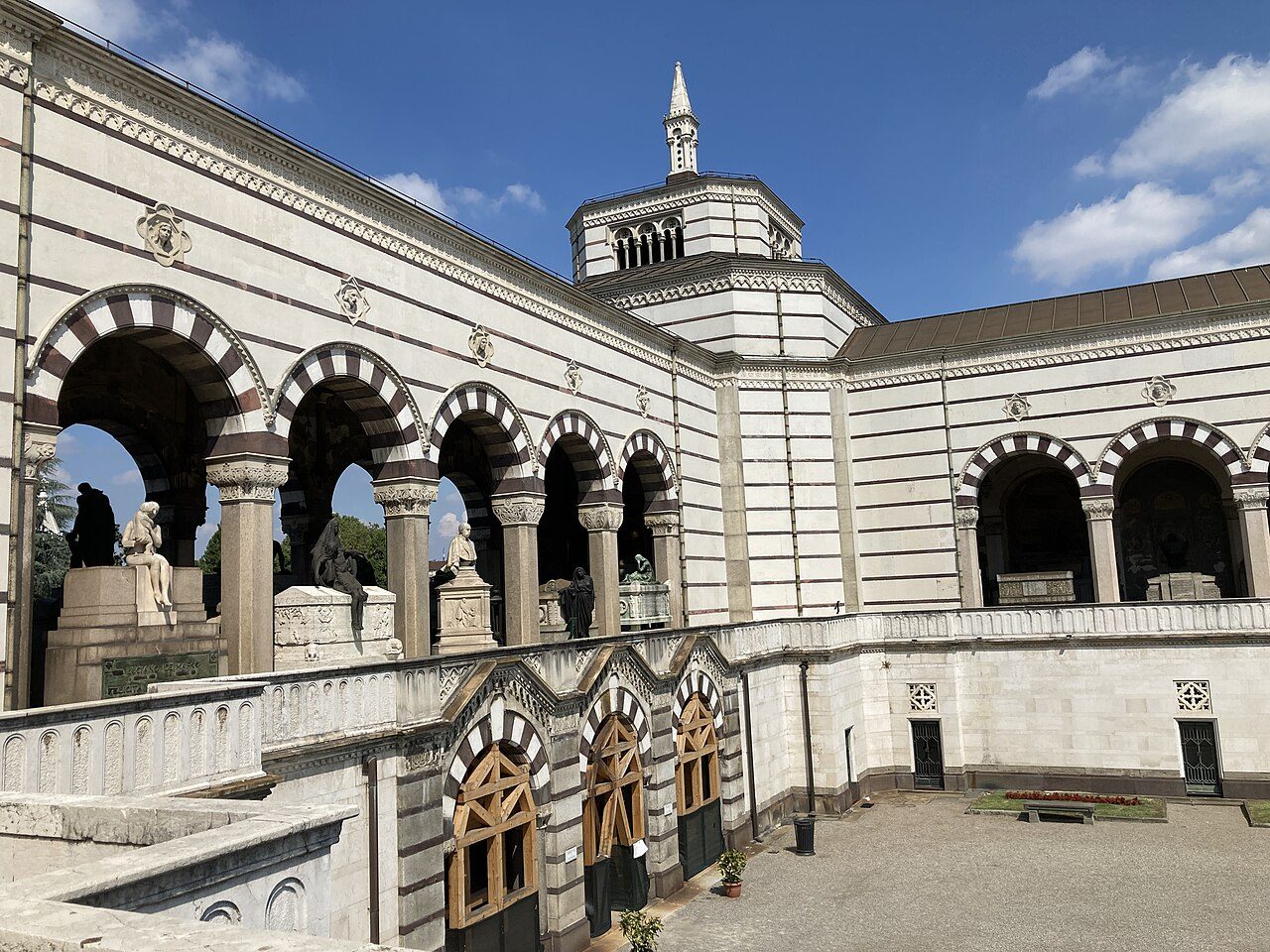
A facade in red and white stripes that belongs to no particular style. It was designed by Carlo Maciachini, a former carpenter turned architect, after almost thirty years of failed plans.
Spot the detail
The horizontal stripes on the facade: two colors, two different stones. Which ones?
The full story
Stop on the forecourt and don't be in a hurry to go in. This facade was made to be seen from a distance.
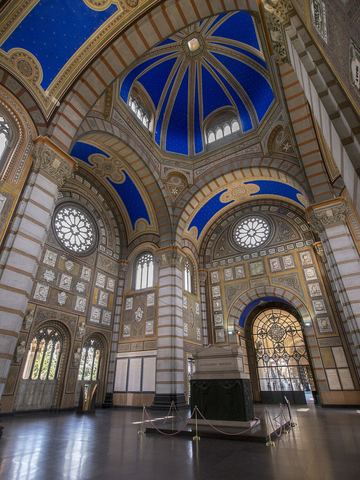
At the center is the tallest building, the , the hall of fame of Milan. Two long arcaded galleries run out from either side, then turn at right angles and come toward you, like two arms around the forecourt. Everything is symmetrical, and everything is there to slow you down.
Red and white stripes
Now look at the colors. White bands and dark red bands run horizontally across the whole front. It looks medieval, but it isn't.
There is a bit of Byzantine here, a bit of Gothic, a bit of Romanesque, mixed with complete ease. It is called , and it is the taste of the nineteenth century: the architect goes shopping in history and comes home with whatever he likes.
The carpenter turned architect
The architect is Carlo Maciachini, and his story is worth the stop. He was born in a village near Varese and worked as a carpenter when he was a boy, with a special gift for carving. At twenty he came to Milan to work in a cabinetmaker's workshop, and in the evenings he took classes in ornament and architecture at the Accademia di Brera, the city's fine arts academy.
By the time he won this competition he had already designed an Orthodox church in Trieste, all domes and golden mosaics. For Milan too he thought of Eastern forms at first, then changed course.
A long string of failures
The competition came after a long string of failures. People had been talking about a single cemetery, to replace the six scattered around the city, since 1837. There were designs approved and never built, a permit refused by the Austrian government, a building site started and then suspended. After the unification of Italy the city council began all over again, and in 1863 the jury picked Maciachini from more than twenty entrants.
The cemetery was blessed on November 2, 1866, All Souls' Day. The first guest was buried that same day, and today his name means nothing to almost anyone: Gustavo Adolfo Noseda, a composer and music collector, dead of consumption at twenty-seven, just when his debut at La Scala, Milan's opera house, was finally within reach. The most famous cemetery in Milan begins with a musician who never got to hear himself played.
Maciachini followed the works for more than twenty years, and in the end he stayed. He is buried here too, inside his own creation.
About this stop
Anecdote
The attack on Anna Kuliscioff's funeral
At the end of December 1925 a great crowd followed Anna Kuliscioff to the Cimitero Monumentale, Milan's monumental cemetery. She was a doctor, a Russian revolutionary and the soul of Italian socialism. Fascism was now master of the country. A group of Fascists threw themselves on the procession and tore away drapes and wreaths. The socialist Pietro Nenni recalled being attacked on the steps of the cemetery, as he shouted Viva il socialismo!, long live socialism. Some have called that funeral the last free demonstration of that Italy. Anna's partner, Filippo Turati, died in exile in Paris in 1932. His remains came back to Milan, to this cemetery, in 1948.
Anecdote
The cemetery's first guest, a musician
On November 2, 1866, while a monsignor blessed Milan's new Cimitero Monumentale, the monumental cemetery, in front of the mayor, its first guest was being buried. His name was Gustavo Adolfo Noseda, a composer and a collector of music manuscripts and prints. He had died of consumption at twenty-seven, just as he was about to make his debut at La Scala, and had been buried in another of the city's cemeteries. He was moved here for the inauguration. Sixteen more burials followed over the next two months, and then the cemetery opened for real.
Next stop
Walk up to the tallest building, at the center of the facade, and go in: this is the Famedio