Stop 6 of 7Must-see
The Tempio Crematorio, the first in Italy
Where to stand
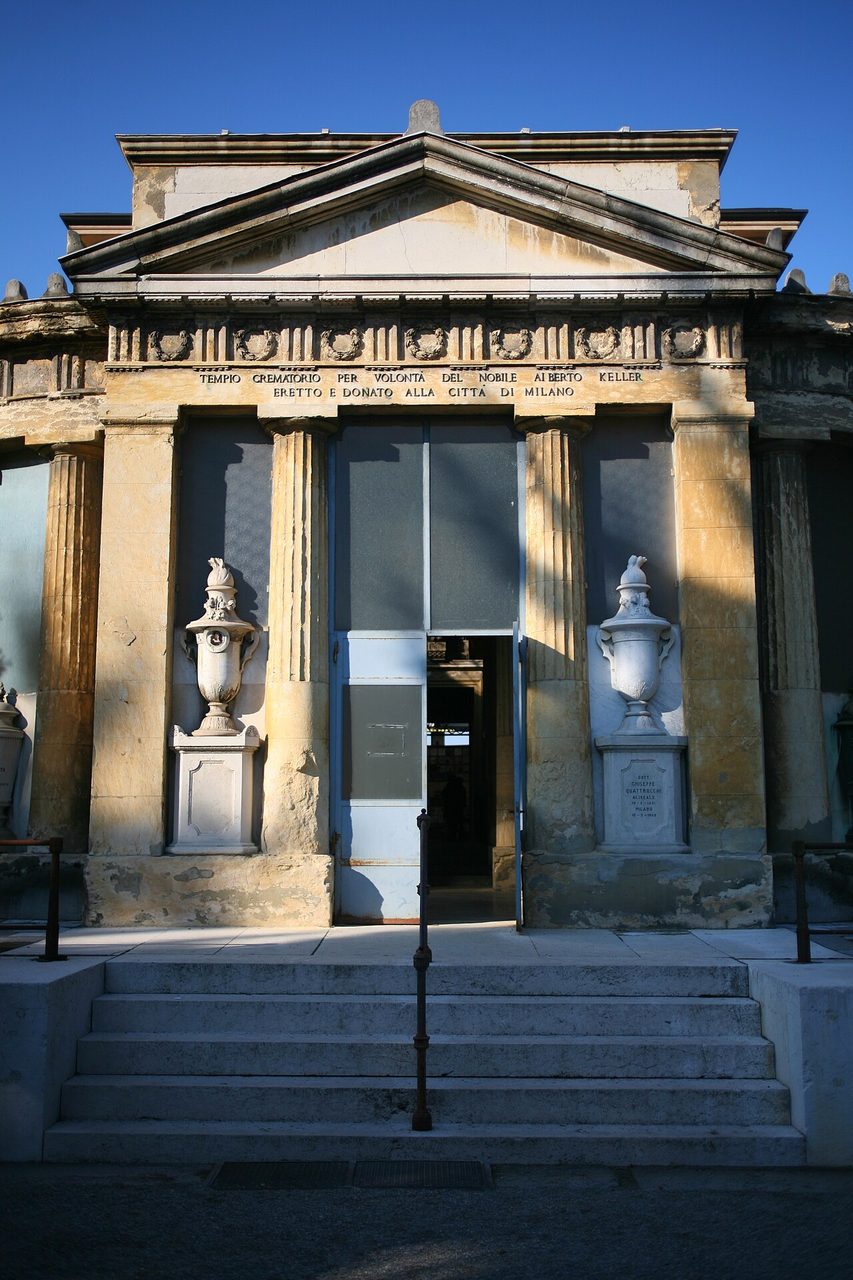
In front of the Tempio Crematorio, the building shaped like a classical temple inside the cemetery walls
Opened in January 1876, this is the first cremation temple in Italy. The industrialist Alberto Keller campaigned for it, and the first cremation was his own. The late nineteenth-century furnaces are still in place.
Spot the detail
Look for the old furnaces, still where they were. How many are there, and what did they burn?
The full story
It looks like an ancient temple that ended up in a Lombard cemetery by mistake. Its forms are classical, while the cemetery entrance plays with the Middle Ages. And it has a good reason to stand apart.
When it opened, on January 22, 1876, there was nothing like it in Italy. The Tempio Crematorio is the country's first cremation temple, and some consider it the first in the whole Western world.
Behind it is one man, Alberto Keller, a textile industrialist. It was he who wanted the facility and campaigned for it. And by one of those ironies that history never denies itself, the first cremation was his own. The man who had wanted the temple was its first guest.
A classical temple, not a church
The design is by Carlo Maciachini, the same architect as the cemetery. For the striped facade at the entrance he had mixed Byzantine, Gothic and Romanesque. Here he changes register and chooses the classical temple. The choice seems to say something: a new kind of ceremony, one that did not belong to a church, called for a form that was solemn but different from a church.
From the altar to wood furnaces
Then there is the technology, which is half the fascination here. At first cremation took place on an altar, with flames fed by illuminating gas, using a system that carries two names, Polli and Clericetti. Twenty years later came four furnaces of the Gorini type, fired with wood.
They are still there. Look at them the way you would look at a locomotive in a museum: they are machines from a century convinced that progress could bring order to everything, even the final business.
In service until 1992
The temple worked for more than a hundred years, until 1992. It stopped when the more modern furnaces at the Lambrate crematorium came into service.
Today it is also a , a place that holds urns, and it keeps a quiet charm. It is not macabre. If anything it has something theatrical about it, like every place designed for a ceremony.
Even if you are short of time, don't skip it. It reminds you that the Monumentale was not just a showcase for sculpture. It was a laboratory, the place where Milan tried out new ideas about death before the rest of Italy.
About this stop
Record
Italy's first crematorium
The Tempio Crematorio at the Cimitero Monumentale, Milan's monumental cemetery, opened on January 22, 1876, is the first cremation temple in Italy, and according to some sources the first in the Western world. The textile industrialist Alberto Keller had campaigned for it, and the first cremation was his own. It used an altar with flames fed by illuminating gas. Twenty years later came four wood-fired furnaces, which are still in place. The temple stayed in operation until 1992.
Next stop
Head back toward the entrance: the Riparto Israelitico, the Jewish section, is east of the Famedio, behind a wall