Church · Magenta and Sant'Ambrogio · 1503–1574
San Maurizio al Monastero Maggiore
A gray facade outside, the most painted church in Milan inside
In brief
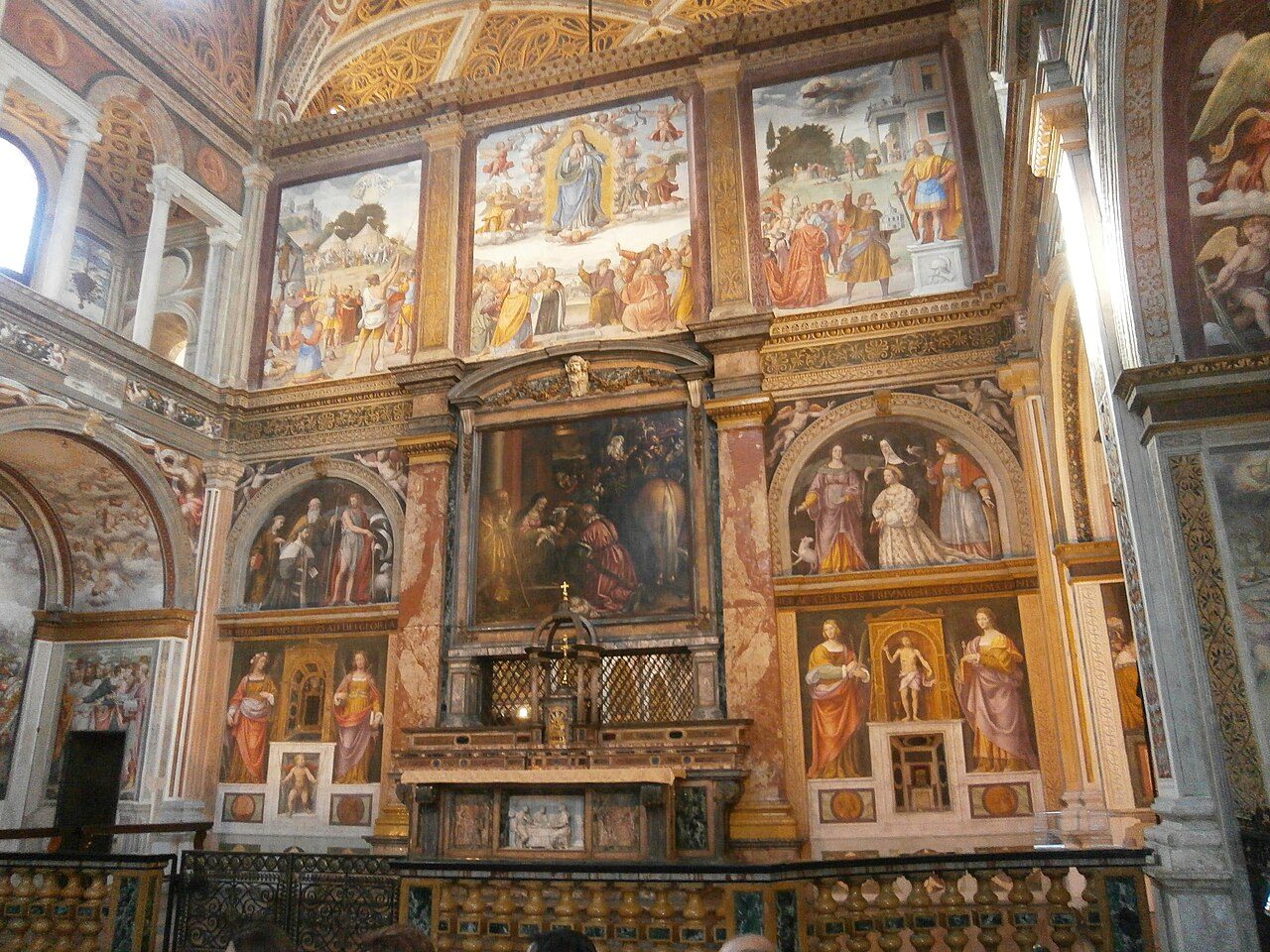
The church of Milan's most powerful Benedictine nuns, rebuilt from 1503 and frescoed from top to bottom by Bernardino Luini and the painters who came after him. A wall cuts it in two: the public on this side, the enclosed nuns on the other.
Stories of this place
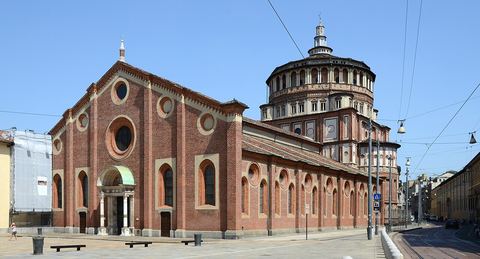
- Record · The facade that gives nothing awayReadThe bell tower where the chariots startedThe bell tower of San Maurizio is twelve hundred years older than the present church. It is a tower of the Roman circus, built around the year 300 by order of the emperor Maximian, when Milan was a capital of the empire. It was part of the carceres, the gates the four-horse chariots burst out of, in a circus 470 meters long. Between the eighth and ninth centuries the convent raised it, set a loggia on top and made it the tower for its bells. That is why it survived. You see it behind the church, on the Via Luini side. Of the circus, it is the best-preserved piece.
- In culture · Two churches in oneReadCaravaggio's teacher by the doorBefore you leave the public hall of San Maurizio, turn toward the entrance. On either side of the door are four scenes painted between 1572 and 1573 by Simone Peterzano, a painter from a Bergamo family who had recently arrived from Venice and presented himself as a pupil of Titian. On one side are stories of devoted sons, with the return of the prodigal son. On the other are stories of anger, with Christ driving the merchants from the temple. About ten years later a boy named Michelangelo Merisi entered Peterzano's workshop. The world knows him as Caravaggio.
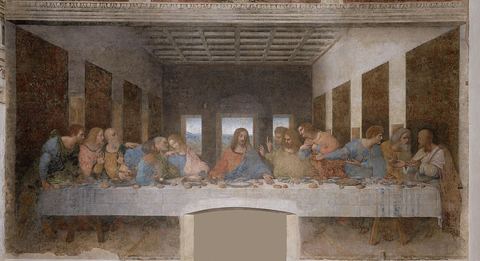
- Anecdote · Two churches in oneReadThe Last Supper, copied down the streetIn the public hall of San Maurizio, in the chapel of the Deposition on the left side, look at the two groups of apostles painted on the side walls. The gestures will seem familiar: they are taken faithfully from Leonardo's Last Supper, which is not far from here, in Santa Maria delle Grazie. They were painted in the second half of the 1500s by Aurelio Luini and his brother Giovan Pietro, who got the apostles up on their feet. Aurelio was a devotee of Leonardo: according to the writer Lomazzo he owned a little book of his caricatures, heads of old men and deformed peasants laughing.
- Anecdote · Two churches in oneReadThirteen apostles: count themIn the public hall of San Maurizio, look up at the center of the dividing wall, high up, above the large canvas with the Magi. The Virgin rises to heaven among angels playing music, and below her the apostles stretch out their arms. Count them: there are thirteen. One too many, and not by oversight. Scholars think a saint was added on purpose, perhaps Saint Paul, probably at the wish of whoever was paying. A second detail: the wall is almost all by the painter Bernardino Luini, but most scholars do not believe this central scene is his. The hand is less sure, and they suspect a workshop assistant.
- In culture · The kneeling ladyReadRuskin takes lessons from LuiniJohn Ruskin, the most influential art critic in Victorian England, spent weeks in 1862 studying Bernardino Luini, the leading painter of the frescoes in San Maurizio. Here he copied one of the saints painted beside the altar, whom he called Saint Catherine, and took the copy to Oxford, to his drawing school, as a model for the students. In a catalog he wrote that the decoration of this church shows perfectly what painters like Luini, Carpaccio and Perugino found beautiful in a building. What he admired in the Lombard painter was the drawing, which he described as grave and balanced.
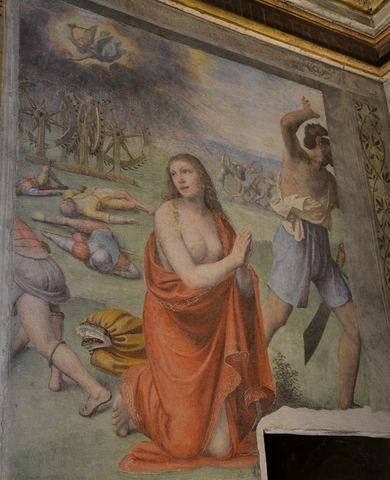
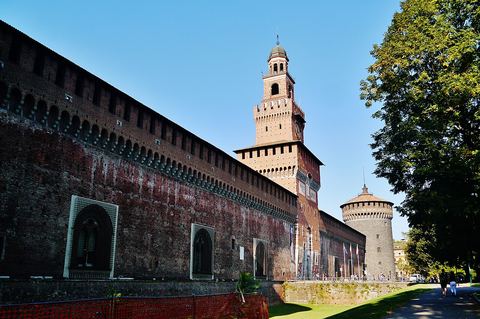
- Legend · Saint Catherine and the shadow of the countessReadThe beheaded countess and her portraitBianca Maria Scapardone, countess of Challant, was beheaded at the Castello, Milan's castle, on October 20, 1526, accused of having a lover killed. The writer Matteo Bandello turned her into a tale and closed it with an invitation: anyone wanting to see her face should go to the church of the Monastero Maggiore, which is San Maurizio. Tradition recognized her in the beheaded Saint Catherine that the painter Bernardino Luini painted in a chapel on the right of the public hall. But that chapel dates from 1530, after Bandello had left Milan. Today several scholars look for the countess in a lunette beside the altar, kneeling near her first husband.
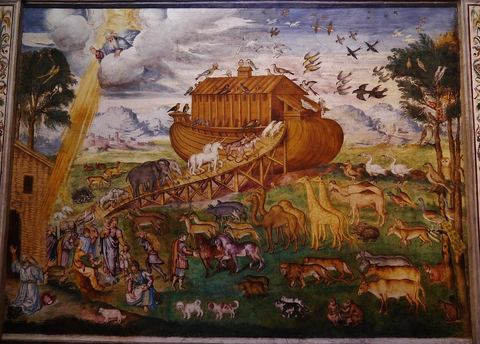
- Anecdote · Noah's ark, unicorns includedReadThe painter the archbishop kept an eye onIn the nuns' hall of San Maurizio, the Noah's ark with the unicorns is by Aurelio Luini, a painter and the son of the more famous Bernardino. In February 1581 an order from Carlo Borromeo, archbishop of Milan, forbade him to paint any image without a drawing approved and signed by the archbishop. The reason is not known. One theory points to the Accademia della Val di Blenio, an irreverent, unorthodox circle of artists: Aurelio belonged to it under the name compà Lovign. How long the measure lasted is unclear. The new commissions on record, including those for the Duomo, Milan's cathedral, come after the archbishop's death.
- Anecdote · The organ and the silenceReadThe secret benefactor of the restorationUntil the 1980s the interior of San Maurizio was blackened by a layer of soot, salts and grease. In 1986 an anonymous bequest made it possible to start the cleaning. Other contributions followed, and the work went on for twenty-five years. The benefactor's name became known only after her death: Maria Bertarelli, daughter of one of the founders of the Touring Club Italiano, Italy's historic travel association. Today a plaque in the church remembers her. Doing good without showing yourself: in a church of enclosed nuns, it is almost a house tradition.
- LegendReadThe convent Barbarossa left standingThe Monastero Maggiore, the convent that San Maurizio served as church, survived the destruction of Milan. In 1162 Frederick Barbarossa, the emperor, took the city and had it demolished. The Roman circus beside the convent ended its story there. But the Milanese had asked for a few sacred places to be spared, among them the basilica of Sant'Ambrogio and this convent. A tradition reported in the 1600s gives a more flattering explanation: the convent had been restored by another emperor, Otto the Great, and so it was left standing. Beneath the museum next door the foundations of the Roman walls are still tipped outward, perhaps because of the besiegers' digging.
- RecordReadFour thousand square meters of paintAccording to the Touring Club, Italy's historic travel association, the walls of San Maurizio carry about four thousand square meters of frescoes, laid down over seventy years by several generations of painters. For the City of Milan it is the most coherent record of seventy years of painting in the city. The comparison with the Sistine Chapel comes from this: not from the style, but from the fact that no corner is left empty. With one feature all its own. Here you watch a whole century change its taste, wall after wall.
Ready-made questions
Because, as in the Vatican chapel, painting covers everything: walls, chapels, arches, vault. No surface is left blank. The nickname should not be taken literally: there is no Michelangelo here, and the mood is more intimate and gentle. But it captures what it feels like to walk in. On top of that, the are of very high quality and almost all from the 1500s, so much so that the church is considered the most coherent record of Milanese painting of that century.
A Roman soldier, San Maurizio in Italian. According to tradition he belonged to the Theban legion and was killed with his companions at Agaunum, today Saint-Maurice in Switzerland, for refusing, as a Christian, to obey the orders of the emperor Maximian. On the site of the martyrdom Saint Sigismund, king of Burgundy, had a church built: that is why the two often appear together in paintings. The name reached Milan, again according to tradition, with a relic given to the monastery by the emperor Otto I. Before that the church was dedicated to Mary.
Go to stop: The kneeling ladyAt first yes, fairly well: a large grille filled the whole arch above the altar, and the floor of their hall was built about half a meter higher precisely to help them. In 1577 Carlo Borromeo, archbishop of Milan, had the opening reduced to make stricter, and soon afterward the arch was closed with a large canvas. From then on the nuns could mostly listen. For communion and for adoring the consecrated host there were still two small openings in the wall, which you can see from their side.
Go to stop: Two churches in oneNo, even if his is the name that sticks. The first to paint, in the early 1500s, were masters who remain anonymous, in the nuns' hall. Luini worked here on and off between about 1522 and 1530: his are much of the dividing wall, on both sides, and the chapel of Saint Catherine. After his death the work stopped until mid-century, then started again with his sons Giovan Pietro and Aurelio. The series was closed in the 1570s by Simone Peterzano and Antonio Campi, whose taste was by then far from his.
They are saints: women's faces painted inside mock medallions along the loggia, the gallery that runs above the chapels. Putting a name to each is hard, because not all of them carry a distinguishing attribute. The painter is unknown; in the past the name of Boltraffio, a pupil of Leonardo, was suggested. The curious thing is that some faces are so individual they suggest real portraits. The scholars' hypothesis is that, at least in some cases, the faces were lent by the nuns who lived here in the early 1500s.
Go to stop: The nuns' skyNothing here is by him, but his shadow is everywhere. When painting began, Leonardo was still in Milan, and the first painters of San Maurizio looked to him. Many critics see his lesson in the sweetness of Luini's faces. Aurelio, Luini's son, copied the apostles of the Last Supper in a chapel with his brother and filled Noah's ark with animals observed with a naturalist's curiosity. And one chapel bears the name of the Bergamini, the family that Cecilia Gallerani married into: she is the Lady with an Ermine painted by Leonardo.
It was suppressed in 1798 by the Cisalpine Republic, and its buildings passed from one use to another: barracks, school, military hospital. In the 1860s the city opened two streets, Via Luini and Via Ansperto, cutting the convent in two and demolishing the main cloister. The bombs of 1943 destroyed more. What remains is the church, one cloister and two Roman towers the monastery had absorbed: one, the circus tower, is the bell tower. Everything that is not church is now part of the Museo Archeologico, the archaeological museum.
Go to stop: The organ and the silenceThe stops
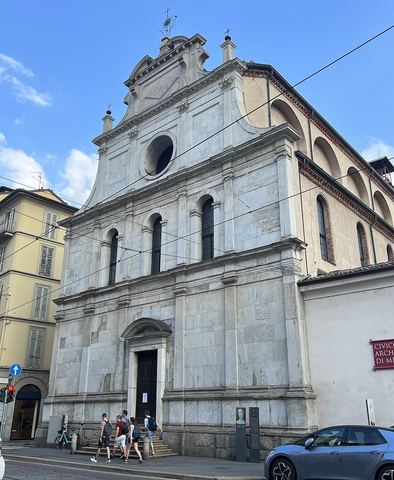
1 The facade that gives nothing away
Gray stone, three tidy stories, no color. It was the last part to be finished, in 1574, and it gives no hint of what is inside. Behind it, for almost a thousand years, lived the most important convent in Milan.
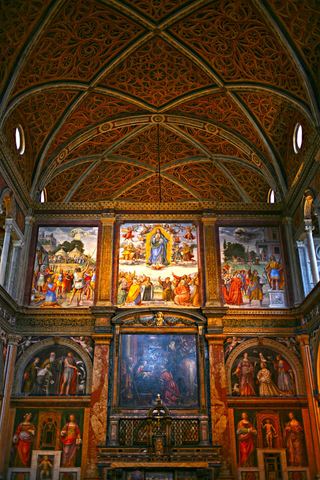
2 Two churches in one
The wall in front of you is not the end of the church: it is a border. On this side the people of Milan prayed, on the other the enclosed nuns, who followed Mass without being seen. The space behind it is bigger than the one you are standing in.
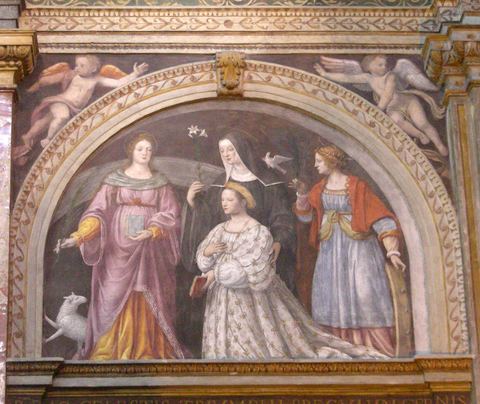
3 The kneeling lady
On either side of the altar Bernardino Luini painted a man and a woman on their knees, dressed in their best among the saints. They are the ones who paid. But who they really are is still an open question, and one of the answers leads to a scaffold.
4 Saint Catherine and the shadow of the countess
Bernardino Luini's last work in San Maurizio, painted in 1530, two years before he died. On the walls is the martyrdom of Saint Catherine. According to tradition, the saint has the face of a countess beheaded in Milan.
5 The nuns' sky
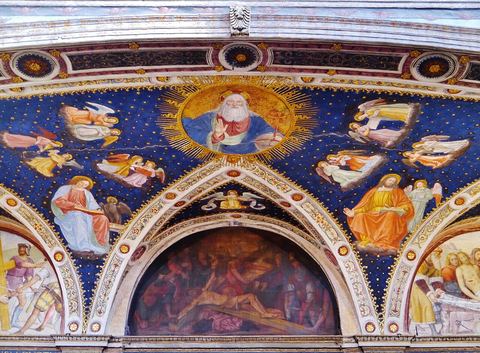
You are in the hidden half of the church. Built against the wall is an arched bridge, the pontile, and under the bridge is the oldest painting in San Maurizio: a blue night full of golden stars.
6 The Passion painted for the nuns
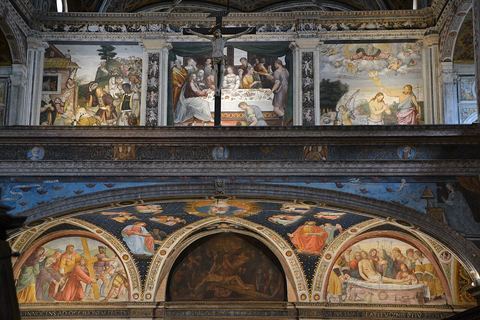
On their side of the wall the nuns had the Passion of Christ told by Bernardino Luini, from the Mount of Olives to the Resurrection. It is more sober painting than in the other hall: made for praying, not for showing off.
7 Noah's ark, unicorns included
Forget Bernardino Luini's composure: here it is his son Aurelio painting, a generation later, and he is having fun. The Flood becomes a parade of animals, real and imaginary, with a pair of unicorns ready to board the ark.
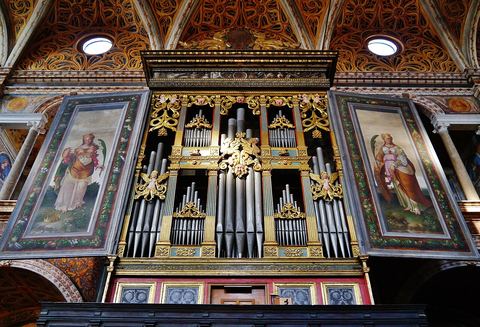
8 The organ and the silence
The organ dates from 1554 and was built by Gian Giacomo Antegnati, who had just delivered the one for the Duomo. It accompanied the nuns' singing until 1798, when the convent was suppressed. Then came a story of neglect and soot.
Timeline
- 9th centuryThe Benedictine convent is already on record, among the remains of the circus and walls of Roman Milan.
- 1447The nuns go into enclosure. This is where the need for a church divided in two comes from.
- 1503The first stone of the present church is laid. Within a few years the building is standing.
- Around 1522Bernardino Luini starts painting the dividing wall. He will come back to San Maurizio several times.
- 1530Luini paints the chapel of Saint Catherine, his last work here. He dies two years later.
- 1577–1579On Carlo Borromeo's orders the nuns' grille is reduced and the arch closed with Antonio Campi's canvas.
- 1798The Cisalpine Republic suppresses the monastery. Changes of use, demolitions and, in 1943, bombs follow.
- 1986Restoration of the frescoes, blackened by soot, begins. It will last twenty-five years.
Who's who
Bernardino Luini
painter, the star of the frescoes
Born near Luino around 1481, died in 1532. Loved by the Milanese nobility for his gentle, composed figures, he worked in San Maurizio on and off for almost ten years.
Aurelio Luini
painter, Bernardino's youngest son
The most gifted of the sons. With his brother Giovan Pietro he took up the work again in the mid-1500s: Noah's ark is his. He owned a little book of caricatures by Leonardo.
Ippolita Sforza Bentivoglio
noblewoman, probable patron
Granddaughter of a duke of Milan and wife of Alessandro Bentivoglio. Cultivated, a friend of Bandello, she had a daughter who was abbess here. Tradition sees her in the lady painted beside the altar.
Bianca Maria Scapardone
countess of Challant
A rich heiress from Casale Monferrato, beheaded in Milan in 1526. Bandello wrote that her portrait is in this church: people have argued ever since about which one it is.
Matteo Bandello
writer, author of the Novelle
A friend of Ippolita Sforza, he told the story of the countess of Challant's end. His tales also include a story of Romeo and Juliet, written before Shakespeare.
Carlo Borromeo
archbishop of Milan
A man of the Counter-Reformation, he wanted stricter enclosure: in 1577 he had the grille through which the nuns followed Mass reduced.
Words to know
Where it is
The neighborhood
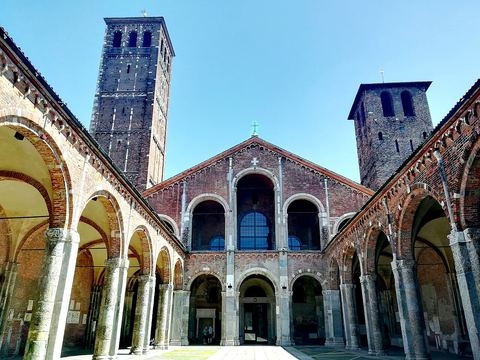
Magenta and Sant'Ambrogio
Related places
The story of the place
From outside it is a gray facade you barely notice on the street called Corso Magenta. Inside, not a hand's width of wall is left unpainted, which is why people call it the Sistine Chapel of Milan. But the real twist is something else. Halfway down the church a painted wall blocks the way, and behind it there is a second hall, bigger than the first.
The convent and its church
This was the church of the Monastero Maggiore, the Greater Monastery, the oldest and largest convent in the city. Benedictine nuns were here as early as the ninth century, among the remains of Roman Milan: a tower of the Roman circus still serves as the bell tower.
Greater was not a figure of speech. The daughters of the families that mattered took their vows here, and when the emperor Frederick Barbarossa destroyed Milan in 1162, the monastery was one of the few places he spared.
In 1447 the nuns go into , cut off from the outside world. Half a century later, in 1503, they decide to rebuild the church from scratch, and they want it made to measure: a hall in front for anyone coming in off the street, a hall behind for themselves, and between the two a , a dividing wall that lets voices through but not glances.
Nobody knows for certain who designed it. The name usually put forward is Gian Giacomo Dolcebuono, an architect who was also working on the Duomo, Milan's cathedral, in those years.
Seventy years of painters
Then the painters arrive, and they don't leave for seventy years. The star is Bernardino Luini, the favorite of the Milanese nobility in the early 1500s, called in around 1522 by families who had daughters in the convent. After him come his sons, and at the end of the century artists whose taste has moved on.
The result is an illustrated handbook of sixteenth-century Lombard painting, all in one room. Or rather, in two.
From suppression to restoration
The monastery is suppressed in 1798 by the Cisalpine Republic, the state born when Napoleon arrived. Of the great convent, sliced through by new streets in the nineteenth century and hit by bombs in 1943, the church and one cloister remain, the cloister now part of the Museo Archeologico, the city's archaeological museum. The , blackened by soot, became readable again only with a restoration that began in 1986 and lasted twenty-five years.
One piece of advice: don't stop at the first hall. Half the wonder is on the other side of the wall.
Sources
- La storia della chiesa, Civico Museo Archeologico di Milano, Comune di Milano (opens in a new tab)Official site
- Le Torri romane e il Monastero Maggiore, Civico Museo Archeologico di Milano (opens in a new tab)Official site
- La torre del circo, Civico Museo Archeologico di Milano (opens in a new tab)Official site
- La torre poligonale e le mura, Civico Museo Archeologico di Milano (opens in a new tab)Official site
- Chiesa di S. Maurizio al Monastero Maggiore, scheda di architettura LMD80-00017, Lombardia Beni Culturali (opens in a new tab)Catalog
- Monastero Maggiore, complesso, scheda LMD80-00087, Lombardia Beni Culturali (opens in a new tab)Catalog
- Campanile della chiesa di S. Maurizio al Monastero Maggiore, scheda LMD80-00368, Lombardia Beni Culturali (opens in a new tab)Catalog
- Affreschi e arredi di San Maurizio, schede delle opere da 1j570-00001 a 1j570-00032, Lombardia Beni Culturali (opens in a new tab)Catalog
- S. Maurizio al Monastero Maggiore, Touring Club Italiano (opens in a new tab)Institution
- Luini, Bernardino, Dizionario Biografico degli Italiani, Treccani (opens in a new tab)Encyclopedia
- Luini, Aurelio, Dizionario Biografico degli Italiani, Treccani (opens in a new tab)Encyclopedia
- San Maurizio al Monastero Maggiore, il successo dei Volontari Touring, Touring Club Italiano (opens in a new tab)Institution
- Engraving of the Lay Hall of San Maurizio al Monastero Maggiore, Ruskin teaching collection, Ashmolean Museum (opens in a new tab)Institution
- The Works of John Ruskin, Library Edition, volume 24, Lancaster University (opens in a new tab)Institution
- Mariarosa Bricchi, Decorazione e musica nella chiesa di San Maurizio al Monastero Maggiore di Milano, tesi di laurea magistrale, Università di Pavia, 2023/2024 (opens in a new tab)Institution
- Agostino Allegri, Intorno a Pellegrino Tibaldi, tra Milano e la Spagna, tesi di perfezionamento, Scuola Normale Superiore, 2022/2023 (opens in a new tab)Institution
- Chiesa di San Maurizio al Monastero Maggiore, Wikipedia in italiano (opens in a new tab)Wikipedia
- San Maurizio al Monastero Maggiore, Wikipedia in inglese (opens in a new tab)Wikipedia
- Bianca Maria Scapardone, Wikipedia in italiano (opens in a new tab)Wikipedia
- Aurelio Luini, Wikipedia in italiano (opens in a new tab)Wikipedia
- Circo romano di Milano, Wikipedia in italiano (opens in a new tab)Wikipedia
- Chiesa di San Maurizio al Monastero Maggiore, Wikidata Q1255890 (opens in a new tab)Other source
- 1526: Bianca Maria Gaspardone, the Insatiate Countess, Executed Today (opens in a new tab)Other source
- San Maurizio al Monastero Maggiore, la Cappella Sistina di Milano, MilanoFree (opens in a new tab)Other source