Stop 8 of 8
The organ and the silence
Where to stand
In the nuns' hall, in front of the organ and the wooden choir
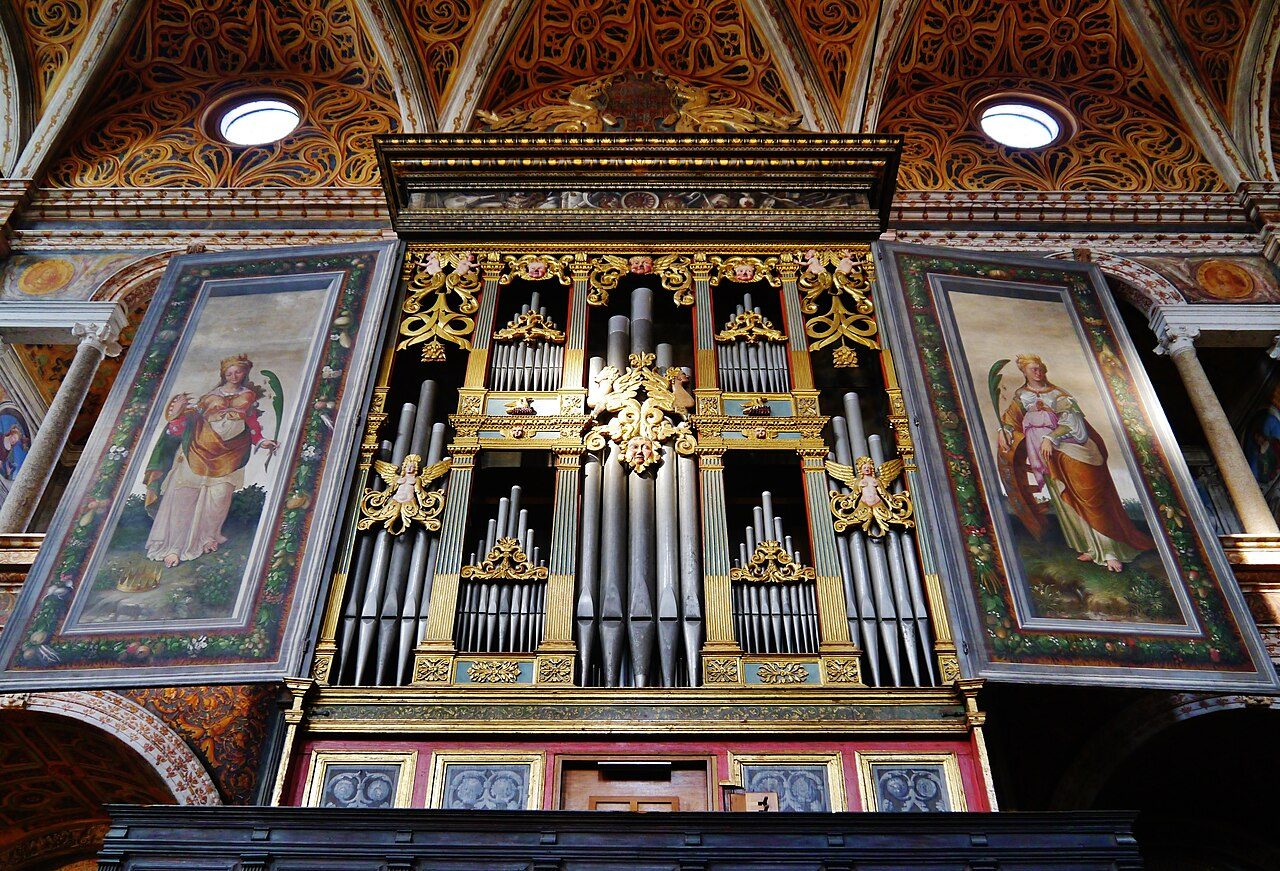
The organ dates from 1554 and was built by Gian Giacomo Antegnati, who had just delivered the one for the Duomo. It accompanied the nuns' singing until 1798, when the convent was suppressed. Then came a story of neglect and soot.
Spot the detail
The organ shutters: which saints do you see painted? It depends on how you find them, open or closed
The full story
In a church where people could not see each other, sound was everything. The nuns sang, the congregation on the other side listened, and from 1554 this instrument was there to support the voices.
The contract still exists. It was signed in September of that year, and it bound the builder to deliver the instrument within twelve months.
The builder was the best around: Gian Giacomo Antegnati, from a family of organ makers in Brescia, who two years earlier had built the organ for the Duomo, Milan's cathedral. The shutters were painted by Francesco de' Medici da Seregno, helped by his son.
The instrument is entirely mechanical: the keys and pedals work the pipes directly, with no other assistance. In the nineteenth century it was altered to suit the musical taste of the time, and a restoration in the late twentieth century brought it back toward its original sound.
The suppression of the monastery
Then came the silence. In 1798 the Cisalpine Republic, the state born when Napoleon arrived, suppressed the monastery. The buildings became a barracks, a school, a military hospital.
The city opened two new streets through the convent, and the bombs of World War II did the rest. It was in the nineteenth century, with the nuns gone, that the passages in the dividing wall were opened: the two churches became one.
Twenty-five years of restoration
The church stayed standing, but in what a state. Damp, salts, and a layer of soot and grease so thick it blackened the whole interior. The restoration of the began in 1986 thanks to an anonymous bequest and lasted twenty-five years, wall by wall.
Think about it on your way out. The colors you saw today were invisible to anyone who came in here fifty years ago. In a sense San Maurizio has been inaugurated twice: the first time for a few nuns, the second for everyone.
About this stop
Anecdote
The secret benefactor of the restoration
Until the 1980s the interior of San Maurizio was blackened by a layer of soot, salts and grease. In 1986 an anonymous bequest made it possible to start the cleaning. Other contributions followed, and the work went on for twenty-five years. The benefactor's name became known only after her death: Maria Bertarelli, daughter of one of the founders of the Touring Club Italiano, Italy's historic travel association. Today a plaque in the church remembers her. Doing good without showing yourself: in a church of nuns, it is almost a house tradition.
It was suppressed in 1798 by the Cisalpine Republic, and its buildings passed from one use to another: barracks, school, military hospital. In the 1860s the city opened two streets, Via Luini and Via Ansperto, cutting the convent in two and demolishing the main cloister. The bombs of 1943 destroyed more. What remains is the church, one cloister and two Roman towers the monastery had absorbed: one, the circus tower, is the bell tower. Everything that is not church is now part of the Museo Archeologico, the archaeological museum.