Stop 3 of 8Must-see
The kneeling lady
Where to stand
In front of the dividing wall, near the altar, looking at the two lunettes painted on either side of it
On either side of the altar Bernardino Luini painted a man and a woman on their knees, dressed in their best among the saints. They are the ones who paid. But who they really are is still an open question, and one of the answers leads to a scaffold.
Spot the detail
Higher up, a king hands a soldier a miniature church. Who are those two?
The full story
Come closer. This wall is the most precious thing in the church, and almost all of it is by Bernardino Luini, the painter that fashionable Milan fought over in the early 1500s. They called him in around 1522. Giorgio Vasari, the biographer of the Renaissance artists, was already crediting him with the great altar wall.
At the bottom, on either side of the altar, four female saints stand in painted niches: Cecilia, Ursula, Apollonia and Lucy. Above them are two .
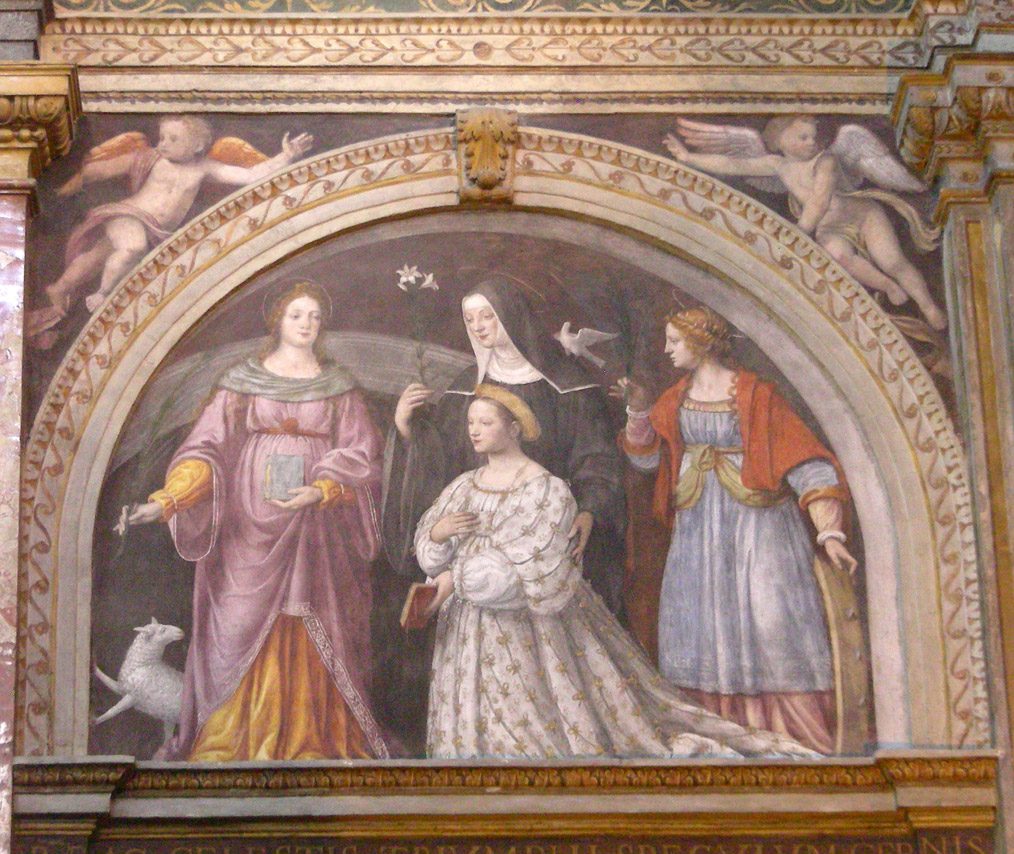
In one a man is kneeling, in the other a woman, both in court dress, each with three saints behind them. One saint rests her hand on the lady's shoulder, as if introducing her.
These are the . They had themselves painted right here, beside the altar, as if they were attending Mass with the congregation. In the front row forever.
The Bentivoglio, according to tradition
The traditional version says they are Alessandro Bentivoglio, son of the lord of Bologna, and his wife Ippolita Sforza, granddaughter of a duke of Milan. Ippolita was a cultivated woman, a friend of the writer Matteo Bandello, who considered her the inspiration for his Novelle, his collection of tales. The couple had a daughter in this convent, Alessandra, who became its in 1522, that very year. It all adds up.
The trail of the countess
But there is another trail, and it starts with Bandello himself. At the end of his tale about the countess of Challant, beheaded in Milan in 1526 for having a lover killed, the writer notes that anyone who wants to see her face "portrayed from life" should go to the church of the Monastero Maggiore, the convent this church belonged to. For centuries people looked for the countess in a chapel nearby.
Some recent studies think instead that she is the lady in the , painted years before the scandal together with her first husband, Ermes Visconti. Archive papers back this up: a debt Visconti owed Luini for work in this church, and an inventory of clothes that resemble the painted ones.
The question is not settled, and the official catalogs stick with the Bentivoglio couple. In the meantime, take a good look at her. Either she is a great and pious lady, mother of an . Or she is the most talked-about woman in sixteenth-century Milan, kneeling among the saints a few years before the scaffold.
About this stop
In culture
Ruskin takes lessons from Luini
John Ruskin, the most influential art critic in Victorian England, spent weeks in 1862 studying Bernardino Luini, the leading painter of the in San Maurizio. Here he copied one of the saints painted beside the altar, whom he called Saint Catherine, and took the copy to Oxford, to his drawing school, as a model for the students. In a catalog he wrote that the decoration of this church shows perfectly what painters like Luini, Carpaccio and Perugino found beautiful in a building. What he admired in the Lombard painter was the drawing, which he described as grave and balanced.
A Roman soldier, San Maurizio in Italian. According to tradition he belonged to the Theban legion and was killed with his companions at Agaunum, today Saint-Maurice in Switzerland, for refusing, as a Christian, to obey the orders of the emperor Maximian. On the site of the martyrdom Saint Sigismund, king of Burgundy, had a church built: that is why the two often appear together in paintings. The name reached Milan, again according to tradition, with a relic given to the monastery by the emperor Otto I. Before that the church was dedicated to Mary.
Next stop
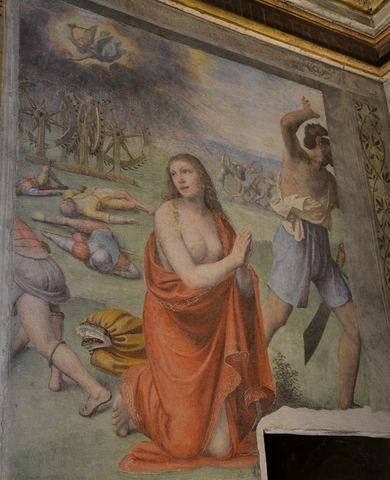
Stay in the public hall and look on the right side for the chapel with a saint in a golden robe kneeling before the executioner