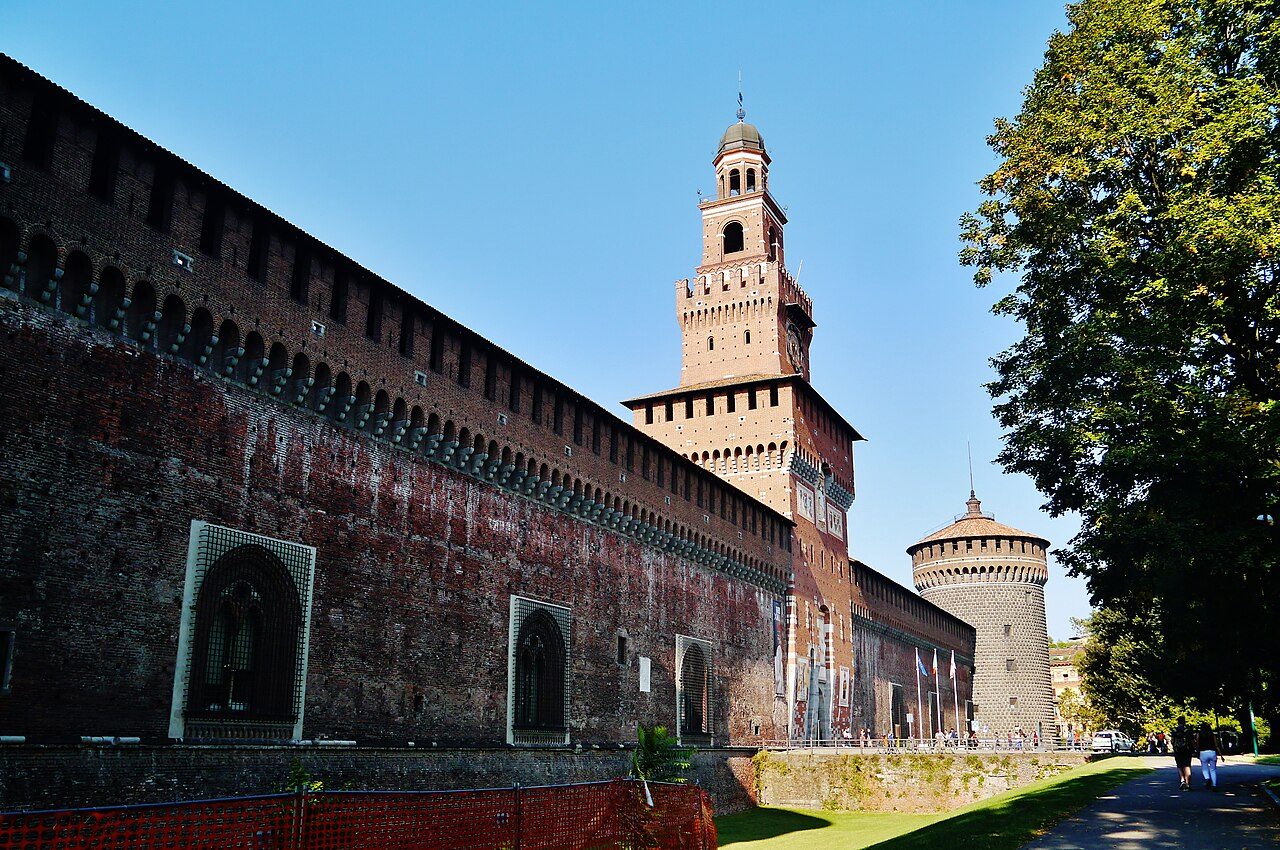
Monument · Castello and Sempione · 1358–1905
Castello Sforzesco
The fortress Milan tore down, loathed, rescued, and finally took to heart
In brief
A fortress for the Visconti, a palace for the Sforza, a barracks for more than three centuries, then nearly demolished and restored in the late 1800s. In its courtyards you'll find the court of Ludovico il Moro, traces of Leonardo, and Michelangelo's last sculpture.
Stories of this place
- In culture · The round towers and the castle Milan hatedReadThe castle Machiavelli pannedThe Castello Sforzesco was born amid the resentment of the Milanese. They had torn down the fortress of the Visconti, the city's old lords, as a symbol of tyranny. In 1450 the mercenary captain Francesco Sforza took Milan, became its duke and, a little over three months after he rode in, had the first stone of the new one laid. A few decades later Niccolò Machiavelli, in The Prince, cited it as a mistake: in his view that castle had done the Sforza more harm than any other disorder in the state. For a prince, he wrote, the best fortress is not to be hated by the people.
- Record · The Piazza d'ArmiReadA star of bastions three kilometers aroundThe biggest part of the Castello Sforzesco you see today is missing. From the mid-1500s the Spanish, then masters of Milan, enclosed it in a ring of bastions shaped like a star: first six points, then twelve. The outer defenses stretched for about three kilometers and covered almost twenty-six hectares. Inside lived a garrison of up to three thousand men. All of it was leveled on Napoleon's orders, starting in 1801. In its place today are a square and a park.
- Anecdote · Michelangelo's Pietà RondaniniReadThe Pietà and the architect who said noThe Pietà Rondanini, Michelangelo's last sculpture, stands in the Castello Sforzesco, in the old Ospedale Spagnolo, the Spanish Hospital. When he was asked to design its new home, the architect Michele De Lucchi said no. They asked him at least to come and see the place. He walked into the room where soldiers sick with plague had nothing left but prayer, and changed his mind: a sacred place for a sacred statue. He set the sculpture where the altar had been, three oak benches in front of it, and almost nothing else.
- Anecdote · The Corte DucaleReadThe golden tyrant above the altarIn the Castello's Museo d'Arte Antica, the museum of ancient art, a marble horseman sits upright in the saddle. He is Bernabò Visconti, lord of Milan in the 1300s. He ordered the statue himself, in his lifetime, almost all gilded, for the church beside his palace. A French friar was scandalized: an abominable idol above God's altar. The poet Petrarch replied that it stood in a chapel, not on the altar. In 1385 his nephew Gian Galeazzo captured him by a trick and locked him up first here, in the Visconti castle, then at Trezzo. Bernabò died before the year ended. One chronicler says from a bowl of poisoned beans.
- Anecdote · The Corte DucaleReadWhen Leonardo staged the partiesJanuary 1490. Ludovico il Moro, who rules Milan for his nephew, wants to celebrate in style the young duke's marriage to Isabella d'Aragona, his wife of almost a year. The court poet Bernardo Bellincioni writes the verses. The staging falls to Leonardo da Vinci. In a hall of the Castello the Paradiso appears: a half egg gilded inside, full of lights like stars, with the twelve zodiac signs lit by lamps inside glass. The seven planets are actors in costume who recite the bride's praises. An ambassador who was there describes it with admiration. Before the Last Supper, Leonardo in Milan was this too: the man for the parties.
- In culture · The Corte DucaleReadThe plaque from the column of infamyUnder the Portico dell'Elefante, the Elephant Portico in the Corte Ducale of the Castello Sforzesco, is a plaque that comes from another place and another story. In 1630, at the height of the plague, Milan went looking for culprits. Gian Giacomo Mora was accused of being an untore, that is, of spreading the contagion on purpose. Where his house had stood a column was raised, called the column of infamy, in memory of the sentence. It was pulled down in 1778, and the plaque ended up here. Alessandro Manzoni, author of The Betrothed, devoted a whole book to that trial, the Storia della colonna infame.
- Anecdote · The Rocchetta, the fortress within the fortressReadA Leonardo in exchange for a watchThe Rocchetta, the most closed-in courtyard of the Castello Sforzesco, is home to the Biblioteca Trivulziana, the Trivulzio family library. Among its treasures is a notebook by Leonardo da Vinci, the Codex Trivulzianus. Inside, between war machines and caricatures, run long columns of learned words: Leonardo copied them out to enrich his vocabulary. In the mid-1700s the notebook belonged to a man from Novara, Gaetano Caccia. The Milanese nobleman Carlo Trivulzio got it from him around 1750. In exchange he gave a silver watch, bought secondhand at that. He says so himself in a note attached to the codex. Perhaps the best deal ever struck in Milan.
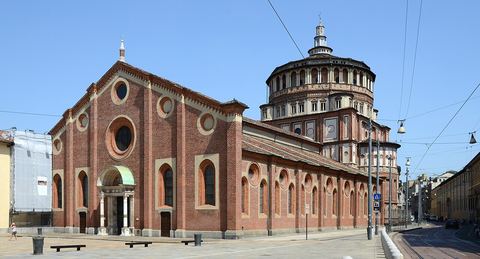
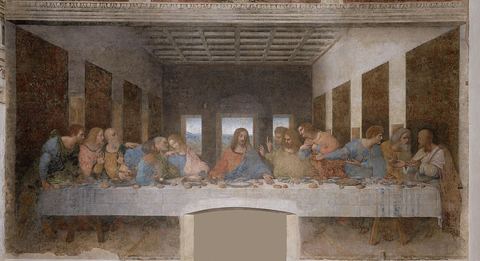
- Legend · The Ponticella and Leonardo at il Moro's courtReadThe secret passage to the GrazieThe story goes that a tunnel runs from the Castello Sforzesco all the way to Santa Maria delle Grazie, the church of the Last Supper, where the Sforza, dukes of Milan, wanted their family tombs. The duke could have reached it without being seen. What is certain are the drawings of tunnels Leonardo da Vinci left in the Codex Forster and the surveys of 2024, which used ground-penetrating radar and lasers to confirm a network of passages from the 1400s beneath the Castello. Whether one really reaches the church remains, for now, a hypothesis.
- LegendReadThe ghost of the beheaded countessOn October 20, 1526, at the Castello Sforzesco, Bianca Maria Scapardone, countess of Challant, is beheaded. Young and rich, she is accused of having a lover killed. The writer Matteo Bandello turns her story into a tale. In 1891 Giuseppe Giacosa brings her to the stage with the play La signora di Challant. So much for the facts. Then comes the legend: her ghost is said never to have left these walls and to wander the corridors still. Nobody has ever proved it, but among the ghosts attributed to the Castello it is one of the most famous.
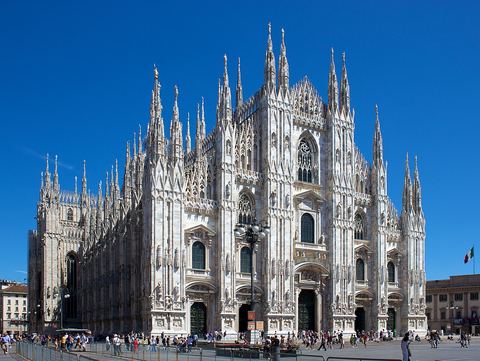
- In cultureReadA Milanese in the KremlinIt is often said that the walls of the Kremlin, in Moscow, were modeled on the Castello Sforzesco. What is certain is that a Milanese helped build them. Pietro Antonio Solari was the son of Guiniforte, engineer of the Fabbrica del Duomo, the cathedral works. Around 1488 he sold his house in Milan and left for Moscow, where he continued the Kremlin walls and built several of its towers, including the Spasskaya, on the Red Square side. A plaque still remembers him as Petrus Antonius Solarius Mediolanensis, that is, from Milan. That he modeled them on the castle of his hometown is an appealing idea, not a documented fact.
Ready-made questions
More than you fear, less than it seems. The layout, the walls of the courts, and the porticoes of the Rocchetta and the Corte Ducale are from the 1400s. The oldest part is the facade facing the park, which goes back to the Visconti. The Torre del Filarete, on the other hand, is an early 1900s reconstruction, and the on top of the round towers were redone as well. The architect Luca Beltrami restored the Castello to take it back to the Sforza era. Where pieces were missing, he redrew them from old documents and paintings.
After the Sforza, the family that took Milan in 1450 and rebuilt the castle as we know it. The founder, Francesco, was a , a mercenary captain, who had married a Visconti, Bianca Maria, and who also kept the Visconti coat of arms. Before that the fortress had another name: Castello di Porta Giovia, after the gate in the city walls that stood beside it. What remains of the Sforza are the coats of arms of the six dukes, on the entrance tower.
Yes, in the service of Ludovico il Moro. He painted several rooms of the ducal apartment alongside other court painters and, in 1498, the Sala delle Asse: a make-believe pergola of mulberry trees covering walls and vault. Between the 1800s and the 1900s the vault was entirely repainted. Since 2012 a long restoration has been trying to recover the original painting, layer by layer. On one wall there is a monochrome drawing, with roots sinking into rock, thought to be probably by his own hand. The Castello also holds one of his notebooks, the Codex Trivulzianus.
Go to stop: The Corte DucaleBecause Milan bought it. The Pietà stayed in Rome for almost four centuries: in Michelangelo's house, then in a workshop, and from 1744 in the palace of the Rondanini marquises on Via del Corso. In the early 1900s, when the palace changed hands, the Italian state gave up in writing its right to buy it first. So in 1952 the City of Milan, urged on by the scholar Fernanda Wittgens, was able to acquire it for the collections of the Castello.
Go to stop: Michelangelo's Pietà RondaniniBecause it is, and for two reasons at once. Michelangelo worked on it until a few days before his death, in 1564, and ran out of time. But above all, at a certain point, he started over inside the same block, carving new, thinner figures out of the marble of the ones already made. Of the first version, Christ's legs and an isolated arm remain. The rest is the second, barely roughed out. What you see is not just an interrupted work: it is a change of mind left open.
Go to stop: Michelangelo's Pietà RondaniniA bit of everything, because this is where Milan brought its civic collections together. The Museo d'Arte Antica, the museum of ancient art, has the sculpture and runs as far as Leonardo's Sala delle Asse. The Pinacoteca, the picture gallery, has paintings by Mantegna, Antonello da Messina, Filippo Lippi, Correggio, Canaletto, and Tiepolo. Then there are an Egyptian section, musical instruments, furniture, and decorative arts. The Biblioteca Trivulziana, the library, holds a Leonardo notebook, the Codex Trivulzianus, and an illuminated manuscript of the Divine Comedy from 1337. If you have time for only one thing, it is still the Pietà Rondanini.
Yes. The moat that runs around the Castello was flooded, and today it no longer is. Another water-filled moat ran alongside the Ghirlanda, the outer ring of walls from the 1400s, of which few traces remain. And a third still cuts through the interior: the fossato morto, or dead moat, a stretch of the city's medieval moat, which separates the Piazza d'Armi from the dukes' courts. To enter the Rocchetta, the innermost refuge, you originally had to cross a .
Go to stop: The Piazza d'ArmiThe stops
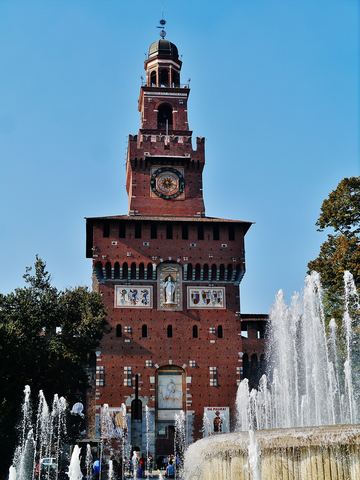
1 The Torre del Filarete
The tower that stands for the Castello is its youngest part. The original from the 1400s blew up in 1521. What you see is an early 1900s reconstruction, pieced together like a detective case.
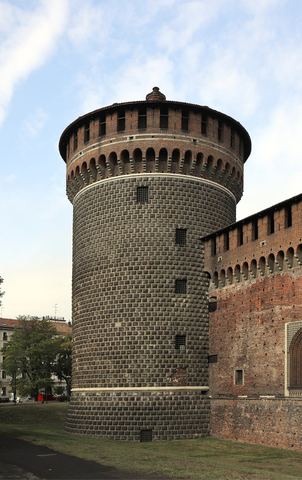
2 The round towers and the castle Milan hated
Two stone towers aimed at the city, not at its enemies. They tell of a fortress the Milanese feared and loathed for centuries, to the point of wanting it razed. Inside, today, there is a surprise.
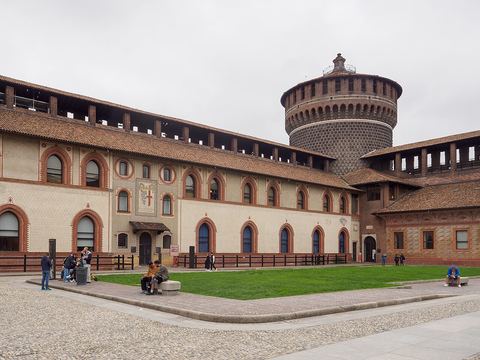
3 The Piazza d'Armi
The Castello's biggest courtyard was made not for dukes but for soldiers. It tells of the three centuries and more when the Sforza palace was a barracks: Spanish, Austrian, French.
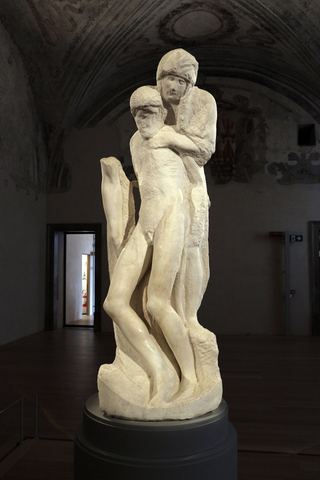
4 Michelangelo's Pietà Rondanini
Michelangelo's last sculpture, which he worked on until a few days before his death. A mother and son almost fused into a single body, in marble left half done. If you have time for only one thing, this is it.
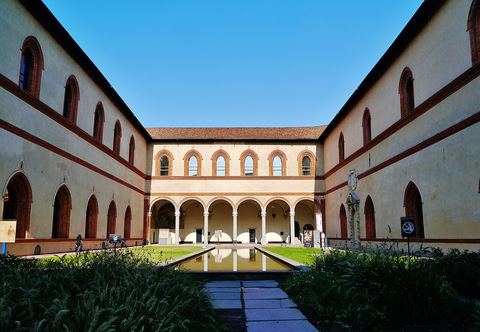
5 The Corte Ducale
Here the Castello stops making war and starts being a palace. This is the home of the Sforza dukes, where Bramante and Leonardo worked for some twenty years and Milan felt like a capital of the Renaissance.
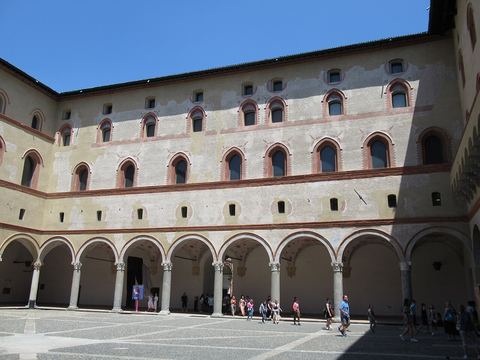
6 The Rocchetta, the fortress within the fortress
The last refuge of the Sforza: a closed courtyard, with the duchy's treasure watched over by a painted guardian. A place so secure that for a child duke it became a prison.
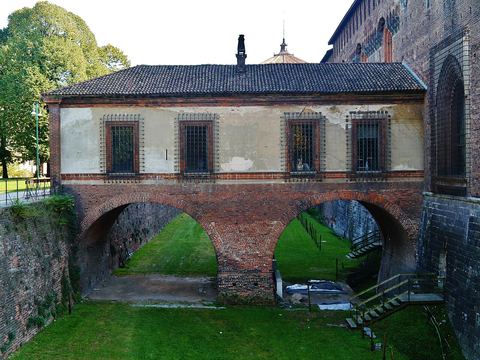
7 The Ponticella and Leonardo at il Moro's court
An elegant little bridge over the moat, attributed to Bramante, where Duke Ludovico il Moro shut himself away to mourn his wife. It is the right place to talk about Leonardo, the tunnels, and how the party ended.
Timeline
- around 1358–1370Galeazzo II Visconti, lord of Milan, builds a fortress beside Porta Giovia, straddling the city walls.
- 1450Francesco Sforza takes Milan and rebuilds the castle that the Ambrosian Republic had ordered demolished three years earlier.
- 1498At the court of Ludovico il Moro, Leonardo da Vinci paints the Sala delle Asse. The next year the duke flees before the French.
- 1521The entrance tower, used as a weapons store, explodes. The facade will stay without a tower for almost four centuries.
- 1550Under the Spanish, work begins on the star-shaped bastions. The Castello is by now a military citadel.
- 1800Under Napoleon, a decree orders the fortress demolished. The bastions disappear, the Castello stays standing.
- 1905Luca Beltrami's restoration, begun in the late 1800s, ends with the Torre del Filarete rebuilt. The civic museums have moved into the halls.
- 2015Michelangelo's Pietà Rondanini, in Milan since 1952, finds its home in the former Ospedale Spagnolo.
Who's who
Francesco Sforza
duke of Milan from 1450
A condottiero, he marries Bianca Maria Visconti and takes the duchy. Months later he has the castle the Milanese tore down rebuilt and gives the entrance tower to Filarete.
Ludovico il Moro
duke of Milan at the end of the 1400s
He makes the Castello one of the richest courts in Europe, with Leonardo and Bramante in his service. In 1499 he flees before the French.
Bona di Savoia
regent duchess of Milan
Widow of Galeazzo Maria Sforza, assassinated in 1476, she rules for her young son and raises the tower that bears her name. Her brother-in-law Ludovico takes son and power from her.
Leonardo da Vinci
artist and engineer at il Moro's court
At the Castello he paints the Sala delle Asse, works on an equestrian monument he never finishes, and draws the underground tunnels.
Michelangelo Buonarroti
sculptor, painter, and architect
He works on the Pietà Rondanini until a few days before his death, in 1564. The sculpture comes to the Castello in 1952.
Luca Beltrami
architect and restorer
From 1883 he fights the demolition of the Castello. Then he restores it and rebuilds the Torre del Filarete from old drawings and paintings.
Words to know
Where it is
The neighborhood
Castello and Sempione
Related places
The story of the place
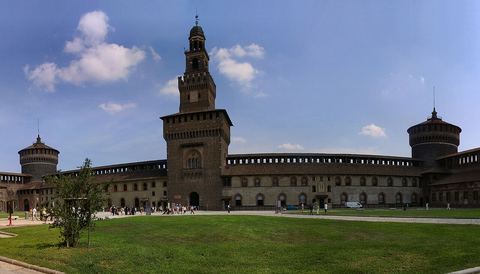
Look at it from a distance: red brick, towers, , a moat. It looks like the perfect castle, straight out of a picture book. Partly it really is, and partly it is an idea of a castle, rebuilt a little over a century ago. To make sense of it you need to know one thing: for almost all of its history, Milan did not love this place.
From the Visconti to the Sforza
It all starts in the second half of the 1300s. Galeazzo II Visconti, lord of Milan, raised a fortress straddling the city walls, beside a gate called Porta Giovia. Its job was to defend the city, and to defend the Visconti from the city. When the dynasty died out, in 1447, the Milanese proclaimed a republic, and one of their first acts was to order it torn down.
That didn't last. In 1450 power went to Francesco Sforza, a , or mercenary captain, turned duke. A few months later he had the castle rebuilt, to the city's displeasure.
His heirs turned it into a palace. Under Ludovico il Moro, duke at the end of the 1400s, Leonardo da Vinci and Bramante worked here, and the court was among the richest in Europe.
From barracks to museum
Then came the foreign rulers. French, Spanish, Austrian: for more than three centuries the castle was a barracks, shut inside a star of .
Napoleon had the pulled down, and for a moment there was talk of a colossal square all around it. In 1848 Austrian cannons fired from here on the city in revolt. After Italy was unified, many Milanese wanted just one thing: to raze it to the ground.
An architect saved it, Luca Beltrami. Between the late 1800s and the early 1900s he restored it, and where something was missing he reinvented it, entrance tower included. The city moved its museums in. Bombed in 1943 and put back on its feet, the castle is now the most open place in town: people walk straight through it on their way to the park.
How the visit unfolds
The visit follows this story from the outside in. First the facade and the round towers, then the soldiers' courtyard, then the Pietà Rondanini, Michelangelo's last sculpture. Finally the two innermost courts: the one where the dukes lived and the one where they barricaded themselves. You finish outside, on the park side, with Leonardo.
Sources
- Castello Sforzesco, complesso. Lombardia Beni Culturali, scheda 1A050-00070 (opens in a new tab)Catalog
- Beltrami, Luca. Dizionario Biografico degli Italiani, Treccani (opens in a new tab)Encyclopedia
- Solari, Pietro Antonio. Dizionario Biografico degli Italiani, Treccani (opens in a new tab)Encyclopedia
- Contemplare la Pietà Rondanini nell'antico Ospedale Spagnolo, Arte.it (opens in a new tab)Other source
- Castello Sforzesco, Wikipedia in italiano (opens in a new tab)Wikipedia
- Sforza Castle, Wikipedia in inglese (opens in a new tab)Wikipedia
- Pietà Rondanini, Wikipedia in italiano (opens in a new tab)Wikipedia
- Sala delle Asse, Wikipedia in italiano (opens in a new tab)Wikipedia
- Francesco I Sforza, duca di Milano. Dizionario Biografico degli Italiani, Treccani (opens in a new tab)Encyclopedia
- Gian Galeazzo Maria Sforza, duca di Milano. Dizionario Biografico degli Italiani, Treccani (opens in a new tab)Encyclopedia
- Castello Sforzesco, Wikidata Q23354 (opens in a new tab)Other source
- Biblioteca Trivulziana, Wikipedia in italiano (opens in a new tab)Wikipedia
- Da non perdere, sito ufficiale del Castello Sforzesco (opens in a new tab)Official site
- Leonardo al Castello Sforzesco, sito ufficiale del Castello Sforzesco (opens in a new tab)Official site
- Archivio Storico Civico e Biblioteca Trivulziana, sito ufficiale del Castello Sforzesco (opens in a new tab)Official site
- Visconti, Bernabò. Dizionario Biografico degli Italiani, Treccani (opens in a new tab)Encyclopedia
- Bellincioni, Bernardo. Dizionario Biografico degli Italiani, Treccani (opens in a new tab)Encyclopedia
- Codex Trivulzianus, Museo Galileo su Google Arts & Culture (opens in a new tab)Institution
- Monumento funebre di Bernabò Visconti, Wikipedia in italiano (opens in a new tab)Wikipedia
- Codice Trivulziano 2162, Wikipedia in italiano (opens in a new tab)Wikipedia
- Festa del Paradiso, Wikipedia in italiano (opens in a new tab)Wikipedia
- Bianca Maria Gaspardone, Wikipedia in italiano (opens in a new tab)Wikipedia
- Fantasmi al Castello Sforzesco di Milano, MilanoFree (opens in a new tab)Other source
- 1526: Bianca Maria Gaspardone, the Insatiate Countess. Executed Today (opens in a new tab)Other source
- The Notebook of Leonardo da Vinci, Archivio Storico Civico e Biblioteca Trivulziana su Google Arts & Culture (opens in a new tab)Institution
- Paola Ventrone, Paradisi e voli angelici nello spettacolo e nell'iconografia in Italia nel lungo Quattrocento. Drammaturgia, Firenze University Press, 2022 (opens in a new tab)Institution
- Giacosa, Giuseppe. Dizionario Biografico degli Italiani, Treccani (opens in a new tab)Encyclopedia
- Castello Sforzesco a Milano: la storia e i fantasmi che lo abitano, DiLei (opens in a new tab)Other source
- Chiesa di San Giovanni in Conca, Wikipedia in italiano (opens in a new tab)Wikipedia