Stop 5 of 7Must-see
The Corte Ducale
Where to stand
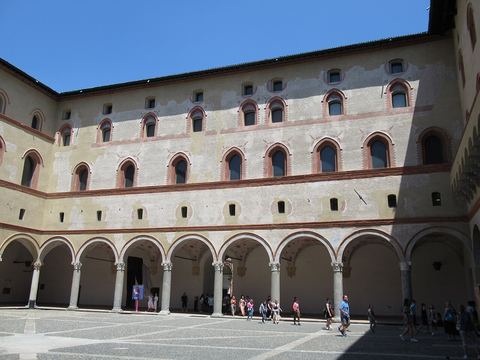
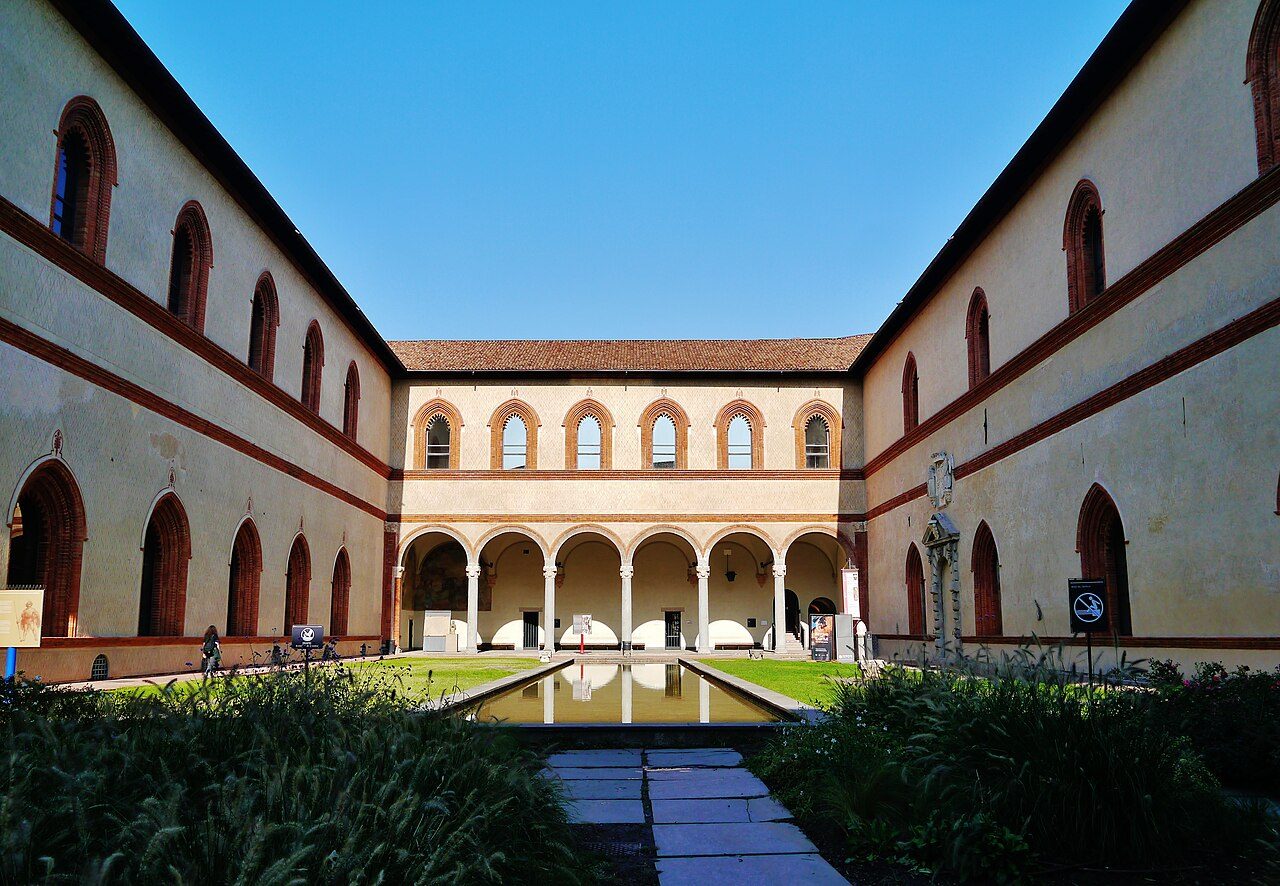
In the middle of the Corte Ducale, the U-shaped courtyard, facing the portico at the far end
Here the Castello stops making war and starts being a palace. This is the home of the Sforza dukes, where Bramante and Leonardo worked for some twenty years and Milan felt like a capital of the Renaissance.
Spot the detail
Under the portico at the far end, look for a faded fresco on the wall. Which animals can you make out?
The full story
After the soldiers' courtyard, this feels like a different building. The space tightens, and slender columns, regular arches, and terracotta moldings appear. This is the Corte Ducale, the Ducal Court: here the Castello Sforzesco stops making war and starts being a palace.
The courtyard is shaped like a U. Along the far end runs the Portico dell'Elefante, the Elephant Portico, with its arcades on stone columns.
In one corner there is a smaller portico with an elegant above it, the Loggia di Galeazzo Maria. You reach it by a staircase with low steps. They were made that way so you could ride up on horseback.
Galeazzo Maria's palace
The master of the house is the man himself, Galeazzo Maria Sforza, second duke of the dynasty. His father Francesco had rebuilt the fortress, but the court was still in the old palace beside the Duomo, Milan's cathedral. In 1468, the year he married Bona di Savoia, Galeazzo Maria moved in here.
He wanted a residence to match the great courts of Italy. He called in the architect Benedetto Ferrini, who brought a thoroughly Tuscan sense of proportion into the Lombard fortress. He called in the painters of the duchy to fresco the halls and the chapel, where Bonifacio Bembo worked. It didn't last: on Saint Stephen's Day, the day after Christmas, in 1476, Galeazzo Maria was assassinated.
Ludovico il Moro and Leonardo
The golden moment came with his brother, Ludovico il Moro. Under him, at the end of the 1400s, these rooms became one of the richest courts in Europe, with Bramante and Leonardo da Vinci in his service.
In the corner tower, on the ground floor, is the Sala delle Asse. Leonardo turned it into a painted pergola, with mulberry trees climbing the walls and weaving their branches across the vault. In April 1498 an official wrote to the duke that Master Leonardo promised to finish it by September. The following year the French arrived and il Moro fled.
The plaque under the portico
Under the Portico dell'Elefante, besides the fresco that gives it its name, there is a plaque that has nothing to do with the dukes. It belongs to the colonna infame, the column of infamy, a monument of shame raised in the 1600s on the site of the house of a Milanese man condemned as an , that is, accused of spreading the plague. The column was pulled down in the 1700s. The plaque ended up here.
Today behind these windows are the Museo d'Arte Antica, the museum of ancient art, and the Pinacoteca, the picture gallery. But the message comes across from outside too. For some twenty years, in this courtyard, Milan felt like a capital of the Renaissance.
About this stop
Anecdote
The golden tyrant above the altar
In the Castello's Museo d'Arte Antica, the museum of ancient art, a marble horseman sits upright in the saddle. He is Bernabò Visconti, lord of Milan in the 1300s. He ordered the statue himself, in his lifetime, almost all gilded, for the church beside his palace. A French friar was scandalized: an abominable idol above God's altar. The poet Petrarch replied that it stood in a chapel, not on the altar. In 1385 his nephew Gian Galeazzo captured him by a trick and locked him up first here, in the Visconti castle, then at Trezzo. Bernabò died before the year ended. One chronicler says from a bowl of poisoned beans.
Anecdote
When Leonardo staged the parties
January 1490. Ludovico il Moro, who rules Milan for his nephew, wants to celebrate in style the young duke's marriage to Isabella d'Aragona, his wife of almost a year. The court poet Bernardo Bellincioni writes the verses. The staging falls to Leonardo da Vinci. In a hall of the Castello the Paradiso appears: a half egg gilded inside, full of lights like stars, with the twelve zodiac signs lit by lamps inside glass. The seven planets are actors in costume who recite the bride's praises. An ambassador who was there describes it with admiration. Before the Last Supper, Leonardo in Milan was this too: the man for the parties.
In culture
The plaque from the column of infamy
Under the Portico dell'Elefante, the Elephant Portico in the Corte Ducale of the Castello Sforzesco, is a plaque that comes from another place and another story. In 1630, at the height of the plague, Milan went looking for culprits. Gian Giacomo Mora was accused of being an , that is, of spreading the contagion on purpose. Where his house had stood a column was raised, called the column of infamy, in memory of the sentence. It was pulled down in 1778, and the plaque ended up here. Alessandro Manzoni, author of The Betrothed, devoted a whole book to that trial, the Storia della colonna infame.
Yes, in the service of Ludovico il Moro. He painted several rooms of the ducal apartment alongside other court painters and, in 1498, the Sala delle Asse: a make-believe pergola of mulberry trees covering walls and vault. Between the 1800s and the 1900s the vault was entirely repainted. Since 2012 a long restoration has been trying to recover the original painting, layer by layer. On one wall there is a monochrome drawing, with roots sinking into rock, thought to be probably by his own hand. The Castello also holds one of his notebooks, the Codex Trivulzianus.
This stop on the map
Next stop
Go back to the central passage and look on the opposite side for the entrance to the Rocchetta, the Castello's most enclosed courtyard