Stop 2 of 7
The round towers and the castle Milan hated
Where to stand
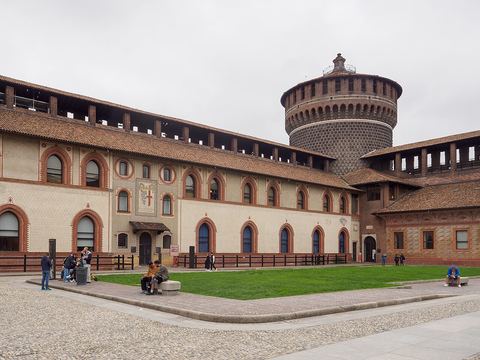
In Piazza Castello, at the foot of one of the two round towers at either end of the facade
Two stone towers aimed at the city, not at its enemies. They tell of a fortress the Milanese feared and loathed for centuries, to the point of wanting it razed. Inside, today, there is a surprise.
Spot the detail
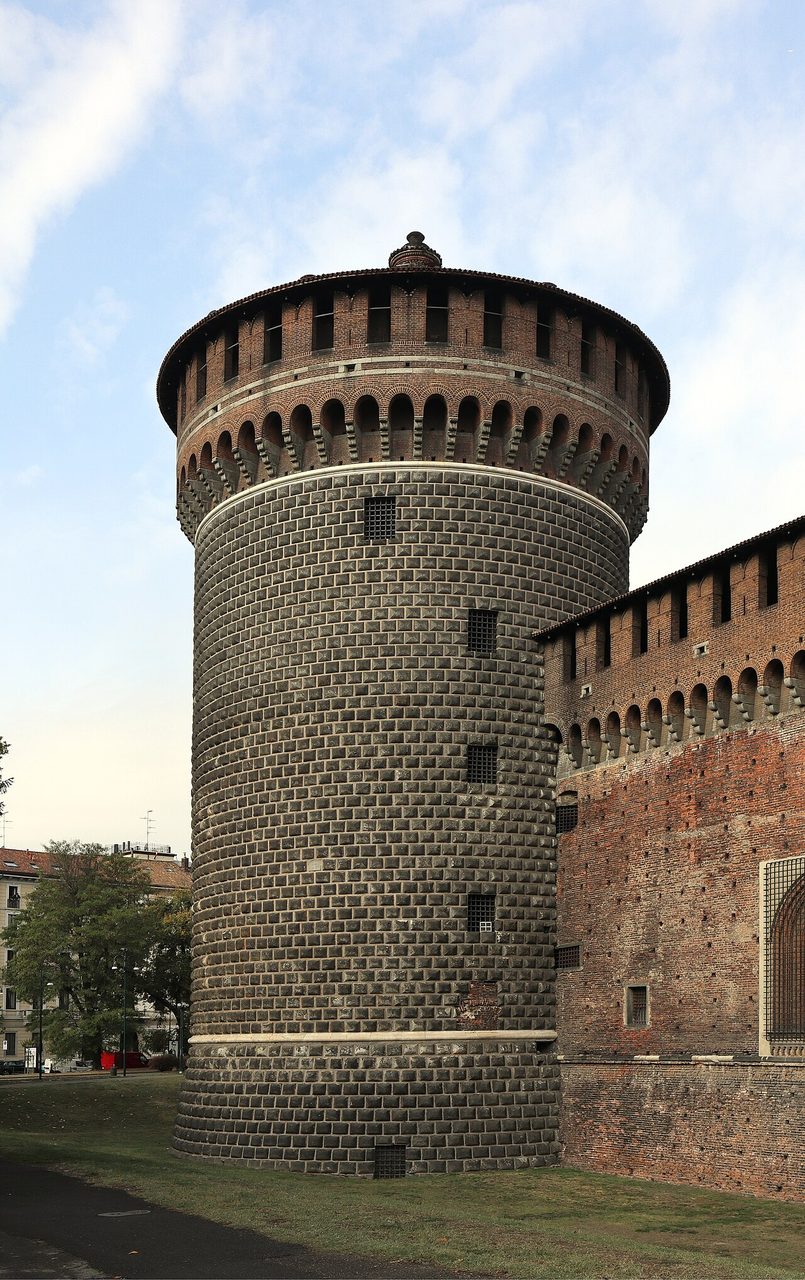
Go up to the tower and look at the stones one by one: what shape is each block?
The full story
Look where these two towers are pointing. Not toward the countryside, where armies came from. Toward the Duomo, Milan's cathedral, toward the houses. The message was for the Milanese.
They are the Torrione dei Carmini and the Torrione di Santo Spirito, the two great round towers of the Castello Sforzesco, and they close off the facade like a pair of fists. The other two corner towers, on the park side, are square. These are round, faced in gray stone, and they were also prisons. Inside are the remains of the cells where patriots of the Risorgimento, the movement for Italian unification, ended up.
A fortress against the city
The city returned the feeling. In the mid-1400s, once the ruling Visconti family had died out, the Milanese proclaimed a republic and tore the fortress down as a symbol of tyranny. Then came Francesco Sforza, the new duke of Milan, and rebuilt it. After him came the Spanish, who shut it inside a star of three kilometers around and kept up to three thousand soldiers there.
When Napoleon arrived, in 1800, a decree ordered the whole thing pulled down. Work began the following year. The fell, and over the 1800s the round towers lost their upper parts too.
The architect Antolini proposed dressing what was left in neoclassical style and setting it at the center of the Foro Bonaparte, a circular plaza almost six hundred meters across, ringed with monumental buildings. It was Napoleon himself who said no: too expensive, and out of scale for a city of a hundred and fifty thousand people.
It wasn't over. In 1848, during the Cinque Giornate, the five days of Milan's uprising against the Austrians, Field Marshal Radetzky ordered the city shelled with the Castello's cannons. When the Austrians left, the crowd poured in and looted it. And some twenty years later, many Milanese were asking to level it and build over it, just to forget centuries of barracks.
The restoration and the cisterns
The man who stopped them was the architect Luca Beltrami, who fought for the city to restore it rather than knock it down. The you see on top of the round towers date from that restoration. And the inside changed jobs: since the late 1800s the towers have housed the cisterns of the city's water supply. The prisons became water tanks.
It is the right ending. A fortress built to keep Milan in check ends up giving it water to drink.
About this stop
In culture
The castle Machiavelli panned
The Castello Sforzesco was born amid the resentment of the Milanese. They had torn down the fortress of the Visconti, the city's old lords, as a symbol of tyranny. In 1450 the mercenary captain Francesco Sforza took Milan, became its duke and, a little over three months after he rode in, had the first stone of the new one laid. A few decades later Niccolò Machiavelli, in The Prince, cited it as a mistake: in his view that castle had done the Sforza more harm than any other disorder in the state. For a prince, he wrote, the best fortress is not to be hated by the people.
Next stop
Go back to the central tower, walk under the arch, and stop in the middle of the first, large courtyard