Stop 3 of 7
The Piazza d'Armi
Where to stand
Just past the entrance tower, in the middle of the large courtyard
The Castello's biggest courtyard was made not for dukes but for soldiers. It tells of the three centuries and more when the Sforza palace was a barracks: Spanish, Austrian, French.
Spot the detail
In the middle of the courtyard stands a Baroque statue of a saint. Who put him in the middle of a barracks?
The full story
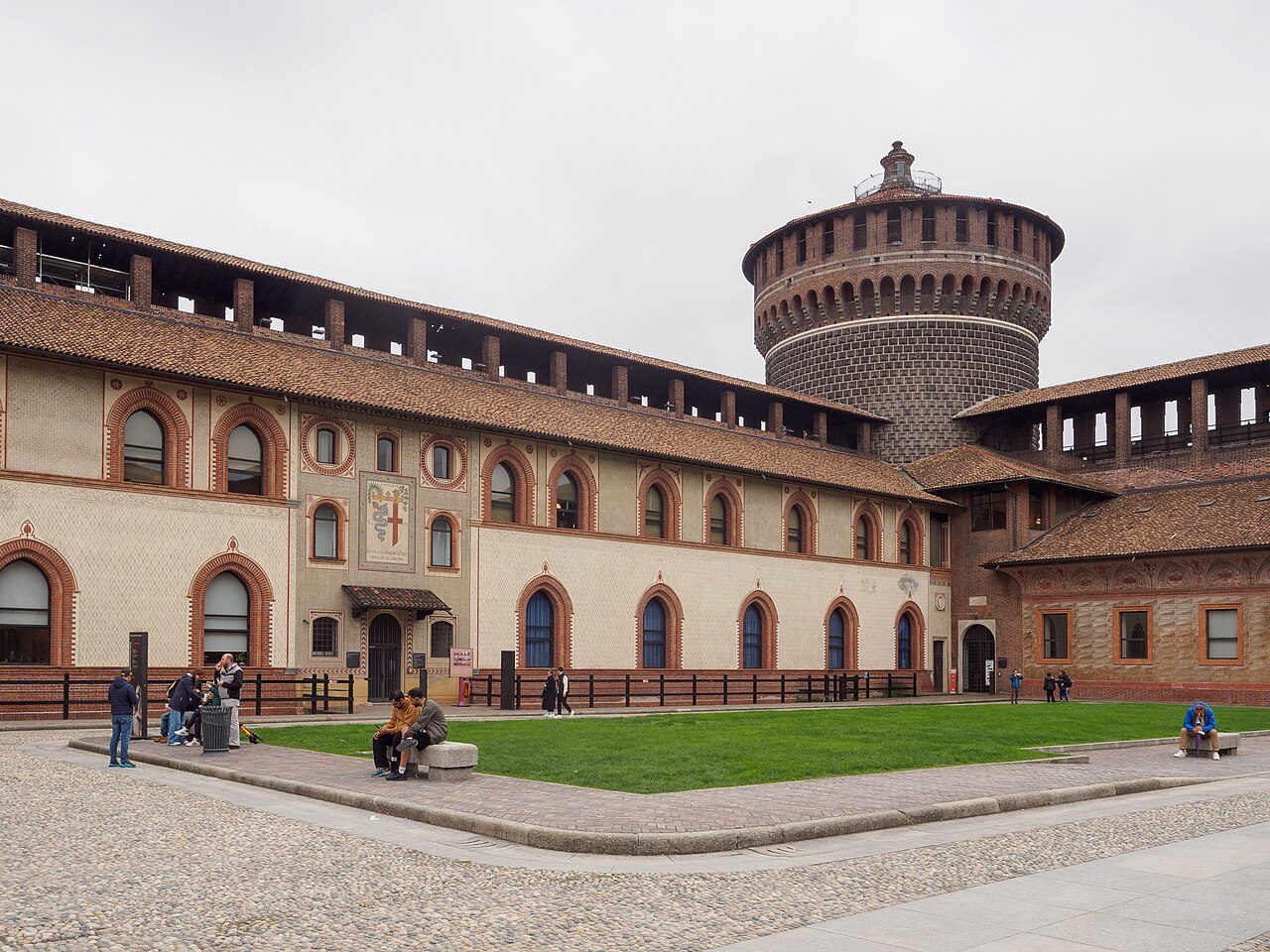
You have just come through the gate, and the first thing the Castello Sforzesco shows you is an empty space. A huge, bare courtyard. It is not a flaw: this is the Piazza d'Armi, the parade ground, where the soldiers mustered.
Turn around slowly. Behind you is the entrance tower. Ahead, at the far end, a high wall with a tower and an arched passage: behind it are the dukes' courts, and you'll get there.
Along one side runs a low building, the Ospedale Spagnolo, the Spanish Hospital. On the opposite side you see pieces of Renaissance facades. They come from buildings demolished around the city and were reassembled here, like an open-air museum.
Three centuries of soldiers
To understand this courtyard, think of the Castello after the Sforza dukes. In 1536 the fortress passed to Charles V, emperor and king of Spain, and stopped being a palace. The governor went to live elsewhere.
The soldiers stayed, anywhere from one to three thousand of them depending on the moment, under the orders of a Spanish . All around grew a ring of in the shape of a star, with twelve points.
After the Spanish came the Austrians, then the French, then the Austrians again. The uniforms changed, the courtyard kept doing the same job. For more than three centuries the Castello Sforzesco was above all this: a barracks.
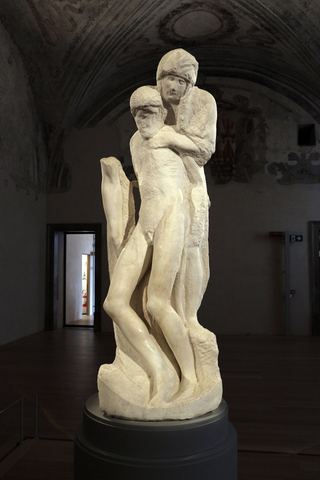
The Ospedale Spagnolo dates from those years, from 1576, and was built for soldiers of the garrison struck by the plague. Keep it in mind: today it holds Michelangelo's last sculpture, and it is your next stop.
The moat and the tower
Now look at the far wall. At its foot runs a moat, known as the fossato morto, the dead moat. It is a piece of the moat that surrounded the walls of Milan in the Middle Ages.
The Castello was born straddling those walls, half inside the city and half outside, beside the old gate of Porta Giovia. Walking through the arched passage means leaving medieval Milan.
The tower guarding the passage is the Torre di Bona. It was built by Bona di Savoia, duchess of Milan, after her husband Galeazzo Maria Sforza was assassinated on Saint Stephen's Day, the day after Christmas, in 1476. Left to rule on behalf of a son who was still a child, Bona planted her tower at the spot that controls everything: the soldiers' courtyard on one side, the family courts on the other.
A woman who trusted no one. As you'll find out further on, she was right.
About this stop
Record
A star of bastions three kilometers around
The biggest part of the Castello Sforzesco you see today is missing. From the mid-1500s the Spanish, then masters of Milan, enclosed it in a ring of shaped like a star: first six points, then twelve. The outer defenses stretched for about three kilometers and covered almost twenty-six hectares. Inside lived a garrison of up to three thousand men. All of it was leveled on Napoleon's orders, starting in 1801. In its place today are a square and a park.
Yes. The moat that runs around the Castello was flooded, and today it no longer is. Another water-filled moat ran alongside the Ghirlanda, the outer ring of walls from the 1400s, of which few traces remain. And a third still cuts through the interior: the fossato morto, or dead moat, a stretch of the city's medieval moat, which separates the Piazza d'Armi from the dukes' courts. To enter the Rocchetta, the innermost refuge, you originally had to cross a .
This stop on the map
Next stop
Head for the low building on your left as you come in from the tower: the former Ospedale Spagnolo, home of the Pietà Rondanini