Stop 1 of 7Must-see
The Torre del Filarete
Where to stand
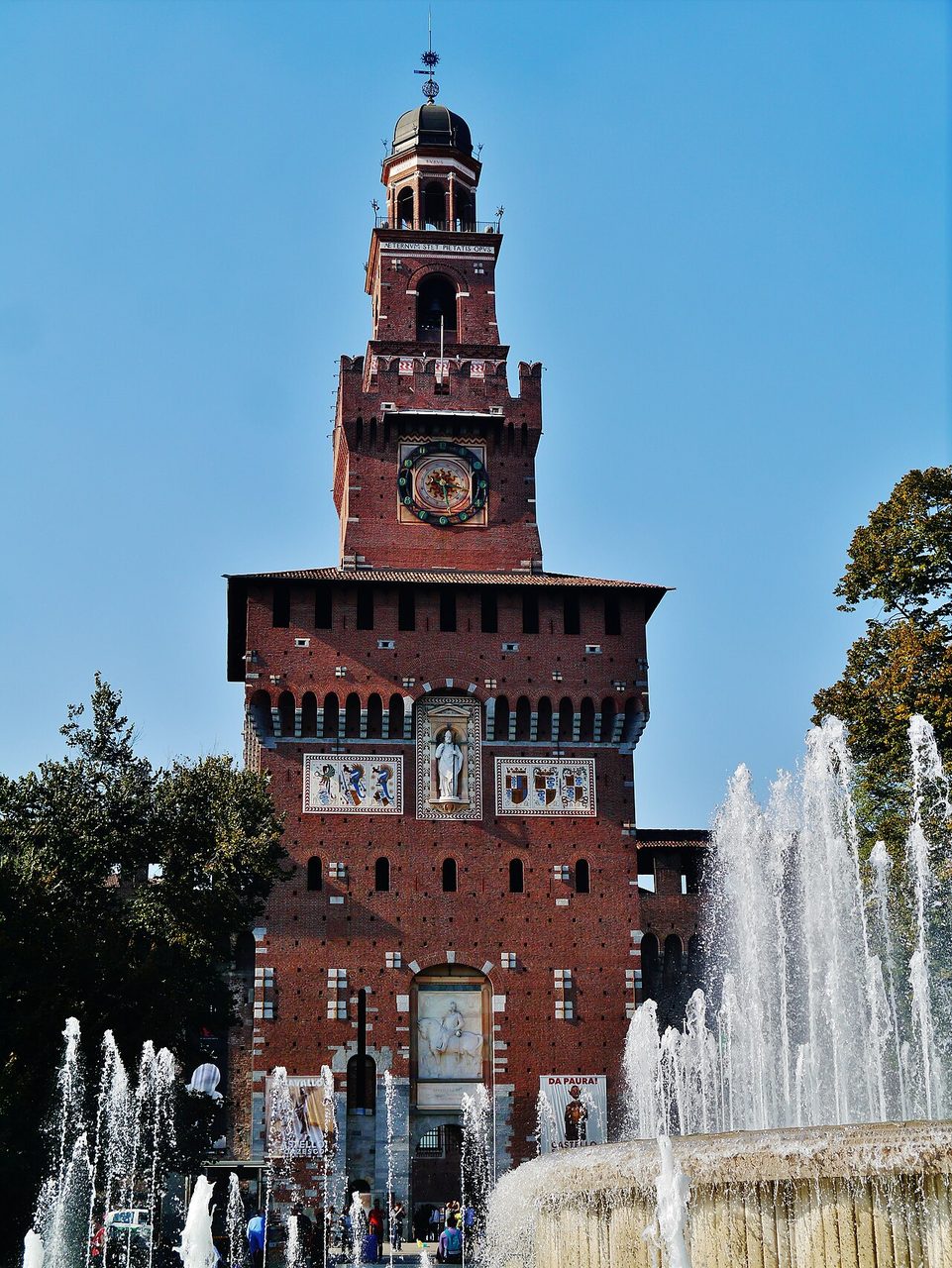
In Piazza Castello, facing the main entrance, far enough back to take in the whole central tower
The tower that stands for the Castello is its youngest part. The original from the 1400s blew up in 1521. What you see is an early 1900s reconstruction, pieced together like a detective case.
Spot the detail
Above the entrance arch a horseman is carved in pale marble. He is not a Sforza. Who is he?
The full story
This tower is the symbol of the Castello Sforzesco, Milan's castle, and a little bit of Milan itself. It is also the youngest part of it: just over a hundred years old.
Stand far enough back to see all of it. It is about seventy meters tall, some 230 feet, and rises in steps: three blocks stacked one on top of the other, each narrower than the last, and at the very top a small eight-sided with a little dome. Halfway up there is a clock. At the center of its face shines a sun with rays, one of the emblems of the Visconti, the lords of Milan before the Sforza.
The tower of the 1400s
The first tower went up in the mid-1400s. Francesco Sforza, the , or mercenary captain, who had just become duke of Milan, was rebuilding the fortress and wanted the side facing the city to be beautiful, not just strong. He called in a Florentine architect, Antonio Averlino, known as Filarete.
Filarete dreamed of decoration in marble and terracotta. The duke's engineers wanted thick walls and fast work. He treated them like bricklayers, the building site slowed down, and in the end the job went to others. The name, though, stayed his.
The tower lasted less than seventy years. In 1521 the Castello was in the hands of the French, who used it to store weapons. A soldier, apparently by mistake, set off a bomb. Everything went up. For almost four centuries the facade stood without its tower.
Luca Beltrami's reconstruction
The man who put it back was Luca Beltrami, the architect who saved the Castello from demolition in the late 1800s and restored it. The trouble was that nobody knew exactly what it had looked like anymore. Beltrami worked like a detective.
- He studied old drawings.
- He found the tower painted in miniature in the background of a Madonna by a follower of Leonardo.
- He found it again in a fresco at an old Milanese farmhouse.
- He took the tower of the castle at Vigevano as his model.
Then he put the clues together and built. So what you have in front of you is a hypothesis made of brick. A learned one, and so convincing that today nobody can picture the Castello without it.
Beltrami had a second aim, too. In those years Milan had opened Via Dante, the straight street that runs here from the center, and that street needed a backdrop.
If it strikes you as a fake, remember that it was signed by the man who saved everything else. Without him, there might be a block of houses here today.
This stop on the map
Next stop
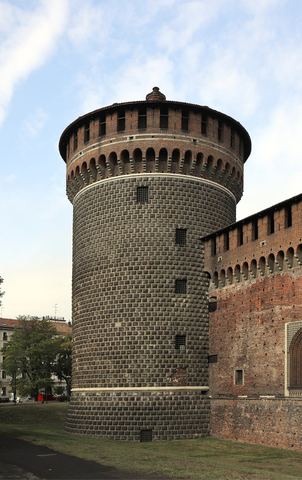
Stay in the square and walk up to one of the two round towers at either end of the facade