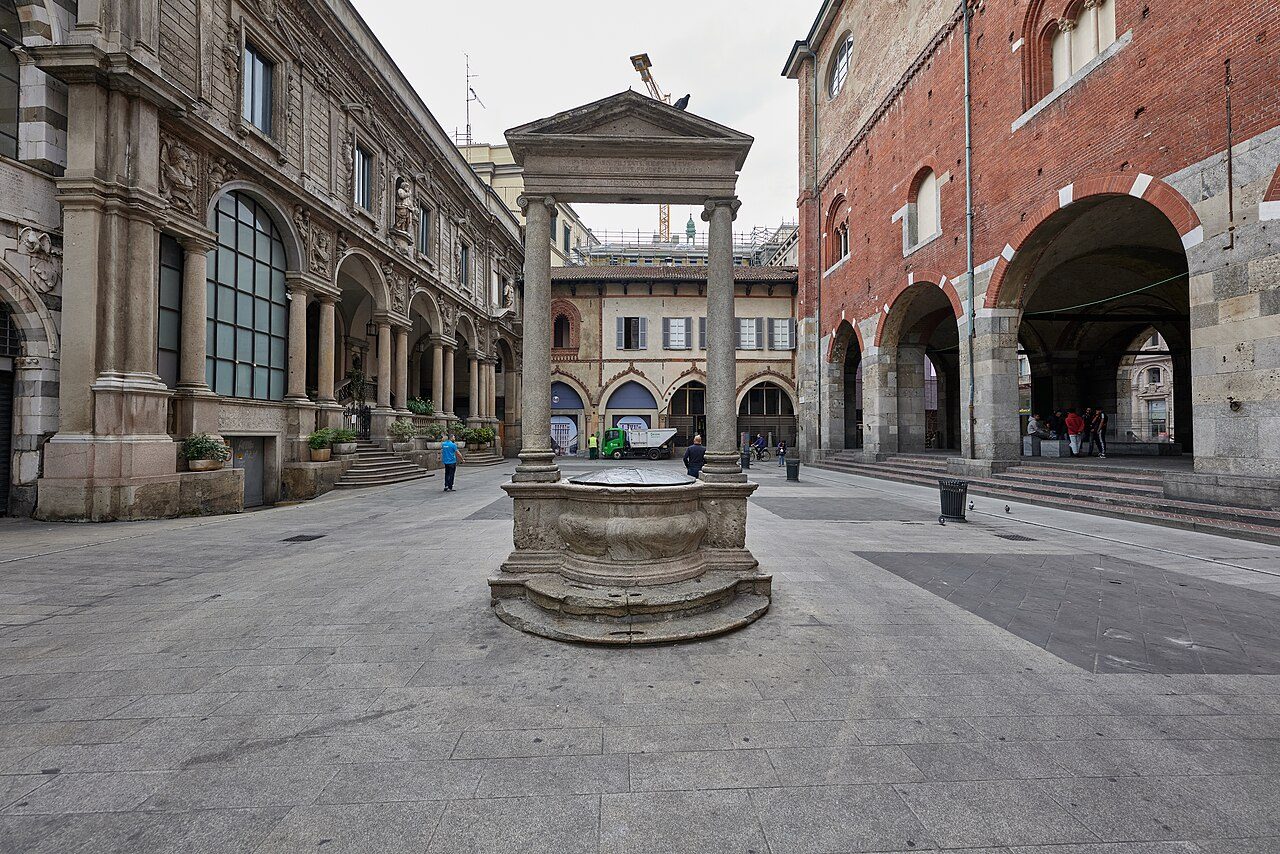
Monument · Historic Center · 1228–1645
Piazza Mercanti
Medieval Milan, hidden a few steps from the Duomo
In brief
For more than five centuries this was Milan's civic heart: the place for trials, trade and the reading of sentences. What's left is a quiet corner with a 13th-century town hall, a black-and-white striped loggia and the sow that, legend has it, gave the city its name.
Stories of this place
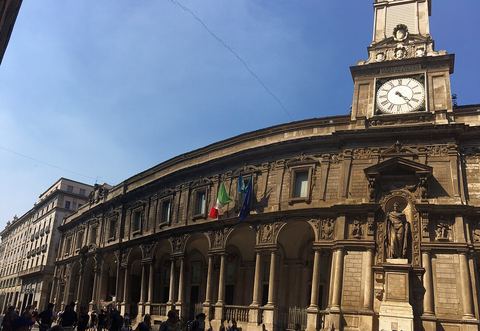
- Anecdote · Via Mercanti and the Palazzo dei GiureconsultiReadA king, a tyrant slayer, a saintThe niche on the facade of the Palazzo dei Giureconsulti has changed tenants with each regime. In 1611 it received a statue of Philip II, king of Spain, by the sculptor Gian Andrea Biffi: Milan was under Spanish rule at the time. In 1797, for the celebration of the constitution of the Cisalpine Republic, the king was turned into Marcus Junius Brutus, the killer of Caesar: a tyrant slayer in place of a sovereign. Then Brutus vanished too. Since 1833 his place has been taken by Saint Ambrose giving a blessing, by Luigi Scorzini.
- Anecdote · Via Mercanti and the Palazzo dei GiureconsultiReadThe noon that came down from the towerThe Palazzo dei Giureconsulti, on Via Mercanti, is built around a 13th-century civic tower, the one with the clock. Before the clock, a bell hung up there: the Zavataria, named after the podestà Zavatario della Strada, who had given it to the city. It announced the curfew, fires and the executions of the condemned. Then came the clock, and with it a new ritual. According to reconstructions, the exact time came from the Brera Observatory by visual signal, and at noon a ball slid down the pole of the lightning rod. So the tower that had spoken in sound for centuries began to give the time by sight.
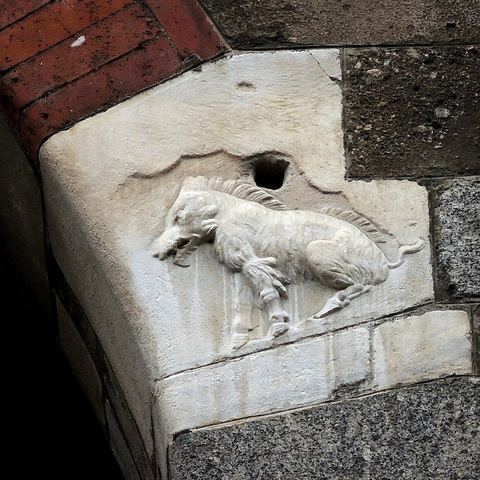
- Legend · The Half-Woolly SowReadThe sow that gave Milan its nameAmong the arches of Palazzo della Ragione, in Piazza Mercanti, there is a small relief of a sow. Legend says she gave Milan its name. The Celtic chieftain Belloveso, down from the Alps, asked the oracles where to found his city and what to call it. The answer: where he saw a sow with a woolly back. He found her, and the city took its name from the omen: medio lanum, "half woolly," hence Mediolanum. The tale is old: the Latin poet Claudian mentions it. Linguists prefer a less colorful explanation: "in the middle of the plain." And the relief, up close, looks more like a wild boar.
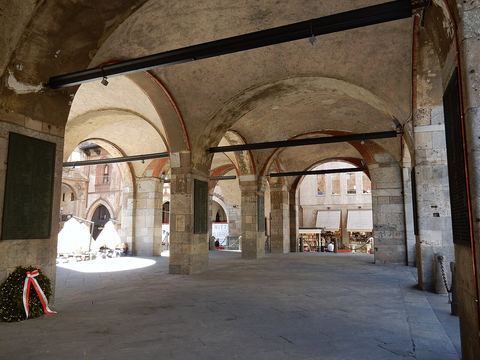
- Legend · The Portico of Palazzo della RagioneReadThe whispering galleryUnder the portico of Palazzo della Ragione there is a game the Milanese hand down from one generation to the next. Two columns, set diagonally from each other, have a hole in them. Lean in to the hole and whisper, and the person at the other column hears you. The story goes that in the Middle Ages merchants and spies used it to swap messages without being seen together, and lovers to talk from a distance. It is a legend, and no document backs it up. But you can test the effect: it takes two people and a little patience.
- Anecdote · The Portico of Palazzo della RagioneReadThe bankers with a carpet on the benchUnder the portico of Palazzo della Ragione, the medieval town hall in Piazza Mercanti, Milan's big banks did business in the 1400s: about twenty of them. You could tell them at a glance: they were the only ones whose bench was covered with a cloth, the "bench with a carpet," and each had a sign bearing a letter of the alphabet. From those benches went out the bills of exchange that made it possible to move money safely all over Europe. To get a bench you needed a hefty deposit and good relations with the government. Smaller lenders worked in the next street over.
- Anecdote · Oldrado, the Podestà on HorsebackReadThe statue of Oldrado that caused a scandalOn the facade of Palazzo della Ragione, in Piazza Mercanti, rides a statue of Oldrado da Tresseno, the podestà who governed Milan when the palace was finished in 1233. The first written verdict on it is a hatchet job. About a hundred years later, the Dominican friar Galvano Fiamma notes in his chronicle that the podestà was carved in marble. And he adds: quod fuit magnum vituperium, which was a great disgrace. Whether that was his opinion alone or a widespread grumble, historians cannot say. But the phrase shaped the monument's reputation for centuries, as the whim of a man who chose to celebrate himself.
- Anecdote · Oldrado, the Podestà on HorsebackReadThe marble horseman who was once in colorOn the facade of Palazzo della Ragione, in Piazza Mercanti, a marble horseman sits in a niche: Oldrado da Tresseno, podestà of Milan in 1233. Today he is the color of stone, but he was once painted. Recent restorations found many traces of paint: the back of the niche was bright red, scattered with gold stars, and the eagle behind him had a yellow-orange beak and feet. The horse was brown, the saddle the color of leather. Scholars also noticed a hole in the right hand: it held an object, in all likelihood a sword, the symbol of justice. Today that closed fist grips thin air.
- Legend · The Well and the Square of SentencesReadThe bankrupts' stoneAccording to tradition, in the middle of Piazza Mercanti, where the well stands today, there was once a large stone: the bankrupts' stone. Anyone who had been ruined and could not pay his creditors had to show himself to the crowd there, bare-bottomed. The details change from one telling to the next, and so does the exact spot where the stone stood. This much is certain: in this square insolvent debtors really were declared so in public, on the steps of Palazzo della Ragione, the town hall, where proclamations were also read and sentences posted.
- Anecdote · The Casa dei PanigarolaReadThe plaque that says don't sueIn Piazza Mercanti, a few steps from the palace where justice was administered, a jurist left a piece of contrarian advice. The terracotta plaque on the Casa dei Panigarola, signed by Tommaso da Caponago in the mid-1400s, warns that disputes over property breed enmity, cost money and wear down body and mind. Those who expect to win often lose, and even those who win, once toil and expense are added up, gain nothing. The sources disagree on the year: 1445 or 1448. In the late 1800s the architect Luca Beltrami built it into the facade he was reassembling.
- In cultureReadShooting hoops with Aldo, Giovanni and GiacomoIn the film Chiedimi se sono felice the comedy trio Aldo, Giovanni and Giacomo play basketball right in Piazza Mercanti. The hoop is the iron halo on the statue of a saint. Look for it and you won't find it: that statue was invented for the film and does not exist in the square. The real saints stand higher up, on the Loggia degli Osii, and on the facade of the Scuole Palatine there is Saint Augustine. None of them, luckily, is within shooting range.
Ready-made questions
After the merchants who worked and struck deals here: mercanti means merchants. In the Middle Ages, though, the Milanese called it Piazza del , after the palace of the Comune that stood in the middle. All around were money changers' benches, notaries, warehouses and the merchants' court, and the nearby streets took their names from the trades: Orefici, Spadari, Armorari, Cappellari, Speronari. Walk around here and you can still read, on the street signs, the list of workshops of a medieval city.
Because justice was administered here: the name comes from its role as a courthouse. The older name is Nuovo. A broletto was the public palace of the Lombard communes, and this one was "new" because it replaced an earlier seat. As early as 1230, with building still under way, the consuls were pronouncing sentences here. The Comune, the city government, stayed until 1786.
Go to stop: The Portico of Palazzo della RagioneBecause you are only seeing part of it. Originally it was a large closed rectangle, with six entrances and Palazzo della Ragione standing alone in the middle. In the second half of the 1800s Milan redrew its center and opened Via Mercanti, which ran through the square and split it. The Palazzo dei , which closed one side, was left across the street. What is called Piazza Mercanti today is the space that remains between the palace, the loggia and the Casa dei Panigarola.
Go to stop: Via Mercanti and the Palazzo dei GiureconsultiNo, but the legend is ancient and the Milanese are attached to it. It says the Celt Belloveso founded the city where he found a sow half covered in wool, in Latin medio lanum. For linguists the name Mediolanum means instead "in the middle of the plain," or "middle land," and describes the city's position. The relief on the palace, in any case, looks more like a wild boar than a sow, and nobody knows for sure how old it is.
Go to stop: The Half-Woolly SowBecause the top floor is not medieval. In 1773 Empress Maria Theresa of Austria had the palace raised to house the notaries' archive. The architect Francesco Croce added a story with large oval windows, in the taste of his day. In the 1970s, when the archive was moved out, there was a debate about demolishing the addition to bring back the 13th-century look. The idea of keeping it prevailed, championed by the architect Marco Dezzi Bardeschi, who went on to oversee the refurbishment of the palace.
Go to stop: Oldrado, the Podestà on HorsebackThey were Christians belonging to a movement that the Church of the day condemned as heresy, and that was active in Lombardy too. In 1224 a law of Emperor Frederick II laid down burning at the stake as the penalty for heretics. In September 1233 the Oldrado applied it in Milan, in the presence of the Dominican friar Pietro da Verona, later venerated as Saint Peter Martyr. The inscription under the statue records it with the words "as he was bound to": for some scholars a boast, for others the formula of an official duty.
Go to stop: Oldrado, the Podestà on HorsebackNo, and not for a long time. Palazzo della Ragione was the seat of the Comune until 1786. Then the offices moved to Palazzo Carmagnola, and since 1861 they have been in Palazzo Marino, where they still are. The notaries stayed on in the square for a long time, with their archive, and so did business: Milan's first stock exchange opened in the Palazzo dei in 1809, and since 1911 that building has belonged to the Chamber of Commerce. Palazzo della Ragione has been owned by the city since 1939.
The stops
1 Via Mercanti and the Palazzo dei Giureconsulti
You are standing in the middle of what used to be the square: this street cut it in two in the 1800s. Ahead is the palace paid for by a Milanese pope and built around the 13th-century civic tower.
2 The Half-Woolly Sow
A small ancient relief set into the wall between the palace arches. According to legend, this is the animal that showed the Celts where to found Milan, and gave the city its name.
3 The Portico of Palazzo della Ragione
A covered square beneath the Comune's palace: here the consuls handed down sentences while notaries and bankers did business. Two columns hide an acoustic trick known as the whispering gallery.
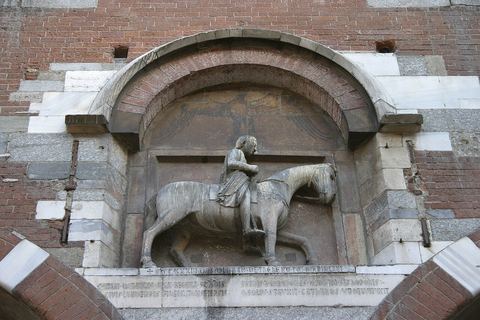
4 Oldrado, the Podestà on Horseback
A marble horseman in a niche: Oldrado da Tresseno, the podestà under whom the palace was finished in 1233. It is one of the first great equestrian monuments of the Middle Ages, and its inscription boasts of a burning.
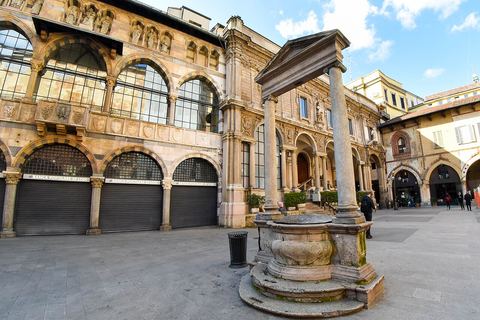
5 The Well and the Square of Sentences
From the center you see the whole square: the palace, the loggia, the schools, the notaries' house. Here proclamations were read, convicts were put on display and, tradition says, bankrupts were humiliated.
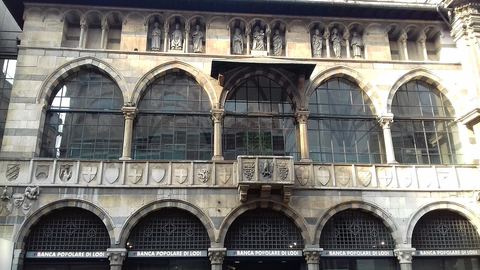
6 The Loggia degli Osii
Two loggias stacked in black and white marble, commissioned by Matteo Visconti in 1316. From the small balcony, magistrates read edicts and sentences to the city.
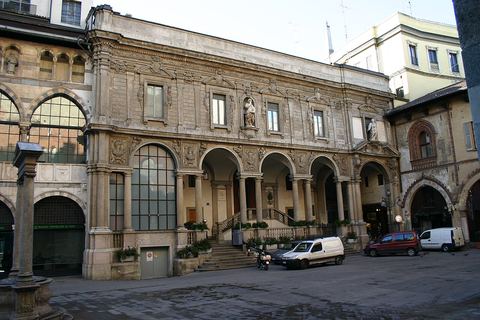
7 The Scuole Palatine
The Baroque facade of Milan's leading schools, rebuilt after a fire in 1644. Two statues watch the square: the Latin poet Ausonius, who praised the city, and Saint Augustine, who taught rhetoric in Milan.
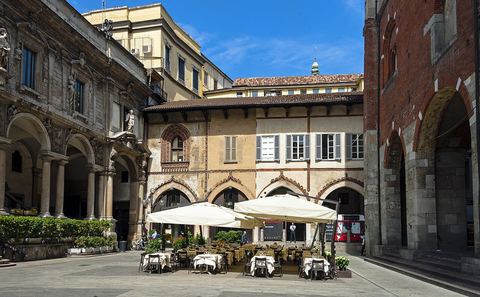
8 The Casa dei Panigarola
The house of the notaries who for centuries recorded the dukes' decrees. Brick, terracotta and Gothic arches from the 1400s, plus a plaque that advises everyone against going to court.
Timeline
- 1228The Comune decides to give itself a new seat with a large square: work begins on the Broletto Nuovo.
- 1233The palace is finished under the podestà Oldrado da Tresseno, portrayed on horseback on the facade.
- 1316Matteo Visconti has the Loggia degli Osii built, with a balcony for reading edicts and sentences.
- 1562Work begins on the Palazzo dei Giureconsulti, commissioned by Pope Pius IV and built around the civic tower of 1272.
- 1644A fire destroys the Scuole Palatine, later rebuilt by the architect Carlo Buzzi.
- 1773Palazzo della Ragione is raised by one story to house the notaries' archive.
- Later 1800sThe opening of Via Mercanti cuts the medieval square in two.
- 1904The Loggia degli Osii, walled up for two centuries, is restored and reopened with a public celebration.
Who's who
Oldrado da Tresseno
podestà of Milan in 1233
From Lodi, in office from June 1233 to May 1234. The palace was finished under him, and he sent the Cathars to the stake. He is the marble horseman on the facade.
Belloveso
Celtic chieftain, legendary founder of Milan
According to legend he founded the city where he found a half-woolly sow. The tradition that makes him the founder goes back to the Roman historian Livy.
Matteo I Visconti
lord of Milan
In 1316 he had the Loggia degli Osii built, part of a system of porticoes planned around the palace of the Comune for judges and notaries.
Pius IV
pope, born Giovanni Angelo Medici
A Milanese nobleman who rose to the papal throne. He commissioned and paid for the Palazzo dei Giureconsulti, begun in 1562 to a design by Vincenzo Seregni.
Galvano Fiamma
Dominican friar and 14th-century chronicler
His chronicle gives one of the earliest reports of the statue of Oldrado, and condemns it: to him it was a great disgrace.
Francesco Croce
18th-century architect
In 1773, on the orders of Maria Theresa of Austria, he raised Palazzo della Ragione by one story. The large oval windows at the top are his.
Words to know
Where it is
The neighborhood
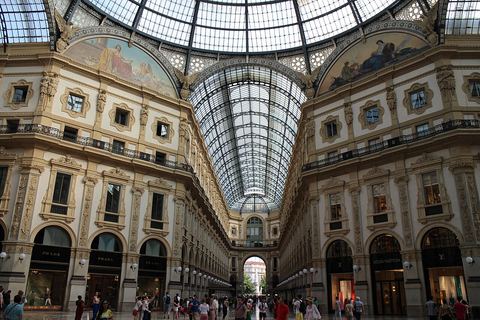
Historic Center
Related places
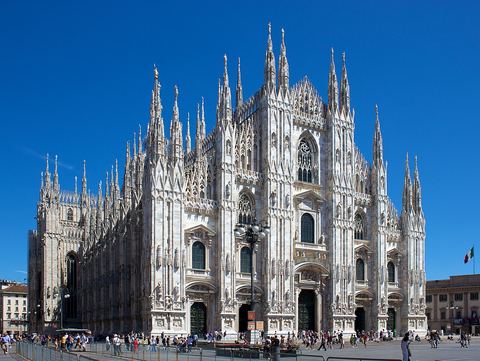
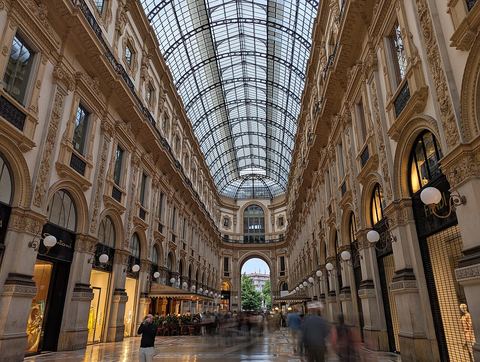
The story of the place
A few steps from the Duomo, Milan's cathedral, there is a square that many people cross without seeing it. It is small, shady, hemmed in by buildings from different eras. And yet for more than five centuries Milan was governed from here.
A square for the Comune
In 1228 the Comune, the self-governing medieval city, decided to give itself a new seat at the most central spot in town. The result was a large arcaded square, closed like a courtyard, with a palace in the middle: the Nuovo, finished in 1233 under the Oldrado da Tresseno, the city's chief magistrate. Later it came to be called Palazzo della Ragione, roughly the Palace of Justice, because this was where justice was done.
You entered the square through six passageways, one for each , the six districts of the city. All around worked judges, notaries, bankers and merchants. The nearby streets still carry the names of the trades: Orefici for the goldsmiths, Spadari for the swordsmiths, Armorari for the armorers, Cappellari for the hatters.
Every century adds a piece
Those who came later left the palace alone: they built around it. In 1316 Matteo Visconti, lord of Milan, commissioned the Loggia degli Osii, with the balcony from which sentences were read. The 1400s brought the house of the Panigarola notaries. In the 1500s Pope Pius IV, a Milanese, paid for the Palazzo dei , the palace of the jurists. In the 1600s, after a fire, the Scuole Palatine, the city's leading schools, were rebuilt.
Then power moved elsewhere. The Comune left the square in 1786, and in the later 1800s Milan redrew its center. The closed square was opened up: a street, Via Mercanti, cut it in two and left the Palazzo dei on the other side.
What remains today
What you see is the part that survives on one side of the palace, which once stood in the middle. It is enough to read almost eight centuries in a few yards: a marble horseman, a stone sow, statues of saints, a plaque that advises you not to go to court.
Give yourself half an hour and look up. Here nearly all the stories are above your head.
Sources
- Saverio Lomartire, Il gruppo equestre di Oldrado da Tresseno nel Broletto di Milano, Rendiconti dell'Istituto Lombardo, Lettere, 156 (2022), archivio IRIS dell'Università dell'Insubria (opens in a new tab)Institution
- Beatrice Del Bo, Nel Broletto Nuovo di Milano: un maestro d'abaco fra i mercanti, in Contro frate Bernardino da Siena, Milano University Press, 2021 (opens in a new tab)Institution
- Milano, Enciclopedia dell'Arte Medievale, Treccani (opens in a new tab)Encyclopedia
- Palazzo Giureconsulti, la storia, Camera di Commercio di Milano (opens in a new tab)Official site
- Milano da scoprire: Piazza dei Mercanti e la galleria dei sussurri, in-Lombardia, Regione Lombardia (opens in a new tab)Institution
- Piazza dei Mercanti, Wikipedia in italiano (opens in a new tab)Wikipedia
- Piazza Mercanti, Wikipedia in inglese (opens in a new tab)Wikipedia
- Palazzo della Ragione (Milano), Wikipedia in italiano (opens in a new tab)Wikipedia
- Palazzo della Ragione, Milan, Wikipedia in inglese (opens in a new tab)Wikipedia
- Oldrado da Tresseno, Wikipedia in italiano (opens in a new tab)Wikipedia
- Scrofa semilanuta, Wikipedia in italiano (opens in a new tab)Wikipedia
- Mediolanum, Wikipedia in italiano (opens in a new tab)Wikipedia
- Loggia degli Osii, Wikipedia in italiano (opens in a new tab)Wikipedia
- Scuole Palatine, Wikipedia in italiano (opens in a new tab)Wikipedia
- Casa dei Panigarola, Wikipedia in italiano (opens in a new tab)Wikipedia
- Palazzo dei Giureconsulti, Wikipedia in italiano (opens in a new tab)Wikipedia
- Palazzo dei Giureconsulti, Wikipedia in inglese (opens in a new tab)Wikipedia
- Piazza Mercanti, Wikidata Q929968 (opens in a new tab)Other source
- Piazza dei Mercanti a Milano: guida al cuore medievale, MilanoFree (opens in a new tab)Other source
- Palazzo della Ragione a Milano: storia e curiosità, MilanoFree (opens in a new tab)Other source
- Palazzo dei Giureconsulti, MilanoFree (opens in a new tab)Other source
- Lapide di Tommaso da Caponago in piazza Mercanti, Chi era costui (opens in a new tab)Other source
- Monuments: St. Ambrose takes the place of Philip II of Spain, My Milan (Italy) (opens in a new tab)Other source
- Palazzo dei Giureconsulti, scheda LMD80-00158, Lombardia Beni Culturali (opens in a new tab)Institution
- Scrofa semilanuta, Wikipedia in inglese (opens in a new tab)Wikipedia
- La Rinascente, Wikipedia in inglese (opens in a new tab)Wikipedia