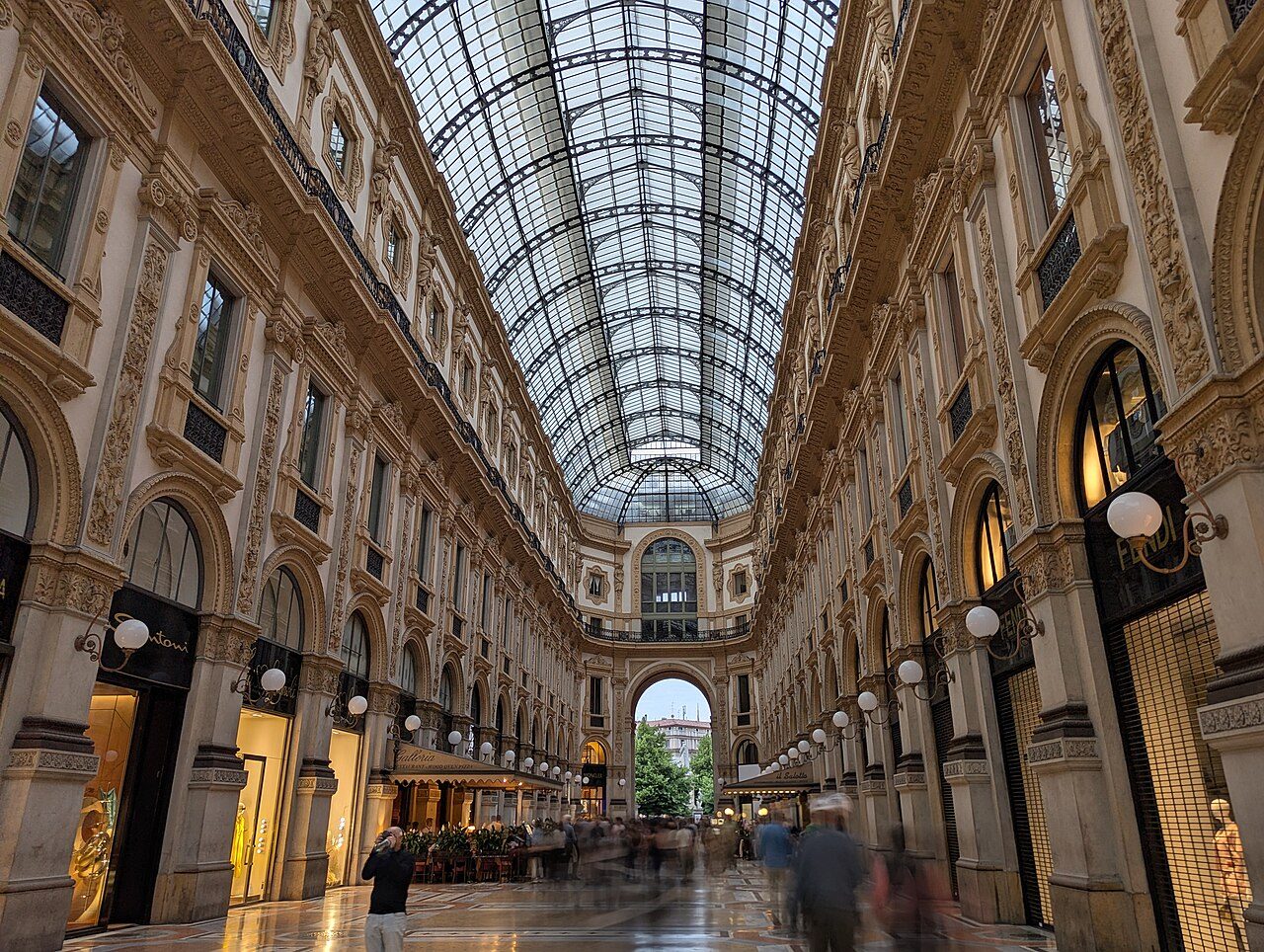
Monument · Historic Center · 1865–1878
Galleria Vittorio Emanuele II
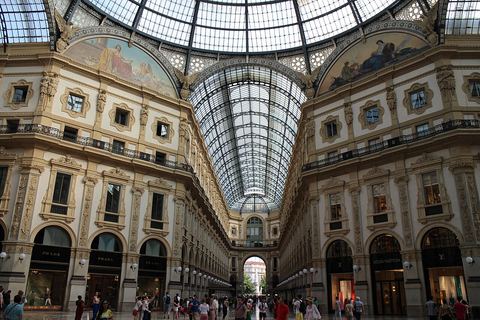
A street under glass between the Duomo and La Scala that cost its architect his life
In brief
A cross-shaped covered street of iron and glass, opened in 1867 to link the Duomo to La Scala and celebrate a newly born Italy. The Milanese call it il salotto, the drawing room: for a century and a half the city has come here to meet, to protest, and to watch itself go by.
Stories of this place
- Anecdote · Piazza del DuomoReadThe mayor who never opened the GalleriaThe new Piazza del Duomo and the Galleria Vittorio Emanuele II, Milan's glass-roofed arcade, had a political godfather: Antonio Beretta, mayor of Milan from 1860. But city finances sank, and some newspapers accused him of misusing public funds. There was talk of a house due for demolition, overpaid to a city official, his brother-in-law. And of a secret deal with the English construction company to build one story higher: some accounts call it a bribe. His administration refused an inquiry and sued a newspaper, but the case came to nothing. No court ever established the charges. Beretta resigned in July 1867. Two months later the Galleria was inaugurated without him.
- Anecdote · The Entrance ArchReadMengoni, the architect who fell from his archGiuseppe Mengoni, the architect who designed the Galleria Vittorio Emanuele II, Milan's glass-roofed arcade, worked on it for almost fifteen years, through controversy, delays, and the bankruptcy of the company building it. For the great entrance arch facing the Duomo, Milan's cathedral, he acted as contractor himself. On December 30, 1877, with the work done a day ahead of the deadline, he climbed the scaffolding for a final check and fell. He was forty-eight. The official version called it an accident, but a rumor of suicide went around at once, never proven. He is buried in Milan's Cimitero Monumentale, and a plaque at the Galleria's entrance remembers him.
- Anecdote · The Octagon and the DomeReadThe little mouse that lit the lampsIn its early years the Galleria Vittorio Emanuele II, Milan's glass-roofed arcade, was lit by gas. To light the lamps high up around the octagon, the eight-sided hall under the dome, there was an automatic device: a small locomotive that ran from one little flame to the next and lit them in sequence. The Milanese called it the rattìn, which means little mouse in dialect, and its evening run became almost a ritual. It lasted until 1883, when the Galleria switched to electric light. One of the cafés, the Gnocchi, had already adopted it three years earlier.
- In culture · The Octagon and the DomeReadThe Galleria under the sole of your bootsAt the center of the Galleria Vittorio Emanuele II, Milan's glass-roofed arcade, the two arms cross in an eight-sided hall, the octagon. That shape has traveled far, and on foot. In 1937 the mountaineer Vitale Bramani invents the first rubber sole for the mountains. The brand is Vibram, the name he signed his articles with in mountaineering magazines. Since 1947 that word has sat inside an octagon, and the company explains why: a tribute to Milan and its Galleria. In the late 1960s the octagon turns yellow. If you wear hiking boots, look under the sole: maybe a piece of this hall has already climbed some trail with you.
- Legend · The Bull and the MosaicsReadThree spins on the Galleria's bullOn the mosaic floor of the octagon, the crossing at the heart of the Galleria Vittorio Emanuele II, Milan's glass-roofed arcade, is the coat of arms of Turin: a rearing bull. Tradition says anyone who plants their right heel on its testicles and spins around three times will have good luck. No one knows when it began. Supposedly it started as Milanese mockery of the House of Savoy, the royal family, later turned superstition, but no document confirms it. What is documented is the damage: the mosaic there wears through and is constantly redone. In the 1960s restoration the bull was remade without testicles. The ritual went on anyway.
- In culture · Il Salotto di Milano, the City's Drawing RoomReadBoccioni paints a brawl in the GalleriaIn 1910 the painter Umberto Boccioni paints Rissa in galleria, or Riot in the Galleria: two women scuffle in front of the Campari café in the Galleria Vittorio Emanuele II, Milan's glass-roofed arcade, and a whole crowd runs to watch. The picture is small and still made of separate touches of color, as Divisionism required. But the crush twisting toward the center already has the tension of Futurism, which Boccioni would soon help lead. It says more about the Galleria than many photographs: an elegant place where next to nothing made everyone stop and stare. It hangs in Milan's Pinacoteca di Brera.
- In culture · Il Salotto di Milano, the City's Drawing RoomReadHemingway at the tables of the GalleriaIn 1918 a nineteen-year-old American spends long hours at the café tables of the Galleria Vittorio Emanuele II, Milan's glass-roofed arcade. He is Ernest Hemingway, later one of the twentieth century's great writers. He drove a Red Cross ambulance, was wounded on the Piave front, and is being treated in a hospital a few hundred meters from the Duomo, Milan's cathedral. In the Galleria he reads the papers, writes home, plays cards, and watches people go by. Some ten years later those evenings end up in a novel, A Farewell to Arms: the outdoor tables, the waiters coming and going, the shaded candles on the tablecloths, the people passing by.
- In culture · The Exit Toward La ScalaReadMark Twain wanted to live in the GalleriaThe American writer Mark Twain describes Milan in A Tramp Abroad, a travel book published in 1880. Of the Galleria Vittorio Emanuele II, Milan's glass-roofed arcade, he writes that he spent most of his time there. This is how he describes it: new and sumptuous buildings, streets roofed over with glass at a great height, marble pavements, tables everywhere, people eating, drinking, and smoking, other people strolling by. His conclusion is a declaration of love: I should like to live in it all the time.
- Record · The Exit Toward La ScalaReadGalleria, a word Milan exportedThe Galleria Vittorio Emanuele II, Milan's glass-roofed arcade, was not the first covered street in Europe: London and Brussels already had theirs. But it was bigger than all those that came before, and architectural historians consider it the direct ancestor of today's enclosed shopping malls. The effect shows in the vocabulary too. Naples built its own Galleria Umberto I, and in the United States many shopping malls carry the Italian name Galleria, starting with the one in Houston, which borrowed the glass vault from the original. It all starts from a cross of iron and glass almost two hundred meters long.
- In culture · The Exit Toward La ScalaReadThe singers waiting for a contractThe Galleria Vittorio Emanuele II, Milan's glass-roofed arcade, ends in front of the Teatro alla Scala, the opera house, and in the nineteenth century that made it, in a few years, a kind of job market for musicians. Singers and players gathered here hoping to be hired by one of Lombardy's theaters. Not everyone was lucky. The writer Giovanni Verga told it in the story Primavera: a young musician arrives in Milan, his music under his arm, and finds that artists' dreams, from every corner of Italy, grow pale under the gleaming glass of the Galleria. Finally he takes a job playing piano in cafés in faraway countries, and leaves.
Ready-made questions
Because it was born along with united Italy. In 1859 Milan passes from the Austrians to the kingdom of the House of Savoy, and soon afterward Vittorio Emanuele II becomes the first king of Italy. The city decides to rebuild its center and to name its most important project after the sovereign. He was the one who laid the first stone in 1865 and inaugurated the Galleria in 1867. The dedication at the top of the arch is signed by the Milanese.
Go to stop: The Entrance ArchFor luck. Tradition says it brings good fortune to spin around three times with your right heel planted on the testicles of the bull, which is the coat of arms of Turin. Nothing is certain about the origin: the story goes that it began as a way of mocking the House of Savoy. The result is that at that spot the mosaic wears out fast and is restored constantly.
Go to stop: The Bull and the MosaicsYes. Giuseppe Mengoni died on December 30, 1877, plunging from the scaffolding of the great arch facing the Duomo, Milan's cathedral, during his final inspection. The work had just been finished, a day ahead of the deadline. Officially it was an accident. In the city there was immediate talk of suicide as well, because the architect had been heavily criticized, but no one has ever proved it. The arch was inaugurated two months later.
Go to stop: The Entrance ArchBecause from its earliest years it has been the place where the city receives guests and shows itself off, as you would in the salotto, the drawing room, at home. Cafés and shops opened under the vault right away, and the Milanese middle class got into the habit of coming here to meet, argue, and be seen. The nickname appears a few years after the inauguration and has never gone away.
Go to stop: Il Salotto di Milano, the City's Drawing RoomNo. The bombing of August 1943 destroyed the entire glass roof and part of the iron structure. Reconstruction began after the war and the Galleria was inaugurated a second time in December 1955, rebuilt as it had been. A major restoration, which brought the plaster back to its original colors, was then carried out between 2014 and 2015. The shape you see is the one Mengoni wanted; the materials, for the most part, are not.
Go to stop: The Iron and Glass VaultNo. Glass-covered passages already existed in London and Brussels, and Milan had a smaller one too, the Galleria De Cristoforis. Mengoni's won out through size and ambition: two entire streets forming a cross, a dome at the center, a for an entrance. That is why it became the model for all the arcades that came after, and gave its name to many of them.
It depends on what you count. The Galleria proper went up fast: first stone in March 1865, inauguration in September 1867. But the arch facing the Duomo, Milan's cathedral, was missing. The English company doing the building went bankrupt in 1869, the city took over everything, and work resumed at a crawl. The arch was inaugurated only in February 1878. Thirteen years in all, not counting those spent earlier on the competitions.
The stops
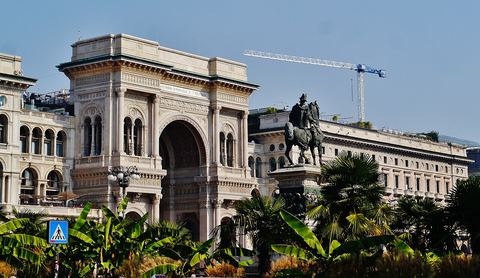
1 Piazza del Duomo
The Galleria wasn't born alone: it is the showpiece of a plan that redrew the whole square in the mid-1800s. From here you see Mengoni's project in full, porticoes included, and the king it is dedicated to.
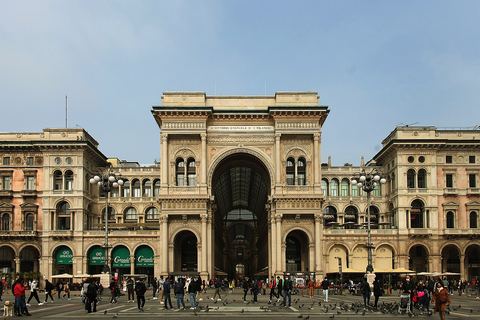
2 The Entrance Arch
A triumphal arch more than thirty meters tall, finished ten years after the rest of the Galleria. It is the last thing Mengoni built: he fell from its scaffolding just as the work was done.
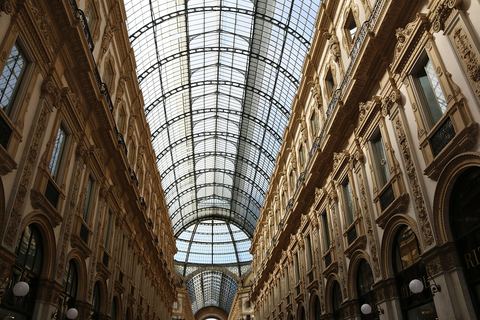
3 The Iron and Glass Vault
A sky of glass held up by iron arches, almost thirty meters above the ground. In 1867 this was the most advanced technology around, and the iron came from France.
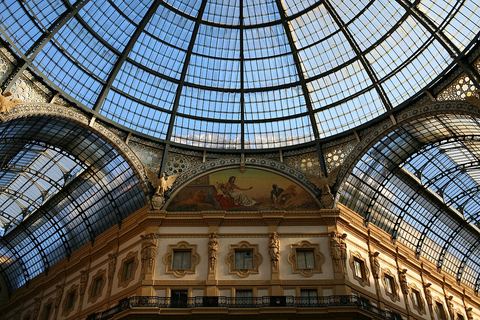
4 The Octagon and the Dome
The heart of the cross: an eight-sided square under a glass dome almost forty meters wide. Up high, four painted continents watch Milan go by.
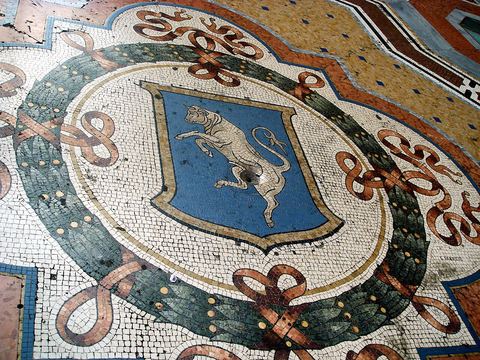
5 The Bull and the Mosaics
The floor holds a history lesson: the Savoy coat of arms and, around it, those of Milan and the three capitals of the Kingdom of Italy. One, the bull of Turin, has become a good-luck charm. And it shows.
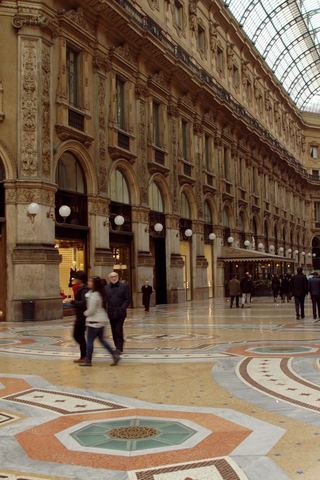
6 Il Salotto di Milano, the City's Drawing Room
Cafés, bookstores, brawls, protests: since day one the Galleria has been the place where Milan arranges to meet. That is why they call it il salotto, the drawing room.
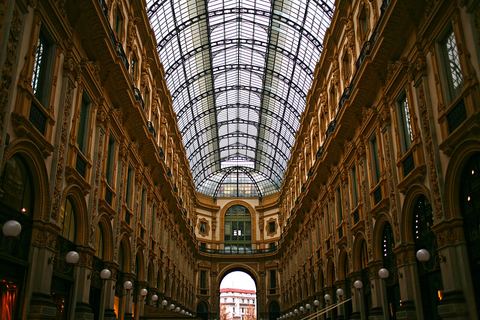
7 The Exit Toward La Scala
From the far end you see the whole Galleria, and you understand what it left the world: a model copied everywhere and a word, galleria, that ended up on the signs of American shopping malls.
Timeline
- 1863After three rounds of competition, the city chooses Giuseppe Mengoni's design for the square and the Galleria.
- 1865On March 7, King Vittorio Emanuele II lays the first stone.
- 1867On September 15 the Galleria is inaugurated, still without the arch facing the Duomo.
- 1869The English company that built the Galleria goes bankrupt. The city of Milan takes it over.
- 1877On December 30 Mengoni dies falling from the scaffolding of the arch, which had just been finished.
- 1878On February 24 the arch on Piazza del Duomo is inaugurated.
- 1943In August, bombing destroys the glass roof and part of the iron structure.
- 1955With reconstruction complete, the Galleria is inaugurated for the second time.
Who's who
Giuseppe Mengoni
architect and engineer, designer of the Galleria
Born near Imola in 1829 and trained in Bologna. He also redesigned Piazza del Duomo. He died on December 30, 1877, falling from the scaffolding of the arch.
Vittorio Emanuele II
first king of Italy
He laid the first stone in 1865 and inaugurated the Galleria in 1867. He died in 1878, the year the arch with the dedication from the Milanese was inaugurated.
Gaspare Campari
liqueur maker and café owner
Inventor of the bitter that bears his name. In 1867 he opened a café at the entrance to the Galleria. His son Davide, born that year, is remembered as the first child born in the Galleria.
Umberto Boccioni
Futurist painter
In 1910 he painted Rissa in galleria, now in the Brera. In 1914 he was arrested with other Futurists after a demonstration in favor of entering the war.
Mark Twain
American writer
He described the Galleria in his 1880 travel book A Tramp Abroad. In Milan he spent nearly all his time there, and wrote that he would like to live in it all the time.
Camillo Boito
architect, head of the Società degli artisti
One of the project's most prominent opponents. The Società degli artisti, the artists' society he led, challenged the works and judged the Galleria useless.
Words to know
Where it is
The neighborhood
Historic Center
Related places
The story of the place
Calling it a galleria is already a tribute: as a word for a covered place full of shops, it traveled around the world starting from here. In truth it is a street. Two streets, actually, that cross beneath a glass dome and join the square of the Duomo, Milan's cathedral, to the square of La Scala, its opera house.
From competition to building site
The idea takes shape in 1859, when Milan has just rid itself of the Austrians and wants a center to match Paris and London. The city holds a competition, then another, then a third: in 1863 the winner is Giuseppe Mengoni, an engineer and architect who came up from Bologna. His plan goes well beyond the Galleria. It redraws the whole square, with the porticoes you still see today, and to make room for it an old arcade and an entire city block are torn down.
King Vittorio Emanuele II lays the first stone in 1865. A little over two years later the Galleria opens, built by an English company with iron shipped from France.
Then the money runs out. The company goes bankrupt, the city takes over everything, and the great arch facing the Duomo stays unbuilt for another ten years. Mengoni finishes it himself and dies there: on December 30, 1877, he falls from the scaffolding during his final inspection.
The drawing room, then the bombs
By then the Milanese have already made it their own. They come to sit at the cafés, to be seen, to argue about politics and, now and then, to throw a few punches. They call it il salotto di Milano, Milan's drawing room, and the name has stuck. Painters and writers put it in their pictures and their stories; the Futurists get themselves arrested here.
In August 1943 bombs smash through the vault. Milan rebuilds it as it was and reopens it in 1955.
How to visit it
The visit is a walk in a straight line. You start in the square, pass under the arch, walk with your head up as far as the octagon, then with your head down over the mosaics, and come out in front of La Scala.
There is only one piece of advice: slow down. Rush through and you see shop windows. Stop and you see the nineteenth century that believed in progress, whole and intact.
Sources
- Galleria Vittorio Emanuele II, scheda SIRBeC, Lombardia Beni Culturali (opens in a new tab)Catalog
- Nel cuore di Milano: Piazza del Duomo e la Galleria Vittorio Emanuele II, Lombardia Beni Culturali (opens in a new tab)Institution
- Mengoni, Giuseppe, Dizionario Biografico degli Italiani, Treccani (opens in a new tab)Encyclopedia
- Beretta, Antonio, Dizionario Biografico degli Italiani, Treccani (opens in a new tab)Encyclopedia
- Camparino in Galleria, la storia (opens in a new tab)Other source
- Vibram, Le nostre icone: la storia del logo ottagonale (opens in a new tab)Other source
- Alberto Saibene, Hemingway a Milano, doppiozero, 22 febbraio 2018 (opens in a new tab)Other source
- Pierfranco Bianchetti, Hemingway non abita più qui, Lombardia Spettacolo (opens in a new tab)Other source
- Giovanni Verga, Primavera, Wikisource (opens in a new tab)Other source
- Storia di Milano, cronologia dal 1861 al 1870 (opens in a new tab)Other source
- Cinzia Gerli, Antonio Beretta, il sindaco smanioso di grandezza, Milano da Vedere (opens in a new tab)Other source
- Andrea Bratta, Vitale Bramani: da Milano in vetta, Zero, 24 novembre 2025 (opens in a new tab)Other source
- Ernest Hemingway, A Farewell to Arms, capitolo 18, Wikisource (opens in a new tab)Other source
- Mónica Vázquez Astorga, Arte e cultura nei caffè storici nella Galleria Vittorio Emanuele II di Milano, Tvriaso XXVIII, Università di Saragozza (opens in a new tab)Institution
- Mark Twain, A Tramp Abroad, capitolo 48 (opens in a new tab)Other source
- Galleria Vittorio Emanuele II, Wikipedia in italiano (opens in a new tab)Wikipedia
- Galleria Vittorio Emanuele II, Wikipedia in inglese (opens in a new tab)Wikipedia
- Galleria Vittorio Emanuele II, Wikipedia in tedesco (opens in a new tab)Wikipedia
- Giuseppe Mengoni, Wikipedia in italiano (opens in a new tab)Wikipedia
- Antonio Beretta, Wikipedia in italiano (opens in a new tab)Wikipedia
- Vibram, Wikipedia in italiano (opens in a new tab)Wikipedia
- Piazza del Duomo (Milano), Wikipedia in italiano (opens in a new tab)Wikipedia
- Monumento a Vittorio Emanuele II (Milano), Wikipedia in italiano (opens in a new tab)Wikipedia
- Rissa in galleria, Wikipedia in italiano (opens in a new tab)Wikipedia
- Coperto dei Figini, Wikipedia in italiano (opens in a new tab)Wikipedia
- The Galleria (Houston), Wikipedia in inglese (opens in a new tab)Wikipedia
- Galleria Vittorio Emanuele II (Q51112), Wikidata (opens in a new tab)Other source