Stop 6 of 7
Il Salotto di Milano, the City's Drawing Room
Where to stand
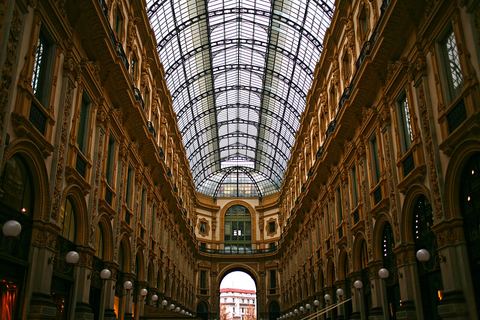
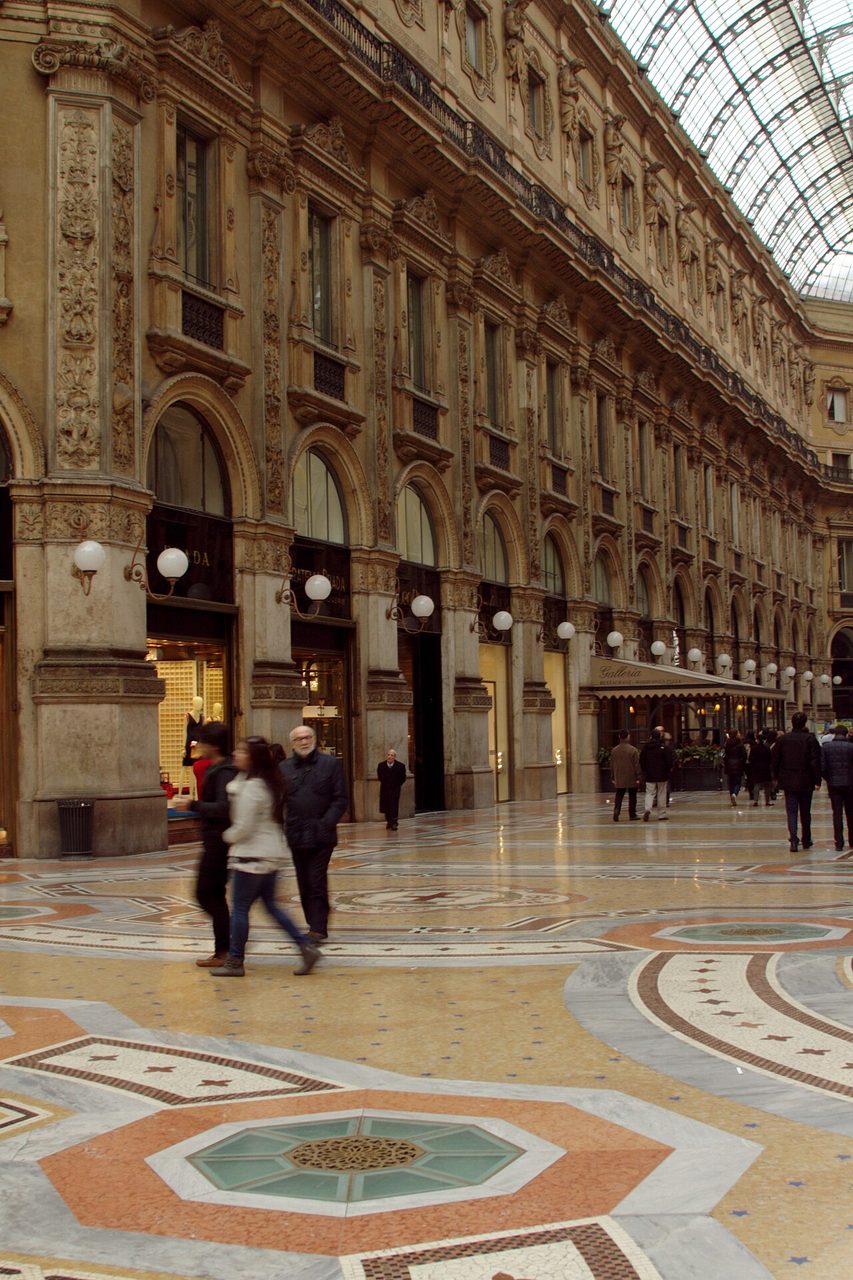
In the arm between the octagon and Piazza della Scala, halfway along, in the middle of the walkway between the two rows of shop windows
Cafés, bookstores, brawls, protests: since day one the Galleria has been the place where Milan arranges to meet. That is why they call it il salotto, the drawing room.
Spot the detail
The shop signs: what do they all have in common?
The full story
The salotto is the drawing room, the room where you receive guests and show yourself at your best. The Milanese began calling the Galleria that a few years after it opened, and it was not just a compliment. It meant that you came here to see and to be seen.
The credit goes to the cafés. In 1867, with the Galleria only just open, the liqueur maker Gaspare Campari took a space at the entrance facing the Duomo, Milan's cathedral. Two months later his son Davide was born: family lore remembers him as the first citizen to come into the world in the Galleria. As a grown man Davide opened a second place, also here, and had it furnished by masters of Liberty, the Italian Art Nouveau, such as the cabinetmaker Eugenio Quarti and the ironworker Alessandro Mazzucotelli.
The brawl Boccioni painted
The Galleria's most famous scuffle is also set in front of the Campari café. In 1910 a young painter, Umberto Boccioni, painted two women coming to blows and the crowd rushing in to watch. The picture is called Rissa in galleria, or Riot in the Galleria.
The figures are made of small touches of color, and the crush of people twists toward the center like a whirlpool. Futurism, the movement that wanted to paint the energy of the modern city, is already there in that canvas. Today it hangs in the Pinacoteca di Brera, Milan's great picture gallery.
Politics and protest under the vault
The Futurists were at home in the Galleria, and not only to paint. In 1914, with war just broken out in Europe, Boccioni, the poet Marinetti, and other companions demonstrated for Italy to enter the war too: leaflets, shouting, Austrian flags set on fire. They ended up under arrest.
Because the Galleria has always been this as well: a political square with a roof. Ten days after the inauguration there was already a protest, over the arrest of Garibaldi. Since then many heated seasons of Italian history have passed through here, with marches, scuffles, and broken shop windows.
The writers' Galleria
Writers have made a character of it too. Giovanni Verga put it in his Milanese short stories, and not from the elegant side: in one, a poor woman who sells coffee on the street spends her nights under the entrance arch. Luigi Capuana summed it up in a single line: it is the heart of the city.
Look around you. The goods in the windows have changed, but the game is the same as a century and a half ago: people come here to watch other people who come here.
About this stop
In culture
Boccioni paints a brawl in the Galleria
In 1910 the painter Umberto Boccioni paints Rissa in galleria, or Riot in the Galleria: two women scuffle in front of the Campari café in the Galleria Vittorio Emanuele II, Milan's glass-roofed arcade, and a whole crowd runs to watch. The picture is small and still made of separate touches of color, as Divisionism required. But the crush twisting toward the center already has the tension of Futurism, which Boccioni would soon help lead. It says more about the Galleria than many photographs: an elegant place where next to nothing made everyone stop and stare. It hangs in Milan's Pinacoteca di Brera.
In culture
Hemingway at the tables of the Galleria
In 1918 a nineteen-year-old American spends long hours at the café tables of the Galleria Vittorio Emanuele II, Milan's glass-roofed arcade. He is Ernest Hemingway, later one of the twentieth century's great writers. He drove a Red Cross ambulance, was wounded on the Piave front, and is being treated in a hospital a few hundred meters from the Duomo, Milan's cathedral. In the Galleria he reads the papers, writes home, plays cards, and watches people go by. Some ten years later those evenings end up in a novel, A Farewell to Arms: the outdoor tables, the waiters coming and going, the shaded candles on the tablecloths, the people passing by.
Because from its earliest years it has been the place where the city receives guests and shows itself off, as you would in the salotto, the drawing room, at home. Cafés and shops opened under the vault right away, and the Milanese middle class got into the habit of coming here to meet, argue, and be seen. The nickname appears a few years after the inauguration and has never gone away.
Next stop
Keep going straight to the arch that opens onto Piazza della Scala, and stop before you step out