Stop 6 of 8Must-see
The Loggia degli Osii
Where to stand
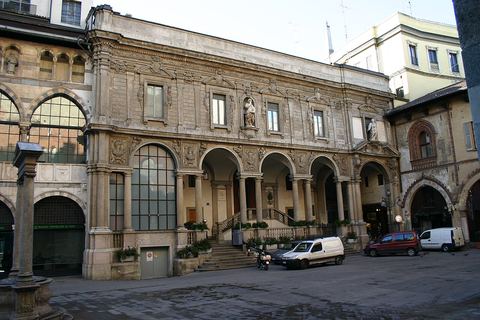
In the square, facing the black-and-white striped loggia, a few yards back so you can take it all in
Two loggias stacked in black and white marble, commissioned by Matteo Visconti in 1316. From the small balcony, magistrates read edicts and sentences to the city.
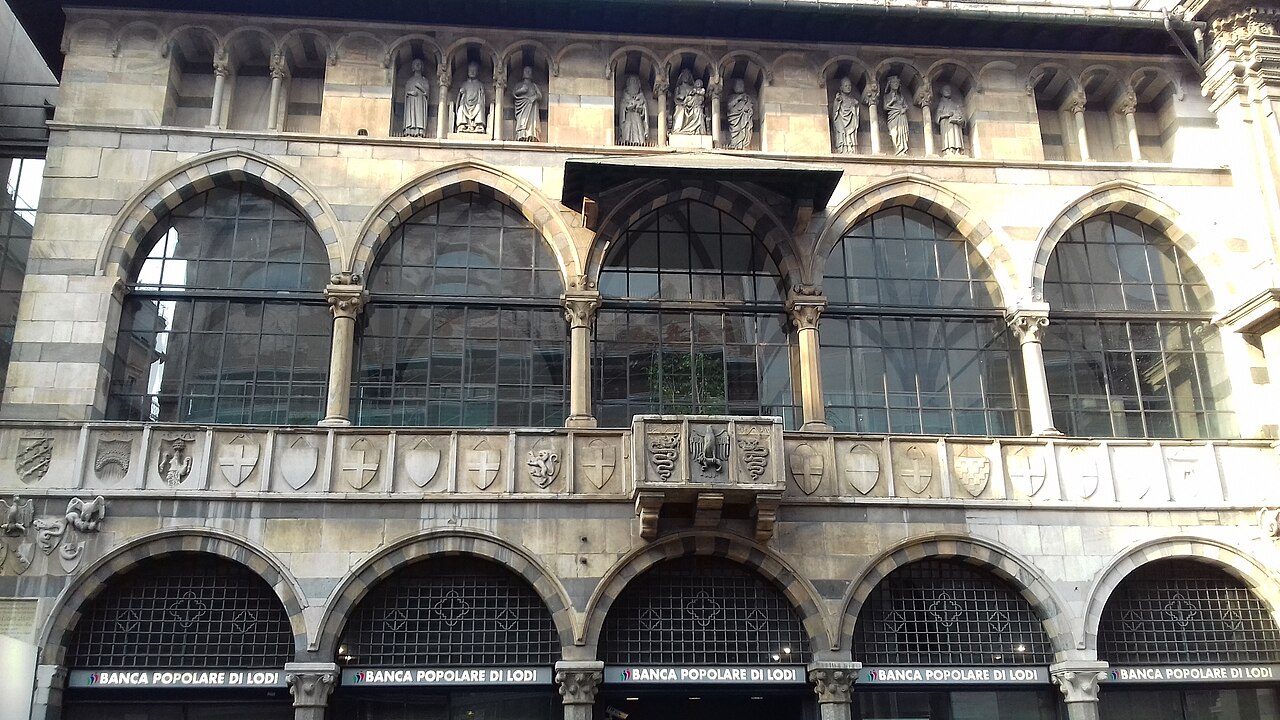
Spot the detail
Find the small balcony jutting out from the loggia. Which animal decorates it?
The full story
After so much stone and brick, this facade seems to have arrived from another city. Stripes of black and white marble, two loggias one above the other, pointed arches, and at the top a row of statues looking out from .
In Milan it really is a rarity. Banded marble is not at home on the city's civic buildings, and it brings Genoa to mind instead. Some link it to a wedding: a few years after the loggia was built, Stefano Visconti married Valentina Doria, from a Genoese family.
The voice of power
The loggia dates from 1316. Matteo Visconti, lord of Milan, commissioned it, and the architect Scoto da San Gimignano built it. The name comes from the Osii family, who had their houses here: a document of 1252 already speaks of a loggia "that belonged to the Osii."
Matteo had a precise plan: to ring the palace of the Comune, the city government, with porticoes for judges and notaries. And directly opposite the palace there is a balcony. It is the small one jutting out from the facade: the . From there the magistrates read edicts and sentences to the crowd.
Look at the band of coats of arms that runs along the parapet. You'll find the six , the districts named after the city gates, the arms of Milan and those of the Visconti. The Comune and the lord, on the same line.
Walled up, then set free
The statues at the top are figures of saints. They were carved in the first decades of the 1300s, some by masters from Campione and some by Tuscans.
For two centuries nobody saw the loggia like this. Between the 1600s and the 1700s the arches were walled up and a staircase was added in front. It only got its old look back in 1904, with a restoration paid for by a public collection, by the Chamber of Commerce and by the widow of General Egidio Osio.
A surname that comes back six centuries later: a plaque commemorates the general. In the end the Loggia degli Osii was saved partly in the name of an Osio.
This stop on the map
Next stop
Look at the building next to the loggia, with the portico of paired columns at the top of a few steps