Stop 7 of 8
The Scuole Palatine
Where to stand
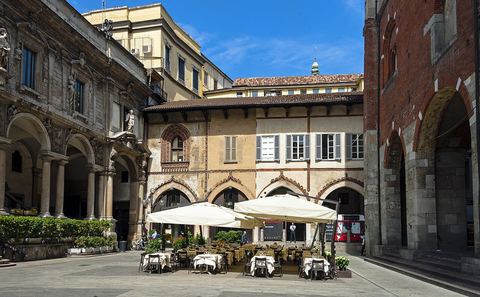
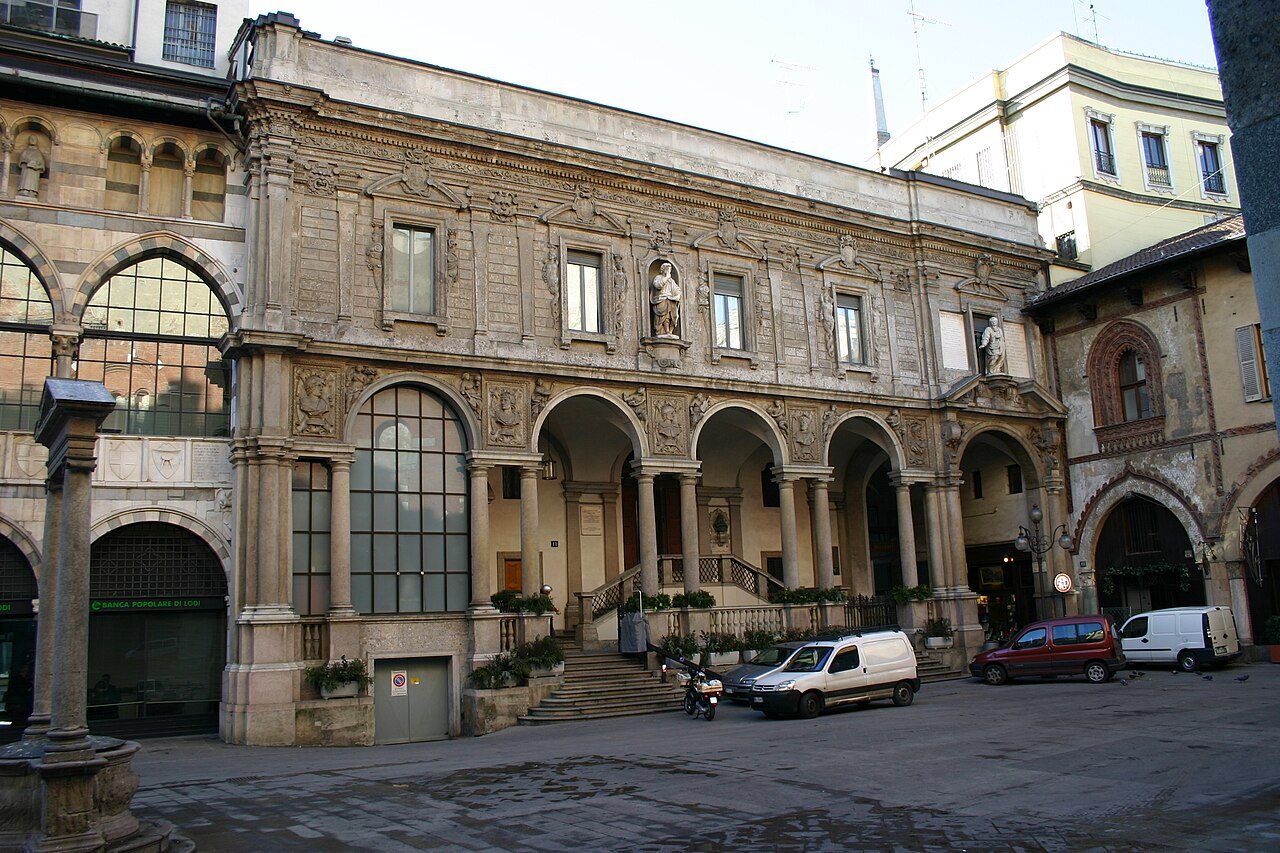
In the square, in front of the building next to the loggia, with the portico of paired columns at the top of a few steps
The Baroque facade of Milan's leading schools, rebuilt after a fire in 1644. Two statues watch the square: the Latin poet Ausonius, who praised the city, and Saint Augustine, who taught rhetoric in Milan.
Spot the detail
There are two marble statues here: a saint and a Roman poet. Where are they?
The full story
More than three centuries separate the medieval loggia from this building, and it shows. Here everything is symmetry: a portico raised on a few steps, columns in pairs, busts of emperors above the arches. This is the 1600s striking a pose.
If it reminds you of the palace you saw on Via Mercanti, you're right. In 1644 a fire destroyed the old schools, and the Comune, the city government, had the architect Carlo Buzzi rebuild them on the model of the Palazzo dei , the palace of the jurists. The same motif of arches and columns, the , repeated from one side of the old square to the other.
The school for future rulers
The Scuole Palatine, the Palatine Schools, were the most important schools of higher learning in Milan. They had been in the , the town hall complex, since the 1400s. The grand name came later, from a Flemish professor of Latin eloquence, Erycius Puteanus: a nod to the schools of Milan when it was a capital of the Roman Empire.
The students were young nobles headed for the College of Jurists. Rhetoric, Latin, Greek, law: two years, and then the university in Pavia. In the 1700s the schools opened to the middle classes as well, and the subjects multiplied, from astronomy to chemistry.
A poet and a saint
Both statues are by the sculptor Giovan Pietro Lasagna. At the center of the facade is Saint Augustine, who before becoming a bishop and a saint taught rhetoric right here in Milan. On the arch of the passageway next door is the Latin poet Ausonius. In the fourth century he celebrated the city's wonders in verse: to him they held their own even next to Rome.
Then the schools left the square too: in 1773 they were moved to Brera. And today only the facade of this building is old. Behind it is a modern structure.
That happens a lot in this square. What looks intact has been rescued, rebuilt or pieced back together. But the scene, from where you stand, still works.
This stop on the map
Next stop
On the last side of the square, look for the brick house with the low pointed arches