Museum · Magenta and Sant'Ambrogio · 1953
Museo Nazionale della Scienza e della Tecnologia
A submarine, a sailing ship, and Leonardo's machines inside a monastery
In brief
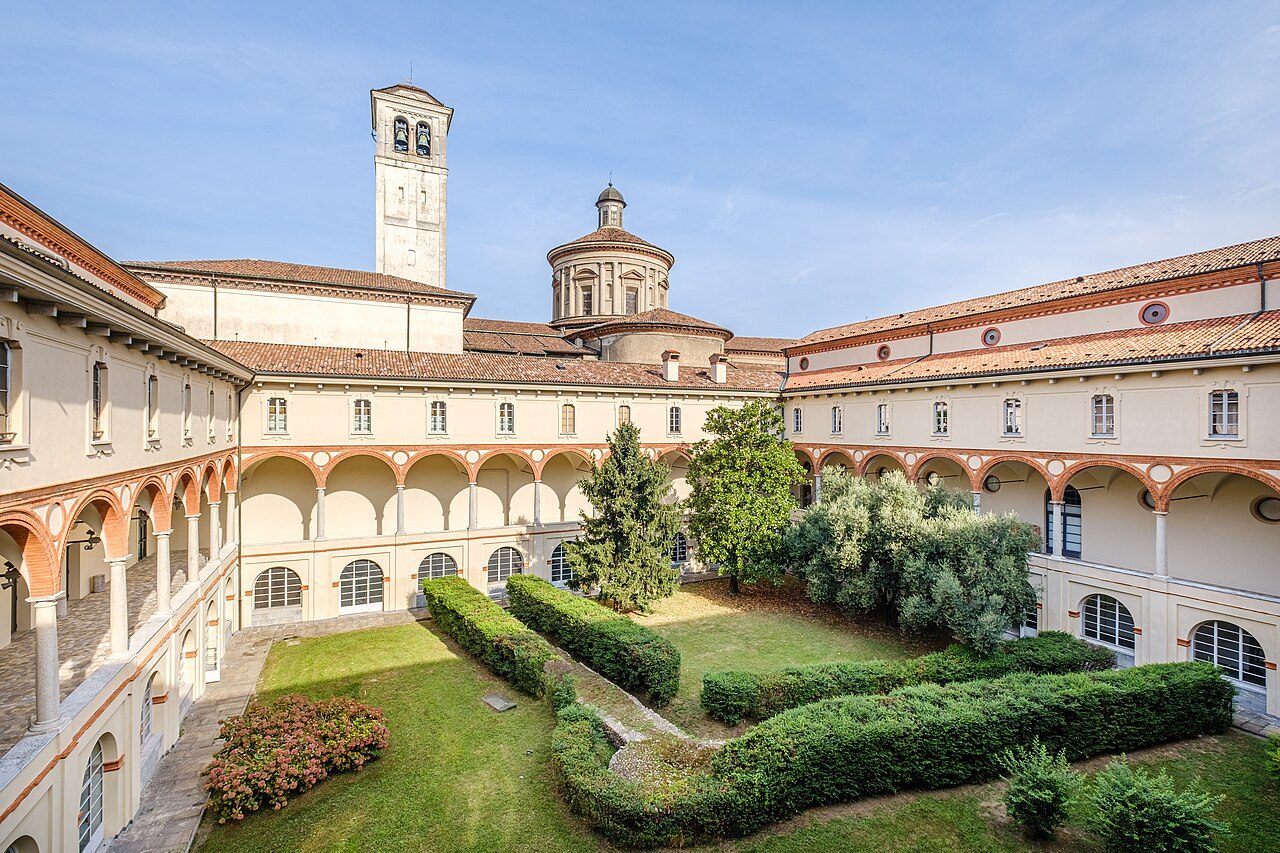
Italy's largest museum of science and technology, opened in 1953 in the former Olivetan monastery of San Vittore. Among the cloisters you'll find models built from Leonardo's drawings, locomotives, a complete sailing ship, the bridge of an ocean liner, and a Cold War submarine.
Stories of this place
- Anecdote · The Gallerie Leonardo da VinciReadLeonardo's first models never came backIn the museum's Gallerie Leonardo, the models of machines by Leonardo da Vinci, painter and inventor, had unlucky predecessors. In 1939 Milan devoted a major exhibition to him at the Palazzo dell'Arte exhibition hall, with about two hundred models built specially from his drawings. The models went around the world: in 1940 they were in New York, in 1942 in Tokyo, in the middle of the war. They did not come back. The ship carrying them home to Italy was hit, and they were lost. Many technical drawings survived. They also served to rebuild the models in military workshops and arsenals, in time for the museum's opening in 1953.
- In culture · The Martians' Telescope and the MoonReadThe Martians were born in MilanThe museum's Spazio exhibition, the one about space, opens with the big telescope of Giovanni Schiaparelli, astronomer and director of the Osservatorio di Brera, Milan's observatory. In 1877 Schiaparelli had seen a network of lines on Mars and called them canali. In English the word was translated as canals, which means only man-made waterways, rather than channels. Out of that misunderstanding came the idea of a Martian civilization. The American astronomer Percival Lowell argued for it in three books, imagining great waterworks. The dispute was settled only by the Mariner probes, between 1965 and 1971: Mars is a desert. With this telescope Schiaparelli carried on those studies.
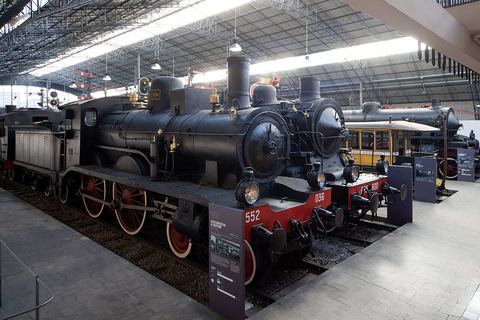
- Legend · The Padiglione FerroviarioReadWhy it is called Gamba de LegnIn the museum's Padiglione Ferroviario, the railroad pavilion, is a small locomotive the Milanese called Gamba de Legn, wooden leg. It was the nickname of the steam trams that from the late 1800s linked Milan to the towns around it. Why that name? According to a popular tale, a man with a wooden leg worked along the line. There is no proof. The most believable explanation is the gait: slow and wobbly, like someone limping. In the city the train could not exceed ten kilometers an hour. The last one to serve Milan ran along Corso Vercelli on August 31, 1957, waved off by people along the street.
- Anecdote · The Sailing Ship Ebe and the Conte BiancamanoReadEvita, the Biancamano's secret passengerThe command bridge in the museum's Padiglione Aeronavale, the air and sea pavilion, comes from the Conte Biancamano, an Italian liner. In 1957 the ship carried a secret cargo from Buenos Aires to Genoa: a coffin registered to Maria Maggi de Magistris, an Italian widow who had died in Argentina. Inside was the embalmed body of Evita Perón, the Argentine president's wife, who had died in 1952. Argentina's military government did not want her grave to become a shrine. She was buried under a false name in Milan's Cimitero Maggiore cemetery, and stayed there fourteen years. A woman was paid to bring her flowers. She never knew for whom.
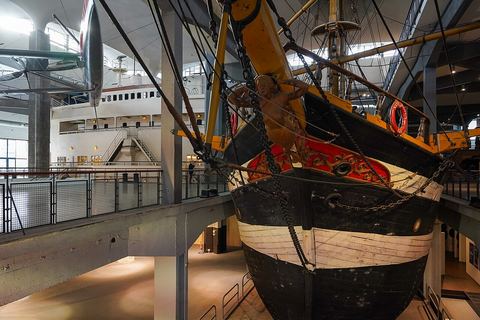
- Anecdote · The Sailing Ship Ebe and the Conte BiancamanoReadThe sailing ship cut into slicesIn the museum's Padiglione Aeronavale, the air and sea pavilion, stands a complete sailing ship fifty meters long: the Ebe, a former Italian Navy training ship. In the early 1960s she was due to be scrapped in La Spezia, and the museum managed to get her. The hull was cut into ninety pieces of about ten tons and trucked to Milan. The bow was stopped by an overpass that was too low, and the crew shortened it there, at night. She was reassembled from the keel up. As the mainmast was being set, Guido Ucelli, the museum's founder, placed a gold coin at its foot, an old shipbuilders' custom.
- Record · The Sailing Ship Ebe and the Conte BiancamanoReadA steam helicopter from 1877On the upper floor of the museum's Padiglione Aeronavale, the air and sea pavilion, is the experimental helicopter of the engineer Enrico Forlanini, a model from the 1800s. It is small and pilotless, but it holds a record: the museum and the Politecnico di Milano remember it as the first heavier-than-air craft to lift off under engine power. In 1877 it was tested in Milan, before engineers and enthusiasts. The machine climbed to about thirteen meters, stayed up for some twenty seconds and came down gently. The engine was steam-powered and extremely light. Two rotors turned in opposite directions on the same shaft, to keep the craft from spinning.
- In culture · The Sailing Ship Ebe and the Conte BiancamanoReadA fighter with a name out of DanteAmong the aircraft on the upper floor of the museum's Padiglione Aeronavale, the air and sea pavilion, is a Macchi MC 205, an Italian fighter that entered service in 1943. It is called the Veltro, an old word for a hunting greyhound. It is the same animal that, in the first canto of the Divine Comedy, is awaited as the savior of Italy. Very few of these planes are left today, and the museum's is one of the rare ones you can see up close.
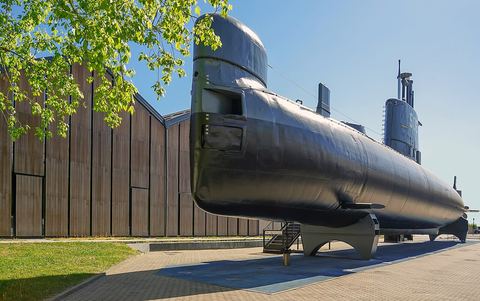
- Anecdote · The Submarine Enrico TotiReadA submarine in the streets of MilanIn the courtyard of Milan's science and technology museum sits a real submarine: the Enrico Toti, launched in 1967. It got there by road, in August 2005. It left Cremona on the evening of August 8, on a trailer more than sixty meters long, with thirty axles and 250 wheels. For the last kilometers in the city, 22 traffic lights, 44 light poles and 95 road signs were removed. One service road was taken the wrong way, and twice the convoy had to reverse direction. At 6:30 a.m. on August 14 it entered the museum. According to press reports, more than 150,000 people had followed it along the streets.
- AnecdoteReadThe museum's founder in a San Vittore cellGuido Ucelli, the engineer who founded the Museo della Scienza e della Tecnologia, was arrested on July 14, 1944, with his wife Carla Tosi and taken to San Vittore, Milan's prison. The charge: helping a Jewish couple, friends of theirs, escape to Switzerland. Guido was freed on August 3, thanks to a prisoner exchange. Carla was deported to the Bolzano camp and released at the end of September. Nine years later Ucelli opened his museum in the former monastery of San Vittore, which bears the same name as the prison. Since 2019 Milan has honored the couple in its Giardino dei Giusti, the Garden of the Righteous.
- AnecdoteReadThe engineer who lowered a lakeThe engineer who founded Milan's Museo della Scienza e della Tecnologia was, in full, Guido Ucelli di Nemi, and he had earned that di Nemi. On the bottom of Lake Nemi, near Rome, two ships of the emperor Caligula, more than seventy meters long, had lain for almost two thousand years. For centuries no one managed to raise them: so it was decided to lower the lake. Ucelli ran Riva, a Milan turbine maker, which supplied the pumps. From 1928 the water dropped more than twenty meters, and the ships emerged. In 1942 the king let him add Nemi to his surname. Two years later a fire destroyed the hulls.
Ready-made questions
Because after the war that monastery was a ruin with no future. Built by the monks from 1508 on, it had become a barracks under Napoleon, and in August 1943 the bombs had devastated it. The engineer Guido Ucelli, who had spent years looking for a home for his museum of technology, obtained it in 1947. The restoration was led by the architect Piero Portaluppi. The museum opened in 1953, and the have become part of the visit.
Go to stop: The Olivetan CloistersFor two reasons. The first is a date: the museum was inaugurated in 1953 with an exhibition for the five hundredth anniversary of Leonardo's birth, and the models of his machines were the first core of the display. The second is an idea. For the museum, Leonardo stands for the unity of knowledge: someone who did not separate art, science and technology. It is the same thing the museum tries to do by putting frescoes, sculptures and locomotives under one roof.
Go to stop: The Gallerie Leonardo da VinciNo. They are modern models, built from his drawings. What survives of Leonardo is the sheets, not the machines. The museum's models are historic in their own right, though: many are the ones the museum opened with in 1953. Look at them as interpretations. Each model is an attempt to work out what Leonardo had in mind when he drew.
Go to stop: The Gallerie Leonardo da VinciIn two stages. In 2001 the Toti left Sicily under tow, sailed up the Adriatic and then up the Po as far as Cremona, where it stayed for four years. In August 2005 it covered the last 93 kilometers by road. To make it lighter and lower, the conning tower and the lead ballast were removed. It traveled on a trailer with 250 wheels and, where the road couldn't hold, on metal bridges laid by army engineers. It entered the museum at dawn on August 14.
Go to stop: The Submarine Enrico TotiThe words get used interchangeably, but they are not the same. A submersible, sommergibile in Italian, is a boat that can dive but is designed mainly to travel on the surface. A submarine is made to travel underwater. The Toti, though many Italians call it a sommergibile, is technically a submarine. The numbers say so too: submerged it reached about 14 knots, on the surface it stayed under 10.
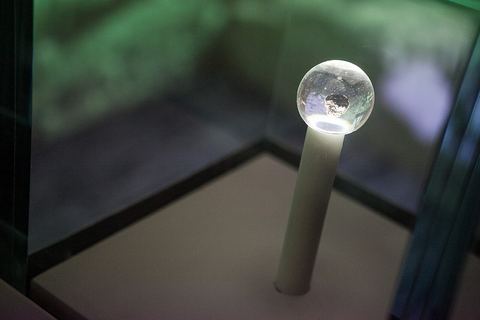
Go to stop: The Submarine Enrico TotiYes. It is a small piece of basalt, meaning lava, broken off a rock that the Apollo 17 astronauts collected on the Moon in December 1972. It was the last mission with a crew on board. Commander Eugene Cernan hoped the rock would be shared among all the peoples of the Earth, as a sign of brotherhood: that is why it is called the Goodwill Rock. The Italian fragment was given to Italy in 1973 by US President Richard Nixon, and Giovanni Leone, president of the Republic, entrusted it to the museum.
Go to stop: The Martians' Telescope and the MoonWith three big things. The Gallerie Leonardo, which are the reason for the name and the most carefully done part. The Padiglione Aeronavale, where a complete sailing ship and the of an ocean liner sit under the same roof. And the submarine Toti, which is well worth a look even from the outside. In between, walk through the : they are there to remind you that you are in a monastery. Everything else, from the trains to the piece of the Moon, is an excellent reason to come back.
The stops
1 The Regina Margherita Power Plant
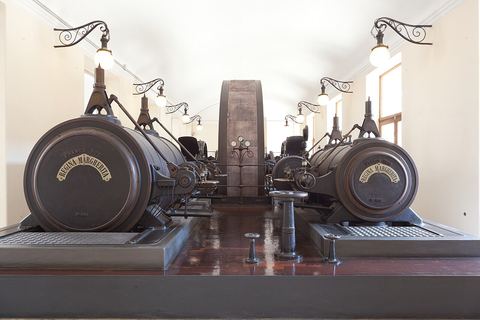
A steam-driven power plant from 1895, brought here from a silk mill in Desio. It drove up to 1,800 looms and lit the factory sheds. It is one of the first things the museum puts in front of you.
2 The Olivetan Cloisters
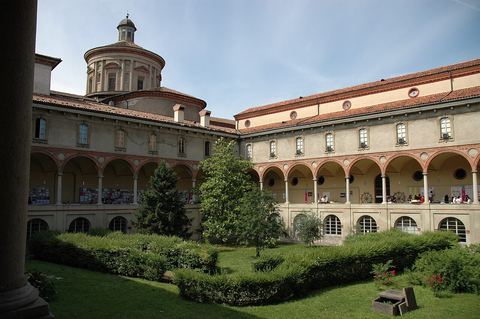
Two large cloisters from the 1500s, the heart of the monastery of San Vittore. They were a barracks for more than a century, and rubble after the bombs of 1943. In the garden, seven stone figures look at one another in silence.
3 The Sala del Cenacolo
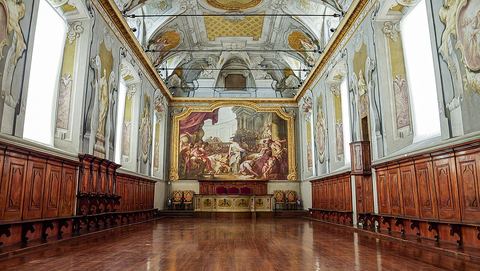
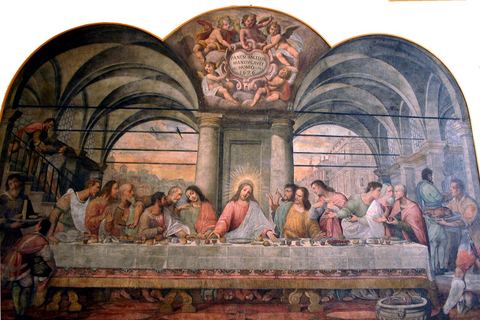
The monks' refectory, built and frescoed in the early 1700s. It is one of the few rooms of barocchetto lombardo, the light Lombard Baroque, left in Milan. On the end wall there is a huge painted banquet: the Wedding at Cana.
4 The Gallerie Leonardo da Vinci
The museum bills it as the world's largest permanent exhibition devoted to Leonardo: about 170 pieces, from historic models to frescoes and old books. He didn't build the machines: they are modern models, made from his drawings.
5 The Martians' Telescope and the Moon
The telescope Giovanni Schiaparelli used to study Mars, giving birth to the myth of the Martians without meaning to. And farther on, a chip of the Moon, collected in 1972 by the last mission that took people there.
6 The Padiglione Ferroviario
The railroad pavilion is laid out like a late-1800s station, with tracks, platforms and signals. Here you'll find the big steam locomotives, one of the first electric ones, and the streetcars that carried workers to Milan's factories.
7 The Sailing Ship Ebe and the Conte Biancamano
A complete sailing ship fifty meters long, about 165 feet, and a piece of an ocean liner from the 1920s. The pavilion was built specially for them. The airplanes are upstairs.
8 The Submarine Enrico Toti
The first submarine built in Italy after World War II: a hull 46 meters long, about 150 feet, a crew of 26, thirty years of patrols in the Mediterranean. In 2005 it crossed Milan on a trailer with 250 wheels.
Timeline
- 1507The Olivetan monks take over San Vittore al Corpo. Construction of the monastery begins the following year.
- 1709–1712Baroque enlargement: the refectory is built, now the Sala del Cenacolo, frescoed by Pietro Gilardi and il Castellino.
- Early 1800sUnder Napoleonic occupation the monastery becomes a military hospital, then a barracks: it stays one until World War II.
- 1943The August air raids devastate the complex.
- 1953On February 15 the museum opens, the project of Guido Ucelli, with an exhibition for the five hundredth anniversary of Leonardo's birth.
- 1964The Padiglione Aeronavale opens, built for the sailing ship Ebe and the command bridge of the Conte Biancamano.
- 2005The submarine Enrico Toti reaches the museum after a road trip from Cremona, followed by a crowd.
- 2019The Gallerie Leonardo da Vinci reopen, redone from scratch, five hundred years after Leonardo's death.
Who's who
Guido Ucelli
engineer and industrialist, founder of the museum
An executive at Riva, a Milan turbine maker, he led the recovery of the Roman ships of Nemi. The museum was his idea, and he chaired it until his death in 1964.
Leonardo da Vinci
Renaissance artist and engineer
He worked in Milan at the court of the Sforza. The museum bears his name and tells his engineering side through models made from his drawings.
Piero Portaluppi
architect
Between 1947 and the early 1950s he led the restoration of the bombed monastery, turning it into a museum, with Enrico Griffini and Ferdinando Reggiori.
Giovanni Schiaparelli
astronomer, director of the Osservatorio di Brera
He studied Mars and described its canali, giving rise despite himself to the myth of the Martians. His big telescope opens the Spazio exhibition.
Fausto Melotti
twentieth-century sculptor with an engineering degree
Creator of I Sette Savi, the seven stone figures in the cloister garden. He studied at Brera under Adolfo Wildt, in the same class as Lucio Fontana.
Pietro Gilardi
Lombard painter of the early 1700s
He painted the Wedding at Cana in the monastery's refectory, working alongside Giuseppe Antonio Castelli, known as il Castellino.
Words to know
Where it is
The neighborhood
Magenta and Sant'Ambrogio
Related places
The story of the place
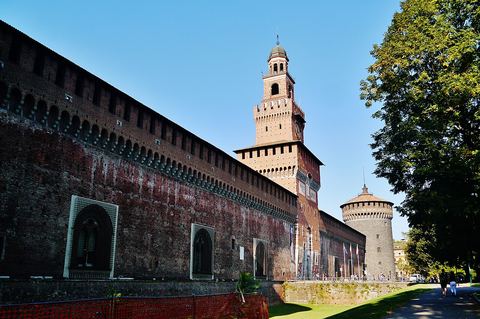
From the outside it looks like a monastery, and for three centuries it was one. Inside there are locomotives, a sailing ship, a piece of the Moon and, out in the yard, a submarine. The best way into this museum is right there: the contrast between the container and what it contains.
In 1507 the , a branch of the Benedictine monks, took over San Vittore al Corpo, next to a church founded in the early Christian centuries. The following year they started building their monastery. What survives is two large and a Baroque , added in the early 1700s.
From monastery to barracks
Under Napoleon the monastery was shut down. It became a military hospital, then a barracks. It stayed a barracks until World War II. In August 1943 the bombs reduced it to rubble.
An engineer's idea
This is where Guido Ucelli, engineer and industrialist, comes in. Since the 1930s he had imagined a museum of technology for Milan, like the ones in London and Munich. In 1947 he was given the ruins of San Vittore. The restoration was led by the architect Piero Portaluppi.
The museum opened on February 15, 1953, in the presence of Prime Minister Alcide De Gasperi. It was inaugurated with an exhibition on Leonardo da Vinci, for the five hundredth anniversary of his birth. That is where the name comes from. And so does the idea that still holds it together: art, science and technology are children of the same curiosity.
A museum grown by pavilions
Then the museum spilled out of the . In the 1960s a pavilion went up, built specially for a sailing ship and the command of an ocean liner. Another is laid out like a train station, with tracks and platforms. In 2005, traveling by road, the submarine Enrico Toti arrived.
Today the collections hold more than twenty thousand objects. Don't try to see them all. Pick a few big things, and let the monastery be your pause between one machine and the next.
Sources
- Museo Nazionale Scienza e Tecnologia Leonardo da Vinci, sito ufficiale: esposizioni permanenti (opens in a new tab)Official site
- Museo Nazionale Scienza e Tecnologia, sito ufficiale: Gallerie Leonardo da Vinci (opens in a new tab)Official site
- Museo Nazionale Scienza e Tecnologia, sito ufficiale: Sala del Cenacolo (opens in a new tab)Official site
- Museo Nazionale Scienza e Tecnologia, sito ufficiale: I Sette Savi (opens in a new tab)Official site
- Museo Nazionale Scienza e Tecnologia, sito ufficiale: centrale termoelettrica Regina Margherita (opens in a new tab)Official site
- Museo Nazionale Scienza e Tecnologia, sito ufficiale: esposizione Spazio (opens in a new tab)Official site
- Museo Nazionale Scienza e Tecnologia, sito ufficiale: telescopio Merz-Repsold di Schiaparelli (opens in a new tab)Official site
- Museo Nazionale Scienza e Tecnologia, sito ufficiale: pietra lunare (opens in a new tab)Official site
- Museo Nazionale Scienza e Tecnologia, sito ufficiale: lanciatore Vega (opens in a new tab)Official site
- Museo Nazionale Scienza e Tecnologia, sito ufficiale: trasporti ferroviari (opens in a new tab)Official site
- Museo Nazionale Scienza e Tecnologia, sito ufficiale: locomotiva Gr 552 036 (opens in a new tab)Official site
- Museo Nazionale Scienza e Tecnologia, sito ufficiale: trasporti navali (opens in a new tab)Official site
- Museo Nazionale Scienza e Tecnologia, sito ufficiale: nave scuola Ebe (opens in a new tab)Official site
- Museo Nazionale Scienza e Tecnologia, sito ufficiale: transatlantico Conte Biancamano (opens in a new tab)Official site
- Museo Nazionale Scienza e Tecnologia, sito ufficiale: trasporti aerei (opens in a new tab)Official site
- Museo Nazionale Scienza e Tecnologia, sito ufficiale: Macchi MC 205 V (opens in a new tab)Official site
- Museo Nazionale Scienza e Tecnologia, sito ufficiale: elicottero sperimentale di Enrico Forlanini (opens in a new tab)Official site
- Museo Nazionale Scienza e Tecnologia, sito ufficiale: sottomarino S506 Enrico Toti (opens in a new tab)Official site
- Guido Ucelli di Nemi and Carla Tosi, Gariwo, la foresta dei Giusti (opens in a new tab)Institution
- Nel Giorno della memoria, Milano ricordi Guido e Carla Ucelli, Linkiesta (opens in a new tab)Other source
- Come il sottomarino Enrico Toti è arrivato a Milano, Mentelocale (opens in a new tab)Other source
- Museo della scienza di Milano, le Nuove Gallerie Leonardo, AGI (opens in a new tab)Other source
- Il Museo della Scienza di Milano inaugura le Nuove Gallerie Leonardo, Artribune (opens in a new tab)Other source
- Quattro passi con Leonardo da Vinci, Focus (opens in a new tab)Other source
- Il Museo della scienza di Milano compie settant'anni, Internazionale (opens in a new tab)Other source
- Gilardi, Pietro, Dizionario Biografico degli Italiani, Treccani (opens in a new tab)Encyclopedia
- Presentazione del telescopio Merz-Repsold di Schiaparelli restaurato, Media INAF (opens in a new tab)Institution
- Enrico Forlanini, Frontiere, Politecnico di Milano (opens in a new tab)Institution
- Milano, riapre la Sala del Cenacolo del Museo Scienza, Finestre sull'Arte (opens in a new tab)Other source
- Museo della Scienza e della Tecnologia, i Sette Savi di Fausto Melotti tornano a Milano, Sky TG24 (opens in a new tab)Other source
- La politica e le scoperte di Schiaparelli, Museo Astronomico di Brera, INAF (opens in a new tab)Institution
- La Luna si conquista con il crowdfunding, Arte.it (opens in a new tab)Other source
- Il convento di San Vittore trasformato nel Museo della Scienza e della Tecnica, MilanoFree (opens in a new tab)Other source
- Sottomarino S 506 Enrico Toti, OpenStreetMap (opens in a new tab)Other source
- Valigia delle Indie, Wikipedia in italiano (opens in a new tab)Wikipedia
- Locomotiva FS 552, Wikipedia in italiano (opens in a new tab)Wikipedia
- Mausoleo imperiale di San Vittore al Corpo, Wikipedia in italiano (opens in a new tab)Wikipedia
- Italian training ship Ebe, Wikipedia in inglese (opens in a new tab)Wikipedia
- Thermal power station Regina Margherita, Wikipedia in inglese (opens in a new tab)Wikipedia
- Museo nazionale della scienza e della tecnologia Leonardo da Vinci, Wikipedia in italiano (opens in a new tab)Wikipedia
- Museo Nazionale Scienza e Tecnologia Leonardo da Vinci, Wikipedia in inglese (opens in a new tab)Wikipedia
- Basilica di San Vittore al Corpo, Wikipedia in italiano (opens in a new tab)Wikipedia
- Guido Ucelli, Wikipedia in italiano (opens in a new tab)Wikipedia
- Enrico Toti (S 506), Wikipedia in italiano (opens in a new tab)Wikipedia
- Conte Biancamano (transatlantico), Wikipedia in italiano (opens in a new tab)Wikipedia
- Giovanni Schiaparelli, Wikipedia in italiano (opens in a new tab)Wikipedia
- Ucelli di Nemi, Guido, Dizionario Biografico degli Italiani, Treccani (opens in a new tab)Encyclopedia
- The Leonardo exhibition of 1939 and the models of the Museo Nazionale Scienza e Tecnologia, Science Museum Group Journal (opens in a new tab)Institution
- Leonardo da Vinci show: la mostra del 1939, Focus (opens in a new tab)Other source
- La tormentata storia della salma di Evita Perón, Il Post (opens in a new tab)Other source
- Campo 86: en busca de Eva Perón por el cementerio de Milán, La Nación (opens in a new tab)Other source
- 70 años de la muerte de Evita: el destino del cuerpo de Eva Perón, BBC Mundo su El Observador (opens in a new tab)Other source
- Gamba de Legn, storico tram a vapore di Milano, MilanoFree (opens in a new tab)Other source
- Quando al lavoro si andava con il Gamba de Legn, VareseNews (opens in a new tab)Other source
- Secreto de confesión: cómo y por qué la Iglesia escondió el cuerpo de Evita durante 14 años, Perfil (opens in a new tab)Other source
- The Nemi Ships, Encyclopaedia Romana, University of Chicago (opens in a new tab)Institution
- Il tempio galleggiante di Caligola: la nave santuario riemersa dal lago di Nemi, Focus (opens in a new tab)Other source
- Tranvia Milano-Magenta/Castano Primo, Wikipedia in italiano (opens in a new tab)Wikipedia
- Gamba de legn, Wikipedia in italiano (opens in a new tab)Wikipedia
- Navi di Nemi, Wikipedia in italiano (opens in a new tab)Wikipedia
- Eva Perón, Wikipedia in italiano (opens in a new tab)Wikipedia