Stop 1 of 8
The Regina Margherita Power Plant
Where to stand
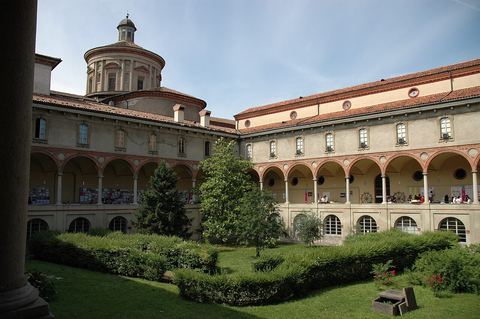
In the monastery building, in front of the big steam engine that greets you as you arrive
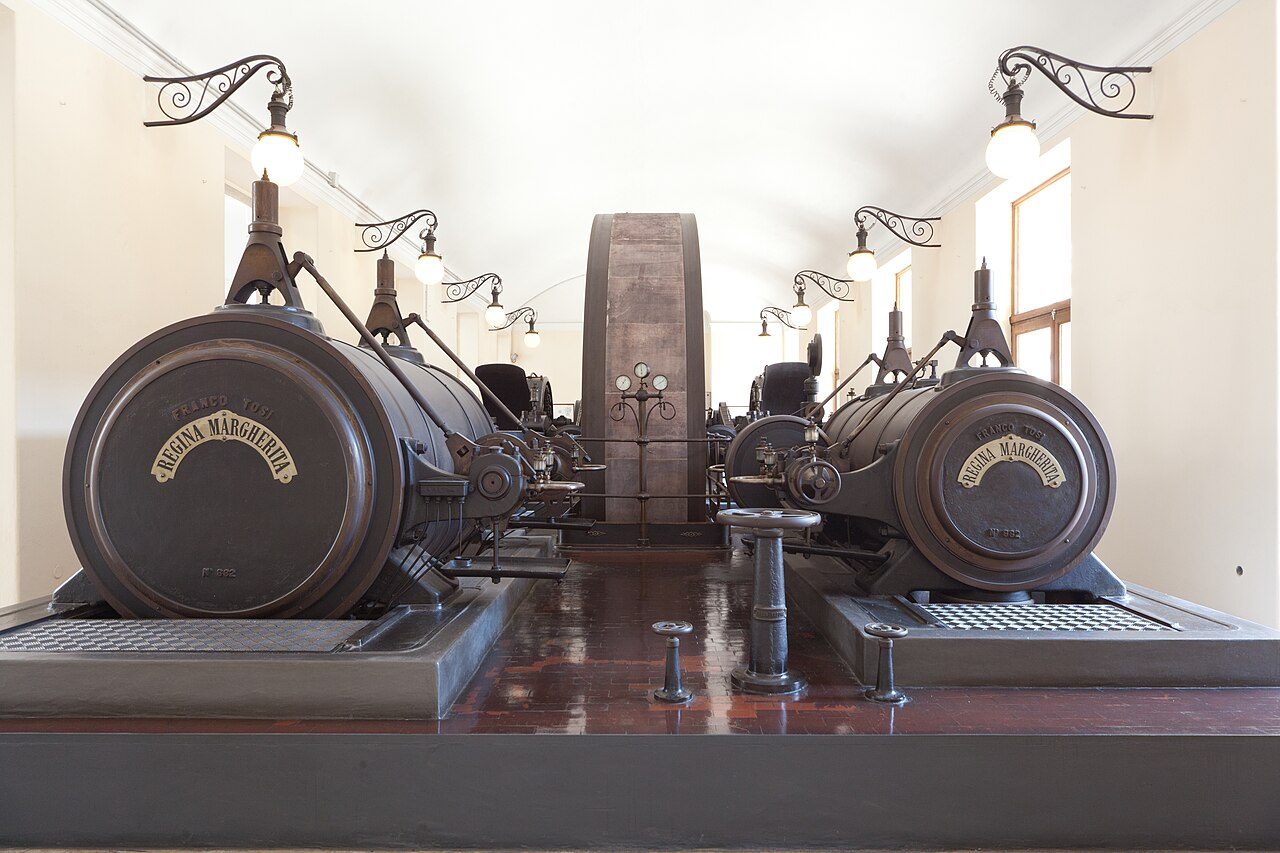
A steam-driven power plant from 1895, brought here from a silk mill in Desio. It drove up to 1,800 looms and lit the factory sheds. It is one of the first things the museum puts in front of you.
Spot the detail
A steam engine needs a boiler. Look for it
The full story
Before any explanation, look at how big it is. This is no laboratory machine. It is a piece of a factory, taken apart and brought here.
It is called Regina Margherita, Queen Margherita, because on opening day in 1895 King Umberto I and the queen were there, and the plant was dedicated to her. It stood in the Gavazzi silk mill in Desio, near Milan. It made electricity for two purposes: lighting the factory's lamps and driving the silk looms. The mill eventually had 1,800 of them.
Stop on that number for a moment. Eighteen hundred looms driven by a single machine. It is the portrait of an age when Italian industry, little by little, was switching to electricity.
Two cylinders instead of one
The engine is a compound, meaning double-expansion. Steam enters a first cylinder at high pressure and pushes it. Then, instead of going to waste, it passes into a second cylinder, a larger one, and does more work.
It is a way of squeezing the steam twice. The idea is more than two centuries old: the first patents date from the late 1700s, and it took a few decades to find the right proportion between the two cylinders. The engine was built by the Officine Franco Tosi, the Franco Tosi works in Legnano, one of the great names of Italian engineering.
A cumbersome gift
The plant ran until 1954. A few years later the Gavazzi family offered it to the museum, and the trouble began. To make room, a reading room had to be moved, the floor torn up, and a foundation built that could carry the weight.
It was dismantled in Desio, loaded onto a tractor-trailer and put back together here by hand. Not all of it, though: the firebox and the boiler stayed where they were.
A family story
Then there is a family connection. The museum's founder, the engineer Guido Ucelli, had married Carla Tosi. She was the daughter of the same Franco Tosi who gave his name to the works in Legnano. So the machine that welcomes you is also a memento of home.
Next stop
Head to the monastery cloisters and stand under the portico, with the garden in front of you