Stop 5 of 8Must-see
The Martians' Telescope and the Moon
Where to stand
At the start of the Spazio exhibition, in front of the big telescope; the piece of the Moon is farther along the route
The telescope Giovanni Schiaparelli used to study Mars, giving birth to the myth of the Martians without meaning to. And farther on, a chip of the Moon, collected in 1972 by the last mission that took people there.
Spot the detail
Near the piece of the Moon, look for a small Italian flag
The full story
The tube in front of you is more than seven meters long, about 23 feet. With its mount, the instrument weighs around seven metric tons. In 1886, when it went to work on the rooftops of the Osservatorio di Brera, Milan's observatory, it was one of the biggest scientific investments of the young Kingdom of Italy.
It is a : it gathers light with a lens, and this one measures almost half a meter across. The man who wanted it was Giovanni Schiaparelli, the observatory's director. Parliament paid for it, with a law passed for the purpose: an enormous expense for a newly unified country short of money.
Canali, not canals
Schiaparelli pointed it at Mars. On the planet he had been seeing, since 1877 and with a smaller instrument, a network of thin lines. He called them canali.
In Italian the word does not say whether a channel is the work of nature or of somebody. In English it was translated as canals, which means only the man-made kind.
That was enough. If there were canals that had been dug, somebody had dug them. The American astronomer Percival Lowell wrote three books about it, imagining great waterworks built by Martians.
The canals did not exist. They were optical illusions, and space probes confirmed it by showing a dry planet full of craters. But by then the Martians had been born. And they were born in Milan.
A stone from another world
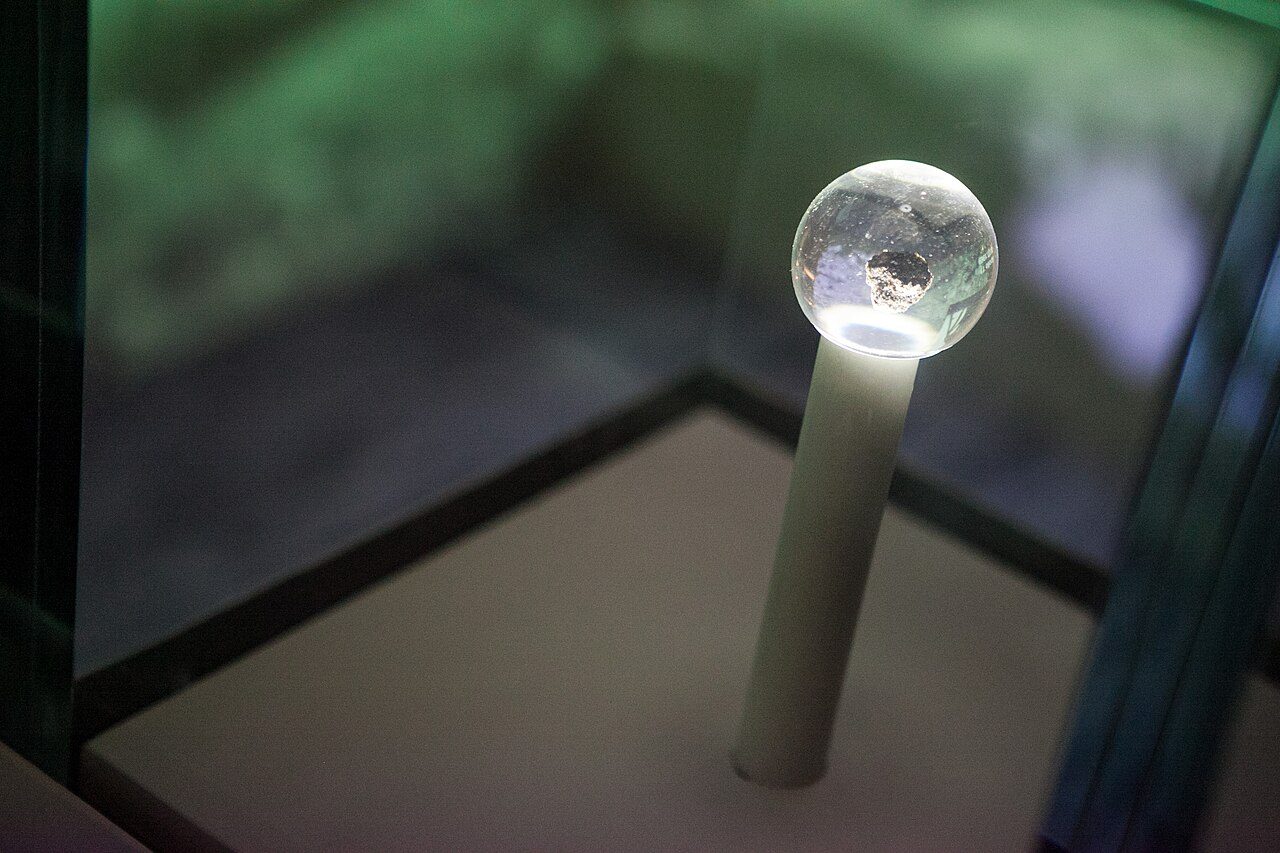
Farther on, the exhibition moves from looking at space to going there. There you'll find one of the smallest objects in the museum, and perhaps the most precious: a piece of the Moon.
It is basalt, which is to say solidified lava. It was collected in December 1972 by Eugene Cernan, commander of Apollo 17, the last mission to take people to the Moon. Cernan hoped that rock would be divided up and given to all the peoples of the Earth. It was named the Goodwill Rock.
The Italian piece arrived the following year, a gift from US President Richard Nixon. The museum presents it as the only one of its kind in Italy.
All the Apollo missions together brought back about 380 kilos of lunar rock. They are among the rarest samples scientists can work on.
And outside, a rocket
When you step outdoors, look up. The museum displays a full-size model of Vega, the European satellite launcher developed largely in Italy. It stands about thirty meters tall.
About this stop
In culture
The Martians were born in Milan
The museum's Spazio exhibition, the one about space, opens with the big telescope of Giovanni Schiaparelli, astronomer and director of the Osservatorio di Brera, Milan's observatory. In 1877 Schiaparelli had seen a network of lines on Mars and called them canali. In English the word was translated as canals, which means only man-made waterways, rather than channels. Out of that misunderstanding came the idea of a Martian civilization. The American astronomer Percival Lowell argued for it in three books, imagining great waterworks. The dispute was settled only by the Mariner probes, between 1965 and 1971: Mars is a desert. With this telescope Schiaparelli carried on those studies.
Yes. It is a small piece of basalt, meaning lava, broken off a rock that the Apollo 17 astronauts collected on the Moon in December 1972. It was the last mission with a crew on board. Commander Eugene Cernan hoped the rock would be shared among all the peoples of the Earth, as a sign of brotherhood: that is why it is called the Goodwill Rock. The Italian fragment was given to Italy in 1973 by US President Richard Nixon, and Giovanni Leone, president of the Republic, entrusted it to the museum.
Next stop
Follow the signs to the Padiglione Ferroviario, the railroad pavilion