Stop 7 of 8Must-see
The Sailing Ship Ebe and the Conte Biancamano
Where to stand
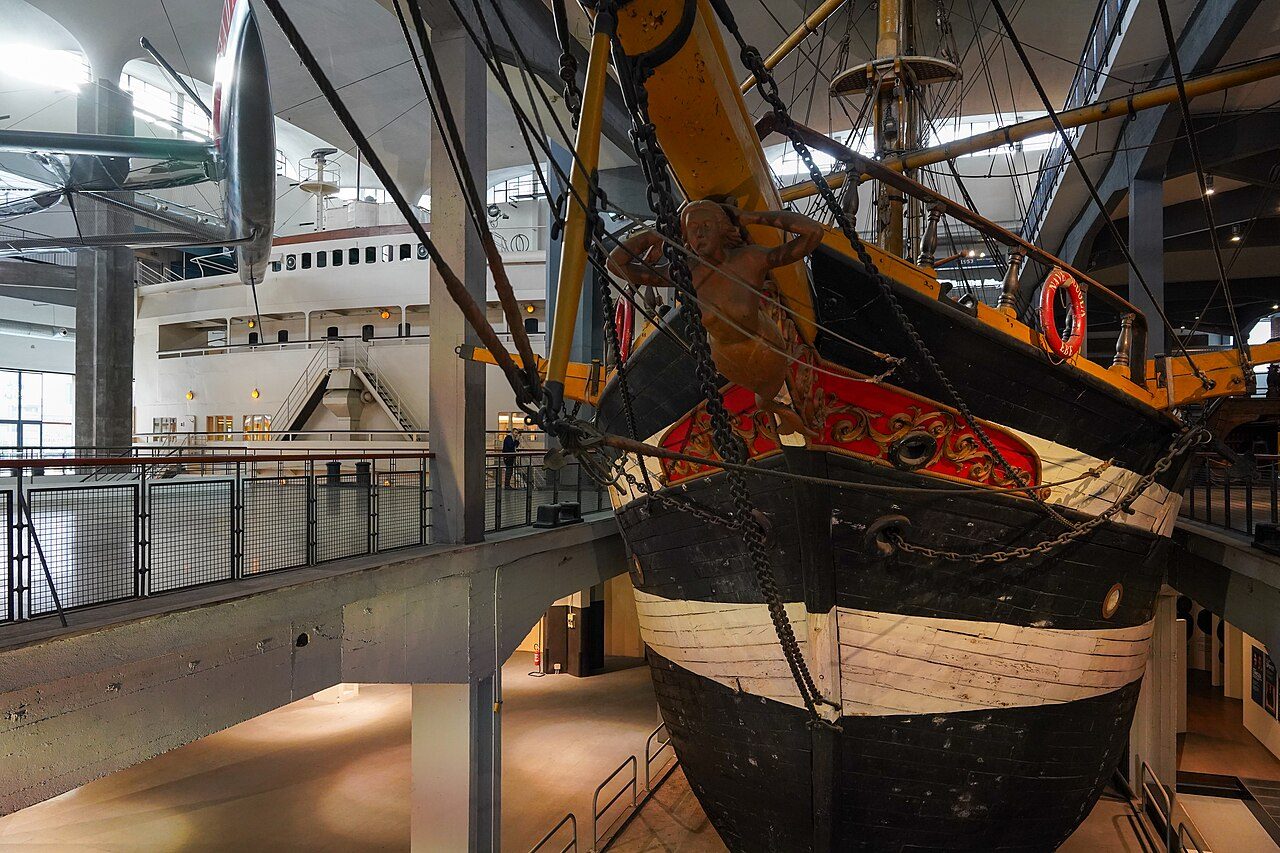
In the Padiglione Aeronavale, the air and sea pavilion, in front of the bow of the sailing ship Ebe
A complete sailing ship fifty meters long, about 165 feet, and a piece of an ocean liner from the 1920s. The pavilion was built specially for them. The airplanes are upstairs.
Spot the detail
Look at where the Ebe's mainmast enters the hull: something is hidden under there
The full story
The question asks itself: how did she get in? In pieces. And the pavilion was built specially for her and for the ocean liner beside her.
The Ebe is a : she carries square sails on the foremast and fore-and-aft sails on the mainmast. She was built in Viareggio right after World War I, under another name, to carry cargo around the Mediterranean. She went to war as a minesweeper, and in the 1950s became a training ship for the Italian Navy. On board, the Navy's boatswains learned their trade.
A sailing ship cut into slices
When the Navy marked her for scrapping, the museum managed to get her whole. One detail remained: bringing her to Milan. The hull was cut into ninety pieces of about ten metric tons each and loaded onto trucks.
The hardest piece was the bow. Along the way an overpass stopped it, and the crew had to shorten it on the spot, at night.
In Milan the ship was put back together starting from the keel, and rigged again with sails and lines. The pavilion opened in April 1964, in the presence of Antonio Segni, president of the Republic.
A piece of an ocean liner
Next to her is a piece of a much bigger ship. The Conte Biancamano was launched in Scotland in 1925 and made her debut on the route between Genoa and New York. She carried wealthy passengers, used to every luxury.
Then came the war. The United States seized her, renamed her Hermitage and used her to carry troops: more than a hundred thousand soldiers in all. Returned to Italy, she was rebuilt from scratch, with interiors entrusted to artists such as Gio Ponti, Mario Sironi and Massimo Campigli.
She sailed until 1960. In the 1950s she even got an unusual cargo: the embalmed body of Evita Perón, from Buenos Aires to Genoa. When she was retired, the museum saved a section several decks high: the command , a few cabins and the ballroom.
Above the ships, the airplanes
Before you leave, go upstairs. Among the aircraft, the most important is also the smallest: the experimental helicopter of Enrico Forlanini, a steam-powered model from the 1800s. It rose off the ground for about twenty seconds, and is remembered as the first heavier-than-air craft lifted by an engine.
About this stop
Anecdote
Evita, the Biancamano's secret passenger
The command in the museum's Padiglione Aeronavale, the air and sea pavilion, comes from the Conte Biancamano, an Italian liner. In 1957 the ship carried a secret cargo from Buenos Aires to Genoa: a coffin registered to Maria Maggi de Magistris, an Italian widow who had died in Argentina. Inside was the embalmed body of Evita Perón, the Argentine president's wife, who had died in 1952. Argentina's military government did not want her grave to become a shrine. She was buried under a false name in Milan's Cimitero Maggiore cemetery, and stayed there fourteen years. A woman was paid to bring her flowers. She never knew for whom.
Anecdote
The sailing ship cut into slices
In the museum's Padiglione Aeronavale, the air and sea pavilion, stands a complete sailing ship fifty meters long: the Ebe, a former Italian Navy training ship. In the early 1960s she was due to be scrapped in La Spezia, and the museum managed to get her. The hull was cut into ninety pieces of about ten tons and trucked to Milan. The bow was stopped by an overpass that was too low, and the crew shortened it there, at night. She was reassembled from the keel up. As the mainmast was being set, Guido Ucelli, the museum's founder, placed a gold coin at its foot, an old shipbuilders' custom.
Record
A steam helicopter from 1877
On the upper floor of the museum's Padiglione Aeronavale, the air and sea pavilion, is the experimental helicopter of the engineer Enrico Forlanini, a model from the 1800s. It is small and pilotless, but it holds a record: the museum and the Politecnico di Milano remember it as the first heavier-than-air craft to lift off under engine power. In 1877 it was tested in Milan, before engineers and enthusiasts. The machine climbed to about thirteen meters, stayed up for some twenty seconds and came down gently. The engine was steam-powered and extremely light. Two rotors turned in opposite directions on the same shaft, to keep the craft from spinning.
In culture
A fighter with a name out of Dante
Among the aircraft on the upper floor of the museum's Padiglione Aeronavale, the air and sea pavilion, is a Macchi MC 205, an Italian fighter that entered service in 1943. It is called the Veltro, an old word for a hunting greyhound. It is the same animal that, in the first canto of the Divine Comedy, is awaited as the savior of Italy. Very few of these planes are left today, and the museum's is one of the rare ones you can see up close.
This stop on the map
Next stop
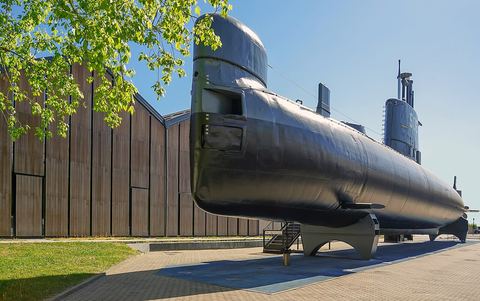
Go out into the museum's outdoor areas and walk to the submarine Enrico Toti