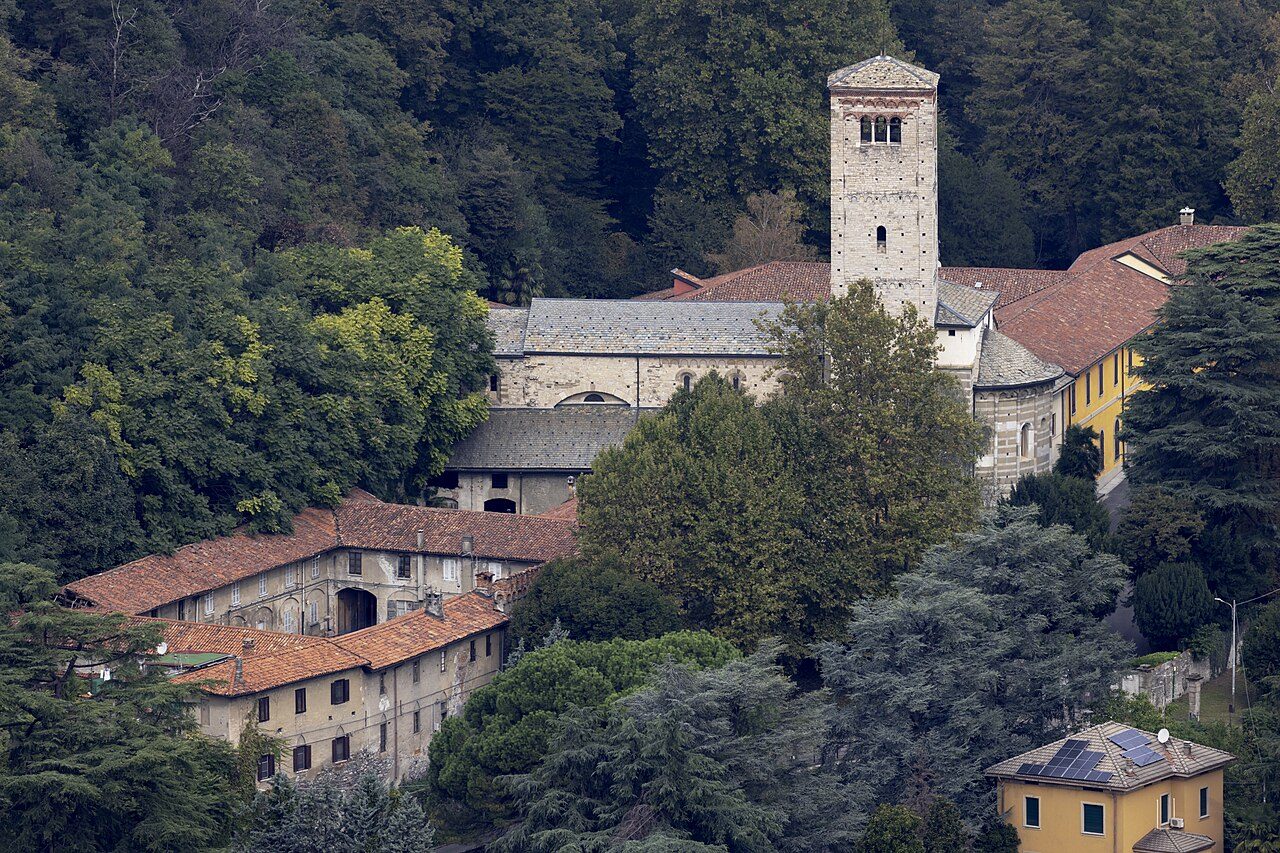
Church · The Borghi · XI–XII secolo, su una fondazione del IV
Basilica di San Carpoforo
Where tradition says Christian Como began, at the foot of the Baradello hill
In brief
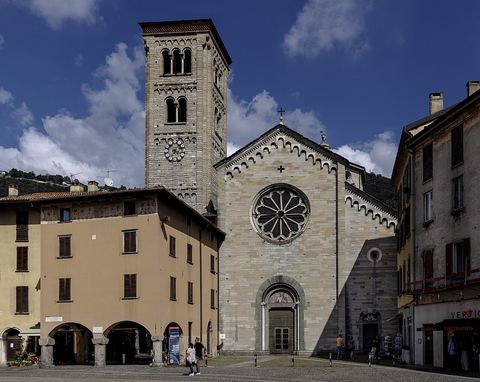
Tradition calls it Como's first church, founded in the fourth century over the martyrs' tombs. What you see is Romanesque: a doorless facade against the hill, a gray stone tower, a crypt under a towering altar. It is often closed, but even from outside it has plenty to say.
Stories of this place
- Legend · At the foot of the BaradelloReadCarpoforo and the soldiers on the runThe basilica of San Carpoforo, in Como, is named after a martyr. According to tradition Carpoforo and his companions were Christian soldiers, in some accounts members of the legendary Theban Legion. During the persecution under the emperor Maximian, in the early fourth century, they flee Milan. They are caught at the gates of Como and beheaded at the foot of the Baradello hill, where the basilica now stands, in a place called the Selvetta. With them was Fedele, who escapes along the lake and is killed farther north. None of this is proven. But two of Como's oldest churches, San Carpoforo and San Fedele, carry the names of those fugitives.
- Legend · At the foot of the BaradelloReadA temple of Mercury under the church?In Como people have always said that the basilica of San Carpoforo stands on top of a pagan temple dedicated to Mercury, turned into a church by Felice, the city's first bishop. Inscriptions that speak of a cult of the god have been found at the foot of the Baradello, the hill behind the church, and more than one scholar thinks it likely. Historical confirmation, though, is missing. Part of the story's appeal is that it is so neat: Christianity taking the place of the old gods. Take it for what it is: a good story, not an established fact.
- Anecdote · The courtyard and the church with no facadeReadThree men shot in front of the churchOn April 11, 1849, shots ring out in front of the basilica of San Carpoforo, in Como. The Austrians execute Andrea Brenta, an innkeeper in Val d'Intelvi, the valley between Lake Como and Lake Lugano, and leader of the uprising that had broken out there the year before, along with two companions, Andrea Andreetti and Giovanbattista Vittori. They had been captured a few days earlier, betrayed and surrounded at night in a tavern. Brenta is buried in a mass grave. Eleven years later, with Lombardy now liberated, his body is moved with full honors to Como's main cemetery.
- Anecdote · The courtyard and the church with no facadeReadThe forged charter of the Lombard kingAmong the papers of the monastery of San Carpoforo, in Como, one was cited for centuries: a donation from Liutprand, king of the Lombards, dated 724. Too bad it is a forgery. Scholars have shown it is modeled on a charter of the emperor Conrad II, three centuries later, and that its list of properties comes from a genuine document of the emperor Frederick Barbarossa, from 1159. It was made, it seems, shortly afterward. Some copies, perhaps the oldest, even got the era wrong, with the year 800. In Como someone noticed and made a new one with a more believable date. Even forgers sometimes brush up on their history.
- Record · The nave and aislesReadA restoration fifty years longThe restoration that gave the basilica of San Carpoforo, in Como, back its medieval look begins in 1871, on the initiative of the canon Vincenzo Barelli, and ends only half a century later. In those decades the sixteenth-century vaults are demolished, the roof of timber beams is rebuilt, the plaster is stripped from the walls, and the bell tower, which was threatening to fall, is reinforced. The irony: once the work is done, the church loses its status as a parish. Made new again, and promptly left alone.
- Record · The presbytery and the cryptReadA Syrian in Como in 401In the basilica of San Carpoforo, in Como, on the left wall of the stairway down to the crypt, there is a tombstone unlike the others: it is written in Greek. It bears the monogram of Christ with the letters alpha and omega and remembers a man from a village in Syria. It is dated to 401. His name is read in different ways, Banneias or Annulei, and some call him a merchant. Some consider it the oldest Christian evidence to survive in the Como area. If so, the oldest Christian voice left in this city speaks Greek, and comes from the other side of the Mediterranean.
- Anecdote · The presbytery and the cryptReadThe contested martyr and Arona's feastThe basilica of San Carpoforo, in Como, is not the only one to claim its martyr. In Arona, on Lake Maggiore, a church keeps relics it says are those of Carpoforo and Fedele, by tradition his companion: they are said to have come from Como in the Middle Ages. In the sixteenth century Carlo Borromeo, archbishop of Milan, had them taken to his city. The people of Arona pressed until part of them came back, on March 13, 1576. Arona still marks the day with a festival, the Tredicino. In Como, meanwhile, tradition kept the martyrs in their basilica. It happens with relics: the same saint rests in several places.
- Anecdote · The presbytery and the cryptReadThe priest of tombstones and the deafThe ancient tombstones of the basilica of San Carpoforo, in Como, had an unusual scholar: Serafino Balestra, a priest and canon of Como's Duomo, the cathedral. In 1873 he published the inscriptions found in the church and nearby, and he followed the restoration with the canon Vincenzo Barelli. But he is remembered mostly for something else. Balestra taught the deaf, and he is credited with bringing the lip-reading method to Italy. He worked for years in France, which awarded him the Legion of Honor. In 1885 he was called to run a school for the deaf in Buenos Aires. He died there the following year, far from his stones.
- AnecdoteReadAmbrose's letters to the first bishopFelice, the first bishop of Como, who by tradition founded the basilica of San Carpoforo, was a friend of Ambrose, the bishop of Milan who had consecrated him. Two letters from Ambrose addressed to him survive. One deals with a very practical problem: Como is short of deacons, the bishop's assistants. Ambrose reassures him: the one who gave you the faithful will give you helpers too. It is a detail that captures what the diocese was like in its earliest days: one bishop, one church outside the city and very few hands.
- In cultureReadThe scholars' appeal for San CarpoforoThe basilica of San Carpoforo, in Como, ended up in an appeal by scholars. In the nineteenth century the city's Romanesque drew Fernand de Dartein, author of a major study of Lombard architecture published in Paris between 1865 and 1882. In 2013 a conference on him and on the Romanesque of Como ended with a unanimous protest from the participants about this very church: too neglected, with inaccessible parts and a facade toward the hill that almost nobody knows. The book that came out of it, published in 2015, records the appeal. It is rare for a volume of architectural history to contain such a practical request: open that door.
Ready-made questions
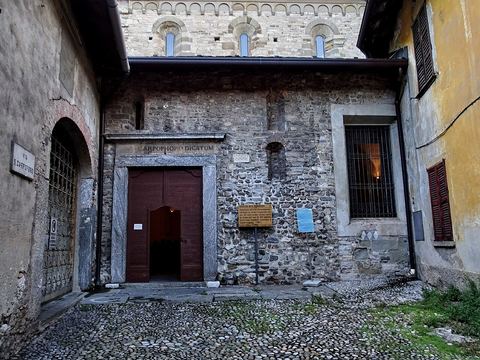
Because the facade is pressed against the hill and has no doors. It faces west, toward the Baradello, and is partly buried. The most repeated explanation blames landslides, said to have wiped out an older entrance: a document from 1204 mentions a portico that no longer exists. There is no sure answer, though. What is certain is that the altar is to the east, as in ancient churches, and to the west there is the mountain. So you go in from the side.
Go to stop: The courtyard and the church with no facadePeople wrote so for a long time, and you will still read it here and there. The reasoning went like this: Felice, the first bishop, is buried here, so this must have been his seat. But Felice's burial proves nothing, and scholars have been debating it for a long time. What is certain is that San Carpoforo began as a cemetery basilica, built outside the city beside the tombs. It remains, according to tradition, the oldest church in the diocese. That is no small thing.
The first martyr of Como, at least according to tradition. The accounts describe him as a Christian soldier, killed with five companions at the foot of the Baradello during the persecution under the emperor Maximian, at the start of the fourth century. Nothing else is known about him, and even this is not documented. What is real is the devotion: for centuries this basilica guarded the tombs that tradition assigns to him and his companions.
Go to stop: At the foot of the BaradelloNot as old as tradition says, but old enough. Nothing visible is left of the fourth-century church. The nave and aisles date from the first half of the eleventh century. The bell tower, the and the are slightly later, between the late eleventh and early twelfth. The entrance doorway is Renaissance in style, the frescoes in the chapels are from the sixteenth century, the high altar is Baroque. And the wooden roof was rebuilt during the restoration that began in 1871.
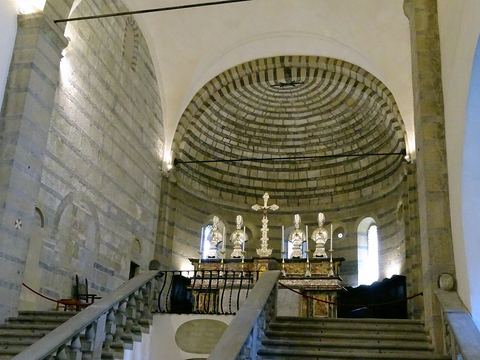
Because the is underneath. In Romanesque churches that guarded venerated tombs, builders often made a vaulted room under the altar area, and the floor above ended up raised. Here the difference in height is considerable: it takes two stone stairways to reach the , and between the two is the way down to the crypt. The effect is theatrical, almost a stage, but it comes from a practical need.
Go to stop: The presbytery and the cryptNo. For centuries the basilica guarded the burials of Carpoforo, his companions and the bishop Felice. In 1932 the parish was transferred to the new church of Santa Brigida, in the Camerlata district, and the relics were taken there. Under the high altar the ancient sarcophagus of Felice remains, clad in colored marble in the seventeenth century. The church that was born to stand beside those tombs now only remembers them.
Go to stop: The presbytery and the cryptThey have been neighbors for centuries. Castel Baradello dominates the hill behind the church: its tower dates from the twelfth century, and in 1278 Napo Torriani, lord of Milan, died a prisoner there, shut in a cage hung on the outside. In 1527 the castle was dismantled by order of the Spanish governor and only the tower was spared. What was left belonged to the Hieronymite monks of San Carpoforo before passing into private hands.
Go to stop: At the foot of the BaradelloThe stops
1 At the foot of the Baradello
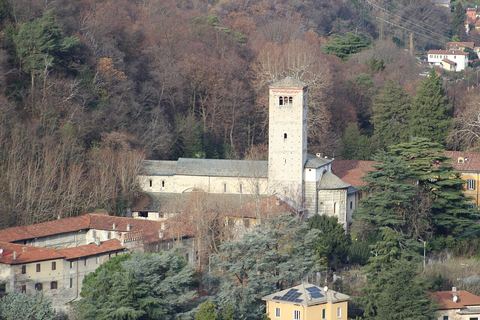
Before you look at the church, look at where it is: outside town, on a slope, below a castle. The road ran here, the Roman tombs were here, and here tradition places the martyrdom of Carpoforo and the first church in Como.
2 The courtyard and the church with no facade
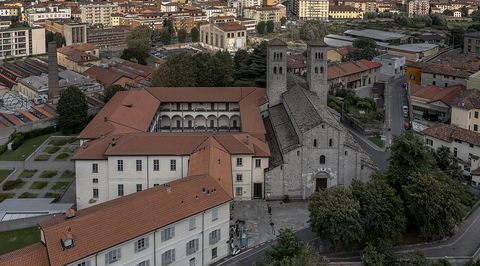
You enter San Carpoforo from the side. There is a facade, but it is pressed against the hill and has no doors. All around, houses and monastery have leaned on the church until they have almost hidden it.
3 The bell tower and the apse
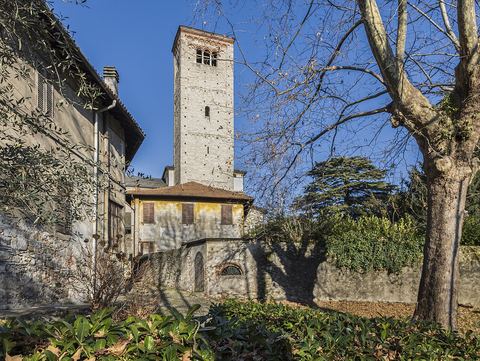
The tower is the most recognizable piece of San Carpoforo: gray stone, with more than nine hundred years on its shoulders. At its foot is the apse, the most carefully finished part of the church.
4 The nave and aisles
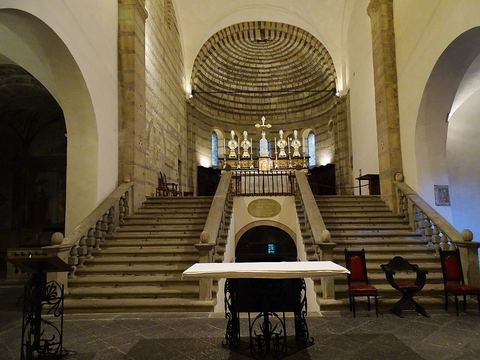
A nave, two aisles, square piers, an open timber roof. It looks like the Middle Ages untouched, but it also owes a lot to a restoration that took down the sixteenth-century vaults. And halfway along there is a puzzle: a transept where you do not expect one.
5 The presbytery and the crypt
The heart of San Carpoforo is on two levels. Above, a presbytery set very high, with an apse in light and dark stripes. Below, a Romanesque crypt on six granite columns, born beside the tombs of the martyrs and of the first bishop.
Timeline
- 386Ambrose consecrates Felice first bishop of Como. Tradition says Felice founds the basilica over the martyrs' tombs.
- 1040The Benedictine monastery by the church is traced to this year, under Bishop Litigerio. Meanwhile the basilica is rebuilt in Romanesque style.
- Late 11th–early 12th centuryThe Romanesque building campaign is completed with the bell tower, the crypt and the main apse.
- 16th centuryThe monastery passes to the Hieronymites. Giovanni Antonio Piotti rebuilds it between 1564 and 1570 and vaults the church.
- 1773The monastery is suppressed and its property sold. The church stays open as a parish.
- 1849On April 11 the Austrians shoot the patriot Andrea Brenta and two companions in front of the basilica.
- 1871Vincenzo Barelli launches the restoration that in half a century returns the church to its medieval look.
- 1932The parish moves to the new church of Santa Brigida, in Camerlata, along with the relics of Felice and the martyrs.
Who's who
Carpoforo
martyr, the saint the basilica is named for
A Christian soldier who, tradition says, was beheaded with five companions at the foot of the Baradello in the early fourth century. He is regarded as Como's first martyr.
Felice
first bishop of Como
Consecrated by Ambrose in 386, he founded the basilica, tradition says, and was buried there beside the martyrs. Two letters from Ambrose addressed to him survive.
Litigerio
bishop of Como in the eleventh century
The Benedictines' arrival at San Carpoforo, and with it the Romanesque rebuilding, is tied to his time as bishop, in 1040. The documents that tell the story are disputed, though.
Giovanni Antonio Piotti
sixteenth-century architect, known as il Vacallo
For the Hieronymites he rebuilt the monastery between 1564 and 1570 and modernized the church with vaults. Three centuries later, much of his work in the basilica was taken apart.
Vincenzo Barelli
canon and scholar, restoration pioneer in Como
He lived from 1807 to 1890, wrote about the basilica, and from 1871 drove the restoration that gave it back its Romanesque look.
Andrea Brenta
patriot of the Risorgimento, Italy's unification
Born in Varenna, an innkeeper in Val d'Intelvi, he led the valley's uprising against the Austrians. He was shot in front of the basilica on April 11, 1849.
Words to know
Where it is
The neighborhood
The Borghi
Related places
The story of the place
San Carpoforo, the basilica of Saint Carpoforo, sits outside the center, on the slope that climbs toward Castel Baradello, the castle on the hill above. It does nothing to get itself noticed. And yet this is where Como places its own Christian beginning.
The tombs along the road
In Roman times one of the main roads into the city passed this way. Along the road, as was the custom, people buried their dead: archaeologists have identified a necropolis in the area.
Tradition says that right here, at the start of the fourth century, Carpoforo and five companions, all Christian soldiers, were beheaded. And that in 386 Felice, the first bishop of Como, sent by Ambrose, bishop of Milan, built a basilica over their tombs and chose to be buried there himself.
For centuries people repeated that this was Como's first cathedral, raised on the site of a temple of Mercury. These are traditions, not proven facts, and scholars still argue about them. What is certain is that it was a cemetery church outside the city, born beside the tombs.
The Romanesque building campaign
Of the building from those first centuries you see nothing. What stands in front of you dates from the eleventh century, when a Benedictine monastery settled next to the church and the builders remade it in Romanesque style. First the nave and aisles. Then, between the late eleventh and early twelfth century, the bell tower, the and the .
In the sixteenth century the Hieronymites arrived, monks of the order of Saint Jerome, and they hired the architect Giovanni Antonio Piotti for a radical modernization, with masonry vaults in place of the wooden roof. In 1773 the monastery was suppressed.
From the restoration to today
The nineteenth century went the other way. From 1871 the canon Vincenzo Barelli set off a restoration that would last half a century, stripping away the additions to find the medieval church again. So the Romanesque you see is partly authentic and partly won back.
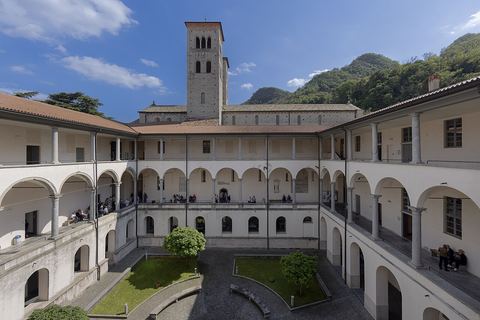
Today the old monastery houses a school. The parish moved elsewhere in 1932, and the basilica has been left on the sidelines. That is its charm and its limit: you will often find it closed.
This is why the visit starts outside, where there is already a lot to understand. And if the door is open, the best part is waiting for you inside.
Sources
- Basilica di S. Carpoforo, Como, Lombardia Beni Culturali (scheda CO180-00088) (opens in a new tab)Catalog
- Basilica di S. Carpoforo, complesso, Lombardia Beni Culturali (scheda CO180-00087 e schede collegate) (opens in a new tab)Catalog
- Monastero (ex) della Basilica di S. Carpoforo, Lombardia Beni Culturali (scheda CO180-00090) (opens in a new tab)Catalog
- Como, Enciclopedia dell'Arte Medievale Treccani (opens in a new tab)Encyclopedia
- Comune di Como, studio archeologico del Piano di governo del territorio, scheda COCE120 San Carpoforo (opens in a new tab)Institution
- Fernand De Dartein e l'architettura romanica comasca, a cura di Gabriella Guarisco, 2015 (archivio IRIS dell'Università di Catania) (opens in a new tab)Institution
- Basilica of St. Carpoforo, Monumenti Aperti (opens in a new tab)Other source
- Basilica di S. Carpoforo, Camminacittà (opens in a new tab)Other source
- San Carpoforo e Baradello da scoprire, Il Giorno, 12 giugno 2024 (opens in a new tab)Other source
- Basilica di San Carpoforo, Musei Online (opens in a new tab)Other source
- Basilica di San Carpoforo, Wikidata (Q2887098) (opens in a new tab)Other source
- Carpoforo, Essanto, Cassio, Severino, Secondo e Licinio, Wikipedia in italiano (opens in a new tab)Wikipedia
- Basilica di San Carpoforo, Wikipedia in italiano (opens in a new tab)Wikipedia
- Carpophorus, Exanthus, Cassius, Severinus, Secundus, and Licinius, Wikipedia in inglese (opens in a new tab)Wikipedia
- Felice di Como, Wikipedia in italiano (opens in a new tab)Wikipedia
- Andrea Brenta, Wikipedia in italiano (opens in a new tab)Wikipedia
- Castel Baradello, Wikipedia in italiano (opens in a new tab)Wikipedia
- Basilica di S. Carpoforo, scheda completa SIRBeC, Lombardia Beni Culturali (CO180-00088) (opens in a new tab)Catalog
- Pierangelo Frigerio, Sandro Mazza, Pier Giacomo Pisoni, Il falso «praeceptum» di Liutprando re, Rivista della Società Storica Varesina, fascicolo XI, 1973 (opens in a new tab)Institution
- Como: San Carpoforo, scheda di Danilo Tancini, Mondi Medievali, 2002 (opens in a new tab)Other source
- Il Tredicino di una volta, VareseNews, 4 marzo 2016 (opens in a new tab)Other source
- Tommaso Pendola, Italian Teacher of the Deaf, UCL Ear Institute & Action on Hearing Loss Libraries (opens in a new tab)Institution
- Chiesa dei Santi Martiri (Arona), Wikipedia in italiano (opens in a new tab)Wikipedia
- Santi Martiri, Arona, Wikipedia in inglese (opens in a new tab)Wikipedia
- Fedele di Como, Wikipedia in italiano (opens in a new tab)Wikipedia
- Serafino Balestra, Wikipedia in italiano (opens in a new tab)Wikipedia
- Daniela Pauli Falconi, Balestra, Serafino, Dizionario storico della Svizzera (opens in a new tab)Encyclopedia