Stop 5 of 5Must-see
The presbytery and the crypt
Where to stand
At the foot of the two stone stairways, facing the central arch that leads down into the crypt
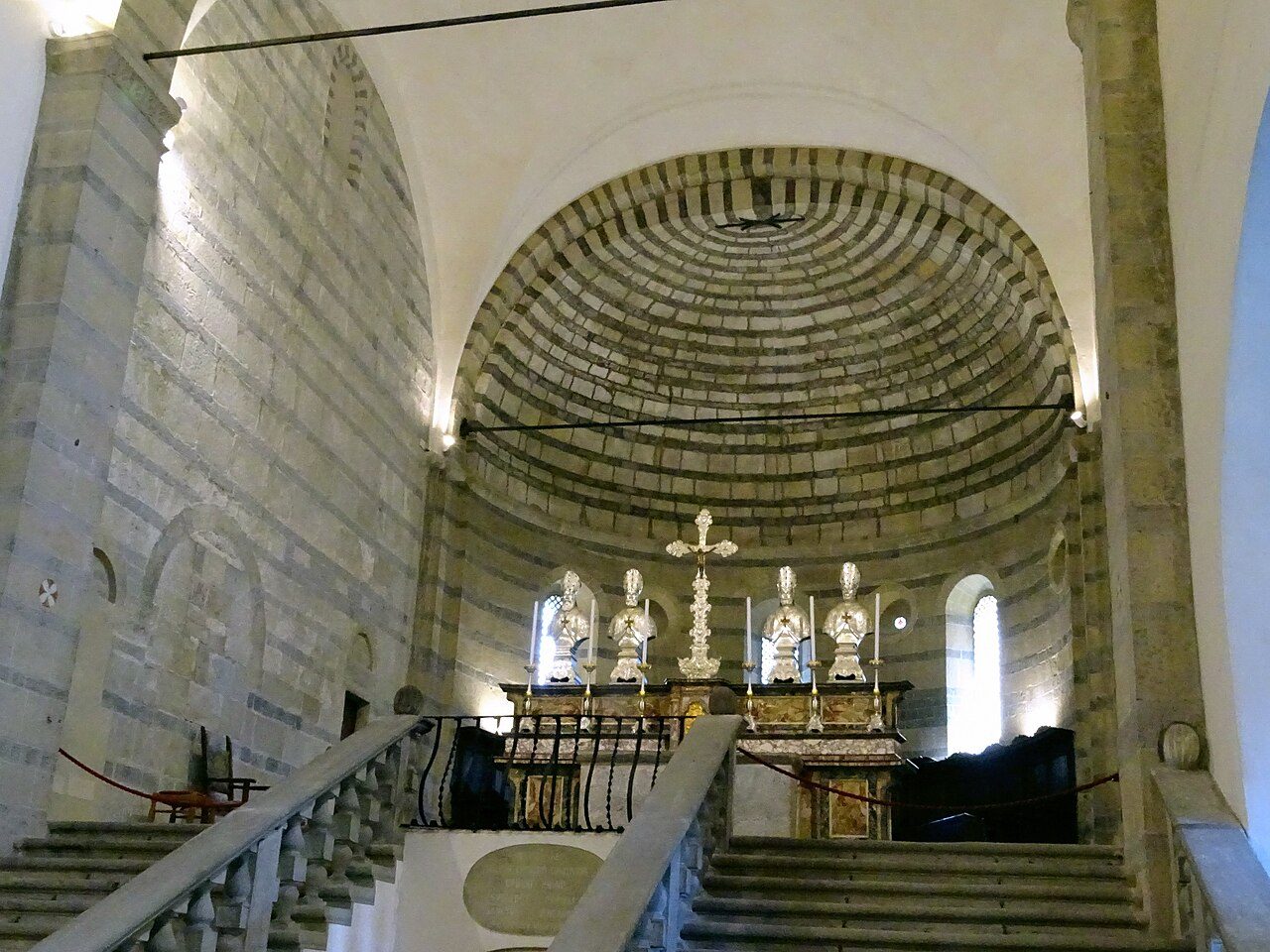
The heart of San Carpoforo is on two levels. Above, a set very high, with an in light and dark stripes. Below, a Romanesque on six granite columns, born beside the tombs of the martyrs and of the first bishop.
Spot the detail
In the apse, above the altar, look at how the stones are laid: how many colors are there?
The full story
This is the point where San Carpoforo stops being a stern church and turns into theater. In front of you two stone stairways climb, wide and solemn, toward the altar. Between them, a low arch leads down into the half-light. Above and below: the whole church is built to bring you here.
Above, the striped apse
Start at the top. The , the area around the altar reserved for the clergy, stands much higher than the nave. At the far end it closes with the , and the apse is the surprise: rows of pale stone alternating with rows of dark stone, running all the way around and continuing into the vault.
The high altar, with its colored marbles, is Baroque. It covers an ancient sarcophagus, clad in marble in the seventeenth century: that of Felice, the first bishop of Como, who according to tradition founded this church and wanted to be buried here.
Below, the crypt
Now go down. The is the reason the altar is so high up: it is a small church beneath the church, carved out under the . Six granite columns divide it into three little aisles.
Look at the capitals, decorated with leaves at the corners, and the groin vaults that rest on them. In the end wall, set inside three niches, are three slender . Scholars date it between the eleventh and twelfth centuries and compare it to other on the lake, at Lenno and on Isola Comacina, the lake's only island.
On your way down, look at the wall of the stairs. Set into it are funerary inscriptions found in the church and nearby. They come from the cemetery that once spread out around here, and some of them commemorate the first Christians of Como. The oldest is dated 401.
The relics are not here
Something is missing, though, and it is only fair that you know. The bodies that gave all this its meaning are no longer here. In 1932 the parish moved to the new church of Santa Brigida, in the Camerlata district, and the relics of Felice and the martyrs followed.
At the end of the sixteenth century the bishop Feliciano Ninguarda could still see the stone slab that listed those buried here. It began like this: here lie Carpoforo, then Cassio and Secondo. Today that too is lost.
What remains is the container, and it is magnificent. Sixteen centuries ago someone decided that this slope outside the city was holy ground. The is the exact point where that decision turned into stone.
About this stop
Record
A Syrian in Como in 401
In the basilica of San Carpoforo, in Como, on the left wall of the stairway down to the , there is a tombstone unlike the others: it is written in Greek. It bears the monogram of Christ with the letters alpha and omega and remembers a man from a village in Syria. It is dated to 401. His name is read in different ways, Banneias or Annulei, and some call him a merchant. Some consider it the oldest Christian evidence to survive in the Como area. If so, the oldest Christian voice left in this city speaks Greek, and comes from the other side of the Mediterranean.
Anecdote
The contested martyr and Arona's feast
The basilica of San Carpoforo, in Como, is not the only one to claim its martyr. In Arona, on Lake Maggiore, a church keeps relics it says are those of Carpoforo and Fedele, by tradition his companion: they are said to have come from Como in the Middle Ages. In the sixteenth century Carlo Borromeo, archbishop of Milan, had them taken to his city. The people of Arona pressed until part of them came back, on March 13, 1576. Arona still marks the day with a festival, the Tredicino. In Como, meanwhile, tradition kept the martyrs in their basilica. It happens with relics: the same saint rests in several places.
Anecdote
The priest of tombstones and the deaf
The ancient tombstones of the basilica of San Carpoforo, in Como, had an unusual scholar: Serafino Balestra, a priest and canon of Como's Duomo, the cathedral. In 1873 he published the inscriptions found in the church and nearby, and he followed the restoration with the canon Vincenzo Barelli. But he is remembered mostly for something else. Balestra taught the deaf, and he is credited with bringing the lip-reading method to Italy. He worked for years in France, which awarded him the Legion of Honor. In 1885 he was called to run a school for the deaf in Buenos Aires. He died there the following year, far from his stones.
Because the is underneath. In Romanesque churches that guarded venerated tombs, builders often made a vaulted room under the altar area, and the floor above ended up raised. Here the difference in height is considerable: it takes two stone stairways to reach the , and between the two is the way down to the crypt. The effect is theatrical, almost a stage, but it comes from a practical need.
No. For centuries the basilica guarded the burials of Carpoforo, his companions and the bishop Felice. In 1932 the parish was transferred to the new church of Santa Brigida, in the Camerlata district, and the relics were taken there. Under the high altar the ancient sarcophagus of Felice remains, clad in colored marble in the seventeenth century. The church that was born to stand beside those tombs now only remembers them.