Stop 1 of 5
At the foot of the Baradello
Where to stand
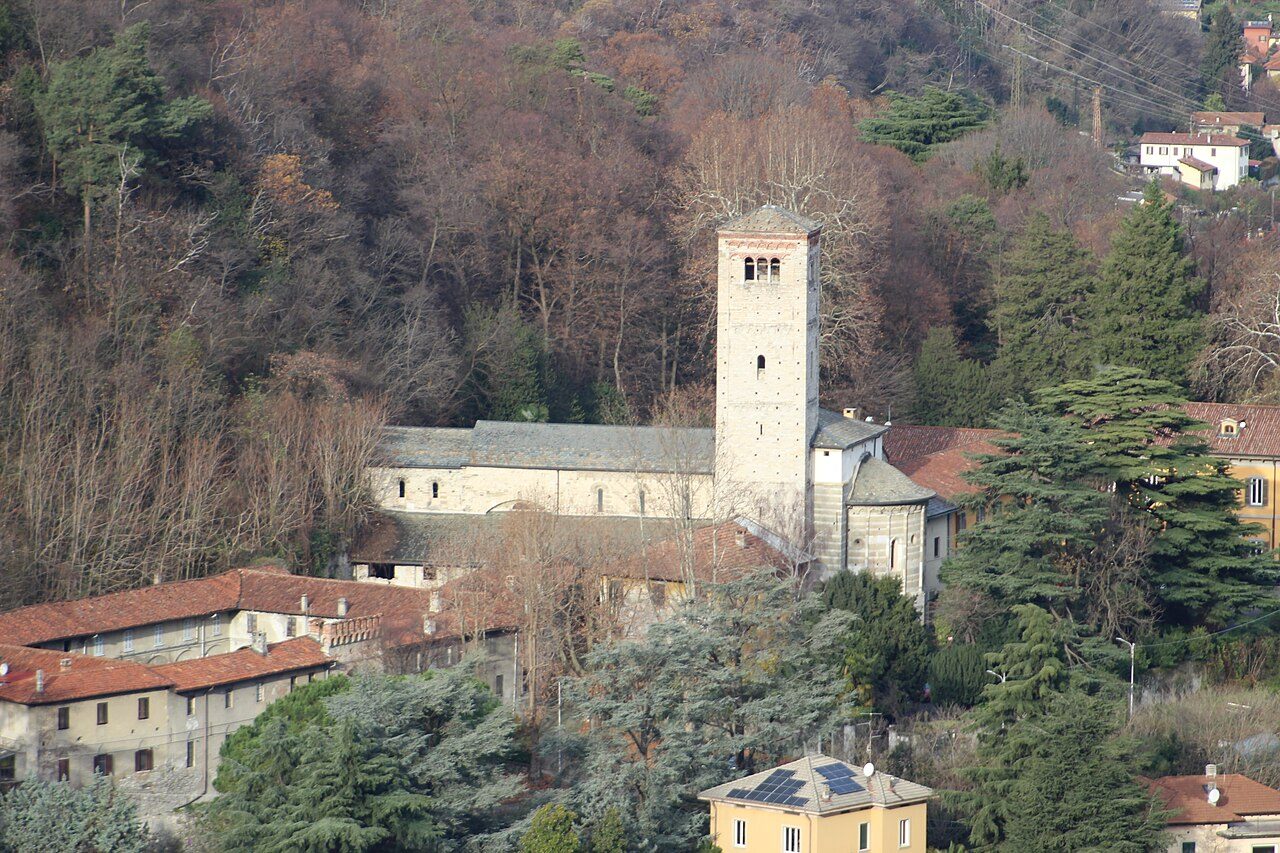
On Via San Carpoforo, before you enter the church courtyard, looking at the wooded hill that rises behind it
Before you look at the church, look at where it is: outside town, on a slope, below a castle. The road ran here, the Roman tombs were here, and here tradition places the martyrdom of Carpoforo and the first church in Como.
Spot the detail
Study the slope: which way does the ground rise in relation to the church?
The full story
Stop for a moment before the courtyard and look around. There is no square, no facade waiting for you. There is a road going uphill, a wood, and at the top of the hill Castel Baradello, the castle that watches over Como.
It seems an odd spot for the church that tradition calls the first in the city. In fact it is the most logical spot of all.
A road among the tombs
In Roman times one of the main roads into the city passed through here. And along the roads, outside the walls, the Romans buried their dead: archaeologists have identified a necropolis in this area. The earliest Christian churches often began just like this, among the tombs, outside the gates.
Martyrs and a first bishop
Then there is the story that gave the place its name, and here you need some caution, because it is a tradition and not a court record. At the start of the fourth century, under the emperor Maximian, a group of Christian soldiers flees Milan. They are stopped before they can enter Como and taken to the foot of the Baradello.
Six of them, Carpoforo among them, are beheaded. One companion, Fedele, manages to escape along the lake and is killed farther north: he is the saint honored by the Basilica di San Fedele, the church in the center of town.
Eighty years later, in 386, Ambrose, bishop of Milan, sends Como its first bishop, Felice. According to tradition Felice builds a basilica here over the martyrs' tombs and chooses to be buried beside them.
Over the centuries the people of Como added two details: that the church took the place of a temple of Mercury, and that it was the city's first cathedral. The first is plausible, but not proven. The second has been debated for a long time, and there is no direct confirmation. What is certain is that it was a cemetery church, important precisely because it guarded those tombs.
The castle comes later
The castle up there comes much later. Its tower dates from the twelfth century. In the sixteenth century the fortress was dismantled, and what was left of it belonged to the monks who lived next to the church. For a while, in other words, the Baradello was San Carpoforo's backyard.
None of this can be seen. But it explains why, climbing up here, you are not heading out to the edge of town: you are going back to where it all started.
About this stop
Legend
Carpoforo and the soldiers on the run
The basilica of San Carpoforo, in Como, is named after a martyr. According to tradition Carpoforo and his companions were Christian soldiers, in some accounts members of the legendary Theban Legion. During the persecution under the emperor Maximian, in the early fourth century, they flee Milan. They are caught at the gates of Como and beheaded at the foot of the Baradello hill, where the basilica now stands, in a place called the Selvetta. With them was Fedele, who escapes along the lake and is killed farther north. None of this is proven. But two of Como's oldest churches, San Carpoforo and San Fedele, carry the names of those fugitives.
Legend
A temple of Mercury under the church?
In Como people have always said that the basilica of San Carpoforo stands on top of a pagan temple dedicated to Mercury, turned into a church by Felice, the city's first bishop. Inscriptions that speak of a cult of the god have been found at the foot of the Baradello, the hill behind the church, and more than one scholar thinks it likely. Historical confirmation, though, is missing. Part of the story's appeal is that it is so neat: Christianity taking the place of the old gods. Take it for what it is: a good story, not an established fact.
The first martyr of Como, at least according to tradition. The accounts describe him as a Christian soldier, killed with five companions at the foot of the Baradello during the persecution under the emperor Maximian, at the start of the fourth century. Nothing else is known about him, and even this is not documented. What is real is the devotion: for centuries this basilica guarded the tombs that tradition assigns to him and his companions.
They have been neighbors for centuries. Castel Baradello dominates the hill behind the church: its tower dates from the twelfth century, and in 1278 Napo Torriani, lord of Milan, died a prisoner there, shut in a cage hung on the outside. In 1527 the castle was dismantled by order of the Spanish governor and only the tower was spared. What was left belonged to the Hieronymite monks of San Carpoforo before passing into private hands.
Next stop
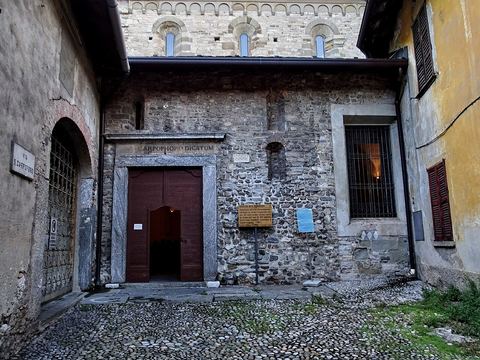
Walk into the cobbled courtyard and stop in front of the doorway, on the side of the church