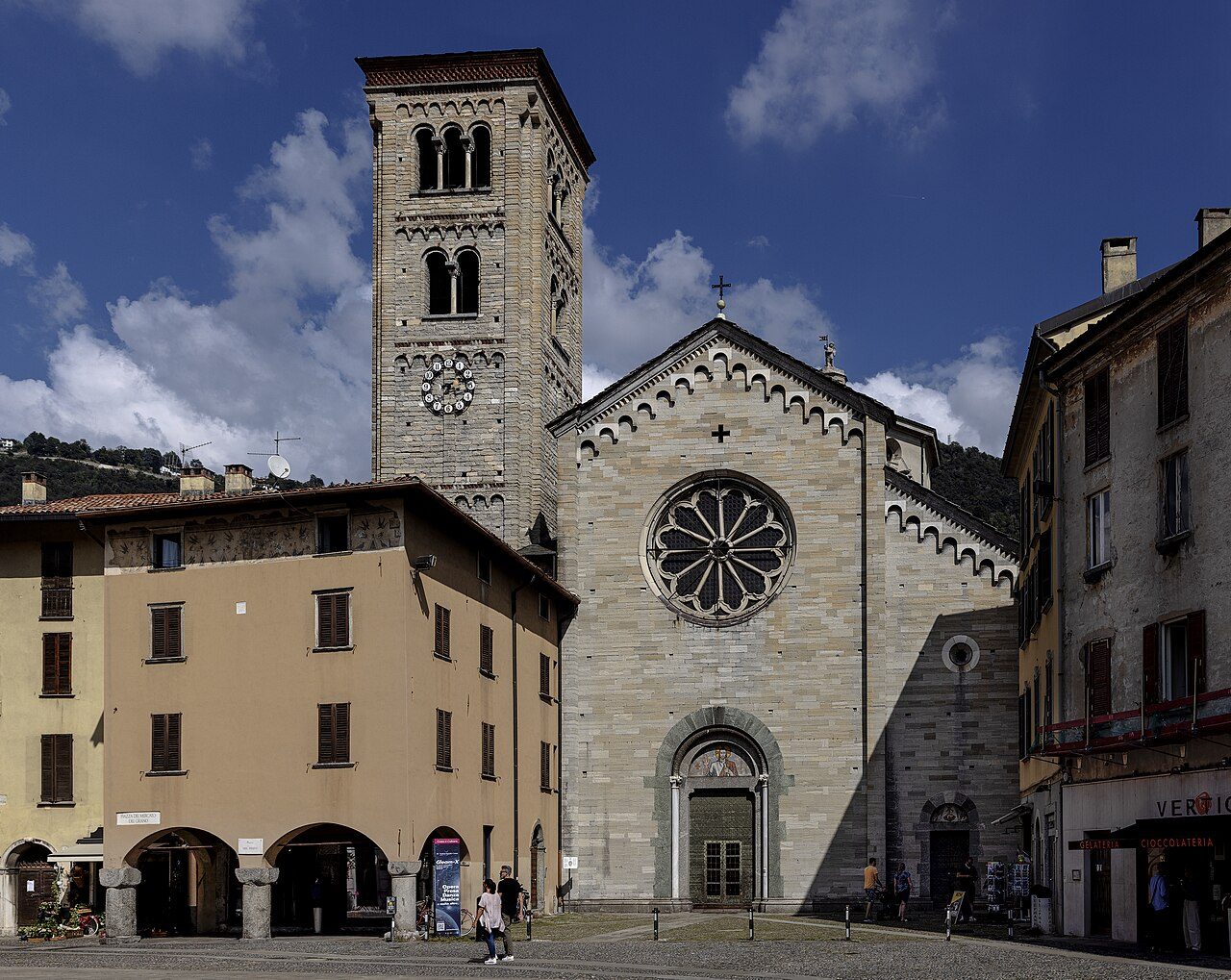
Church · The Walled City · XI–XII secolo
Basilica di San Fedele
A cloverleaf plan that looks to the Rhine and, around the back, a doorway full of dragons
In brief
Almost certainly Como's first cathedral, rebuilt in Romanesque style around the bones of a martyred soldier. Inside, a cloverleaf plan that looks to Germany. Outside, around the back, a doorway carved with dragons, a mermaid and a prophet flown through the air by his hair.
Stories of this place
- Anecdote · The square and the facadeReadThe canons' bakeryTo the left of the facade of San Fedele, in Como, the house of the canons still stands: they were the priests who lived in common and ran the church. In the early twelfth century they opened a bread shop and a wine shop there. Every baker in Como owed a tax to the bishop. Not them: the city's consuls put in a word, and in 1109 Bishop Guido Grimoldi exempted them. Under its roof the house has a painted frieze of flowers and animals dated 1582, which came back to light during a twentieth-century restoration.
- Anecdote · The square and the facadeReadEight Roman columns that moved houseOpposite the basilica of San Fedele, in Como, stood the baptistery of San Giovanni in Atrio. Inside it had eight Roman columns of cipollino marble. They are believed to come from a portico built in the city by Calpurnius Fabatus, grandfather of the wife of Pliny the Younger, the Latin writer born in Como. In 1788 the baptistery was deconsecrated, then sold to a private owner who made it a warehouse. The columns were saved: today they hold up the facade of the Liceo Volta, a high school on Via Cesare Cantù. A Roman portico, a baptistery, a school. Almost two thousand years of work, without ever leaving the city.
- Anecdote · The bell tower that wouldn't stand straightReadThe earthquake that came from VeronaThe bell tower of San Fedele, in Como, was largely brought down by an earthquake that started far away. On January 3, 1117, the ground shook near Verona: it is the strongest quake on record in northern Italy. According to Clemente Tajana, the city's former chief engineer, the tower collapsed to about ten meters above the ground, and the neighbors were to blame. It stood squeezed between the basilica and the canons' house, and during the tremors the two buildings hammered it, one from each side. The bell tower of San Carpoforo, another church in the city, was not squeezed between two buildings, he notes, and stayed standing.
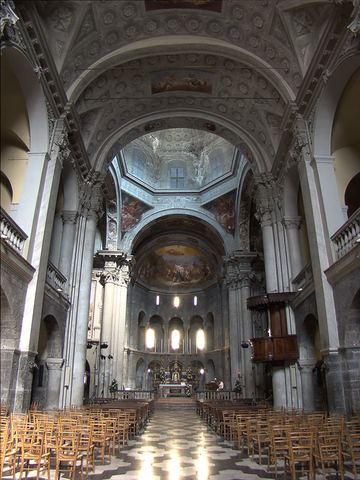
- Record · The nave and the cloverleaf planReadA cloverleaf plan unique in ItalyThe basilica of San Fedele, in Como, has a layout that, according to the parish guide, no other church in Italy shares. A nave and two aisles opening into two large chapels facing each other, wrapped in a corridor, plus the apse at the far end: a cloverleaf. To find anything similar you have to go as far as Cologne, to the church of St. Maria im Kapitol. On top of that it has matronei, galleries on the upper floor, found nowhere else in Como's Romanesque.
- Legend · The altar and the tomb of San FedeleReadThe flight of Fedele the soldierThe basilica of San Fedele, in Como, is named after a martyr whose bones lie under its high altar. According to tradition Fedele was a Roman soldier at the imperial court in Milan. Found out as a Christian, he was imprisoned, escaped with some companions and took the road to Como. The others, Carpoforo among them, were caught and killed at the city gates. He went on to the head of the lake, where he was captured and beheaded. A small chapel rose on the spot; it still exists and is called San Fedelino. Other versions make him a missionary, not a soldier: the sources are few and disagree.
- Legend · The altar and the tomb of San FedeleReadThe dream that found the martyrUnder the high altar of San Fedele, in Como, lie the bones of the martyr Fedele, originally buried at the head of the lake. How did Gualdone, bishop of Como, know where to dig in 964? According to tradition a local woman told him: Fedele had appeared to her in a dream and shown her his burial place, by then forgotten. The bishop, the story goes, had the spot dug up, and the bones were there. For one scholar there is also a less miraculous reason: the church was probably about to hand the title of cathedral to another, and a martyr's bones gave it a new role.
- Anecdote · The altar and the tomb of San FedeleReadOne saint, claimed by three citiesIn the basilica of San Fedele, in Como, the bones of the martyr Fedele lie under the high altar: the city has held them since 964. But Arona, on Lake Maggiore, has also claimed to have them: they were supposedly carried off from Como during a war with Milan. In the sixteenth century Carlo Borromeo, archbishop of Milan, had those relics moved to his own city, where a church is dedicated to San Fedele. Arona protested and got part of them back. Three cities for a single martyr.
- Anecdote · The two lions and the twin chapelsReadBeatified two and a half centuries lateIn San Fedele, in Como, a chapel off the right aisle is dedicated to Innocent XI, the pope born in the city. He lived on little: he is said to have always worn the same clothes, and three times he banned Carnival for the Romans. He died in 1689. Two years later the process to proclaim him a saint opened, then everything stopped: among the charges was his hostility to France, and the French opposed it. Not even a successor, Pope Benedict XIV, was convinced: more than a saint, he wrote, he had been a “good man.” The beatification came in 1956, 265 years after the process began.
- In cultureReadA honeymoon at San FedeleIn 1912 Arthur Kingsley Porter, the American historian of Romanesque architecture, came through Como on his honeymoon with his wife Lucy. The two were struck by the basilica of San Fedele, and Lucy recalled it years later in a travel diary. For Porter, Como was a hinge in the exchanges between Italy and the rest of Europe: exactly what this church has to say, with a plan that looks to the churches of the Rhine. The scholar disappeared in 1933 on an Irish island, and his body was never found.
- AnecdoteReadComo's farewell to Alessandro VoltaWhen Alessandro Volta, the Como-born scientist, died, his city paid tribute to him in the basilica of San Fedele, about a week later. For the occasion a young priest and patriot from Torno, Tommaso Bianchi, was asked to compose a poem. In 1829 Bianchi himself published the first biography of Volta. In the square in front of the church, under a portico, a plaque remembers another Volta: Zanino, an ancestor of Alessandro, who in the seventeenth century was decurione del grano, the councilor in charge of grain, when the grain market was held here.
Ready-made questions
A martyr of the early centuries, about whom little is known. The best-known tradition makes him a Roman soldier in Milan, secretly Christian, who fled toward Como and was killed at the head of the lake during the persecutions. Another describes him as a missionary sent to convert the lands around the lake. His tomb was already venerated in the early sixth century. In 964 the bones were brought to Como, to this church. The diocese remembers him on October 29.
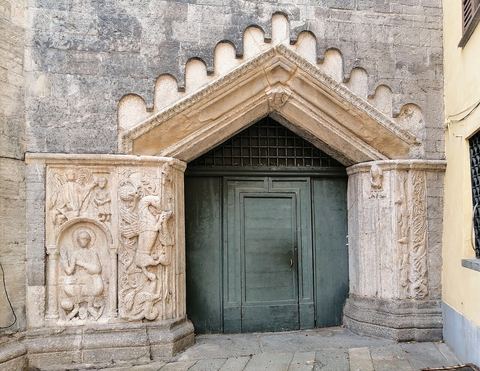
Go to stop: The altar and the tomb of San FedeleBecause of the dragons carved on the marble slabs that frame it. To the right of the door a chimera and two dragons sink their teeth into one another in a chain. Higher up, an upside-down dragon fights a smaller one for a skull. Around them are a headless mermaid, a monkey, a dog chasing a hare and a Bible scene with the prophet Daniel. The reliefs are about nine hundred years old, and their overall meaning is still debated.
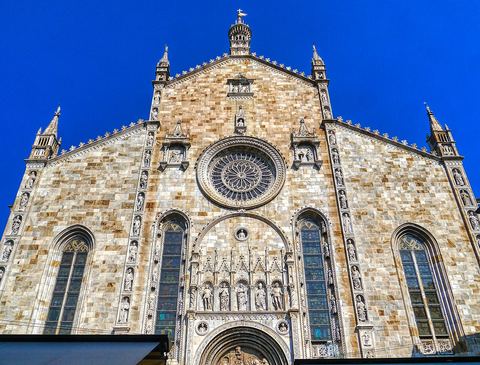
Go to stop: The dragon doorwayNo. It is , meaning rebuilt in medieval style: the engineer Antonio Giussani designed it in 1914, replacing a facade from 1509. Only the in the center survived from that one. The mosaics over the doors are from 1968. The bell tower too is largely the work of Giussani, who rebuilt it a few years earlier. The genuine Romanesque parts are best seen at the back, along Via Vittorio Emanuele II, and inside.
Go to stop: The square and the facadeBecause its builders looked north. The cloverleaf plan, with two large chapels facing each other and a corridor wrapped around them, recalls the churches of the Rhineland, in particular St. Maria im Kapitol in Cologne. It was a model tied to the empire. According to a recent study it was probably chosen by the of San Fedele and not by the bishop, who in those years backed the pope. In Italy, the parish guide says, there is no other church built like this.
Go to stop: The nave and the cloverleaf planThey are called : a second story above the side aisles, looking down on the nave. Those of San Fedele are the only example in Como's Romanesque and, according to the parish guide, show how skilled its builders were. Originally they could be seen all around the perimeter of the church. In the sixteenth century the arches facing the two side chapels were walled up, to make room for canvases, frescoes and stucco.
Go to stop: The nave and the cloverleaf planVery probably, yes. When it was still called Sant'Eufemia, the church was the bishop's seat inside the walls. Beside it stood the baptistery of San Giovanni in Atrio and the church of San Pietro in Atrio. Around the year 1000 the title passed to Santa Maria Maggiore. San Fedele remained a rich and influential collegiate church, with its fourteen , and lost none of its prestige even when, in the fourteenth century, the life of the city shifted toward what is now Piazza del Duomo, the cathedral square.
A chapel off the right aisle is dedicated to Innocent XI, born Benedetto Odescalchi in Como in 1611 and pope from 1676 to 1689. The parish archive keeps his baptismal record. During his papacy a Christian coalition drove the Ottoman threat away from Vienna, in 1683. He also tried to abolish nepotism, but the cardinals would not follow him. He was beatified in 1956.
Go to stop: The two lions and the twin chapelsThe stops
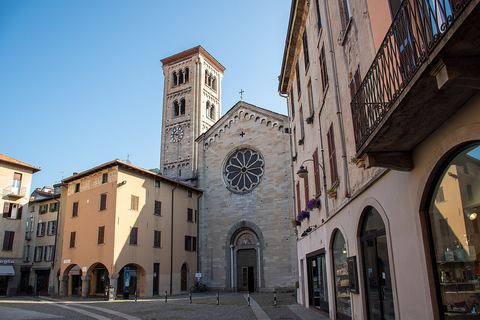
1 The square and the facade
The square is older than the church: Roman Como met here, and for centuries grain was sold here. The facade is the youngest thing in sight: just over a hundred years old, though it pretends to be nine hundred.
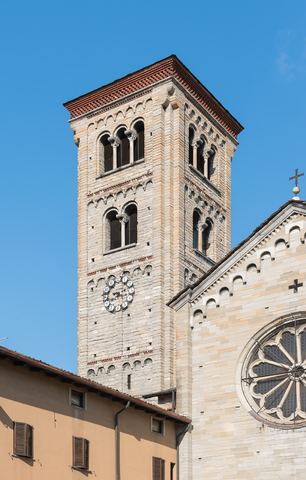
2 The bell tower that wouldn't stand straight
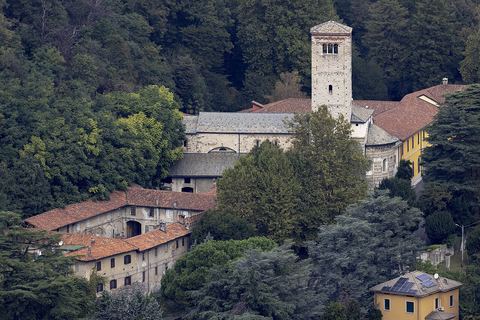
It looks like a medieval tower and is mostly early twentieth century. First an earthquake, then clay soil made it collapse, lean and get rebuilt. Only the base is old: according to a recent study it is the oldest piece of the whole complex.
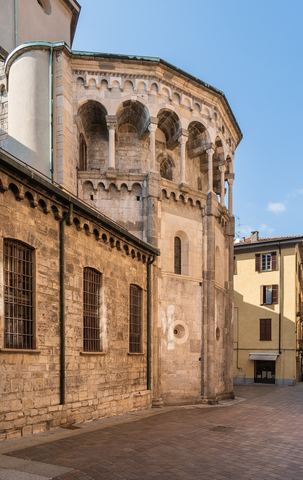
3 The apse and the loggia that holds up nothing
The back is the church's best side. The apse rises in three levels to a little loggia of slender columns that seem to carry the roof and carry almost nothing. It is also the most mature part of the Romanesque building campaign.
4 The dragon doorway
The most famous piece of the church is a back door. Around it are marble slabs carved about nine hundred years ago: dragons biting each other, a mermaid, a monkey and a prophet flown through the air by his hair. Nobody knows for certain what it means.
5 The nave and the cloverleaf plan
Inside, San Fedele looks like a Baroque church. But under the decoration is the most original Romanesque skeleton in Como: a nave and two aisles opening into a cloverleaf, with galleries on the floor above. An idea that came from Germany.
6 The altar and the tomb of San Fedele
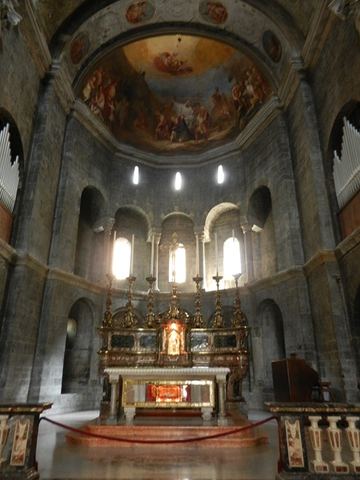
Under the altar is the reason the church has this name: a marble tomb chest holding the bones of Fedele, soldier and martyr. They have been there since 1365, and the chest says so itself, in Latin. Even though other cities have claimed to have them.
7 The two lions and the twin chapels
Two marble lions hold up the holy water basins: they probably stood guard at the doorway of the older church. Beside them, the two chapels of the cloverleaf became, in the seventeenth century, two theaters of fresco and stucco facing each other.
Timeline
- 865A document records a court hearing held in the forecourt of the church of Sant'Eufemia: the first sure mention of the building.
- 964Bishop Gualdone brings the bones of the martyr Fedele to the city. The church of Sant'Eufemia changes its name.
- 1117A strong earthquake brings down part of the bell tower.
- about 1120Traditional date of the Romanesque basilica. Work had begun earlier; the apse was completed later, perhaps in mid-century.
- 1271Bishop Raimondo Torriani orders the canons to rebuild the bell tower, which the clay soil keeps threatening.
- 1365On June 4 Bishop Stefano Gatti has the bones of Fedele moved into the marble tomb chest under the high altar.
- 1903–1907The bell tower, leaning dangerously, is taken down to about twelve meters above the ground and rebuilt in Romanesque style.
- 1914Antonio Giussani rebuilds the facade in neo-Romanesque style. Of the 1509 facade, the rose window remains.
Who's who
San Fedele
Roman soldier and martyr, according to tradition
Killed at the head of Lake Como during the persecutions. His bones, brought to the city in 964, gave the church its name.
Gualdone
bishop of Como in the tenth century
Also called Ubaldo. In 964 he solemnly brought the bones of Fedele to the city and laid them in the church of Sant'Eufemia, which changed its name from then on.
Stefano Gatti
bishop of Como from 1362 to 1369
On June 4, 1365, he had the martyr's bones moved from the middle of the choir to the marble tomb chest under the high altar. The record is carved on the chest itself.
Isidoro Bianchi
painter, pupil of Morazzone
In 1623 he frescoed the Glory of Paradise in the Chapel of the Crucifix, commissioned by the priest Quintilio Lucini Passalacqua.
Innocent XI
pope from 1676 to 1689, born Benedetto Odescalchi
A native of Como: the parish archive keeps his baptismal record. Beatified in 1956, he has a chapel off the right aisle.
Antonio Giussani
engineer
In the early twentieth century he rebuilt the unsafe bell tower from twelve meters up. In 1914 he redid the facade in Romanesque style, saving the sixteenth-century rose window.
Words to know
Where it is
The neighborhood
The Walled City
Related places
The story of the place
This square was the center of Como long before the church. The two main streets of the Roman town crossed close by, and many scholars place the forum here. Until the nineteenth century it was the grain market.
From Sant'Eufemia to San Fedele
The church started out under another name, Sant'Eufemia: an Eastern saint whose cult, the parish says, reached Como with Bishop Abbondio. A document from 865 mentions it already standing, with its forecourt. In all likelihood it was the cathedral inside the walls, until around the year 1000 the title passed to another church, Santa Maria Maggiore.
In 964 Bishop Gualdone brought here the bones of Fedele, a Roman soldier who, according to tradition, was killed for his faith at the head of the lake. The city celebrated, and the church changed its name.
The Romanesque basilica
The building you see is Romanesque. The date everyone repeats is 1120, but it is a date of convenience: work had started earlier and ended later. In between came the ten-year war with Milan, which devastated Como in 1127 and spared the church. San Fedele was a collegiate church, run by fourteen : priests who lived in community, rich and powerful.
What makes it unique is the plan. The nave and its two aisles widen into two large chapels facing each other, each wrapped in a corridor. With the at the far end they draw a cloverleaf.
According to the parish guide no church in Italy is built like this: to find anything similar you have to go up to the Rhine, to Cologne. Above the aisles run the , upper galleries, the only ones in Como's Romanesque.
What later centuries added
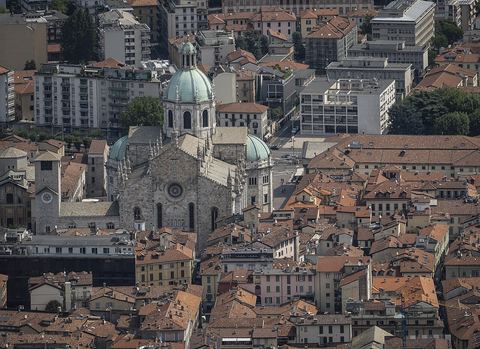
Then every century added something of its own. In the seventeenth century the nave got a Baroque vault. In the early nineteenth century the went up, the eight-sided turret over the crossing.
The facade is the youngest part of all: , from 1914. The bell tower was rebuilt a few years earlier, because it was leaning.
If you only have time for one thing, walk around the back. On the side away from the square you find the and the Portale del Drago, the dragon doorway, with its reliefs of monsters and prophets. It is the most beautiful part of the church, and the part many people skip.
Sources
- Breve guida alla Basilica di San Fedele, Parrocchia di San Fedele in Como (opens in a new tab)Official site
- Campane della basilica di San Fedele in Como, scheda della Parrocchia di San Fedele (opens in a new tab)Official site
- Clemente Tajana, 1117-2017: 900 anni dal terremoto e crollo del campanile di San Fedele, Parrocchia di San Fedele in Como (opens in a new tab)Official site
- Guida alla basilica, volantino della Parrocchia di San Fedele in Como (2024) (opens in a new tab)Official site
- San Fedele's Basilica, guida in inglese della Parrocchia di San Fedele (opens in a new tab)Official site
- Como, Enciclopedia dell'Arte Medievale, Treccani (opens in a new tab)Encyclopedia
- Innocenzo XI, Dizionario Biografico degli Italiani, Treccani (opens in a new tab)Encyclopedia
- Plinio il Giovane, Enciclopedia Italiana, Treccani (opens in a new tab)Encyclopedia
- Pope Innocent XI, Catholic Encyclopedia, New Advent (opens in a new tab)Encyclopedia
- Margherita Tabanelli, San Fedele di Como: un modello architettonico tra centro e meridione dell'Impero (2015), archivio IRIS della Sapienza Università di Roma (opens in a new tab)Institution
- Margherita Tabanelli, La basilica di S. Fedele e il suo campanile: le trasformazioni del più antico complesso sacro di Como tra XI e XII secolo, Arte Medievale (2014), archivio IRIS della Sapienza Università di Roma (opens in a new tab)Institution
- Chiesa di San Fedelino, FAI Fondo per l'Ambiente Italiano (opens in a new tab)Institution
- Luigi Dodi, Storia e leggende in riva al fiume Mera, in Valchiavenna, L'AltraMontagna (il Dolomiti) (opens in a new tab)Other source
- Casa già Ronzoni, già battistero di San Giovanni in Atrio, Como, scheda completa SIRBeC CO180-00150, Lombardia Beni Culturali (opens in a new tab)Catalog
- Nine hundred years since the largest earthquake in Northern Italy, nota stampa dell'Istituto Nazionale di Geofisica e Vulcanologia (opens in a new tab)Institution
- Comune di Como, Dal Medioevo alle soglie dell'età neoclassica (opens in a new tab)Official site
- Centro Studi Alessandro Volta, Piazza and Basilica of San Fedele (opens in a new tab)Institution
- Piazza San Fedele, Italia.it (opens in a new tab)Institution
- Chiesa di San Fedele, in-Lombardia (opens in a new tab)Institution
- What to see in Como? The marvel of Romanesque architecture, Conceptual Fine Arts (opens in a new tab)Other source
- Basilica di San Fedele (Como), Wikipedia in italiano (opens in a new tab)Wikipedia
- Basilica of San Fedele, Como, Wikipedia in inglese (opens in a new tab)Wikipedia
- Fedele di Como, Wikipedia in italiano (opens in a new tab)Wikipedia
- Fidelis of Como, Wikipedia in inglese (opens in a new tab)Wikipedia
- Terremoto di Verona del 1117, Wikipedia in italiano (opens in a new tab)Wikipedia
- Liceo classico e scientifico Alessandro Volta, Wikipedia in italiano (opens in a new tab)Wikipedia
- Novum Comum, Wikipedia in italiano (opens in a new tab)Wikipedia
- Papa Innocenzo XI, Wikipedia in italiano (opens in a new tab)Wikipedia
- Plinio il Giovane, Epistulae, libro V, lettera 11 a Calpurnio Fabato, The Latin Library (opens in a new tab)Other source
- Basilica di San Fedele, Wikidata Q2887102, coordinate (opens in a new tab)Other source