Stop 2 of 7
The bell tower that wouldn't stand straight
Where to stand
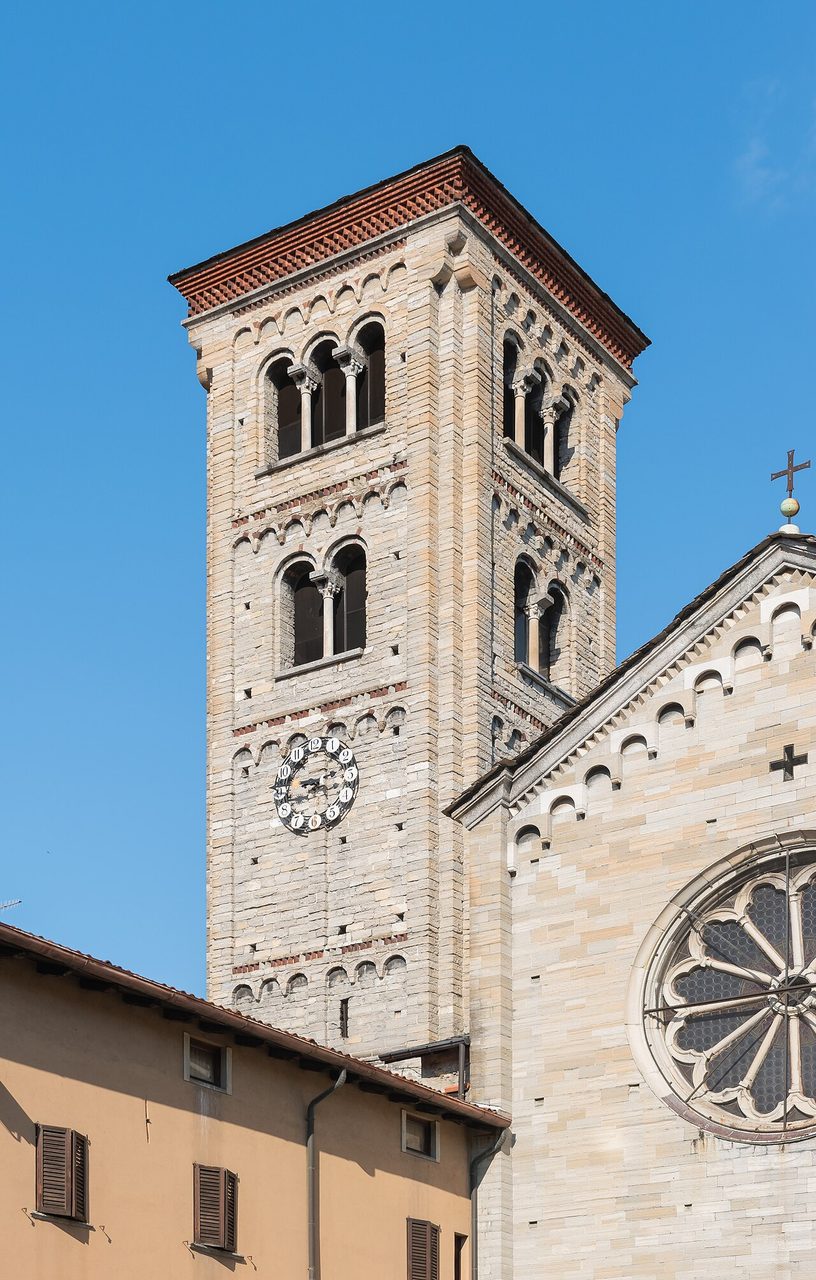
In Piazza San Fedele, looking up to the left of the facade, toward the square tower
It looks like a medieval tower and is mostly early twentieth century. First an earthquake, then clay soil made it collapse, lean and get rebuilt. Only the base is old: according to a recent study it is the oldest piece of the whole complex.
Spot the detail
The windows of the tower: count them floor by floor, from the bottom up
The full story
Look up at the square tower beside the church. Four tiers of little arches, windows that widen as you climb. A textbook Romanesque bell tower. And yet, from about a dozen meters up, it is just over a hundred years old.
Clay under the square
Blame the ground. Under the square there is clay, soft and treacherous.
The tower was probably built together with the basilica, and in 1117 a strong earthquake, recorded in the chronicles, brought part of it down. In 1271 Bishop Raimondo Torriani ordered the of the basilica to rebuild it.
The builders took every precaution they knew. It didn't help. The parish guide admits it candidly: a stable, lasting solution has never been found.
The twentieth-century rebuilding
By the early twentieth century the tower was leaning dangerously. The engineer Antonio Giussani, the same man who later rebuilt the facade, had it taken down to about a dozen meters above the ground and rebuilt it from there up, in Romanesque style, to today's height of almost thirty-two meters, about 105 feet.
Below that cut is the old tower. According to a recent study its lowest level dates to the second half of the eleventh century: it is the oldest piece of the whole complex, older than the church next to it.
The three bells
At the top there are three bells, and there have always been three: a visiting bishop noted as much at the end of the sixteenth century. The two largest have been ringing since 1842. The biggest is dedicated to San Fedele, the second to Sant'Abbondio, patron saint of the diocese.
During the Second World War, when the bronze of church bells was being requisitioned, they were among the few in the city to be spared. The smallest was recast at the time of the Second Vatican Council, and says so in its dedication to the Virgin Mary.
And the ground? It is still in charge. Toward the end of the twentieth century the parish thought of adding two bells. The plan was dropped because of the difficulties with the tower's stability.
Look at it now, straight and calm. Behind many monuments that seem eternal there is someone who, at some point, had to save them.
About this stop
Anecdote
The earthquake that came from Verona
The bell tower of San Fedele, in Como, was largely brought down by an earthquake that started far away. On January 3, 1117, the ground shook near Verona: it is the strongest quake on record in northern Italy. According to Clemente Tajana, the city's former chief engineer, the tower collapsed to about ten meters above the ground, and the neighbors were to blame. It stood squeezed between the basilica and the ' house, and during the tremors the two buildings hammered it, one from each side. The bell tower of San Carpoforo, another church in the city, was not squeezed between two buildings, he notes, and stayed standing.
Next stop
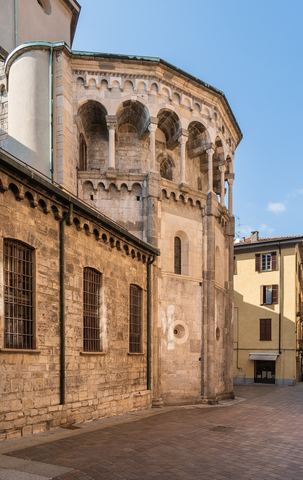
Walk around the church to Via Vittorio Emanuele II, on the side away from the square, where the apse juts out