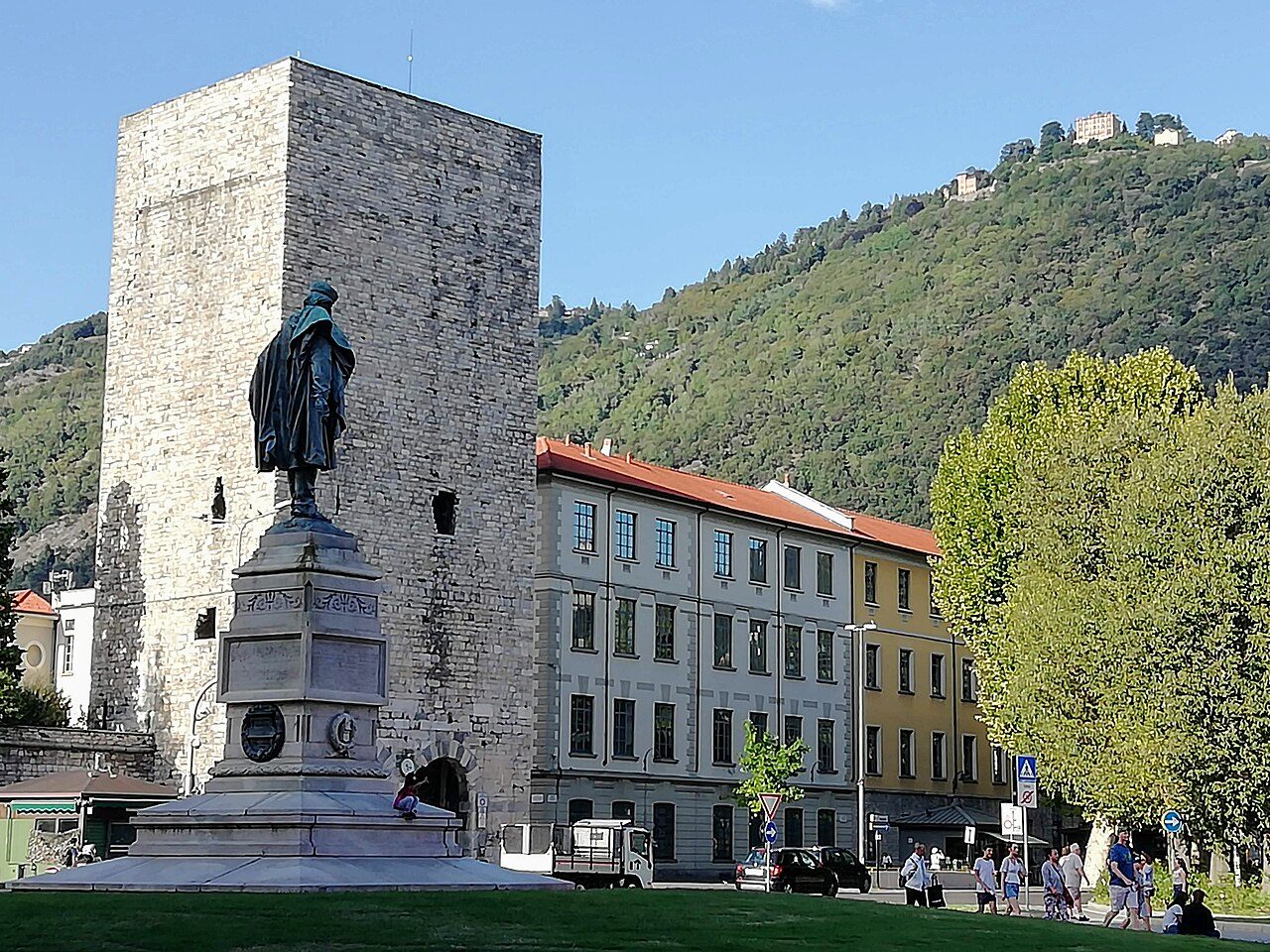
Monument · The Walled City · 1158–1192
Porta Torre e le mura
The gate raised in Milan's face, and the tower where thunderstorms rang the bells
In brief
Some 40 meters of stone from 1192 guarding the road to Milan, and half a kilometer of medieval walls still intact between two corner towers. A fortress outside, a facade of arches inside. In one of the towers Alessandro Volta ran his first experiments on electricity.
Stories of this place
- Anecdote · Porta Torre from the outsideReadA beaten Barbarossa takes shelter in ComoComo stayed on the side of the emperor Frederick Barbarossa, who was at war with Milan, even in the hard days. In 1160 Barbarossa was beaten by the Milanese at Carcano, not far from the city, and found refuge at Castel Baradello, the fortress on the hill overlooking Como. He was among allies: in those very years he was having the city walls and the castle itself rebuilt. Some thirty years later the people of Como completed the work begun alongside him with Porta Torre: a tower some 40 meters tall that serves as the main gate, set on the very side that faces Milan.
- Record · The Garibaldi monumentRead1848: Como captures an Austrian garrisonIn March 1848, while Milan was fighting its Cinque Giornate, the five days of revolt against Austrian rule, Como rose up too. Right at the start the citizens seized the military bakery, and that was the decisive move: the Austrian soldiers shut inside the San Francesco barracks, outside Porta Torre, the city's medieval gate, were left without bread. They tried a sortie and were driven back. After five days they surrendered, in the square where the Garibaldi monument stands today. They also handed over their regimental flag: one of the few seized from Austria in the whole Risorgimento, the movement that unified Italy.
- In culture · The Garibaldi monumentReadThe 1848 Austrian surrender, in a paintingIn front of Porta Torre, Como's medieval gate, the Garibaldi monument has a relief on its pedestal: Austrian soldiers surrendering to the citizens in revolt, in March 1848. The same scene also exists in color. The Como painter Francesco Capiaghi painted it in the late nineteenth century: the crowd, the Austrian command facing the members of the provisional government, the carts bringing food to the starving soldiers. In the background you can see the barracks and the start of Via Milano. The painting is kept in Como's Museo Storico Giuseppe Garibaldi, the city history museum: if you go there after seeing the monument, you will recognize the square.
- Anecdote · The walls along Viale CattaneoReadWalls as a gift, walls for saleMore than once, Como's walls have been a deal between private parties. In 983 the emperor Otto II gave a stretch of them to a certain Bariberto: twenty-five pertiche of wall, an old measure of length, with three towers, near a small secondary gate. Eight centuries later, in 1783, the military treasury sold the entire circuit to the city, which passed several pieces on to the owners of the neighboring houses. That was when the sentry walks began turning into gardens.
- Anecdote · The Torre GattoniReadThe thunderstorm that rang the bellsIn the eighteenth century the tower at the southwest corner of Como's walls belonged to Giulio Cesare Gattoni, canon of the Duomo and physics enthusiast, who put a lightning rod on it. From the rod he ran an iron wire hung with little bells to his house. When the air charged with electricity, the bells rang by themselves. That way, he writes, he and his friend Alessandro Volta, the future inventor of the battery, could predict storms before the rain began. A smaller version became almost a musical instrument: iron wires of different thicknesses on a frame, sounding the seven notes. He called it the armonica meteorologica, the weather harmonica.
- Anecdote · The Torre GattoniReadThe Jesuit who wanted to recruit VoltaIn the corner tower of Como's walls the canon Giulio Cesare Gattoni ran experiments with Alessandro Volta, the future inventor of the battery. But years earlier the two had shared a secret. At the Jesuit college in Como a philosophy teacher, Girolamo Bonesi, had become convinced that young Volta had a vocation, and wanted him in the Society of Jesus. The family took the boy out of the college, but teacher and pupil went on writing to each other in secret. The one carrying the letters was Gattoni, confidant to both, who meanwhile tried to disillusion the Jesuit. He had read it right: Volta chose electricity.
- In cultureReadComo, the crab-shaped cityComo's medieval walls enclosed the body of the city, but the city also had two arms. On either side, along the lakeshore, two fortified borghi grew up, the neighborhoods outside the walls: Vico to the west and Coloniola to the east. In old views they grip the bay like two claws. You can see it clearly in the one engraved in 1689 by the cosmographer Vincenzo Coronelli. This shape gave Como an old Latin nickname: Urbs Cancrina, the crab city. The two borghi still exist, one on each shore: on a map, look for them on either side of the walled city.
- LegendReadCaesar's five hundred GreeksJulius Caesar refounded Como, ringed it with walls, and assigned it five thousand colonists. Among them, says the ancient geographer Strabo, were five hundred distinguished Greeks. From this grew a tradition dear to local scholars: they were supposedly the ones who gave Greek names to the villages on the lake. Corenno like Corinth, Lenno like Lemnos, Dervio like Delphi. Lovely, but today's historians do not believe it. And Strabo himself adds a detail that spoils the party: those Greeks were given citizenship, but they never came to live in Como.
- In cultureReadComo is a wall, says CassiodorusLong before Como had the medieval walls it has today, someone called the whole city a wall. In the sixth century Cassiodorus, a high official of the Gothic kings, writes a letter in defense of the people of Como, worn out by one obligation: supplying horses for the state postal service. And he describes the city like this: past the mountains and the purest of lakes, quasi murus, almost a wall defending the plain. Then he gets carried away, and admits that so beautiful a place seems made for pleasure alone. Fortress and place of delights at once: fifteen centuries later, the definition still holds.
- In cultureReadThe walls in a poem by CatullusComo's walls enter literature when they are still fresh from the builders. Around the middle of the first century BC the Latin poet Catullus, in his poem 35, mentions the walls of Novum Comum, the new Como: the city Julius Caesar had just refounded on the plain by the lake and enclosed in a rectangular circuit, like a military camp. Those walls are gone, but their line is not. Today's medieval walls, with the Porta Torre gate at their center, run almost exactly on the same course.
Ready-made questions
Because it is both things: a gate, porta, for entering the city and a tower, torre, for defending it. In the Middle Ages it was Como's main entrance, on the side facing Milan, and in fact it was also called Porta di Milano, the Milan Gate. Another name you may come across is Torre di Porta Vittoria, after the square in front of it. It inherited the role of the Roman gate, the so-called Porta Pretoria, whose remains are preserved underground a short distance away.
Go to stop: Porta Torre from the outsideSome 40 meters, about 130 feet, roughly the height of a twelve-story building. The sources disagree: many say forty meters, others stop at thirty-four. The base is square and the inside is empty today: the four wooden floors have been lost. The Torre di San Vitale, at the east corner of the walls, reaches about thirty-six meters.
Go to stop: Porta Torre from the outsideThe eight arches match the four stories inside, which had wooden floors. The most common explanation for such an open side is military: had the enemy captured the tower, he would have had no wall to shelter behind and would have been exposed to fire from the defenders in the city. On the outside, where the attacks came from, the wall is almost blind instead.
Go to stop: Porta Torre from the insideThe line is Roman: it goes back to the refounding of the city ordered by Julius Caesar. What you see today, though, is medieval. After the Milanese tore down the old walls in 1127, the people of Como allied themselves with the emperor Frederick Barbarossa, who from 1158 had the defenses rebuilt and strengthened. Porta Torre was completed in 1192. In the thirteenth and fourteenth centuries more gates, towers, and a castle on the east side were added.
Go to stop: The walls along Viale CattaneoIn the eighteenth century the tower at the southwest corner of the walls belonged to the canon Giulio Cesare Gattoni, a physics enthusiast, who had set up a laboratory and a lightning rod in it. Gattoni and Volta had met as boys at the Jesuit school, and in the tower they carried out their first experiments on gases and electricity together. Volta then went his own way, all the way to a professorship in Pavia and the invention of the battery. The tower took the name of the friend who opened his laboratory to him.
Go to stop: The Torre GattoniNot much, and not from the street. The walls laid out by Julius Caesar were about two meters thick, and the medieval ones follow their line, just slightly farther out. The most important remnant is a gate from the imperial age, with two arches between two octagonal towers, preserved in the basement of a school near Porta Torre: tradition calls it the Porta Pretoria. Ancient sarcophagi and columns are gathered along the walls next to the Torre di San Vitale.
No. In May 1859, after his victory at San Fermo, Garibaldi came in through Porta Sala, on the west side of the walls: that gate has been demolished, and it stood where Via Garibaldi runs today. The monument stands in front of Porta Torre for a different reason. Here, in March 1848, the Austrian garrison had surrendered to the citizens in revolt, and that is the scene shown in the relief on the pedestal.
Go to stop: The Garibaldi monumentThe stops
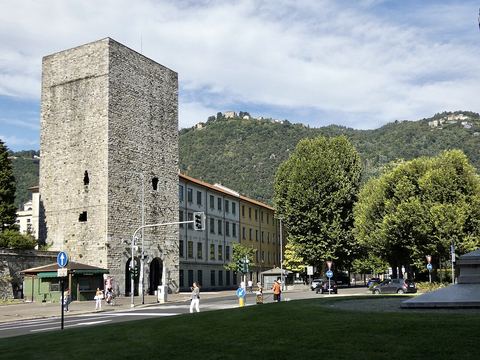
1 Porta Torre from the outside
The face Como showed to anyone arriving from Milan: some 40 meters of stone with barely an opening. It dates from 1192 and is the only gate of its time to have come down to us.
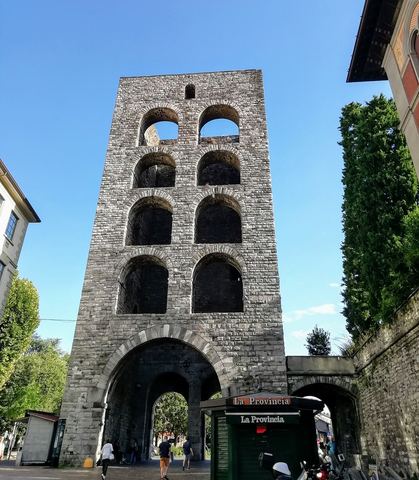
2 Porta Torre from the inside
The same tower, unrecognizable: on the city side the wall opens into four rows of arches, two per floor. They match the four wooden floors inside, now gone.
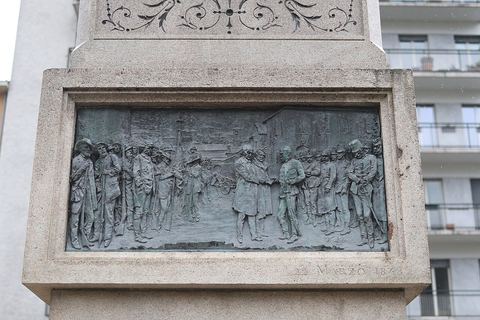
3 The Garibaldi monument
Giuseppe Garibaldi in bronze, by the Ticino sculptor Vincenzo Vela, unveiled in 1889. But the relief on the pedestal tells of another victory: the Austrians' surrender to the people of Como, right here in 1848.
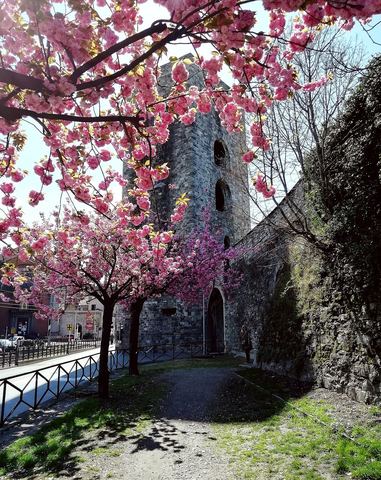
4 The Torre di San Vitale
The tower that closes the walls to the east, about 36 meters tall. In all likelihood it is later than Porta Torre, and it is heavier and barer. Next to it is the Museo archeologico Paolo Giovio, the archaeological museum.
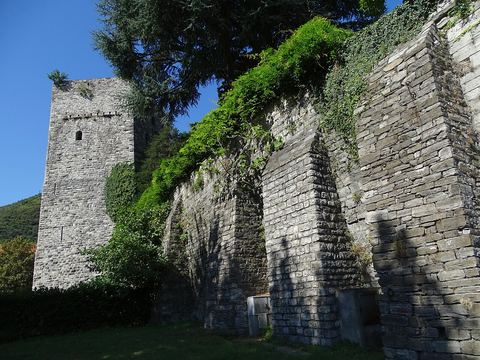
5 The walls along Viale Cattaneo
The south side is the only stretch of the medieval walls left intact. Where you are walking was the moat; on top, in place of the battlements, gardens now spill over.
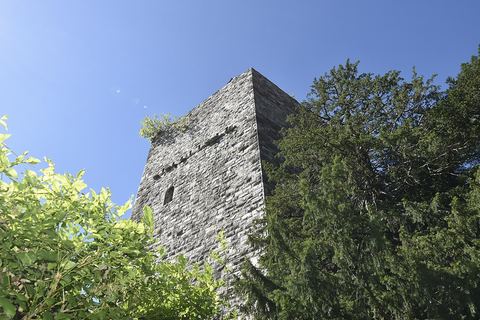
6 The Torre Gattoni
A five-sided medieval tower that became a physics laboratory in the eighteenth century. Here the canon Giulio Cesare Gattoni and the young Alessandro Volta studied the electricity of thunderstorms.
Timeline
- 1st century BCJulius Caesar refounds Como and rings it with walls: the medieval walls will follow their line.
- 1127After ten years of war Milan conquers Como and tears down its walls.
- 1158Frederick Barbarossa starts rebuilding the defenses torn down by the Milanese: the medieval walls are born.
- 1192Porta Torre is completed, on the initiative of the podestà Uberto de' Olevano.
- 1783The military treasury sells the walls to the city, which hands several stretches over to private owners.
- 1817The moat is filled in and replaced by a tree-lined avenue.
- 1848In March, after five days of revolt, the Austrian garrison surrenders to the people of Como outside Porta Torre.
- 1889Vincenzo Vela's monument to Garibaldi is unveiled in Piazza Vittoria.
Who's who
Frederick Barbarossa
Holy Roman Emperor
Como's ally against Milan. From 1158 he had the walls torn down by the Milanese rebuilt and strengthened.
Uberto de' Olevano
podestà of Como
The magistrate who headed the city government in 1192: on his initiative Porta Torre was built, to defend the city's main entrance.
Giulio Cesare Gattoni
canon of the Duomo and physicist
A Como native who lived from 1741 to 1809. In the tower that bears his name he set up a laboratory and a lightning rod, and ran experiments there with Volta.
Alessandro Volta
physicist, inventor of the battery
A Como native and Gattoni's friend since school. In the corner tower of the walls he carried out his first experiments on gases and electricity with him.
Vincenzo Vela
sculptor from Ticino
Creator of the Garibaldi monument, one of his last works. In 1848 he fought as a volunteer in Como and portrayed himself among the insurgents in the relief.
Giuseppe Garibaldi
general of the Risorgimento volunteers
In May 1859 he beat the Austrians at San Fermo and entered Como through Porta Sala. The city dedicated the monument in front of Porta Torre to him.
Words to know
Where it is
The neighborhood
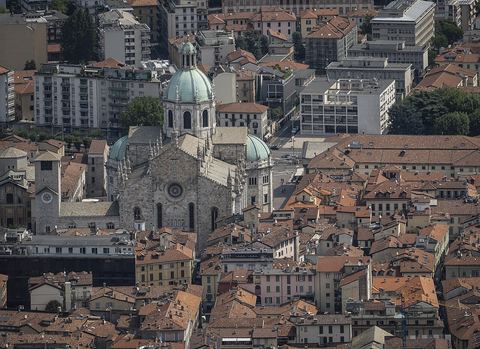
The Walled City
Related places
The story of the place
To understand Porta Torre, the tower gate in Como's city walls, you need to know that Como and Milan spent a long time at war. In 1127, after ten years of fighting, the Milanese took the city and tore down its walls, which still followed the line laid out by Julius Caesar. For some thirty years Como stood defenseless.
Rebuilding with Barbarossa
Revenge came with Frederick Barbarossa, the emperor who had marched into Italy precisely to fight Milan. The people of Como sided with him and in return won permission to rebuild their walls. Work began in 1158, on the Roman line but set a little farther out.
In 1192, on the initiative of Uberto de' Olevano, the podestà, the magistrate who headed the city government, the tower in front of you was completed: the main entrance, planted in the middle of the south side, staring down the road to Milan. The message was clear.
The walls sold to private owners
Over the following centuries the circuit gained corner towers, new gates, and outer defenses. Then it stopped being useful. In 1783 the military treasury sold the walls to the city, which handed several stretches over to private owners.
The were knocked down, the moat was filled in and turned into a tree-lined avenue, and the gardens of the grand houses sprouted on the sentry walks. The walls were left with a single job: marking the customs line for the dazio, the tax on goods entering the city.
And yet history kept passing through here. In a corner tower the canon Giulio Cesare Gattoni and the young Alessandro Volta studied the electricity of thunderstorms. And in March 1848, outside the gate, the Austrian garrison surrendered to the citizens in revolt.
The route in six stops
Today the south side is the only one still intact: about half a kilometer of wall, with Porta Torre in the middle and a tower at each end. The route starts in the square, goes through the gate, reaches the two corner towers, and ends with Volta.
That makes six stops, all outdoors. If you are short on time, keep the two faces of the gate, a stretch of wall, and the Torre Gattoni.
Sources
- Mura medioevali - complesso, Como, Lombardia Beni Culturali (opens in a new tab)Catalog
- Porta Torre, Como, Lombardia Beni Culturali (opens in a new tab)Catalog
- Porta Torre, Italia.it, portale ufficiale del turismo (opens in a new tab)Institution
- Gattoni Tower, alessandrovolta.it (opens in a new tab)Institution
- Legami patriottici: Giuseppe Garibaldi e Vincenzo Vela, in-Lombardia (opens in a new tab)Institution
- Vincenzo Vela, modello per il monumento a Giuseppe Garibaldi e alle Giornate di Como del 1848, Lombardia Beni Culturali (opens in a new tab)Catalog
- Francesco Capiaghi, Dopo la resa di Como il 22 marzo 1848, Catalogo generale dei beni culturali (opens in a new tab)Catalog
- Como's City Walls, Como Companion (opens in a new tab)Other source
- Como – Its Role in the Birth of a Nation, Como Companion (opens in a new tab)Other source
- Torri e antiche mura di Como: ok ai lavori di messa in sicurezza, Il Giorno, 4 gennaio 2023 (opens in a new tab)Other source
- Porta Torre, Como, Musei Online (opens in a new tab)Other source
- Giulio Cesare Gattoni, Dizionario Biografico degli Italiani Treccani (opens in a new tab)Encyclopedia
- Giuseppe Muti, Funzioni urbane e politiche per la città: la storia di Como nei documenti d'archivio, Centro Italiano per gli Studi Storico-Geografici (opens in a new tab)Institution
- Strabone, Geografia, libro V, capitolo 1, traduzione inglese Loeb, LacusCurtius, University of Chicago (opens in a new tab)Institution
- Cassiodoro, Variae, libro XI, lettera 14, testo latino e traduzione, Roman Letters (opens in a new tab)Other source
- Cassiodoro, Variae, libro XI, testo latino, The Latin Library (opens in a new tab)Other source
- Volta, Alessandro Giuseppe Antonio Anastasio, Complete Dictionary of Scientific Biography, Encyclopedia.com (opens in a new tab)Encyclopedia
- Como romana, mappa del percorso a cura del Comune di Como, Assessorato alla Cultura, copia pubblicata da ComoZero (opens in a new tab)Other source
- Poliante Lariano, Viaggio pel lago di Como, Como 1817, Project Gutenberg (opens in a new tab)Other source
- Breve storia di Corenno Plinio, Segnalo.it (opens in a new tab)Other source
- Torre di Porta Nuova, OpenStreetMap (opens in a new tab)Other source
- Torre San Vitale, OpenStreetMap (opens in a new tab)Other source
- Porta Torre (Como), Wikipedia in italiano (opens in a new tab)Wikipedia
- Mura di Como, Wikipedia in italiano (opens in a new tab)Wikipedia
- Giulio Cesare Gattoni, Wikipedia in italiano (opens in a new tab)Wikipedia
- Novum Comum, Wikipedia in italiano (opens in a new tab)Wikipedia
- Lenno, Wikipedia in italiano (opens in a new tab)Wikipedia
- Dervio, Wikipedia in italiano (opens in a new tab)Wikipedia
- Storia di Como, Wikipedia in italiano (opens in a new tab)Wikipedia
- Porta Torre, Wikipedia in inglese (opens in a new tab)Wikipedia