Stop 6 of 6Must-see
The Torre Gattoni
Where to stand
At the corner of Viale Cattaneo and Viale Varese, at the foot of the tower that closes the walls to the west
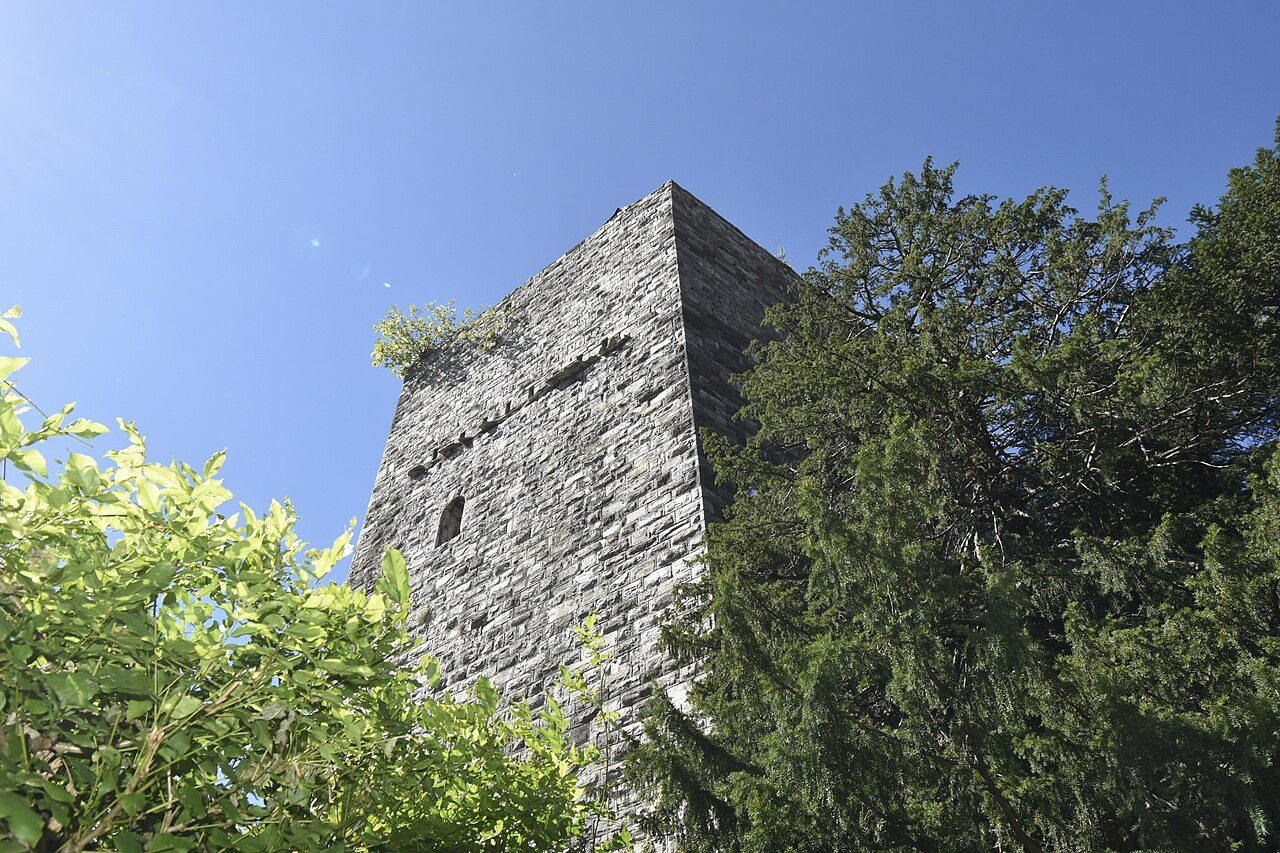
A five-sided medieval tower that became a physics laboratory in the eighteenth century. Here the canon Giulio Cesare Gattoni and the young Alessandro Volta studied the electricity of thunderstorms.
Spot the detail
Look for a small door on the ground floor of the tower: it has nothing to do with the Middle Ages
The full story
The last tower is the strangest, because it has had three lives.
The first is the one you see: a tower on a pentagonal plan, planted on the southwest corner of the walls. It is also called the Torre di Porta Nuova, the tower of the new gate. It stood guard over this corner just as the Torre di San Vitale stands guard over the opposite one.
Canon Gattoni's laboratory
The second life begins in the eighteenth century, when the tower ends up in the hands of a neighbor: Giulio Cesare Gattoni, a canon of the Duomo, Como's cathedral, the son of a marquis, with the family palace a stone's throw away and a consuming passion for physics. Gattoni fills it with instruments: a laboratory, a library, a weather observatory, a small natural history collection. And above all a lightning rod, one of the very first in Italy, modeled on the one invented by Benjamin Franklin.
The bells that announce the storm
And here is the idea. From the lightning rod Gattoni runs an iron wire hung with little bells all the way to his house. When the air charges with electricity the bells start ringing by themselves, and the storm announces itself before a single drop has fallen. He even builds a smaller version, with iron wires of different thicknesses stretched on a frame to sound the seven notes, and christens it the armonica meteorologica, the weather harmonica.
Beside him in those years is a friend he met at the Jesuit school: Alessandro Volta. The two write to each other, debate by letter whether animals have a soul, and meanwhile carry out their first experiments on gases and electricity together. Volta will become one of the most famous physicists in Europe and invent the battery. He took his first steps here, among a friend's instruments.
In 1808, a year before his death, Gattoni donates the tower and his physics cabinet to the city's high school.
Como's first electrical substation
The third life is the most unexpected. In the 1930s, behind a small door on the ground floor, Como's first electrical substation is installed, the one that powered the street lighting. It ran until 1958, and the old panel with its measuring instruments is still in place.
A tower built for war, used to listen to lightning, and ending up distributing current. In Volta's city it could hardly have gone any other way.
About this stop
Anecdote
The thunderstorm that rang the bells
In the eighteenth century the tower at the southwest corner of Como's walls belonged to Giulio Cesare Gattoni, canon of the Duomo and physics enthusiast, who put a lightning rod on it. From the rod he ran an iron wire hung with little bells to his house. When the air charged with electricity, the bells rang by themselves. That way, he writes, he and his friend Alessandro Volta, the future inventor of the battery, could predict storms before the rain began. A smaller version became almost a musical instrument: iron wires of different thicknesses on a frame, sounding the seven notes. He called it the armonica meteorologica, the weather harmonica.
Anecdote
The Jesuit who wanted to recruit Volta
In the corner tower of Como's walls the canon Giulio Cesare Gattoni ran experiments with Alessandro Volta, the future inventor of the battery. But years earlier the two had shared a secret. At the Jesuit college in Como a philosophy teacher, Girolamo Bonesi, had become convinced that young Volta had a vocation, and wanted him in the Society of Jesus. The family took the boy out of the college, but teacher and pupil went on writing to each other in secret. The one carrying the letters was Gattoni, confidant to both, who meanwhile tried to disillusion the Jesuit. He had read it right: Volta chose electricity.
In the eighteenth century the tower at the southwest corner of the walls belonged to the canon Giulio Cesare Gattoni, a physics enthusiast, who had set up a laboratory and a lightning rod in it. Gattoni and Volta had met as boys at the Jesuit school, and in the tower they carried out their first experiments on gases and electricity together. Volta then went his own way, all the way to a professorship in Pavia and the invention of the battery. The tower took the name of the friend who opened his laboratory to him.