Stop 1 of 6Must-see
Porta Torre from the outside
Where to stand
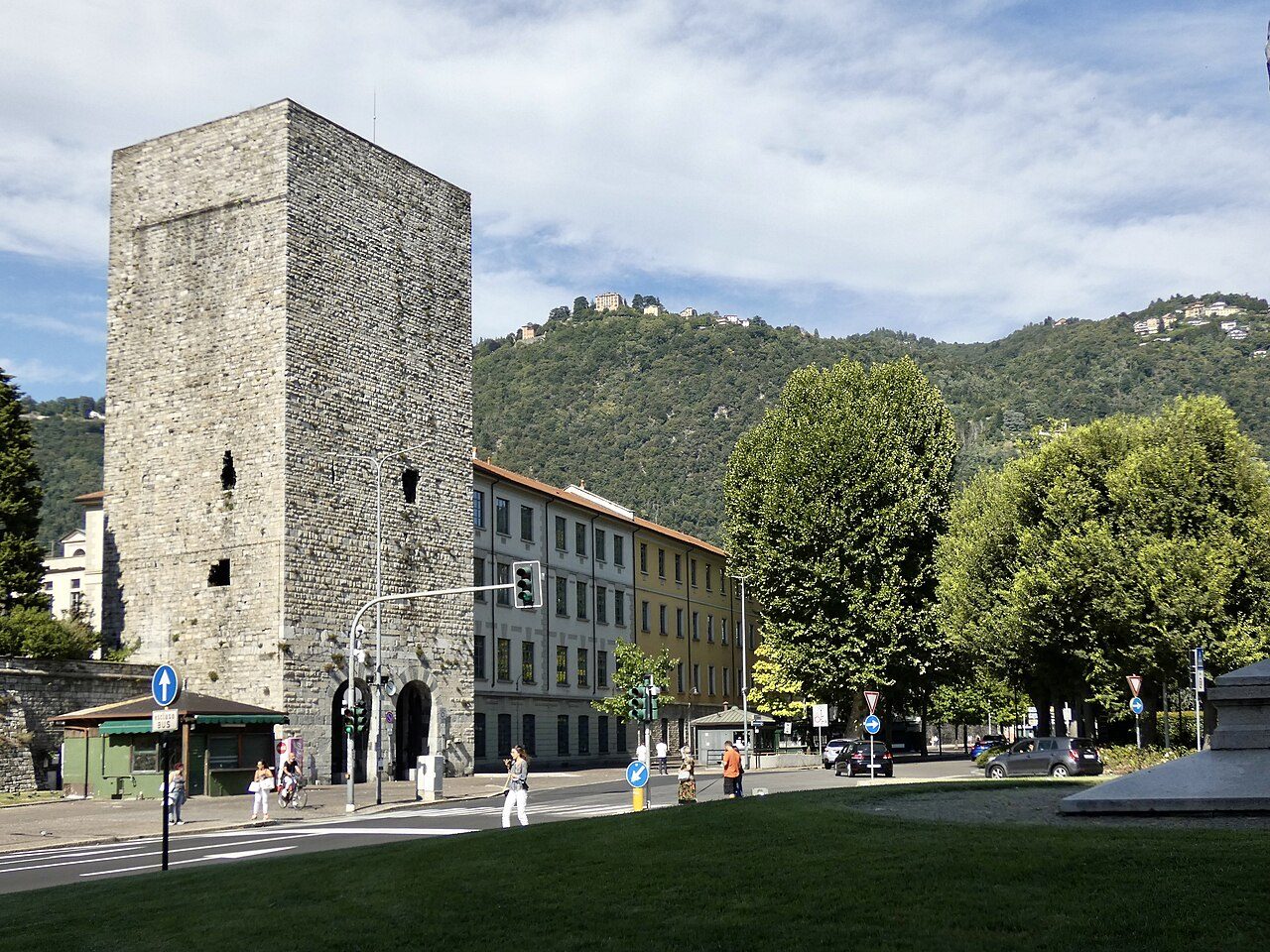
In Piazza Vittoria, a few dozen meters from the tower, facing the city center
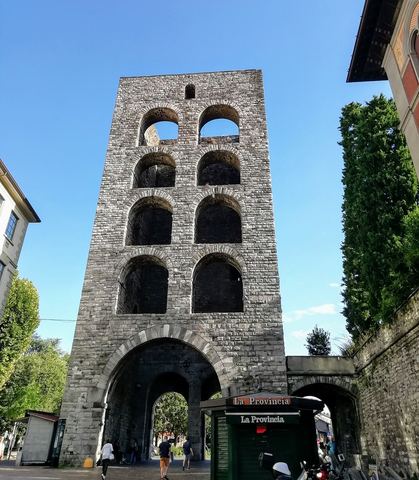
The face Como showed to anyone arriving from Milan: some 40 meters of stone with barely an opening. It dates from 1192 and is the only gate of its time to have come down to us.
Spot the detail
Count the passages at the base of the tower, and remember the number for when you are on the other side
The full story
Stand in the middle of the square and imagine arriving from Milan on foot, eight centuries ago. The first thing you see of Como is this: a block of stone some 40 meters tall, about 130 feet, smooth and almost blind.
No decoration, no courtesy. It is a wall stood on end.
That is deliberate. In 1127 the Milanese had won a ten-year war against Como and torn down its walls. When the people of Como were able to rebuild them, thanks to their alliance with the emperor Frederick Barbarossa, they wanted the main entrance to look straight at the enemy city.
The tower was completed in 1192, on the initiative of Uberto de' Olevano, the podestà, the magistrate who headed the city government. Not by chance, it was also called Porta di Milano, the Milan Gate.
A gate and a tower
Today's name says the simplest thing possible: it is a gate, porta, and it is a tower, torre. The plan is square. At the bottom are two , arched passages through the wall.
Higher up there is almost nothing, because this was the side the enemy came from. Underground, the foundations were reinforced with piling, a forest of stakes driven into the soil.
The defenses you cannot see
What you no longer see is everything that stood in front of it. The gate was not alone: over the centuries outer defenses grew up around it.
- A , a fortification built in front of the entrance to protect it.
- Two smaller pentagonal towers on the flanks.
- In the sixteenth century a semicircular , designed for the age of cannon.
- And of course the moat.
All of it vanished when the walls stopped being useful: the was demolished in the early nineteenth century, and the moat was filled in and replaced by the tree-lined avenue that now runs along the walls.
The Roman gate underground
Then there is a gate you cannot see at all, and it is far older. Close by, in the basement of a school, lie the ruins of the entrance to Roman Como: two arches side by side, squeezed between two octagonal towers, from the imperial age. Tradition calls it the Porta Pretoria. It means that for almost two thousand years, anyone arriving from the south has entered the city at more or less this spot.
Look at it a moment longer like this, closed and hostile. In a minute, from the other side, you will struggle to recognize it.
About this stop
Anecdote
A beaten Barbarossa takes shelter in Como
Como stayed on the side of the emperor Frederick Barbarossa, who was at war with Milan, even in the hard days. In 1160 Barbarossa was beaten by the Milanese at Carcano, not far from the city, and found refuge at Castel Baradello, the fortress on the hill overlooking Como. He was among allies: in those very years he was having the city walls and the castle itself rebuilt. Some thirty years later the people of Como completed the work begun alongside him with Porta Torre: a tower some 40 meters tall that serves as the main gate, set on the very side that faces Milan.
Because it is both things: a gate, porta, for entering the city and a tower, torre, for defending it. In the Middle Ages it was Como's main entrance, on the side facing Milan, and in fact it was also called Porta di Milano, the Milan Gate. Another name you may come across is Torre di Porta Vittoria, after the square in front of it. It inherited the role of the Roman gate, the so-called Porta Pretoria, whose remains are preserved underground a short distance away.
Some 40 meters, about 130 feet, roughly the height of a twelve-story building. The sources disagree: many say forty meters, others stop at thirty-four. The base is square and the inside is empty today: the four wooden floors have been lost. The Torre di San Vitale, at the east corner of the walls, reaches about thirty-six meters.
This stop on the map
Next stop
Walk under the tower and into the city. Take about twenty steps, then turn around and look at it