Museum · The Lakefront · 1925–1928
Tempio Voltiano
A museum born of a fire, dressed up as a Roman temple
In brief
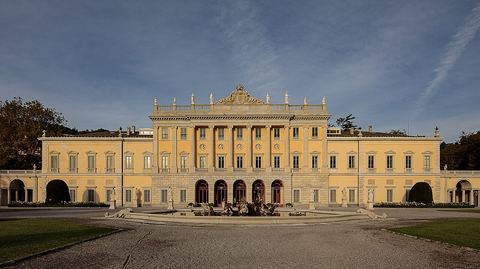
On the lakefront, a small Pantheon in white stone holds the instruments of Alessandro Volta, the Como man who invented the battery. Some are original, others were pieced back together or rebuilt after a blaze. The building is a museum piece too.
Stories of this place
- Legend · The hall under the domeReadVolta and the Telephone ProphecyIn the hall of the Tempio Voltiano, on the loggia parapet, four reliefs by the Como sculptor Pietro Clerici tell the life of Alessandro Volta, the physicist who invented the battery. In one, Volta talks with the people of Lazzate, the village between Como and Milan where he had a house. The museum says he is foreseeing the telephone: one day, he says, thanks to his inventions people will speak at a distance. It is a legend in stucco, a tribute from 1927, when Como's exhibition in his honor had a telephony section. Volta certainly imagined something else: a wire to send an electric signal from Como to Milan.
- Anecdote · The battery and the quarrel with GalvaniReadEinstein, the Great AbsenteeNext to the battery of Alessandro Volta, the Como physicist who invented it, the Tempio Voltiano entrusts Albert Einstein with the most quoted verdict: the battery as the fundamental basis of all later inventions. And yet Einstein never came to Como. In 1927, for the centenary of Volta's death, the city hosted a conference with nearly all the big names in physics. The most famous was missing: Einstein stayed away out of opposition to the regime of Mussolini, whose government had wanted those celebrations. He was not the only one with doubts: the German physicist James Franck would have liked to cancel for political reasons.
- Record · The battery and the quarrel with GalvaniReadAn 860-Volt EelThe Tempio Voltiano displays the battery, the most famous invention of the Como physicist Alessandro Volta. In 1800 he presented it under a name that sounds odd today: artificial electric organ. He compared it to the organ of the torpedo ray, a fish that delivers its shock thanks to hundreds of thin columns. The battery does the same with metal disks and wet cardboard. Two centuries later, zoologists returned the favor. In 2019 they described two new species of electric eel from the Amazon region and named one Electrophorus voltai, in honor of Volta. Its discharge reaches 860 volts: it is the most powerful living generator of electricity known.
- Record · Volta the man, and the honorsReadEleven Nobel Laureates on the LakeOn the upper floor of the Tempio Voltiano, the museum keeps a sheet of autographs. It was signed by physicists who visited the building, not yet open, in September 1927. They were in Como for a conference marking the centenary of the death of Alessandro Volta, the local physicist who invented the battery. Among the sixty-one participants were eleven scientists who already held a Nobel Prize. The physicist Franco Rasetti called the guest list the Almanach de Gotha of physics, the directory of its nobility. On September 16 the Danish physicist Niels Bohr presented the principle of complementarity at the conference, later a pillar of quantum mechanics.
- Anecdote · Volta the man, and the honorsReadVolta and the PotatoesThe upper floor of the Tempio Voltiano follows the travels of Alessandro Volta, the Como physicist who invented the battery, and there you meet a guest you would not expect in a physics museum: the potato. In September 1777 Volta left for Switzerland with his friend Giambattista Giovio, a Como count and man of letters. Between laboratories and scholars, he also noticed how that tuber ended up on the table there. His friend Teresa Ciceri, a noblewoman keen on agriculture, had asked him to bring some home, and she had them planted on her land at Camnago. Together, the museum says, they worked to spread potato growing in Lombardy.
- In culture · Volta the man, and the honorsReadThe Tempio in Your PocketFor almost twenty years millions of Italians carried the Tempio Voltiano in their pockets: the Como museum devoted to Alessandro Volta, the physicist who invented the battery. The ten-thousand-lire banknote issued in 1984 carried on its front a portrait of Volta, taken from an engraving by Giovita Garavaglia, next to a model of the battery. On the back was the Tempio. It was the last ten-thousand-lire note, valid until the change of currency in 2002. More than three billion were authorized: it is hard to imagine more thorough advertising for a museum.
- AnecdoteReadThe Electricity That Burned Itself DownThe Tempio Voltiano, the Como museum devoted to Alessandro Volta, the local physicist who invented the battery, was born of a blaze. In 1899 the city marked the battery's hundredth birthday with a big exhibition on the lake, opened in the presence of King Umberto I. On show were Volta's relics, the latest from the electrical industry, and silk. On July 8 the wooden pavilions caught fire, most likely from a contact between two electric wires, and burned down in under an hour with most of the exhibits. The city did not give up: a public subscription rebuilt everything within weeks, and the show reopened before summer ended.
- AnecdoteReadLombroso and Volta's SkullAlessandro Volta, the Como physicist who invented the battery, was not left in peace even in death. In 1875, almost half a century after his funeral, his tomb in the Camnago cemetery was reopened. The family had been asked by Cesare Lombroso and other doctors. Lombroso was the anthropologist convinced, amid much criticism, that a person's qualities could be read in the skull. He studied criminals, but he was also after the secret of genius. Three plaster casts of the skull survive from that examination: one is in Turin, in the museum named after him. Where the idea for the battery came from, the plaster does not say.
- In cultureReadA March by PucciniIn 1899 Como celebrated the hundredth birthday of the battery invented by Alessandro Volta, the local physicist, with a big exhibition on the lake: that is where the Tempio Voltiano comes from. The party had a soundtrack too. The composer Giacomo Puccini wrote a little march for the occasion titled Scossa elettrica, which means electric shock. In those same months, in Como, Lorenzo Perosi presented one of his oratorios, on the Nativity, for the first time. Science, industry and music were all part of the same party: at the end of the nineteenth century electricity was the great promise of the century about to begin, and it deserved a march.
- In cultureReadVolta According to LibeskindAt the end of the breakwater, facing Piazza Cavour, the main square on the lake, a steel sculpture rises more than thirteen meters. It is The Life Electric, by the architect Daniel Libeskind, unveiled in 2015 and dedicated to Alessandro Volta, the Como physicist who invented the battery. Not everyone liked it: a local civic group collected more than four thousand signatures to demand a referendum, which was never held because the work was already too far along. Together with the Tempio Voltiano and the Faro Voltiano, the Volta lighthouse built in 1927 above Brunate, it shows how much Como still cares about its physicist.
Ready-made questions
Because it was meant to be a tribute before it was a museum. The architect Federico Frigerio wanted a building worthy of Volta in its looks as well, and he chose the most solemn model he had: the Pantheon in Rome, with its round hall and light falling from the dome. The word temple says exactly that. Nobody is prayed to here, but a scientist is celebrated in the forms antiquity reserved for the gods.
Go to stop: The pronaos on the lakePartly, yes. Many relics were destroyed in the fire at the 1899 exhibition, which is why the Tempio exists at all. Today three kinds of objects share the display cases: original instruments, pieces restored with fragments recovered from the blaze, and reconstructions of the ones that were lost. The museum does not hide it: it was designed from the start to house originals and reconstructions together.
One man alone: Francesco Somaini, a cotton industrialist born in Como, who had his mill in Lomazzo and had also been a member of parliament. He promoted the idea, financed the construction and, once the building was finished, gave it to the city. For an industrialist of the day it was a way of leaving a mark. Somaini chose to tie his own name to that of Como's most illustrious son.
It all starts there. The Bologna physician Luigi Galvani had observed that a frog's muscles twitched on contact with metals, and he spoke of animal electricity. Volta argued that the electricity came not from the frog but from the two different metals touching it. To prove it he got rid of the animal and put wet cardboard between metal disks in its place. It worked: that was the battery.
Go to stop: The battery and the quarrel with GalvaniIn honor of Volta. The volt measures potential difference, which is what he called tension. It was Volta who clearly defined concepts such as tension, charge and capacity, and with the battery he made it possible to produce and control a continuous flow of electricity. Every time you read a number of volts on your phone charger, you are reading his surname.
No, even though the building looks like a mausoleum. Volta died in 1827 and rests in the cemetery of Camnago, now Camnago Volta, in a small temple designed by Melchiorre Nosetti, where his remains have been since 1831. The Tempio on the lake came a century later and holds his instruments, not his remains. It is a monument to his work.
It is the name Volta gave to methane. He discovered it in 1776 on Lake Maggiore, stirring the bottom of a marsh and collecting the gas that rose, and he noticed that it burned. To him it was an air, flammable and born of the marshes: hence the name. From that discovery came the , the pistol and the lamp you see in the first display cases.
Go to stop: The flammable air of the marshesThe stops
1 The pronaos on the lake
An ancient temple in looks only: it is a century old, with a skeleton of reinforced concrete and a coat of white stone. Federico Frigerio designed it and a cotton industrialist paid for it. Science and Faith are waiting for you on either side of the door.
2 The hall under the dome
A round hall almost twelve meters across, with light falling from the dome as it does in the Pantheon. Under your feet a marble mosaic, up above four high reliefs on Volta's life and a dedication in gilded letters.
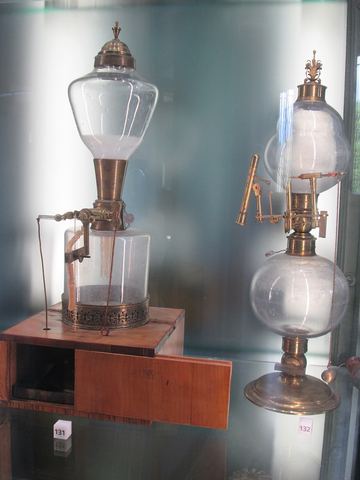
3 The flammable air of the marshes
In 1776 Volta discovers methane in a reed bed on Lake Maggiore. Curious instruments follow: a gauge for how healthy the air is, a pistol that fires nothing but a stopper, and a parlor lamp that doubles as a lighter.
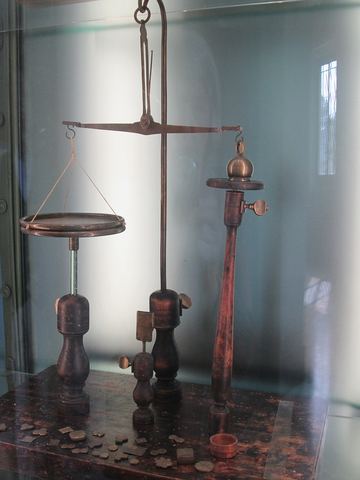
4 Electrophorus, condenser and electric soirées
Before the battery, Volta is already the master of static electricity: he invents the electrophorus, names the condenser and teaches the electroscope to measure. Around him, in the eighteenth century, electricity is a parlor game too.
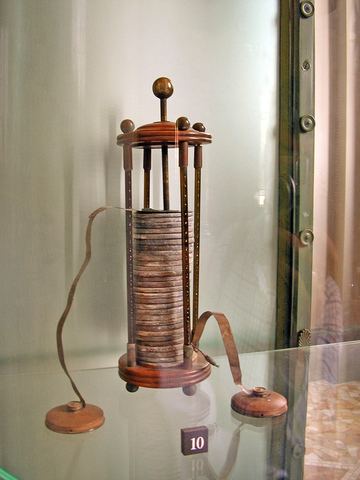
5 The battery and the quarrel with Galvani
The object that made Volta famous across Europe: the first device able to produce a direct current. It was no accident. It came out of a long scientific quarrel with Luigi Galvani, and out of a frog.
6 Volta the man, and the honors
After the machines, the man: an orphan from Como who became a professor, a senator and a count, loaded with medals by Napoleon. Letters, honors and mementos of the celebrations also show how he has been feted for two centuries.
Timeline
- 1745Alessandro Volta is born in Como on February 18.
- 1775Volta invents the perpetual electrophorus, his first instrument. The next year he discovers methane on Lake Maggiore.
- 1800On March 20 Volta announces to the Royal Society in London the invention of the battery, built at the end of 1799.
- 1827Volta dies on March 5. Since 1831 he has rested in the cemetery of Camnago, now Camnago Volta.
- 1899Como marks the battery's centenary with a big exhibition. On July 8 a fire destroys the pavilions and many relics.
- 1925Construction of the Tempio begins, to a design by Federico Frigerio and at the expense of Francesco Somaini.
- 1927Centenary of Volta's death: the international physicists' conference meets in Como, with a dozen Nobel laureates.
- 1928On July 15 the Tempio Voltiano is inaugurated. Somaini donates it to the city.
Who's who
Alessandro Volta
Como physicist, inventor of the battery
Born in Como in 1745, a professor in Pavia, he discovers methane and invents the electrophorus and the battery. Napoleon makes him a senator and a count. The volt is named after him.
Federico Frigerio
architect of the Tempio
Milanese by birth, he works in Como for half a century on banks, hotels and restorations in the Duomo. The Tempio, designed in 1925, is considered his masterpiece. He dies in 1959.
Francesco Somaini
cotton industrialist and patron
From Como, owner of the cotton mill in Lomazzo and a member of parliament. He promotes and pays for the construction of the Tempio, then gives it to the city of Como.
Luigi Galvani
physician from Bologna
He studies the twitching of frogs and argues that an animal electricity exists. Out of the long dispute with him Volta arrives at the battery.
Napoleon Bonaparte
first consul, then emperor of the French
In 1801 in Paris he attends the presentation of the battery and is thrilled by it. He showers Volta with honors: a gold medal, the Legion of Honor, then the titles of senator and count.
Pietro Clerici
sculptor from Como
He made the four high reliefs in stucco with episodes from Volta's life, on the parapet of the loggia overlooking the hall.
Words to know
Where it is
The neighborhood
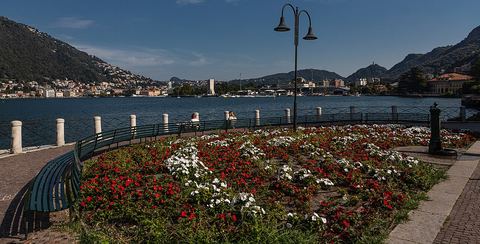
The Lakefront
Related places
The story of the place
The Tempio Voltiano, the Volta Temple, is a museum dressed as a monument, and it was born of a disaster. In 1899 Como celebrates the hundredth birthday of the battery with a big international exhibition on the lake. At its heart are the instruments and relics of Alessandro Volta, the Como physicist who gave his name to the volt.
On July 8 the wooden pavilions catch fire and burn down in less than an hour. The most widely accepted cause is a contact between two electric wires. A show about electricity destroyed by electricity: it is hard to imagine a crueler irony.
A home for the relics
Some of the relics are saved, many are lost. Nearly thirty years later, for the centenary of Volta's death, the city decides to give what remains a safe and solemn home. The money comes from Francesco Somaini, a cotton industrialist, who hands the finished building over to Como as a gift.
The design is by Federico Frigerio, the architect who also gave the city a bank, a theater and a café. Frigerio thinks big: a circular hall under a dome, an open nod to the Pantheon in Rome. Work starts in 1925 and the opening comes on July 15, 1928.
What you find inside
Inside you find a little over two hundred pieces, on two levels. The ground floor has the instruments: gases, electricity, the battery. The upper floor has the man, with letters, honors and portraits.
Not everything is original, and the museum does not hide it. Some instruments are authentic, others were restored using fragments saved from the fire, and others again are reconstructions. That is not a flaw: it is the very story of this place.
Then there is a second way to read it. Building, furnishings, collections and staging form a single whole, so much so that the museum presents itself as a museum within a museum. Look around before you bend over the instruments: the room is part of what is on show.
One last thing. Anyone who remembers the old Italian lira already knows this building, even without ever having been to Como: it was on the back of the ten-thousand-lire banknote. For the people of Como it is simpler. The Tempio is how a city of industrialists said thank you to its most famous son, the one who taught electricity to flow.
Sources
- Tempio Voltiano, opuscolo dei Musei Civici di Como, Comune di Como (opens in a new tab)Official site
- Tempio Voltiano, pannelli del piano superiore in inglese, Comune di Como (opens in a new tab)Official site
- Tempio Voltiano, l'edificio, Oggi a Como, Comune di Como (opens in a new tab)Official site
- Tempio Voltiano, FAI Fondo per l'Ambiente Italiano (opens in a new tab)Institution
- Volta, Alessandro, Enciclopedia Treccani (opens in a new tab)Encyclopedia
- Tempio Voltiano, alessandrovolta.it (opens in a new tab)Institution
- 1899: 100 years since the battery, alessandrovolta.it (opens in a new tab)Institution
- 1927: 100 years since his death, alessandrovolta.it (opens in a new tab)Institution
- Volta's Tomb, alessandrovolta.it (opens in a new tab)Institution
- The column battery, alessandrovolta.it (opens in a new tab)Institution
- Unexpected species diversity in electric eels with a description of the strongest living bioelectricity generator, Nature Communications, 2019 (opens in a new tab)Other source
- Electric Fish and the First Battery, JSTOR Daily (opens in a new tab)Other source
- Donne di Scienza. Teresa Ciceri Castiglioni e Candida Lena Perpenti, guida alla mostra al Tempio Voltiano, Musei Civici di Como, 2023 (opens in a new tab)Official site
- Silvano Montaldo, The Relics of Two 19th-Century Scientists: Carlo Giacomini and Cesare Lombroso, in Savant Relics, 2016, archivio IRIS dell'Università di Torino (opens in a new tab)Institution
- I 1000 volti di Lombroso, cartella stampa, Museo Nazionale del Cinema di Torino, 2019 (opens in a new tab)Institution
- Casa di Alessandro Volta, Lazzate, Lombardia Beni Culturali (opens in a new tab)Catalog
- Como's Famous Daughters: Teresa Ciceri, Agrarian Scientist, Como Companion (opens in a new tab)Other source
- Tempio Voltiano (Q3517634), Wikidata (opens in a new tab)Other source
- Tempio Voltiano (way 30626355), OpenStreetMap (opens in a new tab)Other source
- Tempio Voltiano, Italia.it (opens in a new tab)Institution
- Federico Frigerio: The Face of Como, Como Companion (opens in a new tab)Other source
- Tempio Voltiano, Wikipedia in italiano (opens in a new tab)Wikipedia
- Tempio Voltiano, Wikipedia in inglese (opens in a new tab)Wikipedia
- Federico Frigerio (architetto), Wikipedia (opens in a new tab)Wikipedia
- Esposizione voltiana, Wikipedia (opens in a new tab)Wikipedia
- Como Conference, Wikipedia in inglese (opens in a new tab)Wikipedia
- Alessandro Volta, Wikipedia (opens in a new tab)Wikipedia
- 10 000 lire, Wikipedia (opens in a new tab)Wikipedia
- Life Electric, Wikipedia (opens in a new tab)Wikipedia
- Francesco Somaini (politico), Wikipedia (opens in a new tab)Wikipedia
- Electrophorus voltai, Wikipedia in inglese (opens in a new tab)Wikipedia