Monument · The Lakefront · 1930–1933
Monumento ai Caduti
A Futurist tower on the lake, drawn by an architect killed in the war at twenty-eight
In brief
A stone tower about 30 meters (100 feet) tall on the lakeshore, inaugurated in 1933 for the 650 men of Como who died in the First World War. Its shape comes from a drawing by Antonio Sant'Elia, a Futurist architect killed in 1916. The Terragni brothers were the ones who built it.
Stories of this place
- Anecdote · The Tower from the GardensReadThirty Meters from a Small SketchThe tower of the Monumento ai Caduti, Como's war memorial, comes from a sketch, not from a design. Antonio Sant'Elia, a Futurist architect from Como, drew it before the First World War, in colored pencil with a little watercolor: a silhouette against the sky, with no floor plans and no interiors. Today the sheet belongs to Como's civic collections, at the Pinacoteca, the city art gallery. Out of it came a tower of reinforced concrete clad in stone, about thirty meters tall. And its author, killed at the front in 1916, fourteen years before construction began, had no say on even a single detail.
- Anecdote · The Stones of the CarsoReadThe Blue Colonnade You Will Not SeeComo's war memorial tower, the Monumento ai Caduti, comes from a drawing by Antonio Sant'Elia, a Futurist architect killed in the war in 1916. The first to work on it was Enrico Prampolini, a Futurist painter and set designer. He planned to crown the tower with a blue colonnade three meters high. Como's podestà, the city's head in the Fascist years, rejected it. Prampolini, unable to follow the building site, stayed as artistic consultant, and the job passed to the Terragni brothers: Attilio, an engineer, and Giuseppe, an architect, who removed every decoration. Look at the bare top today and picture a row of blue columns: a different monument.
- Anecdote · The Stones of the CarsoReadThe Memorial Terragni Never BuiltGiuseppe Terragni, the Rationalist architect who completed the tower of the Monumento ai Caduti, Como's war memorial, twice tried to give the city his own memorial. In the mid-1920s he and architect Pietro Lingeri entered the competition with a design for the center, next to the tower of the Broletto, the medieval town hall: it won a prize but stayed unbuilt. Later, for the lakeshore, he proposed two large vertical slabs, pierced and parallel, with the space of remembrance between. That stayed on paper too. In the end he built the memorial, but from someone else's drawing: that of the Futurist architect Antonio Sant'Elia, killed in the war in 1916.
- Legend · Sant'Elia's WordsReadThe Carved Words: Trieste or ParadiseCarved on the lake side of Como's war memorial, the Monumento ai Caduti, are words attributed to Antonio Sant'Elia, the Futurist architect who drew the tower. According to tradition, on October 10, 1916, on the Carso plateau, he stepped into the open at the head of his soldiers, shouting: "Boys, tonight we sleep in Trieste or in paradise with the heroes!" Moments later a machine gun hit him in the forehead. The scene was handed down by Filippo Tommaso Marinetti, the founder of Futurism, in a 1930 text. He says he draws on his own memories and on letters from fellow soldiers, but some believe he rewrote the phrase himself.
- Anecdote · Sant'Elia's WordsReadBuried in the Cemetery He Had DesignedAntonio Sant'Elia, the Futurist architect who drew the tower of the Monumento ai Caduti, Como's war memorial, got an architect's job at the front in the First World War: designing the cemetery for the fallen of his brigade, the Arezzo. When he was killed, in October 1916, they buried him right there, among the graves he had drawn. Como held the solemn funeral a month later, and the Socialist group's leader commemorated him in the city council. Only in 1921 did his remains return to the city's main cemetery, the Cimitero Maggiore. Twelve years later, on the lake, he would get a monument far bigger than any tomb.
- Anecdote · Sant'Elia's WordsReadThe Futurists Who Went to War on Two WheelsCarved on the lake-facing side of the Monumento ai Caduti, Como's war memorial, are words attributed to Antonio Sant'Elia, the Futurist architect who drew the tower and was killed in 1916. When war broke out he joined a unit with a surprising name: the Battaglione lombardo volontari ciclisti, the Lombard volunteer cyclists. Half of Futurism was with him: Filippo Tommaso Marinetti, the poet who founded the movement, and the painters Umberto Boccioni, Luigi Russolo and Mario Sironi. In October 1915 they fought in the mountains, at Dosso Casina. A few weeks later the battalion was disbanded. The movement that glorified engines and speed began the war in a cyclist unit.
- Anecdote · The Shrine and the MonolithReadTwo Friends, a Tower and a StadiumAmong the names carved inside the Monumento ai Caduti, Como's war memorial, is Giuseppe Sinigaglia, the giant of Como rowing. The Canottieri Lario, his rowing club, remembers him as one of the best friends of Antonio Sant'Elia, the Futurist architect who drew the tower: as boys they went to the same gym, the Ginnastica Comense. On July 4, 1914, Sinigaglia won a regatta at Henley, in England, that then counted as a world title. Then both volunteered. They fell in 1916, on the Carso plateau, two months apart. Today the stadium next door bears the rower's name, and the tower has the shape the architect drew.
- Anecdote · The Lakefront from Temple to StadiumReadThe Stones of Another WarIn Como the Monumento ai Caduti, the war memorial tower, is clad in stone from the Carso, a battlefield plateau of the First World War. Nearby, in the lakeside gardens, a second monument holds more stones from afar. It is the Monumento alla Resistenza europea, a memorial to the European Resistance by Milanese artist Gianni Colombo, inaugurated in 1983 by Sandro Pertini, then Italy's president. Three stairways rise toward large plates bearing the words of Resistance members condemned to death. An urn holds stones from the Nazi extermination camps and from Hiroshima. Fifty years after the tower, Como remembered another war with stones from the places where it was fought.
- In cultureReadFrom Como to Metropolis and Blade RunnerAntonio Sant'Elia, the Futurist architect whose drawing gave rise to the tower of the Monumento ai Caduti, Como's war memorial, built almost nothing, and yet you have already seen his cities at the movies. The drawings of the Città Nuova, his New City, with their soaring towers, streets on several levels and suspended walkways, are considered a reference for the sets of Metropolis, Fritz Lang's film of 1927. The same atmosphere returns, darker, in Ridley Scott's Blade Runner, from 1982. The tower on the lake is one of the very rare cases in which one of his drawings became real stone, and you can walk around it.
- RecordReadOne House Against a City on PaperAntonio Sant'Elia, the Futurist architect whose drawing gave rise to the tower of the Monumento ai Caduti, Como's war memorial, built, in practice, just one house. It is Villa Elisi, a small villa built around 1912 at San Maurizio di Brunate, on the hill above Como. No towers and no suspended walkways: a small, well-proportioned house, made in collaboration with the sculptor Girolamo Fontana. Almost everything else stayed on paper. The Pinacoteca Civica, the city's art gallery, holds more than one hundred and seventy of his drawings. One house against a whole city on paper. And yet it is the drawings that changed architecture.
Ready-made questions
No one on his own. The shape comes from a drawing by Antonio Sant'Elia, a architect who died in 1916. The painter Enrico Prampolini turned it into a first design in 1930. Giuseppe Terragni, called in with construction under way, removed the decoration, chose the materials and designed the and interior, while his brother Attilio, an engineer, directed the works. That is why you find the memorial attributed now to Sant'Elia, now to the Terragni brothers. Everyone is right: the idea belongs to the first, the building to the others.
Because the shape was not born for a memorial. Sant'Elia drew the city of the future: stations, power plants, very tall apartment blocks. The sheet chosen as the model is known as the Torre faro, the Lighthouse Tower, for the lantern on its top, but some scholars consider it a study for a power station. The critic Edoardo Persico objected to the idea of making a war memorial out of it. Marinetti thought the opposite: for him there was nothing in the world more beautiful than a great power station.
Go to stop: The Tower from the GardensFrom the , the plateau behind Trieste where the Italian army fought for much of the First World War. The tower has a structure of reinforced concrete, but it is entirely clad in stone from Aurisina and Reppen. The choice is spelled out in the inscription on the side facing the city: Como exalts its sons with the stones of the Carso. In practice, the memorial is made of rock from the battlefield, carried all the way to the lake.
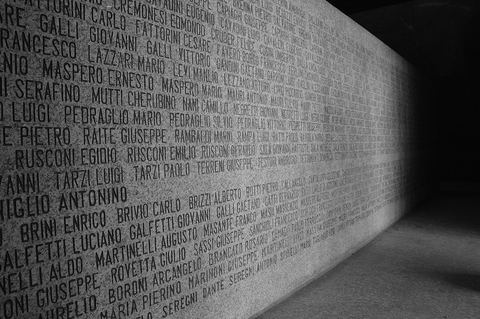
Go to stop: The Stones of the CarsoA designed by Giuseppe Terragni. On top of the is a granite , clad in diorite, that weighs about forty tons and is carved with the names of the 650 men of Como who fell in the First World War. A circular staircase goes down to the , where there is an altar. The crypt and ossuary were enlarged in 1968. The interior is not always accessible, but it is worth knowing: what looks like a solid sculpture from outside is actually a building, with rooms, stairs and an elevator.
Go to stop: The Shrine and the MonolithWe will never know for sure. The phrase about Trieste and paradise is reported by Marinetti, the founder of and his comrade in arms, in a text written in 1930 for the exhibition Como devoted to the architect. Marinetti cites his own memories and the letters that arrived from the front after his friend's death. But he was also a master of the slogan, and some think those words are more his than Sant'Elia's. It is best to read them as a tradition, not as a documented quotation.
Go to stop: Sant'Elia's WordsIt was not the first choice. In the 1920s people had the city center in mind: Terragni and Lingeri's competition design, for example, was attached to the tower next to the Broletto, the medieval town hall. Then the lakefront option gained strength, and it was the one that won. With hindsight it is the right spot. A tower like this needs empty space around it, and here it has the gardens on one side and the water on the other. You can see it from far away, even when arriving in the city from the lake.
Go to stop: The Lakefront from Temple to StadiumIt was born in the years of the regime and bears its mark: the decisions went through the , and the inauguration came on November 4, 1933, with the regime in full swing. But it remembers the dead of a war that ended before Fascism, and its shape comes from a drawing made before that war, by an architect who had been elected to Como's city council with the Socialists. And Terragni removed precisely the most rhetorical decorations. It is a more complicated object than a label.
The stops
1 The Tower from the Gardens
A war memorial without a single statue: a stone tower with two big empty windows. Its shape comes from a small drawing by Antonio Sant'Elia, a Futurist architect from Como who died in the war in 1916.
2 The Stones of the Carso
The tower is reinforced concrete, but everything you see is stone brought from the Carso, the plateau where the First World War was fought. The inscription says so. The final materials and forms were decided by Giuseppe Terragni.
3 Sant'Elia's Words
Facing the lake, the tower carries the words attributed to Antonio Sant'Elia before the assault in which he was killed, at twenty-eight. The memorial honors all of Como's fallen, but this side is his.
4 The Shrine and the Monolith
Inside the tower is a block of granite weighing about forty tons, bearing the names of the 650 men of Como who died in the First World War. The interior is the most personal part of Giuseppe Terragni's work.
5 The Lakefront from Temple to Stadium
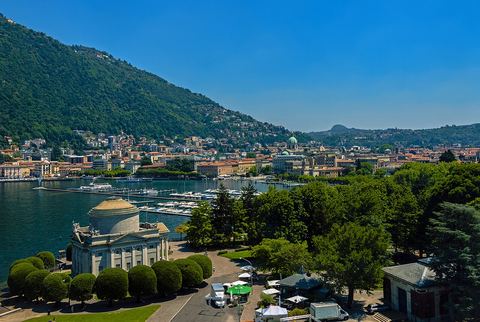
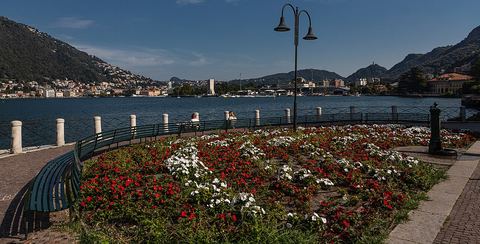
In a few hundred meters the lakefront lines up a neoclassical temple, a Futurist tower and one of Italy's first modern buildings, all built within six years. It is the right place to see how divided the architecture of the time was.
Timeline
- 1914In Milan, Sant'Elia exhibits his drawings of the Città Nuova, the New City, and publishes the Manifesto of Futurist Architecture.
- 1916On October 10 Sant'Elia is killed in action on the Carso, near Monfalcone. He is twenty-eight.
- 1918With the war barely over, Como starts talking about a memorial for the city's fallen.
- 1925–1926Two-stage competition for the memorial. The architects Asnago and Vender win, but the authorities reject the design.
- 1930Como devotes an exhibition to Sant'Elia. Marinetti proposes the Torre faro as the model for the memorial. Construction begins on October 28.
- 1933On November 4 the tower is inaugurated, brought to completion by Giuseppe Terragni.
- 1943Giuseppe Terragni dies in Como at thirty-nine, a few months after returning from the Russian front.
- 1968The crypt and ossuary are enlarged to a design by the architect Emilio Terragni.
Who's who
Antonio Sant'Elia
Futurist architect, author of the drawing
Born in Como in 1888, he imagined the Città Nuova but built very little. He died at the front in 1916. The shape of the memorial comes from one of his drawings, the Torre faro.
Filippo Tommaso Marinetti
poet, founder of Futurism
Sant'Elia's comrade in arms. In 1930 he proposed building the memorial from his drawing, and he handed down his supposed last words.
Enrico Prampolini
Futurist painter and set designer
He was first given the job of turning the drawing into a design. His blue colonnade was rejected by the podestà and the building site passed to the Terragni brothers.
Giuseppe Terragni
Rationalist architect
Born in 1904, died in 1943. Called in mid-construction, he removed the decoration, chose the materials and designed the interior. In Como he also designed the Novocomum and the Casa del Fascio.
Attilio Terragni
engineer, director of works
Giuseppe's brother, with whom he shared a practice in Como. He ran the tower's building site. From 1934 he was the city's podestà.
Edoardo Persico
critic
He objected to the choice of turning into a war memorial a drawing that, for him, was the design for a power station.
Words to know
Where it is
The neighborhood
The Lakefront
Related places
The story of the place
From a distance it looks like a machine. A broad , stone piers rising straight up, two big empty windows with the sky passing through them. No statues, no angels, no bronze soldiers. And yet this is the Monumento ai Caduti, the war memorial where Como remembers its dead of the First World War.
The first failed attempts
The story begins with a string of failed attempts. There was talk of a memorial as early as 1918, when the war had barely ended.
In the mid-1920s the city held a competition. The architects Asnago and Vender won it, but the authorities turned their design down. Meanwhile another idea was gaining ground: to build not in the center, but on the lakeshore.
The drawing by Sant'Elia
In 1930 Como devoted an exhibition to Antonio Sant'Elia, a architect born here and killed at the front in 1916, at twenty-eight. Among the drawings on show was a small one in colored pencil: a tower with a kind of lantern on top, which came to be called the Torre faro, the Lighthouse Tower. Filippo Tommaso Marinetti, the poet who had founded Futurism, picked it as the model for the memorial. It was a powerful idea: the city's most illustrious fallen soldier would give shape to the memory of all the others.
From paper to stone
Getting from paper to stone was more complicated. The job first went to the painter Enrico Prampolini, with the engineer Attilio Terragni running the building site. But the technical drawings were not enough, and with work already under way Attilio's brother was called in: Giuseppe Terragni, the architect who in those same years would begin the Casa del Fascio, the Fascist party headquarters in Como. Giuseppe stripped away the decoration, cleaned up the forms, chose the materials and designed the interior. The memorial was inaugurated on November 4, 1933, the anniversary of the victory.
That is why three hands and two generations live side by side here: Sant'Elia's imagination, Prampolini's passing contribution, Terragni's rigor. The result was controversial from day one. The critic Edoardo Persico did not like at all the idea of remembering the dead with a form designed for something else entirely. Judge for yourself: that very strangeness is what sets the tower apart from every other war memorial you have seen.
The visit is short. You walk around the tower, read the two inscriptions, one facing the city and one facing the lake, and if you find it open you step into the . Then you widen your gaze to the lakefront, which in a few hundred meters lines up a neoclassical temple and some of the first modern buildings in Italy.
Sources
- Monumento ai Caduti, Como, scheda CO180-00009, Lombardia Beni Culturali (opens in a new tab)Catalog
- Torre faro, disegno di Antonio Sant'Elia, scheda 1m030-00123, Lombardia Beni Culturali (opens in a new tab)Catalog
- Sant'Elia, Antonio, Dizionario Biografico degli Italiani, Treccani (opens in a new tab)Encyclopedia
- Silvia Colombo, Monumento ai Caduti, Como 1930-1933, Dialectics of Modernity, University of Manchester (opens in a new tab)Institution
- La collezione Sant'Elia, Pinacoteca Civica di Como, Google Arts & Culture (opens in a new tab)Institution
- Monumento ai Caduti, Italia.it, portale nazionale del turismo (opens in a new tab)Institution
- Giuseppe Terragni, elenco delle opere, MAARC Museo virtuale astrattismo e architettura razionalista Como (opens in a new tab)Institution
- Monumento ai Caduti di Erba, scheda 3m080-00037, Lombardia Beni Culturali (opens in a new tab)Catalog
- F. T. Marinetti, Sant'Elia and Global Futurist Architecture, testo del 1930 tradotto, Drawing Matter (opens in a new tab)Other source
- Gianni Biondillo, Como. Looking for Giuseppe Terragni, Doppiozero (opens in a new tab)Other source
- Como's Rationalist Architecture 1: Around the Stadium, Como Companion (opens in a new tab)Other source
- Como's Internationally Renowned Urban Visionary, Como Companion (opens in a new tab)Other source
- Il Monumento ai Caduti di Como, macchie e segni di degrado, EspansioneTV (opens in a new tab)Other source
- Monumento ai caduti (Como), Wikipedia in italiano (opens in a new tab)Wikipedia
- Antonio Sant'Elia, Wikipedia in italiano (opens in a new tab)Wikipedia
- Antonio Sant'Elia, Wikipedia in inglese (opens in a new tab)Wikipedia
- Giuseppe Terragni, Wikipedia in italiano (opens in a new tab)Wikipedia
- Tempio Voltiano, Wikipedia in italiano (opens in a new tab)Wikipedia
- Stadio Giuseppe Sinigaglia, Wikipedia in italiano (opens in a new tab)Wikipedia
- Novocomum, Wikipedia in italiano (opens in a new tab)Wikipedia
- Terragni, Giuseppe, Dizionario Biografico degli Italiani, Treccani (opens in a new tab)Encyclopedia
- Monumento ai Caduti delle Guerre, way 30626360, OpenStreetMap (opens in a new tab)Other source
- Gli Eroi della Lario, brochure storica della Canottieri Lario «Giuseppe Sinigaglia», Federazione Italiana Canottaggio (opens in a new tab)Institution
- Marinetti, Filippo Tommaso, Dizionario Biografico degli Italiani, Treccani (opens in a new tab)Encyclopedia
- Programma del convegno Europa, Milano e Como 26-27 ottobre 2012, con scheda del Monumento alla Resistenza europea, ANPI Lombardia (opens in a new tab)Institution
- Gianni Colombo: discovering contemporary art in Como, Italics (opens in a new tab)Other source
- Sina, il re dell'acqua ucciso nel fango della guerra, Avvenire (opens in a new tab)Other source
- Guiseppe Sinigaglia, the Italian Giant, Hear The Boat Sing (opens in a new tab)Other source
- Giuseppe Sinigaglia, Wikipedia in italiano (opens in a new tab)Wikipedia
- Battaglione Lombardo Volontari Ciclisti Automobilisti, Wikipedia in italiano (opens in a new tab)Wikipedia
- Monumento alla Resistenza europea, Wikipedia in italiano (opens in a new tab)Wikipedia
- Sant'Elia, Antonio, Enciclopedia on line, Treccani (opens in a new tab)Encyclopedia
- Sironi, Mario, Dizionario Biografico degli Italiani, Treccani (opens in a new tab)Encyclopedia
- Antonio Sant'Elia, convenzione tra i Musei civici di Como e l'Accademia di Brera, EspansioneTV (opens in a new tab)Other source
- Como's Olympic Rowers: Past and Present, Como Companion (opens in a new tab)Other source