Stop 5 of 5
The Lakefront from Temple to Stadium
Where to stand
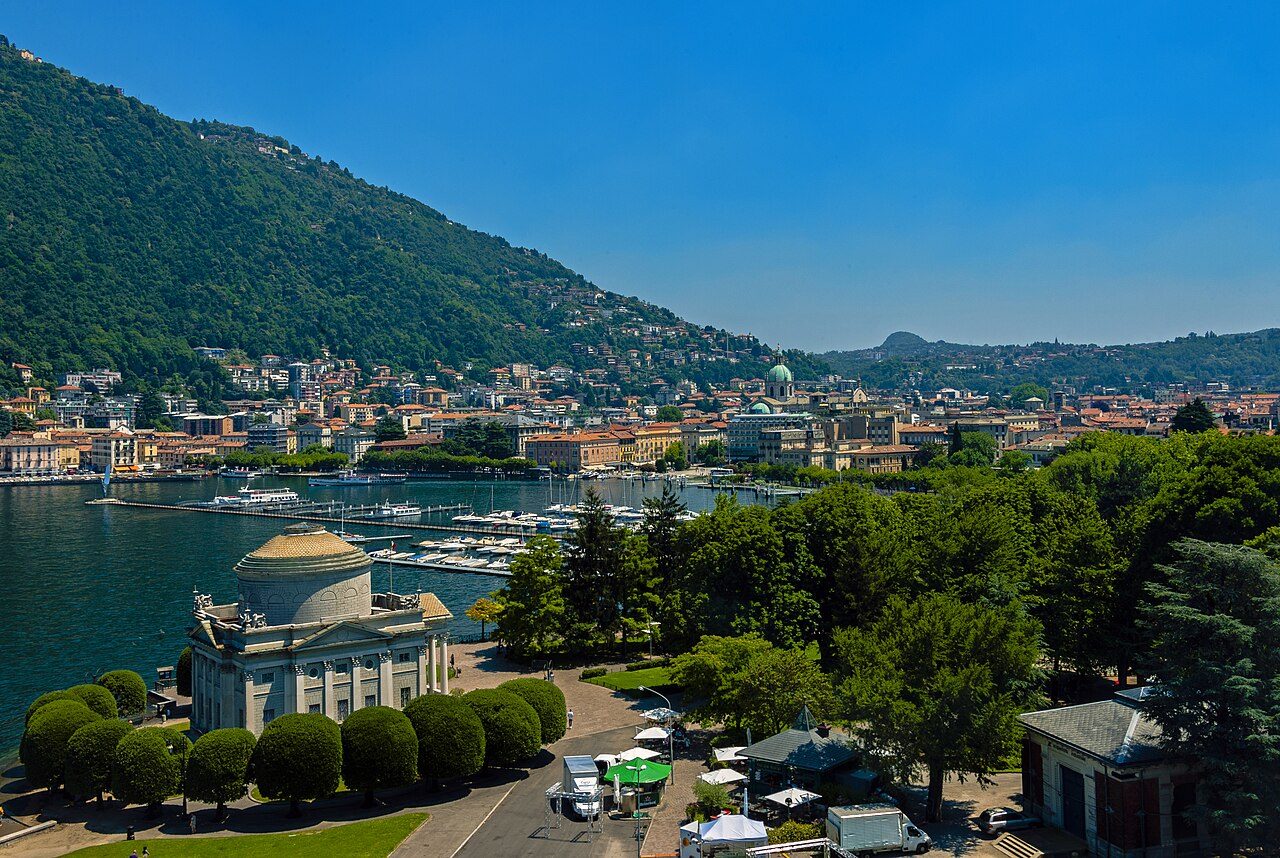
On the lakeshore, near the tower: look first toward the Tempio Voltiano, then over toward the stadium
In a few hundred meters the lakefront lines up a neoclassical temple, a tower and one of Italy's first modern buildings, all built within six years. It is the right place to see how divided the architecture of the time was.
Spot the detail
Compare the Tempio Voltiano and the tower: which of the two looks older to you?
The full story
You have walked all the way around the tower. Now widen your gaze, because this stretch of shore is an open-air architecture lesson, and you can learn it in five minutes.
The Tempio Voltiano
On one side, in the gardens, stands the Tempio Voltiano, the Volta Temple. It is dedicated to Alessandro Volta, the Como scientist who invented the battery.
A cotton industrialist, Francesco Somaini, wanted it and paid for it, and the architect Federico Frigerio designed it with an eye on the Pantheon in Rome. It opened in 1928. It is serene, elegant, and looks as if it came from a century earlier.
Toward the stadium, the Novocomum
On the other side, toward the stadium, the tune changes. The stadium itself is named after Giuseppe Sinigaglia, a rowing champion from Como who died in the First World War, in the same year as Antonio Sant'Elia. Nearby is the home of the Canottieri Lario, the local rowing club, from the early 1930s.
And not far off stands the Novocomum, the apartment building with which Giuseppe Terragni, barely into his twenties, caused a scandal. He had submitted a traditional design to the city and then built a different one: smooth, without ornament, with rounded corners. Because of its profile the people of Como call it the Transatlantico, the ocean liner, and at the time some demanded that it be demolished. Today it is considered one of the first built manifestos of Italian .
In the middle, the tower
In the middle, the tower. It is not classical like the temple, and it is not modern like the Novocomum. It is the dream of Sant'Elia, a Como architect who died in the war, built some fifteen years later by Terragni himself.
The writer and architect Gianni Biondillo has seen in it the point where two generations of young talents from the lake are held together. It is a good image.
Sant'Elia was twenty-eight when he died. Terragni was not yet thirty when he finished the tower. Modern architecture, in Como, was a young man's business.
Think what it meant to stroll here in 1933. In six years a stadium had sprung up, along with an old-style temple, a building that looked like a ship and a tower that looked like a power station. Italy was arguing over which face to give itself, ancient or modern, and Como had put all the answers on the same shore.
Before you go, look at the tower one last time. It is made to be seen from a distance, even from the water, by people arriving in the city by boat. From there the two empty windows look like eyes open on the lake.
About this stop
Anecdote
The Stones of Another War
In Como the Monumento ai Caduti, the war memorial tower, is clad in stone from the , a battlefield plateau of the First World War. Nearby, in the lakeside gardens, a second monument holds more stones from afar. It is the Monumento alla Resistenza europea, a memorial to the European Resistance by Milanese artist Gianni Colombo, inaugurated in 1983 by Sandro Pertini, then Italy's president. Three stairways rise toward large plates bearing the words of Resistance members condemned to death. An urn holds stones from the Nazi extermination camps and from Hiroshima. Fifty years after the tower, Como remembered another war with stones from the places where it was fought.
It was not the first choice. In the 1920s people had the city center in mind: Terragni and Lingeri's competition design, for example, was attached to the tower next to the Broletto, the medieval town hall. Then the lakefront option gained strength, and it was the one that won. With hindsight it is the right spot. A tower like this needs empty space around it, and here it has the gardens on one side and the water on the other. You can see it from far away, even when arriving in the city from the lake.