Stop 5 of 6Must-see
The battery and the quarrel with Galvani
Where to stand
On the ground floor, in front of the last display cases on the route, the ones on the quarrel with Galvani and the battery
The object that made Volta famous across Europe: the first device able to produce a . It was no accident. It came out of a long scientific quarrel with Luigi Galvani, and out of a frog.
Spot the detail
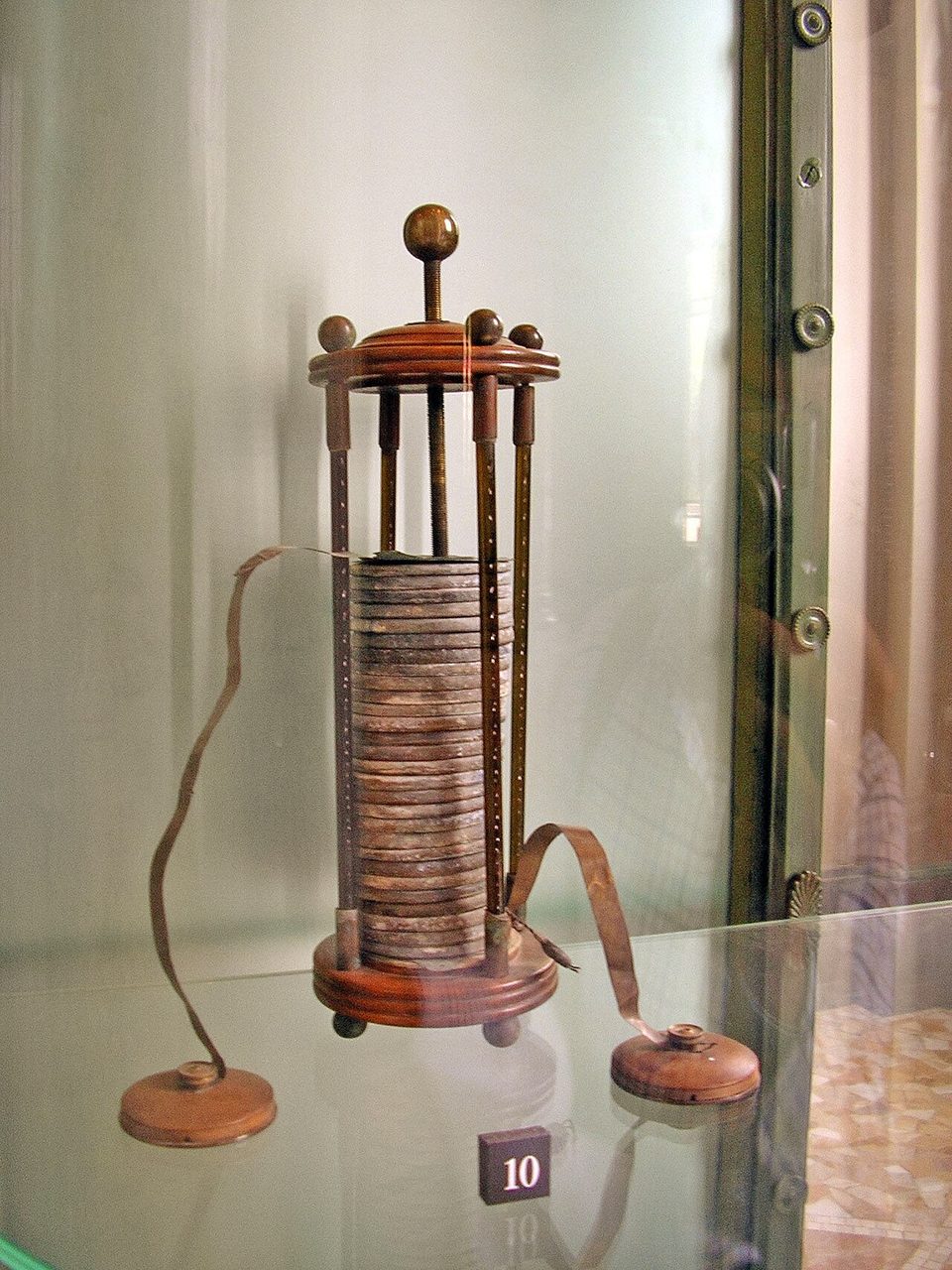
Find the column battery: what sits between one pair of metal disks and the next?
The full story
If the whole museum revolves around one object, this is it: the voltaic pile, the first battery. And the first thing to know is that it was no stroke of luck. It was born of a quarrel.
The quarrel with Galvani
Luigi Galvani, a physician from Bologna, had seen a frog's muscles twitch at the touch of a metal arc, and concluded that animals have an electricity of their own. Alessandro Volta, a physicist from Como and at the time a professor in Pavia, did not believe it. For him the frog was only a detector: the electricity came from the contact between two different metals.
The dispute split scholars for years, with Volta's followers in Pavia on one side and Galvani's in Bologna on the other. To settle it, Volta had to produce electricity with no animal involved at all.
He manages it at the end of 1799. Look at how it is made: disks of copper or silver stacked on disks of zinc or tin, and between one pair and the next a disk of wet cardboard. Nothing else. It is a pile in the most literal sense of the word, a column of stacked disks.
From London to Paris
On March 20, 1800, Volta announces the invention in a letter to Joseph Banks, president of the Royal Society in London. Before long the battery is in laboratories all over Europe and he is a celebrity. The following year he presents it in Paris, at the Academy of Sciences, and sitting in the room is Napoleon Bonaparte, who is thrilled and showers him with honors. The scene became a painting, by Giuseppe Bertini.
The first battery, however, did not deliver much. So it was modified at once: in the very first years of the nineteenth century the column was joined by the crown of cups and by trough batteries, built as rows of small basins.
Why does it matter so much? Before the battery, electricity could only be stored up and discharged in a flash. With the battery it becomes a flow that lasts and can be controlled: a .
Albert Einstein called it the fundamental basis of all later inventions. The volt, the unit used to measure voltage, carries Volta's name. And the battery in the phone you are holding is a distant granddaughter of this column of disks.
If you have time for only one display case, this is it.
About this stop
Anecdote
Einstein, the Great Absentee
Next to the battery of Alessandro Volta, the Como physicist who invented it, the Tempio Voltiano entrusts Albert Einstein with the most quoted verdict: the battery as the fundamental basis of all later inventions. And yet Einstein never came to Como. In 1927, for the centenary of Volta's death, the city hosted a conference with nearly all the big names in physics. The most famous was missing: Einstein stayed away out of opposition to the regime of Mussolini, whose government had wanted those celebrations. He was not the only one with doubts: the German physicist James Franck would have liked to cancel for political reasons.
Record
An 860-Volt Eel
The Tempio Voltiano displays the battery, the most famous invention of the Como physicist Alessandro Volta. In 1800 he presented it under a name that sounds odd today: artificial electric organ. He compared it to the organ of the torpedo ray, a fish that delivers its shock thanks to hundreds of thin columns. The battery does the same with metal disks and wet cardboard. Two centuries later, zoologists returned the favor. In 2019 they described two new species of electric eel from the Amazon region and named one voltai, in honor of Volta. Its discharge reaches 860 volts: it is the most powerful living generator of electricity known.
It all starts there. The Bologna physician Luigi Galvani had observed that a frog's muscles twitched on contact with metals, and he spoke of animal electricity. Volta argued that the electricity came not from the frog but from the two different metals touching it. To prove it he got rid of the animal and put wet cardboard between metal disks in its place. It worked: that was the battery.
Next stop
Go up to the upper floor, to the gallery that tells the story of Volta's life