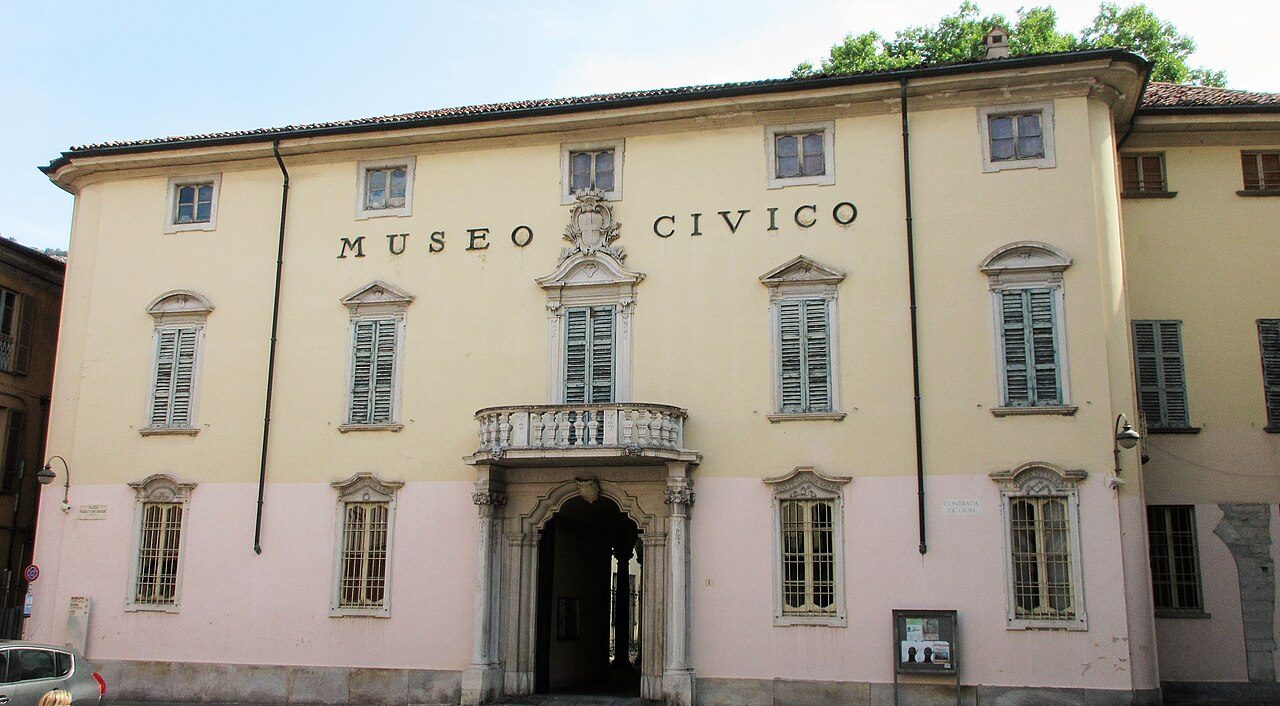
Museum · The Walled City · 1897
Museo Archeologico Paolo Giovio
A woman buried with her wagon, a mummy and Como's first people, all in a count's home
In brief
The museum where Como tells its first three thousand years: the Celts of the Golasecca culture, the Roman city of Pliny the Younger and, as a bonus, an Egyptian mummy and a hundred Greek vases. All of it inside the frescoed rooms of the palazzo of the Giovio counts.
Stories of this place
- In culture · The palazzo and the courtyardReadFoscolo and Count Giovio's daughterPalazzo Giovio, now the museum, was the home of Count Giovan Battista Giovio, the man of letters who gave it today's look in the 1700s. The poet Ugo Foscolo wrote to him for years and was a regular at the family's villas. He fell in love with one of the daughters, Francesca. The count and countess would not hear of it: too great a gap in rank, and the poet's religious and political ideas hardly helped. In 1810 Francesca married Colonel Vittore Vautré. Foscolo did not break with the family: the count's eldest son, Benedetto, inspired a character in his tragedy Ricciarda. Benedetto died in 1812, during the Russian campaign.
- Record · The palazzo and the courtyardReadA thousand gold coins under a theaterIn 2018, in Como, during a dig under the former Cressoni theater, in Via Diaz, a soapstone vessel full of Roman gold coins turned up. There were a thousand solidi, about four and a half grams each, bearing the names of eight emperors. The latest date from between 472 and 474 AD, on the eve of the end of the Western Empire. With the coins were three earrings, three rings and a piece of a gold bar. To display the treasure, the city has set aside the former Orfanelle church, which Count Giovan Battista Giovio joined in the 1700s to his palazzo, now home to the archaeological museum.
- Record · The Ca' Morta wagonReadA wagon in eighty centimetersThe museum's signature piece is a parade wagon 2,500 years old, buried in pieces with the ashes of a woman of the highest rank in the Ca' Morta burial ground, in Como. Her tomb is a paradox of measurements. The slab that sealed it was almost two meters long and weighed about 1.8 metric tons. The pit underneath was a square eighty centimeters on each side and seventy deep. Inside were the parts of the four-wheeled wagon, the bronze urn with the ashes, Etruscan vessels, jewelry and even a helmet, the only weapon among the grave goods. Radiocarbon analysis dates the burial to around 450 BC.
- Anecdote · The priestess IsiuretReadA mummy in the CT scannerIn the museum's Egyptian room lies the mummy of Isiuret, a priestess from Thebes who lived almost three thousand years ago, still sealed in her painted case. In 1990 she was given a CT scan: at the time it was presented as the first ever performed on a mummy in Italy. There was no need to unwrap her, and yet from that scan we know she died between the ages of 18 and 30. Almost twenty years later she left the museum for a year of restoration and analysis in a laboratory in Piedmont. The linen band wrapped around her is seven meters long. She came home in February 2010.
- In cultureReadThe villa that gave museums their nameThe museum is named after Paolo Giovio, a physician, historian and bishop from Como, and occupies his family's town house. Between 1537 and 1543 Giovio built a villa on the lake at Borgovico and called it the Museo: sacred to the Muses, painted in the main hall. Inside he gathered some four hundred portraits of rulers, commanders, poets and philosophers, each with a short biography. The word already existed, but he gave it today's meaning. The villa was torn down in the 1600s, but Cosimo I de' Medici had the portraits copied: the copies are still in the Uffizi. Some forty originals are in the Pinacoteca Civica, Como's picture gallery.
- AnecdoteReadThree Assyrian guards on loanAmong the museum's Near Eastern pieces is a fragment of a limestone relief with three officers of the royal guard. It was part of a large slab from the North Palace of Ashurbanipal at Nineveh, in Mesopotamia, and it has been in Como since 1905. In 2019 the Museo Archeologico Nazionale in Naples, the national archaeological museum, asked for it for an exhibition on the Assyrians, where it was shown alongside pieces from the British Museum and the Vatican Museums. Fine company for a city museum.
Ready-made questions
A man from Como who became one of the best-informed people of his time. Born in Como in the 1480s, he worked as a physician, then as a historian at the court of the popes, and became bishop of Nocera. He wrote a great history of his own times and collected portraits of famous men in the villa he called the Museo. He was the one who pushed Giorgio Vasari to write the Lives of the Artists. He died in Florence in 1552. What this museum has of his is mostly the name: the palazzo was his family's house in town.
No. The city museum was born in the mid-1800s inside the classical high school, and within a few decades the collections had outgrown it. In 1894 the city council decided to move them to Palazzo Giovio, and in 1897 it opened the new home. At first there was a bit of everything here, collections that had little to do with one another. Then they were split up: in 1932 the history museum was created, and in 1989 the Pinacoteca Civica, the city picture gallery, opened.
Go to stop: The palazzo and the courtyardYes, and for quite a while. On the hills southwest of the present city there was a settlement of the Golasecca culture, which lasted from the eleventh to the fourth century BC. In the fifth century it was at its height: it served as a go-between for the Etruscans and the peoples north of the Alps, and Greek pottery reached its houses. The Roman city came later, and since then Como has grown without a break on the same layout. The museum tells the story of the two cities one after the other.
Go to stop: Como's first peopleIn part. The bronze and iron pieces are the ones that came out of the tomb in 1928: the wagon was found taken apart, and only one wheel had survived whole. The assembly you see is a reconstruction, carried out after the discovery by Luigi Perrone, then director of the museum: the other three wheels were restored. Take it as a well-made hypothesis: the metals are ancient, the overall shape is a proposal.
Go to stop: The Ca' Morta wagon, a Celtic language that has since died out. We know it from a handful of inscriptions, and the most important is the Prestino stele, on display in this museum. It is written in an alphabet borrowed from the Etruscans, the neighbors the people of Como traded with back then. It dates to the fifth century BC: that means a Celtic language was already being written in Italy before the Gauls came down. Latin arrived centuries later, with the Romans.
Go to stop: The Prestino steleBecause of one collector's passion. In the 1800s anyone who could afford it bought antiquities from every country: it was a way of studying the world, and also of getting noticed. Alfonso Garovaglio, a collector from Como, gathered Egyptian and Near Eastern antiquities: most of the museum's thousand or so Egyptian objects come from his bequest. Isiuret's coffin had been given in 1819 by the governor of Egypt to a certain Baldassarre Valerio, and later ended up in his collection. Then the collection was bequeathed to the city museum, where it remains.
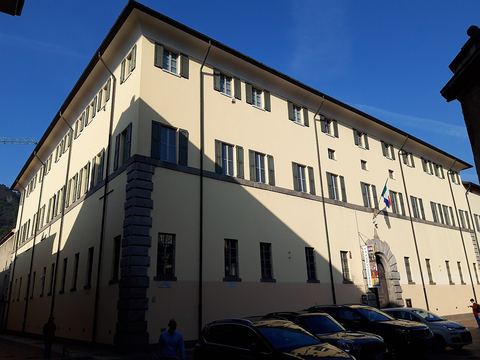
Go to stop: The priestess IsiuretThey are next-door neighbors. The Museo Storico Giuseppe Garibaldi, the city's history museum, founded in 1932, is in Palazzo Olginati, the building next door. The two buildings are joined by a raised passageway that spans Via Balestra, and Palazzo Olginati also houses the Roman section of the archaeological museum. The subjects do not overlap, though: on this side antiquity, from prehistory to the Romans, on that side a history museum that covers a completely different era. It makes sense to treat them as two separate visits.
The stops
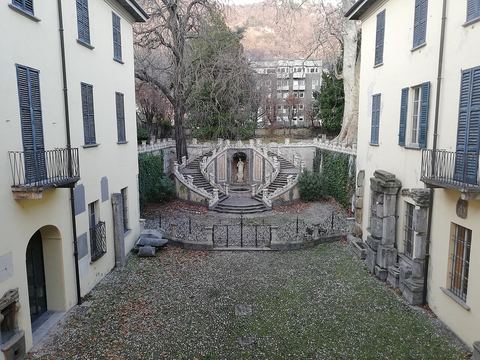
1 The palazzo and the courtyard
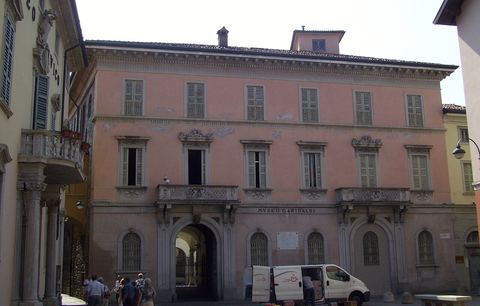
The town house of the Giovio counts, remodeled in the 1700s. From the doorway your eye crosses the courtyard and lands on a double staircase with a mock grotto. Behind it is the earth bank of the old city walls, turned into a garden.
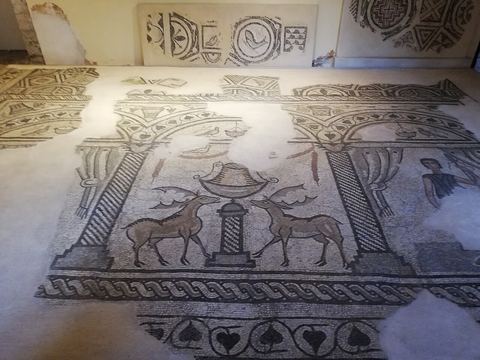
2 The inscribed stones
Coats of arms, plaques and inscriptions gathered from all over Como. The medieval and later ones are under the portico and on the grand staircase, the Roman ones in the rooms. In their midst is a large mosaic with two deer.
3 Como's first people
Before the Romans, the hills around Como were home to a Celtic-speaking people who traded with Etruscans and Greeks. We know them mostly from their tombs: dozens of them, one display case after another.
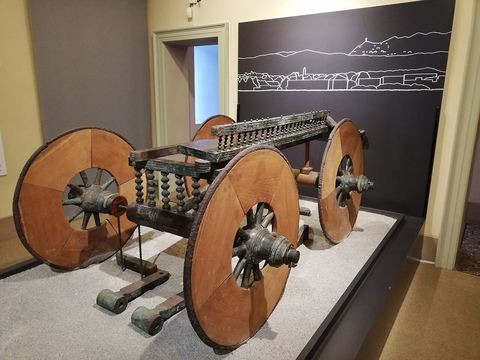
4 The Ca' Morta wagon
A ceremonial wagon of wood, bronze and iron, twenty-five hundred years old. It was buried, taken apart, with the ashes of a woman of the very highest rank. It is the museum's signature piece.
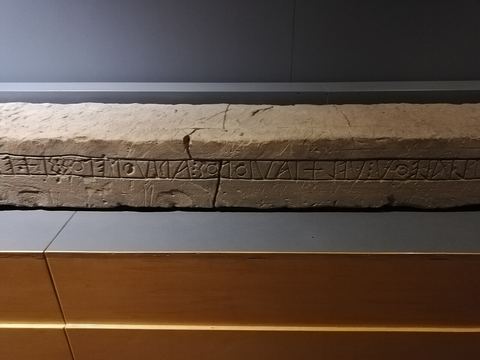
5 The Prestino stele
A block of stone carved with a single sentence. It is the most important document we have of Lepontic, the Celtic language spoken here in the fifth century BC, written in letters borrowed from the Etruscans.
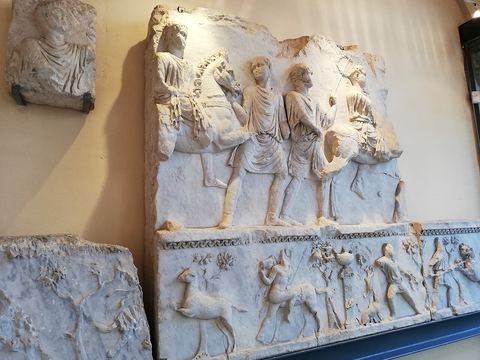
6 Roman Como and the face of Augustus
The city of Pliny the Younger, told through its marbles and its everyday things: a portrait of Augustus, a monumental frieze of horsemen, two eggs that survived whole in a tomb.
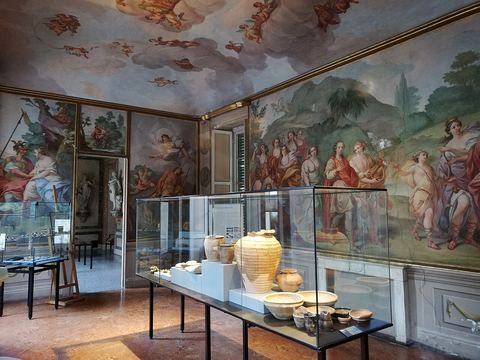
7 The frescoed rooms and the Greek vases
The floor where the counts received their guests. Four large canvases celebrate the family, one hall is covered in painted myths, and the cases hold about a hundred Greek vases and a collection of engraved gems.
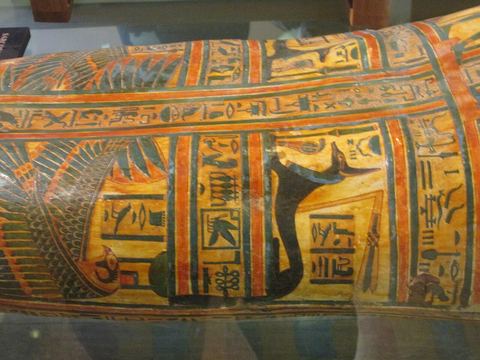
8 The priestess Isiuret
An Egyptian mummy almost three thousand years old, preserved in its painted casing. Her name was Isiuret, she sang and played music for the gods of Thebes, and she died young. We know all this without ever unwrapping her.
Timeline
- 9th century BCIn Thebes, Egypt, lives Isiuret, a priestess in the service of Amun, Mut and Khonsu.
- around 450 BCAt Ca' Morta, south of Como, a woman of high rank is cremated and buried with her ceremonial wagon.
- 1537–1543Paolo Giovio builds on the lake, at Borgovico, the villa he calls the Museo, for his collection of portraits.
- 1775Giovan Battista Rodriguez paints the four canvases of the family's glories for Count Giovan Battista Giovio.
- 1897The city museum, born in the mid-1800s in the classical high school, opens to the public in its new home, Palazzo Giovio.
- 1905An Assyrian relief from the palace of Ashurbanipal at Nineveh reaches Como, among the Near Eastern antiquities gathered by collectors.
- 1928A landslide in a quarry at Lazzago uncovers the wagon tomb; the wagon is later reconstructed by Luigi Perrone, the museum's director.
- 1990Isiuret's mummy is given a CT scan, presented as the first on a mummy in Italy.
Who's who
Paolo Giovio
sixteenth-century physician, historian and bishop
Born in Como, died in Florence in 1552. He called his lake villa, full of portraits of famous men, the Museo. The museum bears his name; the palazzo was his family's home.
Benedetto Giovio
historian of Como, Paolo's elder brother
He studied the city's history and ancient inscriptions, and in the 1500s enlarged the family house. One of the four canvases in the Sala Giovio is devoted to him.
Giovan Battista Giovio
eighteenth-century count and man of letters
He gave the palazzo its facade, its painted rooms and the garden with the nymphaeum. A friend of Alessandro Volta, he had himself painted climbing to the Temple of Glory.
Alfonso Garovaglio
nineteenth-century collector from Como
He gathered Egyptian and Near Eastern antiquities. His collection, including the mummy of Isiuret, was bequeathed to the museum.
Isiuret
Egyptian priestess of the ninth century BC
She played the sistrum for Amun, sang in the choir of Mut and was nurse to Khonsu the Child. She died between 18 and 30. Her mummy is preserved in the painted coffin.
Luigi Perrone
director of the city museum
He reconstructed the Ca' Morta wagon from the fragments that came out of the tomb in 1928. Only one of the four wheels had survived whole.
Words to know
Where it is
The neighborhood
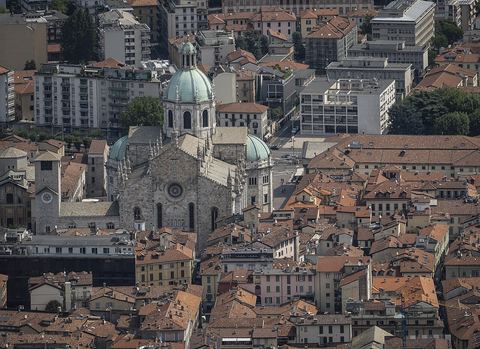
The Walled City
Related places
The story of the place
The name over the door belongs to a man who, in a sense, christened museums. Paolo Giovio, a physician, historian and bishop born in Como at the end of the 1400s, built himself a villa on the lake for his collection of portraits of famous men and called it the Museo, meaning a place of the Muses. That villa is gone. This palazzo, on the other hand, was his family's house in town, and it still carries their name.
The Giovio family had lived here since the Middle Ages. In the 1500s the house was enlarged. In the 1700s Count Giovan Battista Giovio, a man of letters and a friend of Alessandro Volta, gave it the face you see: a new facade, rooms frescoed with the family's glories, and a garden resting on the earth bank of the old city walls, with a staircase and a .
From high school to palazzo
The city museum is younger. It was born in the mid-1800s inside the liceo classico, the city's classical high school, and it grew fast, fed by finds from the surrounding area and by the collections that private collectors left to the city. It soon ran out of room. In 1894 the city council decided to move it into this palazzo, and in 1897 it opened here as a museum.
Two museums in one
Inside there are, in practice, two museums. The first is the story of this territory from the Paleolithic to the Romans. Its strong suit is the Iron Age: before Rome, the hills around Como were home to a Celtic-speaking people who traded with the Etruscans and buried their dead with astonishing . The second museum belongs to the collectors of the 1800s, who came home from their travels with Egypt, Greece and Mesopotamia in their luggage: a mummy, painted vases, gems, coins.
The two museums blend into the house. You may find yourself looking at Greek vases under a ceiling of eighteenth-century gods, or climbing a grand staircase lined with coats of arms from palaces that no longer exist.
The Roman section is in the building next door, Palazzo Olginati, linked to this one by a raised passageway. That building is also home to the Museo Storico Giuseppe Garibaldi, the city's history museum, which covers a different era and deserves a visit of its own.
If you only have time for three things, make it these:
- the Ca' Morta wagon
- the priestess Isiuret
- the portrait of Augustus
Sources
- Museo Archeologico Paolo Giovio, Musei Civici di Como (opens in a new tab)Official site
- Palazzo Giovio, Musei Civici di Como (opens in a new tab)Official site
- Sezione preistorica e protostorica, Musei Civici di Como (opens in a new tab)Official site
- Sezione romana e lapidario, Musei Civici di Como (opens in a new tab)Official site
- Sezione del collezionismo, Musei Civici di Como (opens in a new tab)Official site
- Lapidario medievale e moderno, Musei Civici di Como (opens in a new tab)Official site
- Palazzo Giovio, complesso, Lombardia Beni Culturali (opens in a new tab)Catalog
- Carro della Ca' Morta, Lombardia Beni Culturali (opens in a new tab)Catalog
- Sarcofago della sacerdotessa Isiuret, Lombardia Beni Culturali (opens in a new tab)Catalog
- Ritratto di Augusto, Lombardia Beni Culturali (opens in a new tab)Catalog
- Parata di cavalieri con scene di caccia, Lombardia Beni Culturali (opens in a new tab)Catalog
- Mosaico con cervi alla fonte, Lombardia Beni Culturali (opens in a new tab)Catalog
- Atena e Poseidone si contendono il predominio sull'Attica, Lombardia Beni Culturali (opens in a new tab)Catalog
- Giovan Battista Giovio sale al tempio della Gloria, Catalogo generale dei beni culturali (opens in a new tab)Catalog
- Paolo Giovio alla corte del papa Leone X, Catalogo generale dei beni culturali (opens in a new tab)Catalog
- Giovio, Paolo, Dizionario Biografico degli Italiani, Treccani (opens in a new tab)Encyclopedia
- Museo Civico Archeologico Paolo Giovio presso Palazzo Giovio, UPEL (opens in a new tab)Institution
- Rientra al Museo Giovio la mummia Isiuret, VareseNews (opens in a new tab)Other source
- Ecco com'era Isiuret, Espansione TV (opens in a new tab)Other source
- Ex Cressoni, sono mille le monete del tesoro di Como, Espansione TV (opens in a new tab)Other source
- Il tesoro di Como nell'ex chiesa delle Orfanelle, Espansione TV (opens in a new tab)Other source
- Un bassorilievo del Museo Giovio in mostra a Napoli, Espansione TV (opens in a new tab)Other source
- Il Musaeum di Paolo Giovio, Finestre sull'Arte (opens in a new tab)Other source
- CO·48 Prestino, Lexicon Leponticum, Università di Vienna (opens in a new tab)Institution
- Paolo Giovio ambasciatore presso Francesco I, Catalogo generale dei beni culturali (opens in a new tab)Catalog
- Museo archeologico Giovio (Q3867664), Wikidata (opens in a new tab)Other source
- Museo archeologico Paolo Giovio, Wikipedia in italiano (opens in a new tab)Wikipedia
- Ca' Morta tomb, Wikipedia in inglese (opens in a new tab)Wikipedia
- Lepontic language, Wikipedia in inglese (opens in a new tab)Wikipedia
- Museo storico Giuseppe Garibaldi, Wikipedia in italiano (opens in a new tab)Wikipedia
- Prestino, Wikipedia in inglese (opens in a new tab)Wikipedia
- Cultura di Golasecca, Wikipedia in italiano (opens in a new tab)Wikipedia
- Giovanni Battista Giovio, Wikipedia in italiano (opens in a new tab)Wikipedia
- Museo di Giovio a Borgovico, Wikipedia in italiano (opens in a new tab)Wikipedia