Stop 4 of 8Must-see
The Ca' Morta wagon
Where to stand
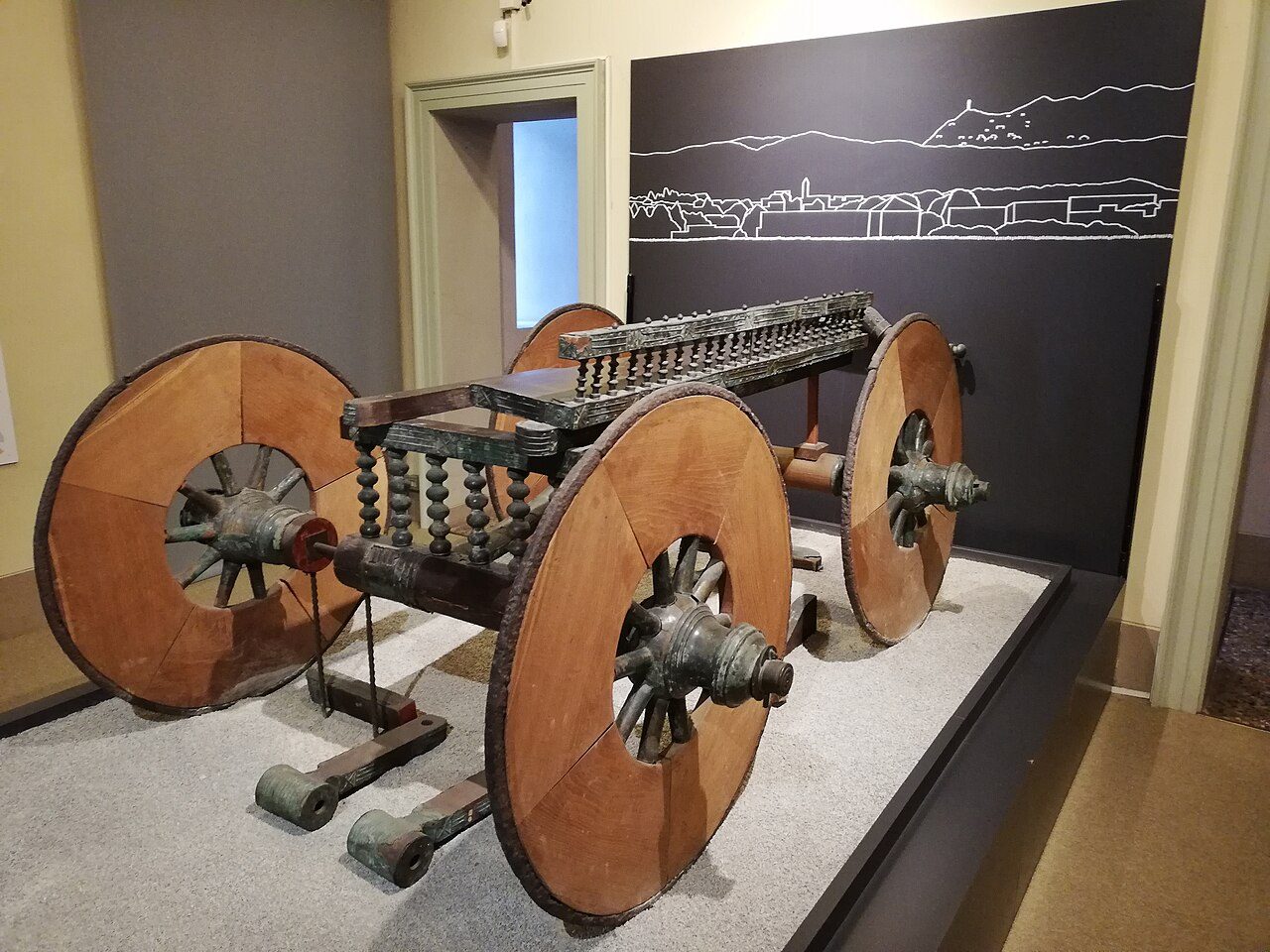
In the protohistory section, in front of the reconstructed four-wheeled wagon
A ceremonial wagon of wood, bronze and iron, twenty-five hundred years old. It was buried, taken apart, with the ashes of a woman of the very highest rank. It is the museum's signature piece.
Spot the detail
Look at the edge of the platform: find the bronze railing that runs around it
The full story
In 1928 a landslide tears open the side of a quarry at Lazzago, on the southern edge of Como. The owner of the land, Giuseppe Butti, finds himself looking at a stone slab weighing almost two tons. Under it is a pit less than a meter wide, about three feet, packed with bronze and iron. They are the parts of a wagon.
Look at it now, put back together. Four wheels with ten spokes each, a platform, an edge enclosed by a finely worked railing. The frame is wood sheathed in bronze sheet, and the wheels have iron tires.
This is a luxury object, not a working vehicle. It is a ceremonial wagon, made to display the rank of its owner.
The woman buried with the wagon
The dead person was a woman. After the cremation her ashes were sealed in a bronze urn and buried along with the wagon, taken apart piece by piece. Jewelry went down into the pit with her, and tableware that had come a long way: Etruscan bronze vessels, a cup of Greek origin.
This is around 450 BC, the high point of pre-Roman Como. The is the one known as Ca' Morta, used for centuries by the people of the Golasecca culture.
Reconstruction and the Vix comparison
What you see is a reconstruction, and it is only fair that you know it. It was carried out after the discovery by Luigi Perrone, then director of the museum, working from the fragments: only one wheel had survived whole, and the other three were restored. Like every reconstruction, it is a hypothesis. But it has a famous point of comparison.
In France, at Vix, the tomb of another woman buried with her wagon was found, the so-called Princess of Vix. In 2013 a team of French archaeologists compared the two wagons piece by piece: railings, bronze sheets and hubs are remarkably alike. The difference is in the rite. The lady of Vix was buried whole, the lady of Como was burned.
We do not know her name. We do know that in the middle of the fifth century BC, on these hills, a woman could be buried like a queen.
About this stop
Record
A wagon in eighty centimeters
The museum's signature piece is a parade wagon 2,500 years old, buried in pieces with the ashes of a woman of the highest rank in the Ca' Morta burial ground, in Como. Her tomb is a paradox of measurements. The slab that sealed it was almost two meters long and weighed about 1.8 metric tons. The pit underneath was a square eighty centimeters on each side and seventy deep. Inside were the parts of the four-wheeled wagon, the bronze urn with the ashes, Etruscan vessels, jewelry and even a helmet, the only weapon among the . Radiocarbon analysis dates the burial to around 450 BC.
In part. The bronze and iron pieces are the ones that came out of the tomb in 1928: the wagon was found taken apart, and only one wheel had survived whole. The assembly you see is a reconstruction, carried out after the discovery by Luigi Perrone, then director of the museum: the other three wheels were restored. Take it as a well-made hypothesis: the metals are ancient, the overall shape is a proposal.
Next stop
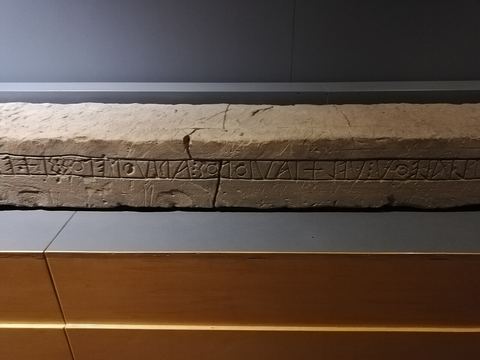
Head toward the end of the protohistory section, where a long block of stone with an inscription is on display