Stop 1 of 8Must-see
The palazzo and the courtyard
Where to stand
In Piazza Medaglie d'Oro, facing the stone doorway; then, past the entrance hall, in the courtyard
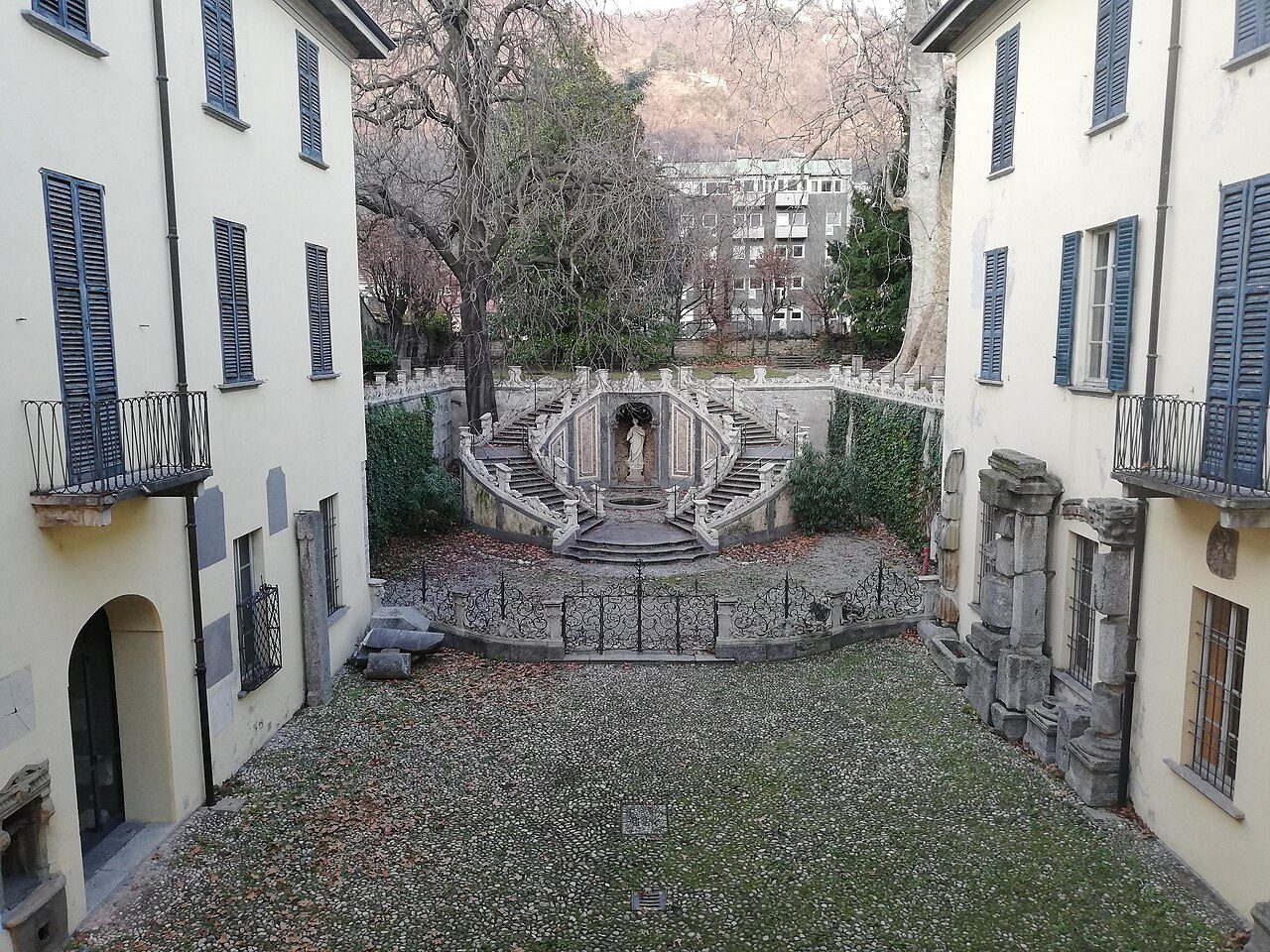
The town house of the Giovio counts, remodeled in the 1700s. From the doorway your eye crosses the courtyard and lands on a double staircase with a mock grotto. Behind it is the earth bank of the old city walls, turned into a garden.
Spot the detail
At the far end of the courtyard, under the two-flight staircase: what does the niche look like?
The full story
Stop in the piazza, in front of the stone doorway with the balcony above it. The facade says Museo Civico, city museum, but this is first of all a house. For centuries a single family lived in it, the Giovio.
They were already living here in the early 1200s, and they had made their way up. In the 1500s they gave the city two brothers known across half of Europe: Benedetto, the historian of Como, and Paolo, a physician, bishop and writer who was at home in the court of the popes. In those years Benedetto had the house enlarged. Back then it was a cluster of buildings around a courtyard.
The eighteenth-century makeover
What you see today, though, is eighteenth century. In the last quarter of that century Count Giovan Battista Giovio, a man of letters with a library of thousands of volumes and no shortage of ambition, reworked the facade: he opened the large windows and added the loggia above the main door. The style is called barocchetto lombardo, the late Baroque of Lombardy: a lightened Baroque, more grace than pomp.
The courtyard and the garden
Now look inside, through the doorway. Entrance hall, portico, courtyard, and at the far end a staircase whose two curving flights embrace a niche. Everything sits on a single line, like a stage set.
The palazzo is shaped like a U, open at the back, and there is a practical reason for that. Behind it ran the earth bank of the city walls, first Roman and then medieval. That raised ground was a natural spot for a hanging garden, and that is how the Giovio used it: the two flights are the way up. Under the stairs, the niche is a , a mock garden grotto.
From house to museum
The count also bought the building next door, the convent of the Orfanelle, the orphan girls: its church became a wing of the palazzo. Then the house changed jobs. At the end of the 1800s the city museum, born in a high school, no longer knew where to put its collections. The city council decided to move it here, and in 1897 opened it to the public.
There is a symmetry the Giovio would have liked. Paolo had given the name Museo to his villa on the lake, full of portraits of famous men. Three and a half centuries later, a real museum moved into his family's house and took his name.
About this stop
In culture
Foscolo and Count Giovio's daughter
Palazzo Giovio, now the museum, was the home of Count Giovan Battista Giovio, the man of letters who gave it today's look in the 1700s. The poet Ugo Foscolo wrote to him for years and was a regular at the family's villas. He fell in love with one of the daughters, Francesca. The count and countess would not hear of it: too great a gap in rank, and the poet's religious and political ideas hardly helped. In 1810 Francesca married Colonel Vittore Vautré. Foscolo did not break with the family: the count's eldest son, Benedetto, inspired a character in his tragedy Ricciarda. Benedetto died in 1812, during the Russian campaign.
Record
A thousand gold coins under a theater
In 2018, in Como, during a dig under the former Cressoni theater, in Via Diaz, a soapstone vessel full of Roman gold coins turned up. There were a thousand solidi, about four and a half grams each, bearing the names of eight emperors. The latest date from between 472 and 474 AD, on the eve of the end of the Western Empire. With the coins were three earrings, three rings and a piece of a gold bar. To display the treasure, the city has set aside the former Orfanelle church, which Count Giovan Battista Giovio joined in the 1700s to his palazzo, now home to the archaeological museum.
No. The city museum was born in the mid-1800s inside the classical high school, and within a few decades the collections had outgrown it. In 1894 the city council decided to move them to Palazzo Giovio, and in 1897 it opened the new home. At first there was a bit of everything here, collections that had little to do with one another. Then they were split up: in 1932 the history museum was created, and in 1989 the Pinacoteca Civica, the city picture gallery, opened.
This stop on the map
Next stop
Stay on the ground floor: under the portico and in the nearby rooms, the inscribed stones begin