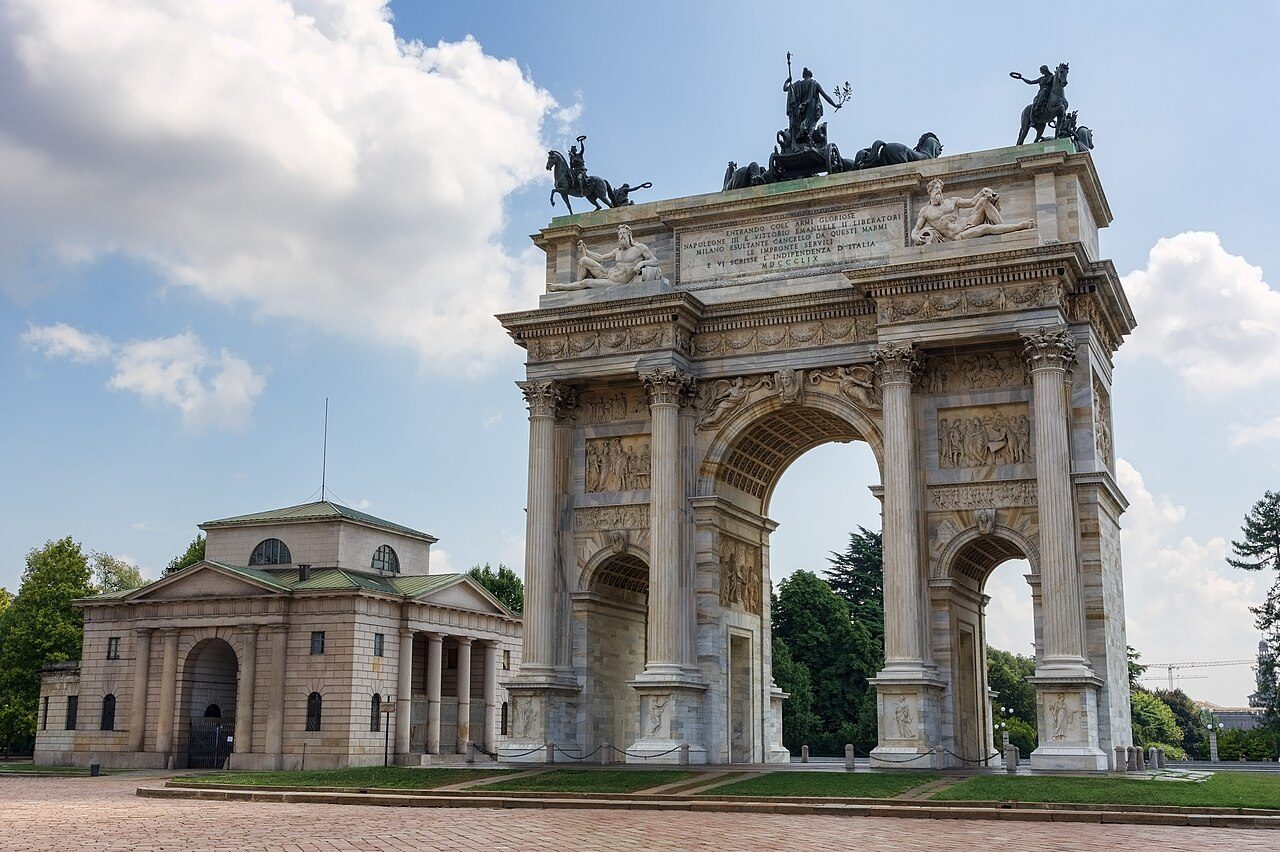
Monument · Castello and Sempione · 1807–1894
Arco della Pace e Parco Sempione
An arch begun for Napoleon, finished by his enemies, and the park at its feet
In brief
The Arco della Pace is a triumphal arch begun in 1807 for Napoleon's victories and opened in 1838 by the Austrians who beat him. In front lies Parco Sempione, the Castello's old parade ground, where the 1900s left a steel tower, the Triennale and a fountain by De Chirico.
Stories of this place
- Anecdote · The arch that changed flags three timesReadThe Arco della Pace began in canvas and plasterMilan's Arco della Pace began as a stage set. In 1806, for the wedding of Eugène de Beauharnais, the viceroy who governed Italy for Napoleon, emperor of the French, the architect Luigi Cagnola designed a temporary arch of wood, canvas and plaster, made to last as long as a party. Milan's city council soon decided to redo it in marble. Cagnola was not an architect by trade: a marquis with a law degree, headed for a career in diplomacy, he called himself a dilettante. Around twenty he caught the craze for hot-air balloons. The final design, though, did not copy the canvas one: it had three openings instead of one.
- Record · The arch that changed flags three timesReadThe Olympic cauldron inside the Arco della PaceIn February 2026, for the Milano Cortina Winter Olympics, Milan's Olympic cauldron was hung inside the central archway of the Arco della Pace, the city's triumphal arch. It was an aluminum structure that opened to about four and a half meters across, inspired by the knots drawn by the painter Leonardo da Vinci. It had a twin in Cortina d'Ampezzo: for the first time in the history of the Games two cauldrons burned together, in two different cities. For a few weeks the arch begun for Napoleon, emperor of the French, and finished by the Austrians had another master, the Olympic flame.
- Legend · The sestiga and the reliefs that changed sidesReadThe arch's horses, turned out of spiteOn top of the Arco della Pace, Milan's triumphal arch, stands the sestiga, a bronze chariot drawn by six horses. In Milan they say the horses originally faced France. Once Napoleon, the emperor of the French, had fallen, the Austrians supposedly had them turned half a circle, so that they showed Paris their rear ends. Lovely, but it is a legend with no sources. The chariot was set on top in 1837, when the Austrians were already running Milan: before that, there were no horses up there to turn. It represents Peace entering Milan: to enter, she had to be arriving from outside.
- Anecdote · Porta Sempione, the road to ParisReadNapoleon III, forty years in a courtyardOn a small rise in Milan's Parco Sempione stands an equestrian statue of Napoleon III, the emperor of the French who entered the city as a liberator in 1859. The sculptor Francesco Barzaghi modeled it around 1880, but Milan never managed to put it in a square: the political opposition was too strong. The emperor was not only the ally of 1859. In 1867 his soldiers had stopped General Giuseppe Garibaldi's volunteers at Mentana, near Rome. So the bronze ended up in the courtyard of the Palazzo del Senato, a palace downtown, half forgotten, and stayed there more than forty years. It reached the park only in 1927.
- In culture · Porta Sempione, the road to ParisReadHemingway and the three arches, Paris to MilanMilan's Arco della Pace turns up in a memoir of Paris. The American writer Ernest Hemingway, in A Moveable Feast, describes an evening in the Tuileries gardens with his wife. They look through the Arc du Carrousel, and he asks her whether the three arches are really in a row: the two in Paris and the one in Milan, which in the book he calls "Sermione." Whether they truly line up or not, the question tells you what these arches had become in the imagination of those who looked at them: the two ends of the same road, the one Napoleon, emperor of the French, wanted between Paris and Milan.
- Anecdote · The Palazzo dell'Arte and the Bagni misteriosiReadThe Triennale, occupied on opening dayThe Palazzo dell'Arte, home of the Triennale design exhibition in Milan's Parco Sempione, saw a show halted on its opening day. On May 30, 1968, the fourteenth edition was opening, devoted to the Grande Numero, meaning mass society. Instead the building was occupied by students, workers and artists, including the sculptor Giò Pomodoro. The architect Giancarlo De Carlo, one of the show's organizers, was photographed in the street arguing with them. With others he had designed a section of that edition titled La protesta dei giovani, the protest of the young. The occupation lasted more than a week and several installations were damaged. The Triennale reopened only in late June.
- Anecdote · The Ponte delle SirenetteReadThe stolen mermaid of Parco SempioneIn Parco Sempione a small iron bridge, the Ponte delle Sirenette, has four mermaids at its ends, and they have led an eventful life. Cast in iron in 1842, when the bridge spanned a canal in the center of Milan, they moved with it to the park in 1930. In 1943 one was badly damaged in an air raid. In 1948 another vanished: someone stole her, and this was no pocket-sized theft, because each statue weighed about three hundred kilograms. In 1954 things were put right with two bronze copies, which weigh in at around eighty.
- Anecdote · The Arena CivicaReadThe first Giro d'Italia ended at the ArenaThe Arena Civica, the nineteenth-century stadium inside Milan's Parco Sempione, is where the first Giro d'Italia, Italy's great bicycle race, came to an end. It was May 30, 1909, and more than twenty thousand people were waiting for the riders. The winner was Luigi Ganna, a bricklayer from Lombardy who as a young man rode his bicycle to work in Milan, about a hundred kilometers a day there and back. At the finish, reporters asked him what his most vivid impression was. Ganna answered in dialect that his backside was burning badly. More than a century later, it is still the best-remembered line of that Giro.
- Record · The Arena CivicaReadItaly's first national team wore whiteItaly's national soccer team played its first match in Milan, at the Arena Civica, the stadium inside Parco Sempione. It was May 15, 1910: Italy against France, six to two, in front of about four thousand people. There was nothing blue about that day. The players took the field in a white jersey, apparently because it cost less. The blue arrived the following year, in the third match. They say that at the end of the game the crowd threw packs of cigarettes onto the field: that was the prize for the first Azzurri, the Blues, who were not blue yet.
- LegendReadThe Dama Nera of Parco SempioneMilan's Parco Sempione has its own ghost, the Dama Nera or Black Lady, and naturally she comes out with the fog. According to legend, on the thickest evenings a lady dressed in black, her face covered by a veil, approaches men crossing the park and lures them to a villa. There, when the veil is lifted, there is no face underneath but a skull. It is a story to tell in the dark, and it should be taken for what it is: a legend made of fog, in a city that knows a thing or two about fog.
Ready-made questions
Because it changed its name in mid-construction. It was meant to be the arch of the Victories of Napoleon, begun in 1807. When Napoleon fell, the Austrians decided to finish it anyway, but dedicated it to the peace, pace in Italian, that had returned to Europe after his wars. It was the victors' peace, and sure enough the reliefs tell of Napoleon's defeats and the congresses of the sovereigns who had beaten him. The name stuck even after 1859, when Milan removed the dedication to the emperor of Austria.
Go to stop: The arch that changed flags three timesIt is Peace, shown as an ancient goddess entering Milan on a chariot pulled by six horses. The group is called a and is the work of the sculptor Abbondio Sangiorgio. It was set up there in 1837, a year before the inauguration. At the corners are four Victories on horseback, by Giovanni Putti, riding to meet her with laurel wreaths. That makes ten bronze horses in all.
Go to stop: The sestiga and the reliefs that changed sidesBecause of an Alpine pass. The Sempione, the Simplon in English, links Italy to Switzerland, and Napoleon wanted a road from Milan that would cross it and run all the way to Paris. The road entered the city right where the arch stands. From it the avenue, the gate, the square and finally the park took their names. In 1906, when the railway tunnel was opened beneath the same pass, Milan celebrated with an International Exhibition inside the park.
Go to stop: Porta Sempione, the road to ParisFirst another park, then emptiness. In the 1400s it was the reserve of the dukes of Milan, behind the Castello, much larger than today. When the Sforza fell it was abandoned, and later it became a for soldiers' drills. After the unification of Italy there were plans to build houses on it. The protests changed the city council's mind, and between 1888 and 1894 the architect Emilio Alemagna designed the park you see.
Go to stop: The Teatro Continuo and the design of the parkOut of respect, or political caution. The tower measures just over 108 meters, and the Madonnina on top of the Duomo reaches just a little higher. When it was built, in 1933, it was Mussolini who set the limit, saying that the human could not rise above the divine. For the Milanese it was a rule they took to heart: nothing in the city was to stand higher than their gilded statue.
Go to stop: The Torre BrancaThey are the Bagni misteriosi, the Mysterious Baths, by Giorgio de Chirico, a fountain from 1973. Two swimmers, one blond and one dark-haired, stand immersed in a basin with a sinuous outline. Around them are a cabin, a diving board, a ball, a swan and a fish. De Chirico takes the sea bathing of his childhood in Greece and turns it into a dreamlike scene. It is one of his last works, meant from the start to stay in the park.
Go to stop: The Palazzo dell'Arte and the Bagni misteriosiYes. The Arena was designed in the early 1800s on the model of Roman circuses, and as in ancient Rome it was also meant to host , mock naval battles. The water came from a nearby canal and flooded the track. A naumachia was staged for the inauguration in December 1807, in the presence of Napoleon. And it was not the only one: over the course of the 1800s the Arena was flooded several more times.
Go to stop: The Arena CivicaThe stops
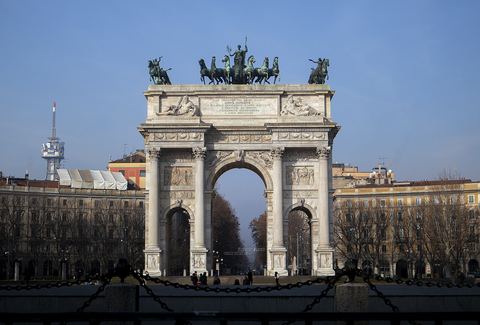
1 The arch that changed flags three times
Begun in 1807 to celebrate Napoleon, halted by his fall, finished in 1838 by the Austrians and dedicated to peace. In 1859 the Italians arrived and rewrote the dedications. Few monuments have changed flags so often.
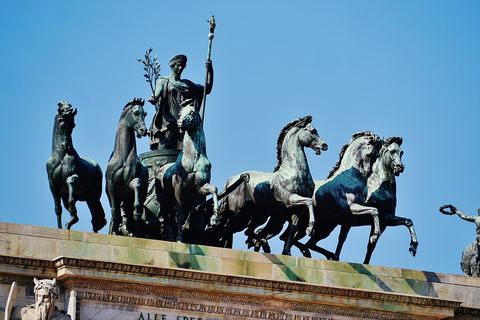
2 The sestiga and the reliefs that changed sides
On the roof, Peace rides into Milan on a six-horse chariot. Lower down, the reliefs tell of Napoleon's defeats, on an arch begun for his victories. And there is a legend about the horses that deserves debunking.
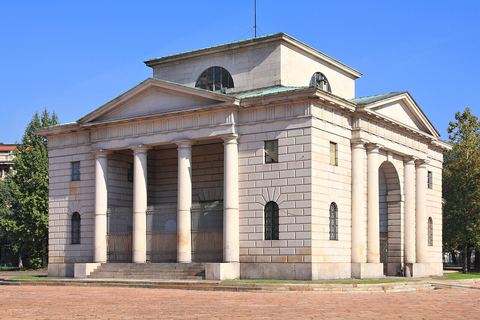
3 Porta Sempione, the road to Paris
The arch was also a city gate, with two tollhouses for collecting duty. From here set out the road Napoleon wanted, toward the Simplon Pass and Paris. And through here, in 1859, the liberators of Milan rode in.
4 The Teatro Continuo and the design of the park
A stage with no theater, set by the artist Alberto Burri where the park frames the Arco one way and the Castello the other. It is the right spot to grasp how this green came about: dukes' park, parade ground, English-style garden.
5 The Torre Branca
A tower of steel tubes just over 108 meters tall, designed by Gio Ponti and put up in 1933 in sixty-eight days of work. It stopped at that height so as not to rise above the Madonnina on the Duomo.
6 The Palazzo dell'Arte and the Bagni misteriosi
The red-brick palace built in 1933 for the Triennale, Milan's great exhibition of architecture and design. In its garden is a fountain by Giorgio de Chirico: two swimmers, a swan and a beach cabin in the middle of Milan.
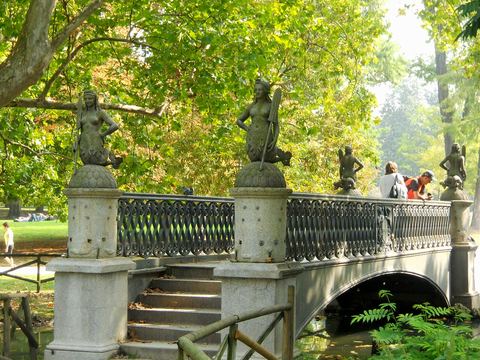
7 The Ponte delle Sirenette
The Little Mermaids' Bridge is considered the first iron bridge built in Italy, from 1842, with four mermaids at its ends. It spanned a canal in the heart of the city: when the canals were covered over it was saved and brought here.
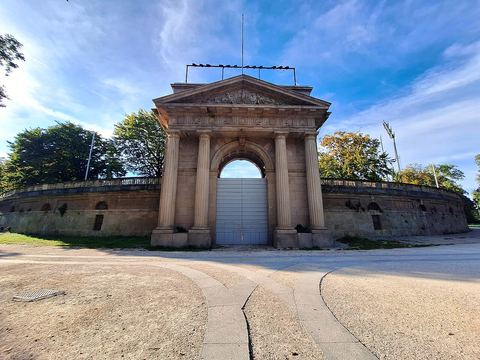
8 The Arena Civica
An ancient-style amphitheater commissioned in Napoleon's Milan and opened in 1807, built with stones from the Castello's fortifications. The track was flooded here for naval battles. In 1910 Italy's national soccer team made its debut here.
Timeline
- 1806For the wedding of the viceroy Eugène de Beauharnais, Luigi Cagnola puts up a temporary arch. The city council decides to rebuild it in marble.
- 1807In October the first stone of the arch is laid, on the Simplon road. In December Napoleon inaugurates the Arena.
- 1826After a dozen years with the site at a standstill, Francis I of Austria has work resume. The arch is by now dedicated to Peace.
- 1838On September 10 the arch is inaugurated in the presence of Emperor Ferdinand I. Cagnola has been dead for five years.
- 1859On June 8 Napoleon III and Vittorio Emanuele II enter Milan through Porta Sempione. The dedications on the arch are rewritten.
- 1888–1894Emilio Alemagna turns the Castello's old parade ground into an English-style park.
- 1933For the fifth Triennale, Giovanni Muzio's Palazzo dell'Arte and Gio Ponti's steel tower open.
- 1973The Triennale brings art into the park: De Chirico's Bagni misteriosi and Burri's Teatro Continuo are born.
Who's who
Luigi Cagnola
architect of the Arco della Pace
A Milanese marquis with a law degree, an architect out of passion. He designs the arch in 1807 and follows it until his death in 1833, without seeing it finished.
Abbondio Sangiorgio
sculptor of the sestiga
He models the chariot of Peace with its six horses, the bronze group hoisted to the top of the arch in 1837.
Luigi Canonica
architect of the Arena
From Ticino, official state architect in the Napoleonic years. He designs the Arena on the model of a Roman circus and sees it inaugurated in 1807.
Emilio Alemagna
architect of Parco Sempione
Between 1888 and 1894 he designs the English-style park, with its small lake and curving paths, so that it frames the Arco on one side and the Castello on the other.
Gio Ponti
architect of the Torre Branca
With the engineers Cesare Chiodi and Ettore Ferrari he designs the park's steel-tube tower in 1933, put up in sixty-eight days of work.
Giorgio de Chirico
painter
One of the fathers of Metaphysical painting. In 1973 he creates the Bagni misteriosi fountain for the park, one of his last works.
Words to know
Where it is
The neighborhood
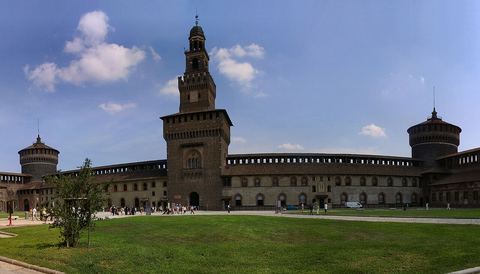
Castello and Sempione
Related places
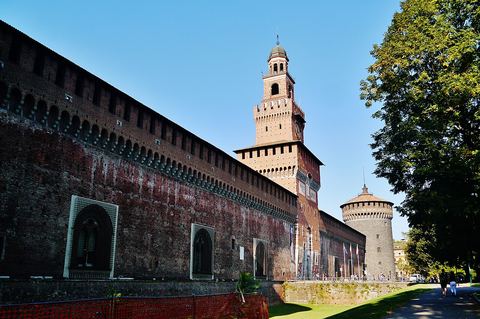
The story of the place
Stand between the arch and the park and look first one way, then the other. On one side you have a triumphal arch in pale marble, the Arco della Pace, with ten bronze horses on its roof. On the other a great lawn, Parco Sempione, and at the far end the towers of the Castello Sforzesco, the dukes' fortress. They are two pieces of the same story, and both begin with Napoleon.
One arch, three dedications
In the early 1800s Milan is the capital of Napoleon's Kingdom of Italy. This is where the Simplon road sets out, the Strada del Sempione that crosses the Alps and leads to Paris, and the city wants an entrance to match. In 1807 the architect Luigi Cagnola starts an arch to celebrate the emperor's victories.
Then Napoleon falls, and the building site stops halfway. The Austrians, the new masters, pick it up again and change the program: the arch becomes the arch of Peace, the victors' peace. They inaugurate it in 1838. In 1859 the liberators of Milan ride in through it, and the inscriptions change once more.
From parade ground to park
The green has an even longer story. It was the dukes' hunting park, then for centuries a , the open space where the Castello's soldiers drilled. After the unification of Italy there were plans to build on it. The city protested, and at the end of the 1800s the architect Emilio Alemagna turned it into an English-style park, designed to frame the arch on one side and the Castello on the other.
The 1900s added their share: a steel tower by Gio Ponti, the palace of the Triennale, a fountain by Giorgio de Chirico. And along one side there is still the Arena that Napoleon wanted, where the track was flooded for naval battles.
How the visit works
You start at the arch, with three stops: the whole, the sculptures, the gate on the road to Paris. Then you go into the park and wander it at an easy pace: Burri's stage, the tower, the Triennale, the mermaids' bridge, the Arena. The Castello, which closes the park on the opposite side, has a visit all its own.
Sources
- Cagnola, Luigi. Dizionario Biografico degli Italiani, Treccani (opens in a new tab)Encyclopedia
- Canonica, Luigi. Dizionario Biografico degli Italiani, Treccani (opens in a new tab)Encyclopedia
- Studio di capitello corinzio per l'Arco della Pace, Catalogo generale dei beni culturali, scheda ICCD8311882 (opens in a new tab)Catalog
- Teatro Continuo, Fondazione Palazzo Albizzini Collezione Burri (opens in a new tab)Institution
- Mysterious Baths, in-Lombardia, portale turistico della Regione Lombardia (opens in a new tab)Institution
- Expo 1906: Sempione, storia e sogno di una metropoli, Zero (opens in a new tab)Other source
- Il braciere delle Olimpiadi Invernali resterà a Milano, Artribune (opens in a new tab)Other source
- Arco della Pace a Milano: storia e curiosità, MilanoFree (opens in a new tab)Other source
- Ernest Hemingway, A Moveable Feast, capitolo «A False Spring», Faded Page (opens in a new tab)Other source
- Parco Sempione, Comune di Milano (opens in a new tab)Official site
- Torre Branca, Lombardia Beni Culturali, scheda 3m080-00060 (opens in a new tab)Institution
- The Mysterious Baths of Giorgio de Chirico, Triennale Milano (opens in a new tab)Official site
- Curiosità sulla vecchia Milano: dai simboli milanesi alla Dama Nera, MilanoFree (opens in a new tab)Other source
- Due bracieri, un inedito per i Giochi di Milano Cortina, AGI (opens in a new tab)Other source
- Barzaghi, Francesco. Dizionario Biografico degli Italiani, Treccani (opens in a new tab)Encyclopedia
- Ganna, Luigi. Dizionario Biografico degli Italiani, Treccani (opens in a new tab)Encyclopedia
- Arena Civica, Lombardia Beni Culturali, scheda LMD80-00378 (opens in a new tab)Institution
- Milano, Triennale, Occupazione (fotografia del 30 maggio 1968), Lombardia Beni Culturali, scheda IMM-3a030-0062048 (opens in a new tab)Institution
- XIV Triennale, La protesta dei giovani (fotografia), Lombardia Beni Culturali, scheda IMM-3u030-0013541 (opens in a new tab)Institution
- The National Team turns 110, Federazione Italiana Giuoco Calcio (opens in a new tab)Institution
- Quando l'Italia divenne Nazionale, Il Foglio (opens in a new tab)Other source
- La prima partita della Nazionale italiana, Il Post (opens in a new tab)Other source
- Correva l'anno 1968: il Movimento a Milano, Artribune (opens in a new tab)Other source
- Il '68 particolare di De Carlo, Il Foglio (opens in a new tab)Other source
- Che avventura quel primo Giro d'Italia, Il Foglio (opens in a new tab)Other source
- Giro eroico, storie e frasi, Il Giorno (opens in a new tab)Other source
- Mentana, Enciclopedia Treccani (opens in a new tab)Encyclopedia
- XIV Triennale, Occupazione della Triennale (fotografia successiva all'occupazione), Lombardia Beni Culturali, scheda IMM-3u030-0017890 (opens in a new tab)Institution
- Mostre, università e luoghi dell'in-between: consonanze inattese nel '68, in Happening, Scenografie, Installazioni, Università di Bologna, 2025 (opens in a new tab)Institution
- Arco della Pace, Wikipedia in italiano (opens in a new tab)Wikipedia
- Arco della Pace (voce Porta Sempione), Wikipedia in inglese (opens in a new tab)Wikipedia
- Parco Sempione (Milano), Wikipedia in italiano (opens in a new tab)Wikipedia
- Arena Civica, Wikipedia in italiano (opens in a new tab)Wikipedia
- Torre Branca, Wikipedia in italiano (opens in a new tab)Wikipedia
- Palazzo dell'Arte, Wikipedia in italiano (opens in a new tab)Wikipedia
- Ponte delle Sirenette, Wikipedia in italiano (opens in a new tab)Wikipedia
- Monumento a Napoleone III, Wikipedia in italiano (opens in a new tab)Wikipedia
- Equestrian statue of Napoleone III, Wikipedia in inglese (opens in a new tab)Wikipedia
- Italia-Francia (1910), Wikipedia in italiano (opens in a new tab)Wikipedia
- 1910 Italy v France football match, Wikipedia in inglese (opens in a new tab)Wikipedia
- XIV Triennale di Milano, Wikipedia in italiano (opens in a new tab)Wikipedia
- Giro d'Italia 1909, Wikipedia in italiano (opens in a new tab)Wikipedia
- Luigi Ganna, Wikipedia in italiano (opens in a new tab)Wikipedia