Stop 2 of 8Must-see
The sestiga and the reliefs that changed sides
Where to stand
Under the central archway, facing its two inner walls; then a few steps out toward the park, to look back up at the chariot
On the roof, Peace rides into Milan on a six-horse chariot. Lower down, the reliefs tell of Napoleon's defeats, on an arch begun for his victories. And there is a legend about the horses that deserves debunking.
Spot the detail
On the two inner walls of the central archway, find the large reliefs. Are they battle scenes?
The full story
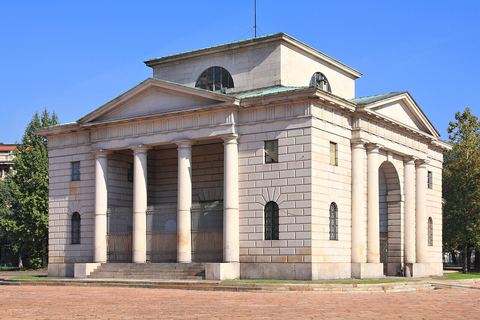
You are under the largest vault. From here the Arco della Pace, Milan's Arch of Peace, stops being a silhouette and becomes a book in stone. Almost every surface is carved: statues, , cornices, rosettes. More than a dozen sculptors worked on it.
A program turned around
The original plan called for the victories of Napoleon, and some of the reliefs were already done when he fell. The Austrians kept the architecture and changed the stories.
Read the subjects and it looks like a joke. There is the Battle of Leipzig, Napoleon's great defeat, carved by Pompeo Marchesi on one flank of the arch. There are the occupation of Paris and the Congress of Vienna, where the victors redrew Europe. All on a monument begun in his honor.
Something of the first version survives. The statues of History and Poetry, by the sculptor Luigi Acquisti, were already finished in Napoleon's day and were kept.
Around them are figures that suit any master. Ancient gods such as Mars, Apollo and Minerva. And four rivers in statue form: the Po and the Ticino on one front, the Adige and the Tagliamento on the other.
The chariot of Peace
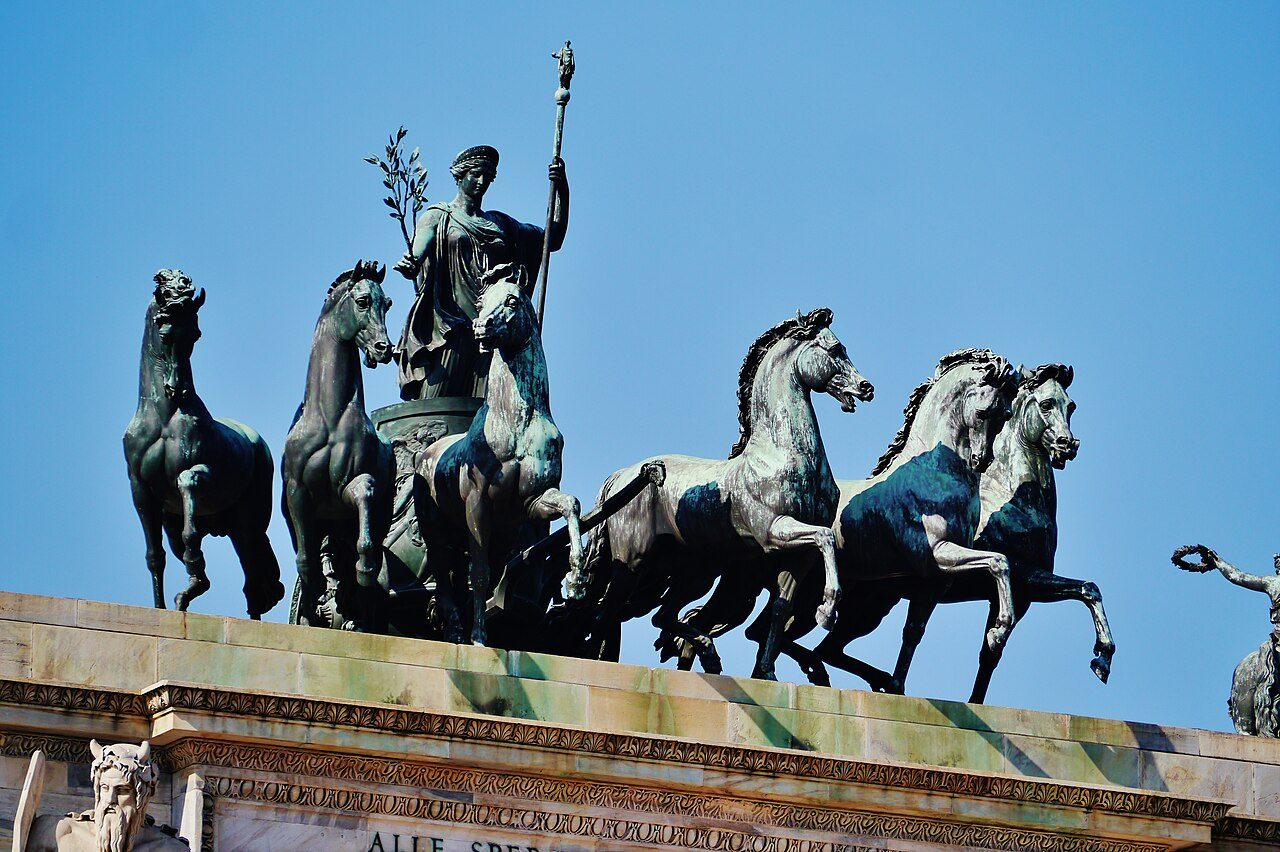
Now step out toward the park, walk a few paces and turn around. On top is the , a chariot pulled by six horses, the work of the sculptor Abbondio Sangiorgio. On the chariot stands Peace, entering the city.
At the corners four Victories on horseback, by Giovanni Putti, offer her laurel wreaths. It is all bronze.
The legend of the turned horses
In Milan they say the horses originally faced France. The Austrians supposedly had them turned around out of spite, to show Paris their rear ends.
It is too good a story not to repeat, but it remains a legend: no source confirms it. The chariot was only hoisted up there in 1837, well into the Austrian era: before that, there were no horses on top of the arch to turn. Besides, this is Peace entering Milan: she can only be arriving from outside.
The real snub to Napoleon isn't in the horses. It is in the reliefs.
About this stop
Legend
The arch's horses, turned out of spite
On top of the Arco della Pace, Milan's triumphal arch, stands the , a bronze chariot drawn by six horses. In Milan they say the horses originally faced France. Once Napoleon, the emperor of the French, had fallen, the Austrians supposedly had them turned half a circle, so that they showed Paris their rear ends. Lovely, but it is a legend with no sources. The chariot was set on top in 1837, when the Austrians were already running Milan: before that, there were no horses up there to turn. It represents Peace entering Milan: to enter, she had to be arriving from outside.
It is Peace, shown as an ancient goddess entering Milan on a chariot pulled by six horses. The group is called a and is the work of the sculptor Abbondio Sangiorgio. It was set up there in 1837, a year before the inauguration. At the corners are four Victories on horseback, by Giovanni Putti, riding to meet her with laurel wreaths. That makes ten bronze horses in all.
This stop on the map
Next stop
Walk through the arch and out the side away from the park, where the straight line of Corso Sempione begins